Executive Overview
In an aggressive push to solidify its position as the premier global town square for real-time video, social media platform X has officially rolled out a completely redesigned, enterprise-grade livestream Application Programming Interface (API). Rebuilt entirely from the ground up, this modern infrastructure is engineered to bridge the gap between third-party video broadcasting software and the X ecosystem, granting developers, creators, and enterprise media organizations unprecedented control over their live content workflows.
For years, live broadcasting on the platform formerly known as Twitter was often criticized as clunky, fragmented, and heavily reliant on native workarounds. With this new API iteration, X is addressing those historic friction points head-on. The overhauled architecture allows third-party video platforms to seamlessly facilitate X streams while unlocking a comprehensive suite of advanced management tools. Creators can now schedule broadcasts well in advance, manage persistent Real-Time Messaging Protocol (RTMP) streams, actively monitor and read incoming live chat feeds, and exercise robust moderation controls—including the ability to mute and boot disruptive viewers—all while streaming through their preferred third-party providers.
This release represents far more than a routine software update; it is a calculated strategic maneuver. By lowering the barriers to entry for professional-grade broadcasting and deeply integrating third-party tools, X is making a bold play to capture a larger share of the booming live-streaming economy. Paired with the July launch of the Livestream Studio command center within the Creator Studio platform, this new API lays the foundational groundwork for a massive influx of video content. As X continues to pivot toward real-time video engagement as a core pillar of its business model, this developer-facing upgrade could fundamentally alter how breaking news, live commentary, and digital entertainment are produced, consumed, and monetized across the platform.
Detailed Chronology of X’s Live Video Evolution
To fully appreciate the significance of the new livestream API, it is essential to examine the historical trajectory of live video on the platform. The journey from rudimentary broadcasting tools to today’s sophisticated ecosystem highlights a deliberate, albeit sometimes turbulent, corporate evolution.
The Periscope Era and Early Experiments (2015–2020)
The foundation of live video on the platform was cemented in March 2015 with the acquisition and subsequent integration of Periscope. At the time, Periscope was a pioneer in mobile live streaming, allowing everyday users to broadcast their immediate surroundings with the tap of a screen. Twitter integrated Periscope directly into its native app in early 2016, enabling users to go live without downloading a separate application.
During this era, live streaming was primarily viewed as a consumer-facing novelty or a breaking-news tool for citizen journalists. However, the underlying API infrastructure remained relatively basic. While media outlets and major brands utilized specialized software encoders via RTMP ingest points, the experience for independent creators was often plagued by latency issues, unstable connections, and limited chat moderation capabilities. In December 2020, facing declining usage and high maintenance costs, Twitter announced the official sunsetting of the Periscope app, though much of its core streaming backend was absorbed into the main Twitter codebase.
The Ownership Transition and Video-First Strategy (2022–2023)
Following the acquisition of the company by billionaire entrepreneur Elon Musk in late 2022, the platform underwent a radical rebranding to X and a sweeping philosophical shift toward becoming an "everything app." Video quickly emerged as a cornerstone of this new vision. Musk and the executive team recognized that if X was to compete directly with YouTube, Twitch, and Meta’s video ecosystem, it needed to evolve from a text-heavy microblogging site into a rich, multimedia-first destination.
Throughout 2023, X rolled out several long-form video initiatives, including the introduction of revenue-sharing programs for creators and native support for multi-hour video uploads. Despite these strides, live streaming remained an under-optimized frontier. Creators attempting to run high-production live streams often encountered API rate limits, erratic chat synchronization, and a lack of granular moderation tools, forcing many to simulcast on competing platforms while treating X as an afterthought.
The Creator Studio and Livestream Command Center (July 2024)
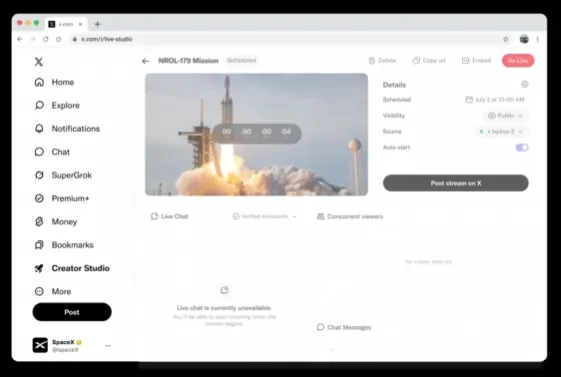
Recognizing that robust infrastructure is required to attract professional talent, X took a major step forward in July 2024 with the launch of the updated livestreaming command center embedded within the Creator Studio platform.
Designed specifically to simplify the broadcasting process, this centralized dashboard gave creators a dedicated interface to manage their schedules, initiate streams, and monitor basic analytics without navigating complex developer settings. While the Creator Studio command center was a massive win for native platform users, it highlighted an ongoing gap: professional creators who rely on external software suites like OBS Studio, Streamlabs, or specialized enterprise encoders still needed a more powerful bridge to connect their setups to X.
The Ground-Up API Overhaul (Current Release)
Culminating months of infrastructure engineering, X released its newly minted livestream API. By rebuilding the system from the ground up, engineers eliminated legacy technical debt inherited from the old Twitter and Periscope architectures. This modern API is designed for scale, reliability, and developer flexibility, effectively signaling that X is ready to aggressively court professional streamers, digital media networks, and independent creators who demand broadcast-grade tools.
Supporting Context & Metrics: The Economics of Live Streaming
The timing of X’s API overhaul is no accident. The global live-streaming market is experiencing unprecedented expansion, driven by changing consumer habits, the rise of interactive digital communities, and the insatiable demand for real-time video content. Understanding the macroeconomic forces and platform metrics surrounding live video provides vital context for why X is investing so heavily in this space.
The Booming Digital Video Landscape
According to recent industry analyses, the global live-streaming market size is valued in the tens of billions of dollars, with projections indicating a compound annual growth rate (CAGR) exceeding 20% over the next decade. Consumers are increasingly turning away from traditional, linear television in favor of interactive, community-driven digital video platforms where they can engage directly with creators in real time.
Within this landscape, real-time discussion and live video form a symbiotic loop. When a major cultural event, sporting match, or breaking news story occurs, users naturally flock to X to read and contribute to the conversation. Historically, that conversation was text-based. By facilitating high-quality live video streams directly within the app, X is capturing the complete user lifecycle: users can watch the live broadcast, participate in the real-time chat, and post threaded commentary, all within a single application window.
Technical Metrics of the New API Integration
To understand the technical leap X has taken, one must examine the specific functional metrics now available to third-party developers and enterprise video platforms:
- Persistent RTMP Management: Creators can now establish stable, ongoing Real-Time Messaging Protocol connections. This eliminates the need to generate a new stream key for every single broadcast, drastically reducing setup time for recurring shows and professional networks.
- Broadcast Lifecycle Control: The API supports full programmatic creation, publishing, and real-time monitoring of live broadcasts. Third-party dashboards can now programmatically track stream health, bitrate stability, and viewer drop-off rates.
- Advanced Scheduling Protocols: Broadcasters can queue up streams well in advance, allowing the platform to generate dedicated event pages and notification alerts, which helps build anticipation and drive initial tune-in metrics.
- Bidirectional Chat Integration: Perhaps the most critical upgrade for community management, the API allows third-party platforms to both read incoming live chat messages and respond directly from external moderation software.
- Granular Moderation Tooling: Live chat toxicity and spam have long plagued high-traffic streams. The new API equips moderators with immediate actions, including the ability to mute disruptive users or permanently boot them from the broadcast environment.
Official Statements and Developer Ecosystem Reaction
The rollout of the updated livestream API was officially announced via the official X Developers handle (@XDevelopers), signaling an open invitation for software engineers, broadcast tool developers, and digital creators to test the new capabilities.
While official corporate press releases have emphasized the product-level benefits—such as streamlined workflows and enhanced audience engagement—independent reactions from the developer community have been largely optimistic, tinged with cautious curiosity. For years, third-party developers working with X’s API ecosystem faced sudden policy shifts, pricing restructurings for API access, and unpredictable rate limits. Consequently, the release of a robust, purpose-built video API is being interpreted by many as a positive signal that X is serious about fostering a healthy, collaborative developer ecosystem.
Industry analysts note that third-party streaming software vendors—ranging from boutique indie developers to major enterprise broadcasting suites—are already evaluating how to integrate the new X endpoints into their software. By allowing platforms like OBS, Restream, and other enterprise streaming tools to natively support X alongside YouTube, Twitch, and Facebook Live, X removes a massive friction point that previously discouraged professional broadcasters from utilizing the service.
Furthermore, creators who participated in early beta tests of the Creator Studio and API tools have reported noticeable improvements in stream stability and viewer retention. Being able to schedule a stream days in advance and leverage automated moderation tools allows professional media companies to treat X as a primary distribution channel rather than an experimental side-project.
Future Outlook: What This Means for the Future of X
As X continues to execute its master plan of evolving into a comprehensive "everything app," the integration of this advanced livestream API opens up a myriad of exciting possibilities—and formidable challenges—for the platform’s future.
Scaling Real-Time Video and Monetization
The immediate horizon for X will likely see an aggressive push to tie live streaming directly into its creator monetization frameworks. As more third-party video feeds into the X system, the platform can collect richer viewership data, enabling more targeted video advertising and expanded subscription models. Creators who generate high engagement through scheduled, professionally moderated live streams will stand to benefit from X’s ad-revenue sharing initiatives, creating a powerful financial incentive to bring high-production content exclusively or primarily to the platform.
Challenges in Moderation and Infrastructure
Despite the technical elegance of the new API, significant challenges remain. Scaling live video ingestion and real-time chat moderation for millions of concurrent users requires immense server infrastructure and sophisticated AI-driven safety filters. While the API provides manual tools like muting and booting, platform-wide enforcement against hate speech, copyright infringement, and illicit broadcasting will remain a monumental task for X’s trust and safety teams. The success of the new livestream initiative will depend heavily on how effectively these automated and manual moderation tools can scale under the pressure of major global breaking news events.
The Broader Competitive Landscape
X’s renewed focus on live video puts it on a direct collision course with established giants like YouTube Live, Twitch, and Kick. While those platforms have spent over a decade refining their streaming ecosystems, X possesses a unique superpower that none of them can fully replicate: the world’s most immediate, real-time social discussion graph. By fusing breaking news conversations with seamless, third-party-enabled live broadcasting, X is carving out a distinct niche where commentary and live video exist as one unified experience.
Conclusion
The launch of X’s rebuilt livestream API marks a defining moment in the platform’s ongoing transformation. By addressing long-standing technical hurdles, empowering third-party video platforms, and equipping creators with enterprise-grade scheduling and moderation tools, X has laid the structural foundation for a thriving live-video economy. As creators, media networks, and developers begin to fully leverage these new capabilities, the platform is well-positioned to capture the next wave of digital engagement, cementing its role as a vital hub for real-time video storytelling in the years to come.