In a legal and technological development that sends shockwaves through the global internet infrastructure community, a Belgian court has delivered a decisive blow to major public DNS providers. On August 20, the President of the French-speaking Business Court of Brussels upheld a controversial anti-piracy order requiring major alternative Domain Name System (DNS) resolver operators—specifically Google, Cloudflare, and Cisco’s OpenDNS—to actively block domains associated with unauthorized sports streaming.
The ruling marks a critical escalation in Belgium’s aggressive, newly minted anti-piracy enforcement regime. While traditional website-blocking mandates targeting Internet Service Providers (ISPs) have become commonplace across Europe, extending this obligation to global public DNS resolvers creates a complex legal and operational labyrinth. For tech giants like Google and Cloudflare, the decision solidifies a compliance path, albeit an arduous one. For Cisco, however, the mandate is fundamentally incompatible with its architectural framework, prompting the networking behemoth to announce a complete withdrawal of its OpenDNS service from Belgian territory for the second time this year.
This comprehensive report examines the genesis of the dispute, the mechanics of the court’s final ruling, the tactical enforcement framework utilizing a rapid 90-minute blocking clock, and the far-reaching implications for network neutrality, global internet architecture, and the future of digital rights enforcement in Europe.
Detailed Chronology: From First Strike to Final Ruling
The Dawn of a New Anti-Piracy Regime
Belgium historically lagged behind its European neighbors in implementing systematic site-blocking measures. However, the landscape shifted dramatically with the inauguration of the country’s dedicated anti-piracy department. Armed with statutory backing and energized by media conglomerates and sports rightsholders, the department wasted little time establishing its authority.
The watershed moment arrived in April 2025, when sports broadcasting giant DAZN secured the first blocking order under the new regulatory framework. Rather than restricting enforcement to domestic ISPs—the standard practice in neighboring jurisdictions—DAZN’s legal strategy aimed for maximum disruption. The order compelled not only traditional broadband providers but also public DNS giants Cloudflare, Google, and Cisco to scrub pirate streaming domains from their resolver networks. Non-compliance carried a punitive threat of €100,000 in fines per day.
The Initial Backlash and Cisco’s Exit
The reaction from the tech sector was immediate and polarized. Cloudflare and Google sought operational compromises, implementing selective measures while navigating compliance. Cisco, conversely, adopted an uncompromising stance. Citing technical incompatibility and architectural risks, Cisco pulled its OpenDNS service out of Belgium entirely, rendering the resolver inaccessible to users relying on its infrastructure.
The legal battle escalated as all three companies formally challenged the order in court. In a temporary reprieve in July 2025, the Brussels court suspended the DNS blocking requirements against Cisco pending a definitive ruling. This temporary injunction allowed OpenDNS to make a brief return to Belgium and temporarily froze auxiliary DNS blocking orders waiting in the wings.
The Final Ruling of August 20
That fragile stability shattered on August 20, when the President of the French-speaking Business Court of Brussels issued its final judgment. Rejecting the core arguments put forward by the DNS providers, the court ruled that the blocking mandate would stand. While the full text of the court’s order remains private, a subsequent implementation decision published by Belgium’s anti-piracy department on September 7 laid bare the mechanics, victories, and concessions of the judicial outcome.
Supporting Context & Metrics: How the Mandate Operates in Practice
The implementation decision provides unprecedented insight into how a modern, agile DNS-level censorship regime functions against rapidly shifting pirate networks.
Technical Feasibility and Geolocation Realities
The court dismissed arguments regarding the disproportionate costs and technical hurdles of implementing dynamic, localized blocks on global infrastructure. Rejecting concerns raised over potential geolocation overblocking errors affecting users near national borders, the court maintained that the benefits of intercepting traffic at the resolver level vastly outweighed edge-case technical anomalies.
The rationale, as articulated in the regulatory documents, is simple:
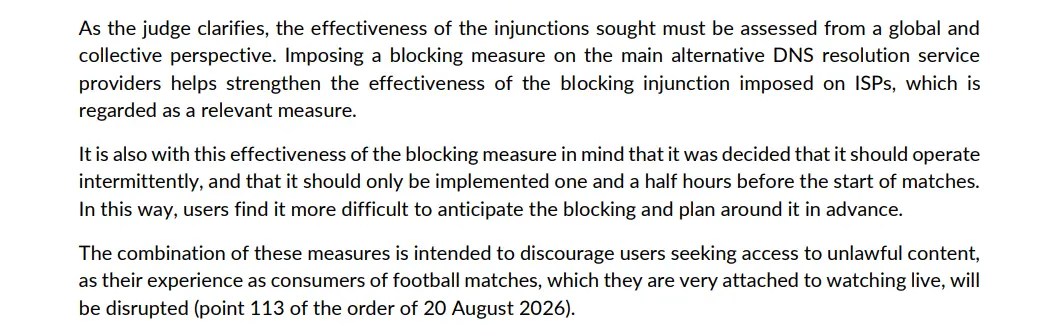
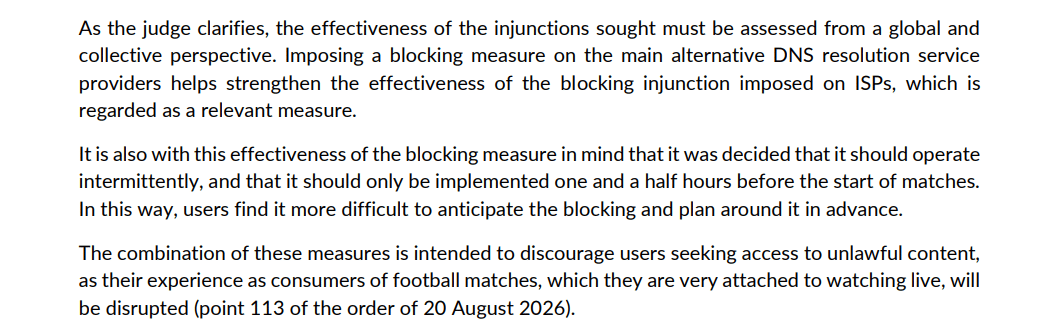
"Imposing a blocking measure on the main alternative DNS resolution service providers helps strengthen the effectiveness of the blocking injunction imposed on ISPs… The combination of these measures is intended to discourage users seeking access to unlawful content, as their experience as consumers of football matches, which they are very attached to watching live, will be disrupted."
The 90-Minute Tactical Clock and Dynamic Blocklists
Perhaps the most innovative—and controversial—aspect of the Belgian enforcement mechanism is its operational fluidity. The mandate targets premier domestic football competitions, most notably the Jupiler Pro League. To counter the agile, transient nature of modern pirate IPTV streams that constantly spin up new domains to evade static blocks, the system relies on a rolling update mechanism:
Update Frequency: DAZN is permitted to submit one blocklist update per week, capping additions at a maximum of 100 new domains per submission.
Scheduling: DAZN must notify the anti-piracy department at least seven working days prior to the targeted matchday. DNS resolvers are subsequently granted a five-day window to integrate the changes.
The Intermittent Window: Rather than maintaining permanent blocks that could be easily cataloged and bypassed, the blockades go live exactly 90 minutes before a match begins.
This tactical delay is designed specifically to disrupt live-event viewing habits. By activating the blocks immediately prior to kickoff, rightsholders and regulators aim to catch casual pirates off guard, making it exceedingly difficult for consumers to find functional alternative links or configure custom workarounds before the whistle blows.
The efficacy of this dynamic approach is reflected in hard data. Publicly shared metrics demonstrate that the initial blocklist of 58 domains rapidly expanded to 258 domains as the season progressed and additional updates were processed.
Concessions and Fine Structures
While the core of the ruling favored the rightsholders, the court did offer some relief to the tech companies, scaling back certain overreaches in the original April order:
Removal of Warning Pages: The requirement compelling DNS resolvers to redirect blocked users to a mandatory warning page was struck down. The court concurred that such user-facing redirection mechanisms cannot logically be imposed on infrastructure-level DNS resolvers.
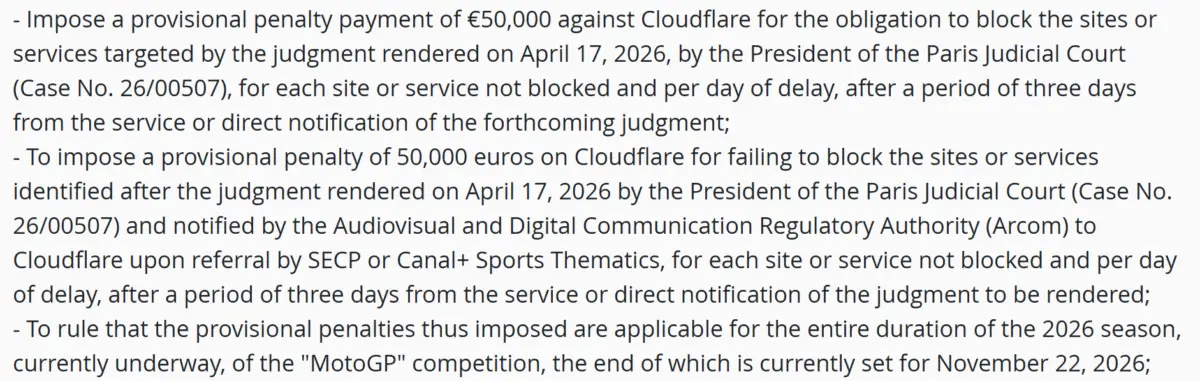
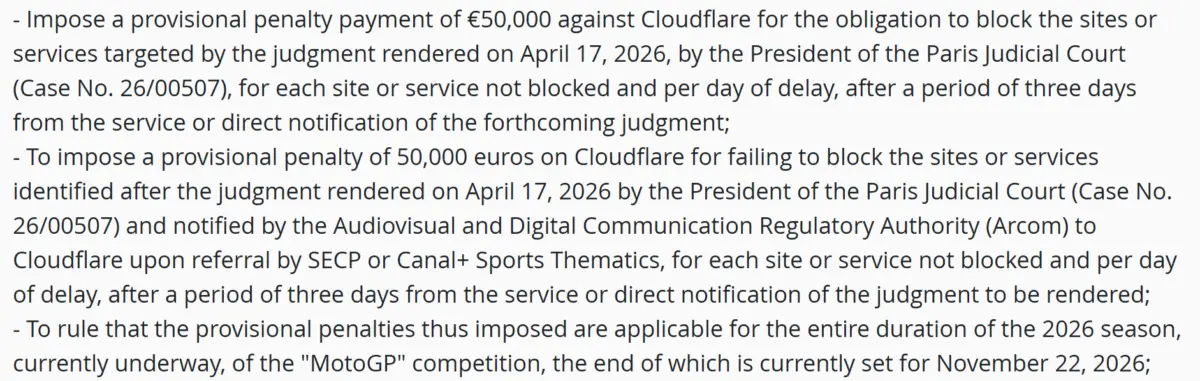
Mitigated Penalties: While the terrifying €100,000 daily fine was upheld, its application was heavily restricted. Penalties now accrue exclusively on days when live DAZN matches are actively broadcast. Furthermore, a cumulative ceiling of €20 million per company was instituted, and fines are explicitly waived for under-blocking incidents resulting from "an exceptional geolocation error."
Official Statements and Industry Reactions
The diverging responses of the targeted technology firms highlight a fundamental philosophical split within the tech industry regarding government-mandated infrastructure filtering.
Google and Cloudflare’s Pragmatism
While Google and Cloudflare initially challenged the legality and overreach of the order, both firms ultimately engineered compliance workflows to maintain their market presence in Belgium. For these global content delivery and DNS giants, compliance—however begrudgingly executed—is viewed as a necessary cost of doing business within European jurisdictions, utilizing automated filtering scripts and regional routing adjustments to absorb the court’s demands.
Cisco’s Unyielding Architecture
Cisco’s position remains diametrically opposed to its peers. During the judicial hearings, Cisco reiterated that its public OpenDNS infrastructure is structurally incapable of supporting the hyper-specific demands of the Belgian mandate.
In an official filing, Cisco noted that OpenDNS:
"…does not allow for the implementation of selective, geolocated and dynamic blocking as required by the order," and warned that forcing such modifications "…would compromise the performance, stability and security of that service."
Faced with a choice between compromising the foundational integrity of its global network architecture or exiting the Belgian market, Cisco chose departure. The Belgian anti-piracy department has formally accepted this withdrawal as a compliant maneuver under the court’s framework.
When contacted by investigative journalists for comment following the release of the September implementation decision, Cisco maintained a guarded stance, issuing a brief, tightly controlled statement:
"OpenDNS currently remains available in Belgium," a corporate spokesperson noted, while declining to answer deeper structural inquiries regarding the timeline of its impending withdrawal.
Future Outlook: A Precedent for Europe?
The legal showdown in Brussels carries profound implications that extend far beyond the borders of Belgium. As entertainment conglomerates and sports leagues globally seek increasingly aggressive methods to clamp down on digital piracy, the weaponization of public DNS resolvers represents a powerful new frontier in enforcement.
The Appeal and the Three-Month Countdown
Under the terms of the court’s decision, the affected DNS providers have been granted a three-month window to fully implement the mandated blocking mechanisms. OpenDNS currently remains functional in Belgium while Cisco finalizes its legal strategy. Industry insiders have confirmed that Cisco intends to formally appeal the ruling. However, legal experts consider overturning the Brussels Business Court’s core logic an uphill battle.
Unless an appeals court intervenes dramatically in the interim, Belgian consumers utilizing OpenDNS will find their resolver service going dark for a second time later this year.
The Broader Threat to Open Internet Infrastructure
Civil liberties advocates and network engineers are watching the Belgian proceedings with mounting alarm. Compelling DNS resolvers—services designed to provide fast, neutral, and uncorrupted translation of domain names into IP addresses—to act as dynamic, intermittent content censors fundamentally alters their operational ethos.
If national courts across Europe embrace the Belgian model, public DNS providers may face a fractured regulatory landscape. In this fragmented future, global tech firms will be forced to choose between Balkanizing their service offerings to comply with localized censorship mandates or abandoning certain national markets entirely. For a resilient, open internet, the precedent established in Brussels may well be remembered not as a victory against piracy, but as the day the foundational plumbing of the web was permanently compromised.