Executive Overview
In the high-stakes landscape of Business-to-Business (B2B) marketing, the margin for error is razor-thin. Millions of dollars are funneled annually into digital advertising ecosystems with the expectation of predictable pipelines and high-yielding returns on investment (ROI). Yet, a persistent frustration remains among corporate marketing executives: why do meticulously crafted campaigns fail to close deals?
According to comprehensive new research released by LinkedIn—synthesizing performance insights from over 50,000 closed deals across 850 B2B organizations, in partnership with analytics firm Factors.ai—the answer lies in a fundamental misalignment between traditional marketing playbooks and the realities of modern buyer behavior.
The data reveals that B2B marketers are habitually committing critical strategic errors. Chief among them is a reliance on short-term campaign windows, hyper-narrow targeting concentrated solely on executive-level leadership, and an over-reliance on paid ads divorced from organic brand-building.
The findings indicate that B2B decision-making units are far more expansive than previously assumed, and the evaluation timeline begins months—sometimes quarters—earlier than when sales teams traditionally make contact. For CMOs and demand-generation leaders, the message is unequivocal: the old ways of driving B2B pipeline growth are obsolete. To maximize return on ad spend (ROAS) and drastically improve deal win rates, organizations must pivot toward extended lead-in promotions, broader cross-organizational stakeholder engagement, and an integrated strategy fusing paid advertisements with robust organic LinkedIn presence.
Detailed Chronology: Mapping the Anatomy of the Modern B2B Purchase
To understand why traditional B2B marketing strategies are failing, one must first dissect the contemporary buyer’s journey. The Factors.ai report commissioned by LinkedIn provides an empirical timeline that shatters long-held industry assumptions regarding sales cycles and prospect engagement.
The 124-Day Discovery Window
Historically, many B2B marketers have designed their demand-generation strategies around the active sales cycle—the window of time when a prospect explicitly engages with a sales representative, requests a demo, or submits an inquiry form. However, the data indicates that this approach misses the critical formative period of the buyer’s journey.
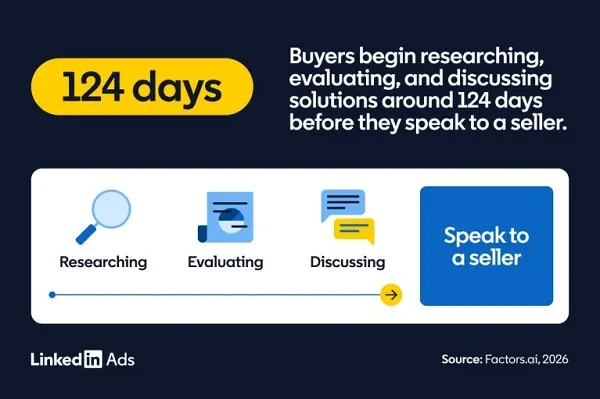
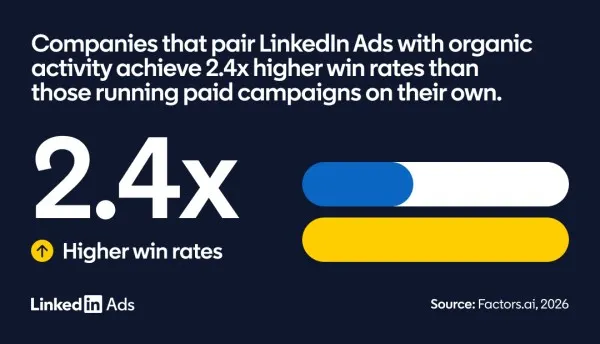
According to the report, B2B buying groups actively explore, research, and evaluate potential marketplace solutions an average of 124 days before they ever speak to a seller.
This four-month-plus runway represents the "early discovery" phase. During this time, prospective buyers are consuming educational content, evaluating competitor landscapes, reading peer reviews, and quietly building internal consensus without the knowledge of the vendor’s sales development representatives (SDRs).
When marketers restrict their promotional windows to short, high-intensity bursts timed closely to the end of a fiscal quarter, they entirely miss this foundational 124-day window. By the time a vendor’s sales team enters the picture, the buyer has often already shortlisted competitors who managed to establish early brand awareness and educational authority during the discovery phase. Consequently, the research argues for a radical restructuring of campaign longevity, advocating for extended, sustained lead-in promotions that capture prospects at the very inception of their exploratory phase.
Supporting Context & Metrics: Unpacking the Numbers Behind B2B Wins
Beyond the timeline of the buyer’s journey, the LinkedIn-Factors.ai study illuminates critical metrics regarding who makes buying decisions and how cross-functional targeting directly impacts win rates.
Expanding the Stakeholder Circle: The Power of Multi-Contact Engagement
A pervasive myth in B2B marketing is that you only need to impress the ultimate economic buyer—typically defined as the C-suite executive or the final sign-off authority. This mindset has driven decades of hyper-targeted executive outreach. However, the data suggests this narrow focus actively damages conversion rates.

Modern B2B purchases are collective, consensus-driven endeavors involving complex buying committees. The Factors.ai research highlights two striking statistical thresholds that dramatically elevate deal success:
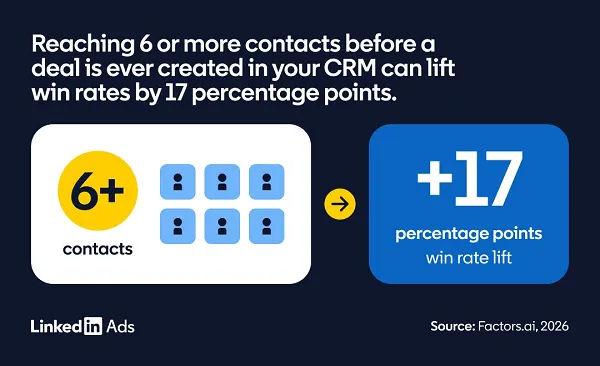
- Pre-Creation Engagement (Before the CRM Deal Exists): Reaching 6 or more contacts within a target account before a formal deal is ever created in the Customer Relationship Management (CRM) system can lift win rates by an impressive 17 percentage points.
- Active Cycle Engagement: Engaging another 3 or more contacts during the active sales and evaluation cycle lifts win rates by an additional 16 points.
These metrics underscore the reality that enterprise software, hardware, and high-value services are rarely purchased on the whim of a single executive. They require internal champions, end-users, IT gatekeepers, and financial approvers to all feel comfortable with the solution. If a marketing campaign only targets the Chief Information Officer or Chief Marketing Officer, it leaves the broader coalition uneducated and unpersuaded, creating internal friction that can easily derail a deal.
The Targeting Blind Spot: The Director-Level Trap
Despite the proven value of multi-contact engagement, current B2B ad spend reveals a significant strategic disconnect.
According to the platform data, 76% of total LinkedIn ad spend targets director-level roles, driven by the assumption that directors are the primary gatekeepers and execution-level decision-makers. While directors undoubtedly play a pivotal role in evaluating solutions, hyper-focusing nearly four-fifths of an organization’s budget on this single tier creates massive blind spots. It starves the broader set of influencers, managers, individual contributors, and cross-departmental stakeholders of the brand exposure they need to advocate for your solution internally.
The Synergistic Effect of Paid and Organic Integration
Another vital insight emerging from the report centers on the ecosystem in which ads are delivered. Many marketing teams treat paid advertising and organic social media as distinct, siloed operational functions—often managed by different agencies or separate internal teams.
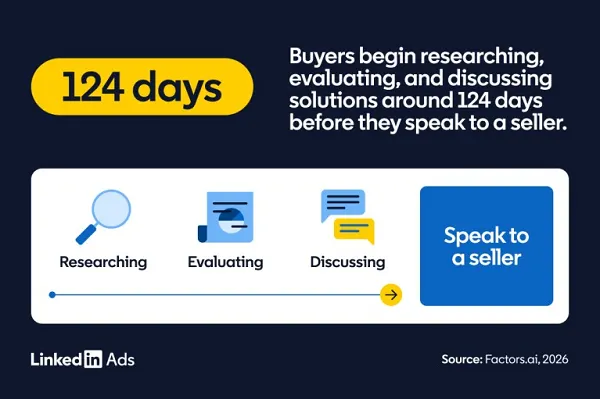
The data exposes the inefficiency of this siloed approach. Companies that strategically utilize LinkedIn Ads in active partnership with organic LinkedIn activity achieve 2.4x higher win rates compared to organizations running standalone paid campaigns.
Organic content builds long-term institutional trust, thought leadership, and cultural relevance within an industry. Paid advertising provides targeted reach, precision frequency, and accelerated visibility. When fused together, they create a halo effect: prospects who see a brand’s organic thought-leadership posts and subsequently encounter its targeted paid advertisements exhibit significantly higher trust and responsiveness, translating directly into closed-won revenue.
Official Statements and Industry Implications
Industry analysts and LinkedIn marketing leaders view these findings as a watershed moment for digital B2B strategy. As marketing budgets face increased scrutiny in macroeconomically volatile times, accountability and efficiency are paramount.
In breaking down the findings from the Factors.ai report, LinkedIn’s official business insights highlight the structural flaws of traditional lead-gen mechanics:
"Factors.ai found that reaching 6 or more contacts before a deal is ever created in your CRM can lift win rates by 17 percentage points. Engaging another 3 or more contacts during the active cycle lifts win rates by 16 points."
This official guidance serves as an empirical rebuke of single-channel, single-persona targeting. Marketing leaders are being urged to transition away from traditional "lead-gen form" mentalities toward a broader, account-based marketing (ABM) philosophy that nurtures entire organizational ecosystems.
Furthermore, digital marketing strategists emphasize that the 124-day discovery window demands a complete overhaul of budget allocation. Rather than front-loading budgets into aggressive, short-lived conversion campaigns, organizations must allocate sustainable, baseline investments toward top-of-funnel awareness and educational content designed to resonate with non-executive stakeholders months before a sales conversation takes place.
Future Outlook: The Next Evolution of B2B LinkedIn Marketing
As we look toward the future of enterprise marketing, the implications of the LinkedIn-Factors.ai study point toward a more holistic, patient, and multi-layered approach to digital customer acquisition.
1. Shift from Short-Term Sprints to Always-On Brand Building
The pressure for immediate quarterly attribution has long forced B2B marketers into short-term ad campaigns. However, with buyers spending over four months in early-stage autonomous research, the future belongs to brands that maintain an "always-on" market presence. Marketers will need to defend longer lead-in promotional cycles to executive boards by demonstrating how early-stage impression share correlates directly with late-stage win rates.
2. Broadening Personas and Account-Level Penetration
Account-Based Marketing (ABM) will evolve from a buzzword into an operational necessity. Successful B2B campaigns of tomorrow will map out entire organizational charts, deploying tailored creative variations not just to the C-suite, but to managers, practitioners, and financial controllers who influence the final purchase. Moving past the 76% director-level concentration will require creative messaging that speaks directly to the unique pain points of diverse corporate roles.
3. Merging Brand and Demand
The days of separating brand marketing (organic/PR) from demand generation (paid ads) are coming to a close. The empirical proof that integrated strategies yield a 2.4x higher win rate will force CMOs to structurally reorganize their marketing departments. Content creators, organic social managers, and paid media buyers must operate as a unified front, ensuring that a prospect’s journey from an organic article to a paid retargeting ad feels cohesive, authoritative, and frictionless.
Ultimately, the data from LinkedIn and Factors.ai offers both a diagnostic tool and a strategic roadmap. By respecting the 124-day discovery timeline, expanding target personas beyond the C-suite and director levels, and fusing organic trust with paid velocity, B2B marketers can transform their LinkedIn ad strategy from an unpredictable expense into a high-performance engine for sustainable business growth.