In the often-murky intersection of digital copyright enforcement and anonymous file-sharing infrastructure, federal courts occasionally play host to bizarre, surreal legal battles. However, few cases match the bewildering twists of a recent intellectual property lawsuit targeting elite, private torrent trackers. What began as a standard copyright infringement complaint filed against major underground platforms—including the notorious trackers PTP (PassThePopcorn) and BTN (BroadcastheNet)—has evolved into a full-scale legal thriller involving allegations of severe identity fraud, improbable statistical coincidences, and an eleventh-hour voluntary dismissal that has left federal judges and defense attorneys scrambling for answers.
At the heart of the controversy is a plaintiff who initiated legal action under the name Matthew Schneider, alleging that the operators of exclusive private torrent communities unlawfully distributed his creative works. Yet, as defense counsel dug deeper into the background of the claims, they uncovered a staggering revelation: the individual driving the federal lawsuit may be an impostor. The real Matthew Schneider—a Canadian independent filmmaker whose work is cataloged on IMDb—swore under oath that he has no association whatsoever with the ongoing federal litigation.
Faced with mounting scrutiny, the plaintiff doubled down, offering a defense that strained credulity: he argued that the case features two completely different independent filmmakers named Matthew Schneider, both of whom coincidentally created three short films with identical titles years apart. As the court prepares to untangle this web of conflicting metadata, procedural counterattacks, and unanswered subpoenas, legal experts are left questioning the underlying motivations of a plaintiff who seemingly went to extraordinary lengths to unmask anonymous torrent operators—only to abruptly attempt to walk away from the table.
Detailed Chronology
1. The Genesis of the Lawsuit and the Impostor Accusation
The legal drama kicked off months ago when a plaintiff identifying as Matthew Schneider filed a federal lawsuit in the United States, targeting several prominent, high-profile private torrent trackers. These platforms—including PTP and BTN—are notoriously difficult to access, operating on strict invite-only systems and cultivating intense subcultural loyalty. For copyright holders seeking to litigate against such platforms, unmasking the individuals behind the operational infrastructure is the ultimate objective.
To advance his claims, the plaintiff issued a barrage of third-party subpoenas to major technology, hosting, and financial entities, including Reddit, GoDaddy, Cloudflare, PayPal, Stripe, Namecheap, and X Corp (formerly Twitter). The goal was simple: force these corporations to hand over identifying records, IP logs, and financial details that would expose the real-world identities of the anonymous tracker operators.
However, the legal tide turned abruptly when defense attorneys Erin Russell and Haley Finch, representing the tracker operators, conducted routine background investigations into the plaintiff’s background. Armed with discrepancies in the filings—including the use of a mail-drop address and questionable copyright assertions—the defense attorneys alerted federal Judge Andrea R. Wood that the entire action may have been initiated by a fraudster masquerading as an independent creator. Acting on these red flags, Judge Wood shifted the case onto a formal sanctions track and scheduled a mandatory in-person hearing.
2. The Appearance of the "Real" Matthew Schneider
Following the defense’s initial disclosures, attorneys Russell and Finch formally moved to hold the plaintiff in contempt of court. Their primary Exhibit A was a sworn declaration from Matthew A. Schneider residing in Ottawa, Ontario.
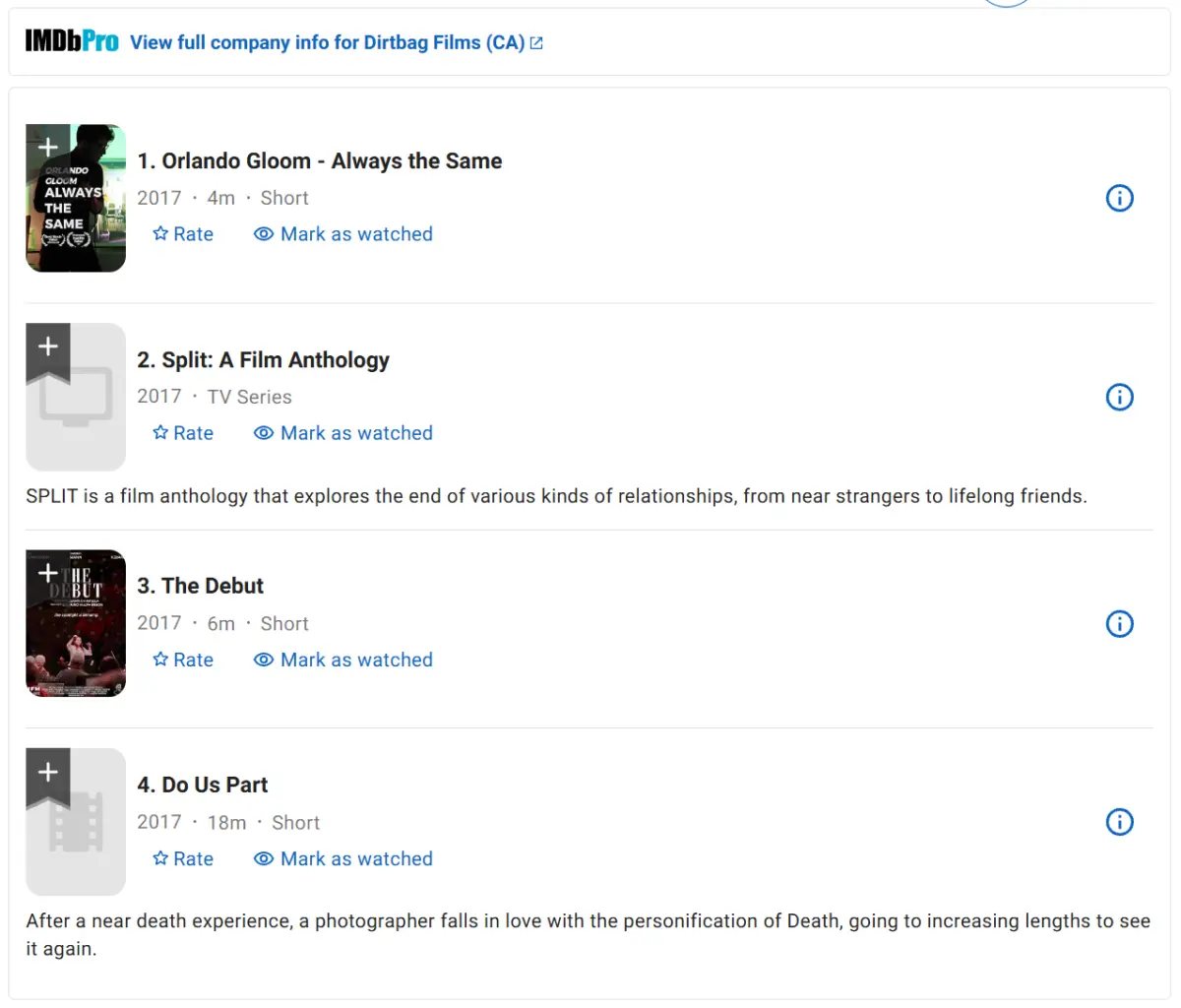
A review of IMDb credits for the three films cited in the federal complaint—titled Split: A Film Anthology, Do Us Part, and Orlando Gloom, Always the Same—reveals that they were produced by Canadian Schneider and his high-school filmmaking collective, "Dirtbag Films," which included collaborator Solmund MacPherson.
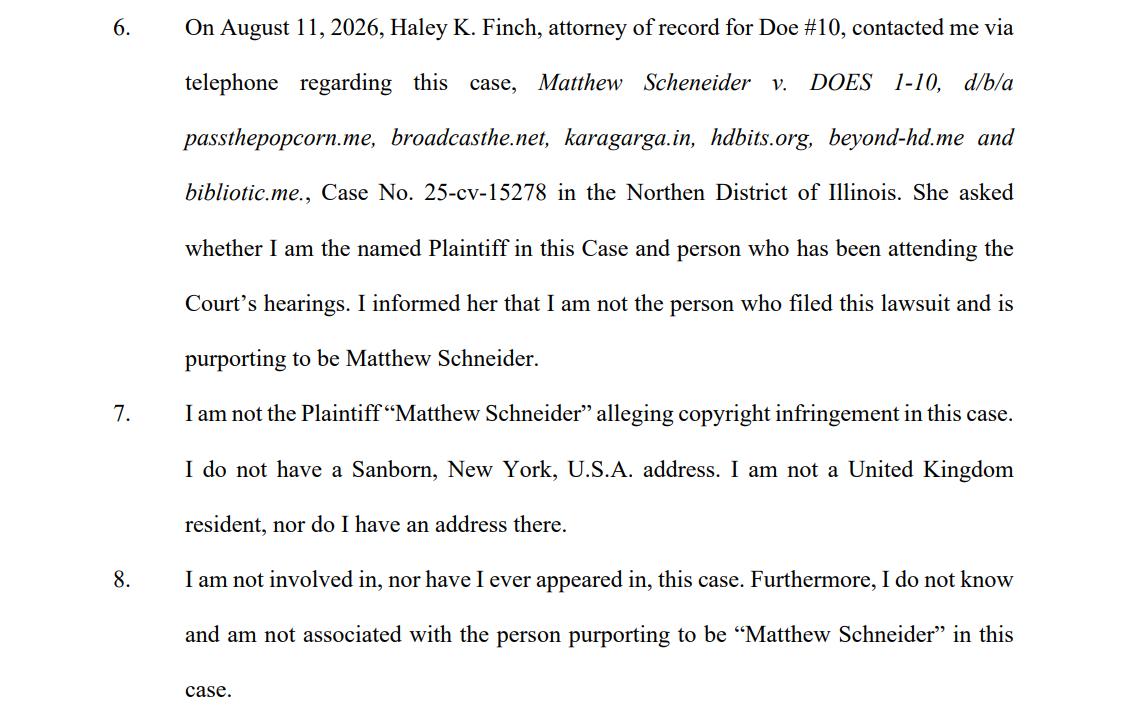
Under penalty of perjury, the Canadian filmmaker dismantled the plaintiff’s standing:
"I am not involved in, nor have I ever appeared in, this case. Furthermore, I do not know and am not associated with the person purporting to be ‘Matthew Schneider’ in this case."
Solmund MacPherson corroborated this statement in his own sworn declaration. MacPherson confirmed that Dirtbag Films never sold the rights to their cinematic works to any third party and stated unequivocally that he did not recognize matthew.schneider94, the email address attached to every single legal filing in the federal docket. Furthermore, MacPherson hunted down archival copies of Do Us Part, in which the real Canadian Schneider appears on screen with a distinct speaking voice and facial features that could easily be compared against any audio or visual recordings of the litigant.
3. The Doppelgänger Defense and Identical Film Titles
Confronted with undeniable proof that the Canadian creator was entirely detached from the proceedings, a reasonable litigant might have folded. Instead, the plaintiff leaned into a narrative of extraordinary coincidence. In a court filing submitted late last week, the plaintiff argued that the defense had fallen victim to a basic misunderstanding: there simply happen to be two independent filmmakers named Matthew Schneider in the world.
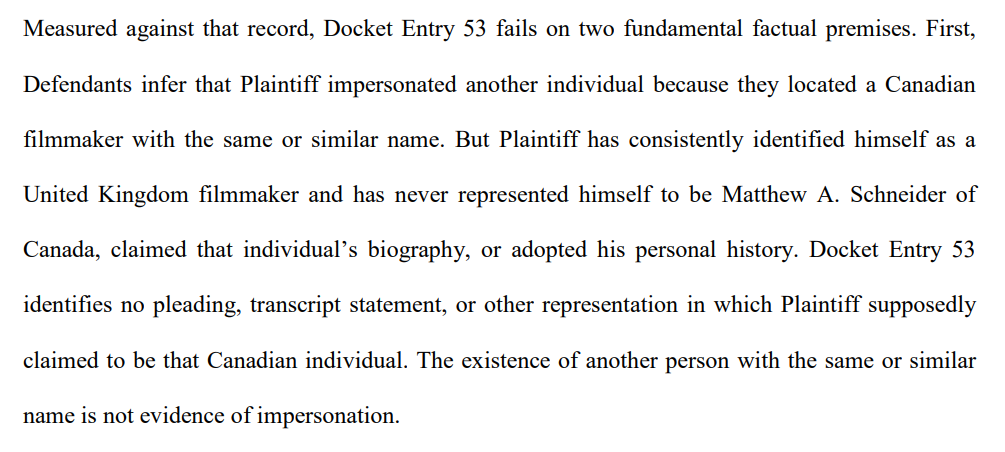
The plaintiff asserted that he has consistently identified himself throughout the legal proceedings as an independent filmmaker and creative professional based in the United Kingdom. He maintained that he never claimed to be the Canadian Schneider and never referenced Dirtbag Films in his initial pleadings, writing:
"The existence of another person with the same or similar name is not evidence of impersonation."
To substantiate this remarkable claim, the UK-based plaintiff submitted an evidentiary exhibit containing metadata for his own self-produced versions of the exact same three films. According to his metadata logs, his iterations were supposedly produced in the UK in 2011 (Split) and 2012 (Do Us Part and Orlando Gloom, Always the Same). Because these dates predate the 2017 Canadian Dirtbag Films productions by roughly five to six years, the plaintiff argued it was physically impossible for him to have plagiarized works that "did not yet exist."
Despite the bold timeline, the plaintiff’s evidentiary exhibits raised more questions than answers. While the files included technical data such as filenames, video resolutions, and frame rates, they completely lacked official copyright office registration numbers, crew lists, casting details, promotional stills, or verifiable IMDb listings. Most suspiciously, one of the disputed titles incorporates "Orlando Gloom"—a direct reference to the actual indie musician for whom the Canadian Dirtbag collective filmed a specialized music video.
4. The Procedural Counterattack and Sudden Dismissal
Not content to merely defend his identity, the plaintiff launched a vigorous procedural offensive against defense counsel. He accused attorneys Russell and Finch of committing ethical violations through improper ex parte contact with Judge Wood, highlighting a phone call defense counsel made to the judge’s chambers prior to the August hearing. Citing American Bar Association (ABA) rules on professional conduct and Seventh Circuit jurisprudence penalizing one-sided judicial communications, the plaintiff demanded that the court disclose the precise dates and contents of those conversations, exclude any statements made outside his presence, and weigh financial sanctions against the defense team.
Crucially, the plaintiff’s extensive defense response addressed only three of the ten works originally listed in his initial complaint. The remaining five short films and two literary works—which the defense argued lacked any verifiable human creator whatsoever—were left entirely unaddressed.
Before Judge Wood could definitively rule on the mounting motions for sanctions, a final dramatic twist occurred: the individual litigating under the name Matthew Schneider filed a formal notice of voluntary dismissal. Despite this abrupt exit, the court’s pending motion for a rule to show cause remains active on the judicial calendar, ensuring that the legal reckoning will proceed regardless of the plaintiff’s attempt to flee the jurisdiction.
Supporting Context & Metrics
To fully understand the gravity of this federal proceeding, one must examine the high-stakes ecosystem of private torrent networks and the procedural mechanisms governing intellectual property enforcement in United States courts.
The Nature of Private Trackers: Platforms like PassThePopcorn (movies) and BroadcastheNet (television) operate behind heavily guarded digital fortresses. Unlike public BitTorrent swarms, membership is strictly vetted, and users must maintain precise upload-to-download ratios to retain accounts. Consequently, intellectual property holders frequently view these communities as impenetrable strongholds of digital piracy.
The Power of Third-Party Subpoenas: In standard copyright litigation campaigns, plaintiffs often rely on mass subpoena operations (frequently dubbed "copyright troll" lawsuits) to force Internet Service Providers (ISPs) and tech giants to unmask anonymous file-sharers. In this case, the subpoenas targeted massive enterprises including Reddit, GoDaddy, Cloudflare, PayPal, Stripe, Namecheap, and X Corp.
The Judicial Freeze: Recognizing the potential for abuse or improper service, Judge Andrea R. Wood intervened proactively in May, placing a total freeze on all third-party subpoena productions. This judicial safeguard prevented the unmasking of any platform operators while the foundational question of the plaintiff’s identity was investigated.
Statistical Improbability: The mathematical probability of two distinct independent filmmakers bearing the exact same name—Matthew Schneider—producing three short films with identical titles, including an obscure musical reference, is exceedingly close to zero. This statistical anomaly sits at the core of the defense’s argument that the court is confronting a fabricated persona.
Official Statements & Legal Arguments
The court docket features sharply contrasting positions from the parties involved, capturing the tension between digital privacy advocates and copyright enforcers.
The Defense Position (Attorneys Erin Russell and Haley Finch):
The defense has maintained from the outset that the lawsuit is a fraudulent fabrication designed to abuse the federal judicial system. By presenting sworn declarations from the authentic Canadian creator and his high-school collaborator, the defense successfully established that the plaintiff lacked standing, misrepresented his identity, and utilized a commercial mail-drop address to evade personal accountability.
The Plaintiff’s Counter-Assertion:
The individual styling himself as the UK-based Matthew Schneider insisted that his constitutional right to litigate was being unfairly suppressed by targeted harassment and coincidental naming conventions:
"The existence of another person with the same or similar name is not evidence of impersonation."
Furthermore, the plaintiff framed the defense’s communications with the judge’s chambers as a severe breach of judicial ethics, attempting to turn the focus of the court away from his own metadata anomalies and toward alleged procedural missteps by opposing counsel.
The Canadian Contributor (Solmund MacPherson):
Highlighting the bizarre nature of the infringement claims, MacPherson’s affidavit provided definitive closure regarding the true origin of the disputed cinematic assets:
"We never sold the rights to the films, and I do not recognize the email address associated with every filing in the federal lawsuit."
Future Outlook
As the dust settles on the voluntary dismissal, the immediate future of this federal litigation remains fraught with unanswered questions.
First and foremost, Judge Andrea R. Wood has indicated that the voluntary dismissal does not automatically erase the pending motion for a rule to show cause. Federal judges possess inherent authority to investigate and punish frauds perpetrated upon the court, regardless of whether a plaintiff attempts to quietly exit through a voluntary motion to dismiss. If the court determines that an impostor deliberately fabricated legal standing, forged metadata, and manipulated the federal docket, the consequences could extend far beyond mere civil sanctions, potentially crossing into criminal contempt or perjury investigations.
Secondly, the unprecedented freeze on third-party subpoenas issued to entities like Cloudflare, GoDaddy, and PayPal remains a pivotal shield for the private torrent trackers involved. Because those production orders were halted before any confidential identifying data could be extracted, PTP, BTN, and their associated operators have successfully weathered the storm—at least for now.
Ultimately, the case serves as an extraordinary cautionary tale in the modern era of digital jurisprudence. It highlights the vulnerabilities of federal civil procedure when confronted with anonymous litigants, digital aliases, and fabricated provenance. Whether the mysterious "Matthew Schneider" is unmasked or fades permanently into the digital ether, this bizarre legal saga will undoubtedly be cited in future copyright battles as a prime example of how an intellectual property lawsuit can completely collapse under the weight of its own identity crisis.