Executive Overview
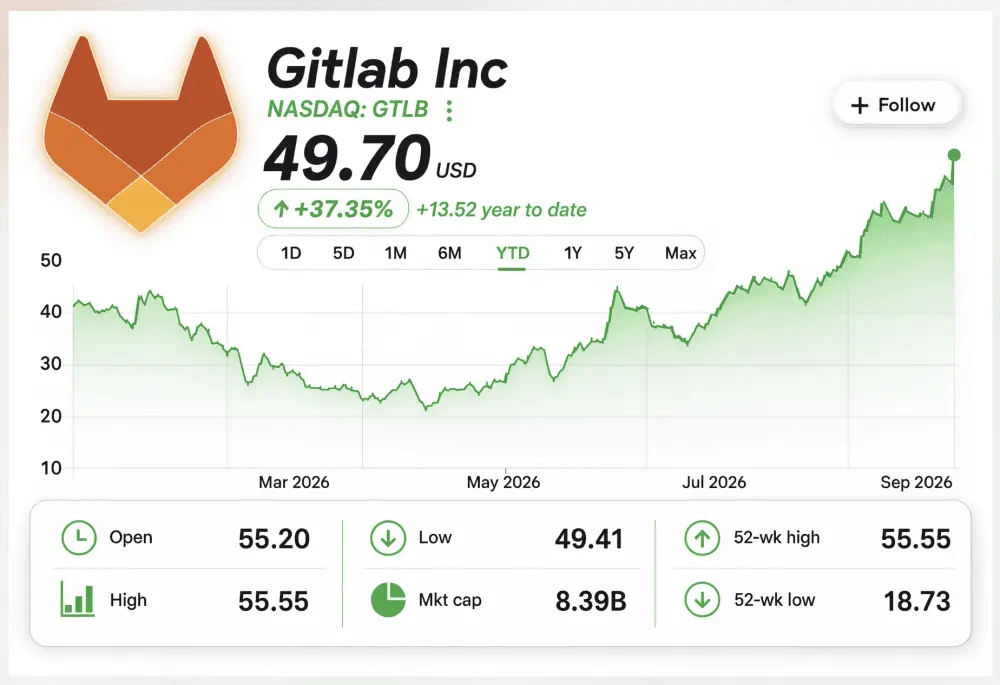
Just four months ago, market sentiment cast GitLab as one of the most vulnerable victims of the artificial intelligence revolution. Wall Street analysts and public B2B investors alike worried that autonomous AI coding assistants—capable of generating boilerplate scripts and refactoring codebases instantly—would hollow out the very foundation of developer tooling seats. The prevailing fear was simple: if enterprises needed fewer developers, they would buy fewer GitLab subscriptions.
Then came the close of Q2 FY27 on September 1, a reporting period that completely detonated that narrative.
GitLab’s financial results revealed a company not only surviving the AI transition, but actively monetizing it through a structural pricing and packaging overhaul. While headline reported revenue grew by a respectable 21% year-over-year to $286.3 million, beneath the surface indicators pointed to explosive underlying momentum. Calculated billings surged 24%—double the previous quarter’s pace—and gross bookings hit an all-time high in the company’s history.
Yet, paradoxically, GitLab issued a Q3 revenue guide below its Q2 prints, sending superficial stock-watchers into a temporary tailspin. This article breaks down the mechanics behind that apparent contradiction, exploring the introduction of "Flex" pricing, soaring AI compute costs, shifting gross margins, and the fundamental evolution of how modern B2B software enterprises price value in an AI-driven economy.
Detailed Chronology: Unpacking the Q2 FY27 Earnings Reveal
To understand how GitLab transformed its market standing in a single quarter, one must trace the timeline and structural shifts that defined Q2 FY27.
Four months prior to the September earnings release, bearish sentiment dominated. Investors viewed GitLab through a legacy lens—as a B2B SaaS vendor tied strictly to per-seat licensing. However, leadership recognized that the software engineering paradigm was shifting from human-authored code to AI-augmented workflows. To capture this shift, GitLab introduced GitLab Flex, a consumption-and-commitment hybrid model.
When Q2 results dropped, they defied simple categorization:
- Reported Revenue: $286.3 million, up 21% from $236.0 million year-over-year.
- Calculated Billings: Up 24%, doubling Q1’s 12% growth rate.
- Gross Bookings: Reached the largest single quarter in the company’s history.
- The Q3 Guide: Guided to $281–$283 million, representing 15–16% year-over-year growth—technically below the $286.3 million printed in Q2.
The Mechanics of Revenue Recognition and the Flex Model
Why would a company experiencing record gross bookings and surging billings guide future revenue downward? The answer lies in revenue recognition timing, engineered deliberately through the adoption of GitLab Flex.
Under traditional self-managed software models, roughly 15% of an annual contract’s value represents the license component, which is recognized upfront in the first quarter of the agreement. The remaining balance is recognized ratably over the year.
Under the new Flex model, however, the license component is recognized ratably over the entire term because customers retain the flexibility to re-elect their product mix on a monthly basis. GitLab’s internal modeling illustrates this clearly: for a hypothetical $100 annual contract, the old model packed 15% plus quarterly components into Q1, whereas Flex spreads the revenue evenly at 20% per quarter.
According to CFO guidance, for every $50 million of self-managed contracts available to renew that convert to Flex in FY27, approximately $5 million of revenue shifts out of FY27 and into future periods, capping the maximum estimated full-year impact at $13 million. Crucially, bookings, billings, and actual cash collections remain entirely unaffected; only GAAP timing shifts.
Management noted that the raised full-year revenue guidance ($1.129–$1.133 billion, up from $1.112–$1.118 billion) does not even incorporate the potential acceleration headwind of Flex conversions. Faster Flex adoption signals a healthier, stickier business, even if it temporarily dampens reported GAAP revenue growth.
Supporting Context & Metrics: Decoding the Numbers
A closer audit of the quarter’s disclosures reveals several critical insights regarding customer acquisition, infrastructure costs, and net ARR metrics.
1. The Reality Behind "Net ARR" Growth
During the earnings call, both the CEO and CFO highlighted that "net ARR" grew 42%, prompting many market commentators to mistakenly assume that total Annual Recurring Revenue (ARR) grew at that clip. It did not.

Revenue grew 21%, net retention hovered at 117%, and the customer count for accounts above $5,000 grew by 8%. A total ARR base growing at 42% is arithmetically impossible under these parameters.
Instead, the 42% figure refers to net new ARR booked in the quarter compared to the same period a year prior—an incremental growth metric rather than a base expansion metric. While it demonstrates strong quarterly sales velocity, conflating it with total ARR growth obscures the baseline performance.
2. The Explosive Adoption of GitLab Flex
Barely six weeks after its market introduction, GitLab Flex secured commitments from over 130 customers, generating more than $20 million in new commitments.
To gauge future performance, management pointed investors toward Paid Consumption Run Rate—defined as GitLab Credit commitments, Flex commitments, and paid on-demand consumption (excluding trials). This metric exited Q1 at $15 million and surged past $40 million exiting Q2, tracking toward an ambitious goal of exceeding $100 million by the fiscal year-end. Meanwhile, Duo Agent Platform paid consumption grew roughly 50% sequentially.
This mirrors a broader industry trend. Cybersecurity titan CrowdStrike experienced a similar paradigm shift with Falcon Flex, which crossed $2.29 billion in ARR and accounts for roughly 39% of its total ARR. When software value decouples from manual seat counts, flexible credit-based pools become the standard procurement mechanism.
3. Skyrocketing AI Costs and Gross Margin Compression
The transition to consumption-based AI features comes with a tangible financial trade-off: cost of revenue is climbing steeply.
- Non-GAAP Gross Margin: 86%, down from 90% a year prior.
- GAAP Gross Margin: 84%, down from 88%.
- Subscription Cost of Revenue: Jumped from $21.8 million to $38.3 million—representing a 76% surge against 21% revenue growth.
This margin compression is directly tied to the costs of powering AI integrations with Anthropic’s Claude models, Amazon Bedrock, and Google Vertex. In the broader B2B software landscape, companies handle AI expenses differently based on architectural choices:
- Inference-buyers (like GitLab) incur ongoing COGS, resulting in permanent gross margin compression.
- Infrastructure-builders capitalize their compute costs onto the balance sheet as capital expenditures, shielding gross margins while depreciating assets over time.
- Governance-sellers (who manage security layers around third-party models) experience minimal compute overhead.
Despite dropping 400 basis points over two years, an 86% gross margin remains exceptionally robust for a platform heavily integrating real-time agent consumption.
Official Statements & Strategic Shifts
GitLab’s executive leadership emphasized that the company’s internal reorganization—including the restructuring of R&D into roughly 60 autonomous teams—is already paying dividends in product velocity.
Furthermore, the expansion of higher-tier adoption is striking. Ultimate tier subscriptions now account for 59% of total ARR, growing at approximately 35% year-over-year. Notably, 8 out of GitLab’s 10 largest deals in Q2 chose the Ultimate tier. Simultaneously, SaaS revenue accounted for 34% of total revenue, expanding at 36%.
The customer base shows clear bifurcation:
- Customers contributing over $5,000 in ARR reached 11,114, up 8% year-over-year.
- Enterprise deals exceeding $500,000 grew by an astonishing 150%.
- The company recorded roughly 1,700 first-order land transactions in Q2 alone.
While smaller customer counts grew at a modest single-digit pace, top-tier enterprise expansion proves that GitLab’s platform has become mission-critical infrastructure for large-scale engineering organizations, offsetting headwinds in lower-tier seat expansions.
Future Outlook & Lessons for Founders
Examining GitLab’s Q2 financial acrobatics yields three vital takeaways for B2B founders and operators navigating pricing transformations in the AI era:
- Transparently Quantify Migration Headwinds Upfront: GitLab published the exact financial mechanics of its Flex transition—including ATR conversion math and revenue recognition buckets—directly in its investor deck. Addressing deceleration and its structural causes simultaneously prevents panic and maintains credibility with sophisticated institutional investors.
- Establish a North Star Consumption Metric: When pivoting away from traditional seat-based models, companies must introduce clear, verifiable internal metrics (such as GitLab’s Paid Consumption Run Rate) to demonstrate that the new economic engine is scaling before legacy revenue streams begin to plateau.
- Recognize That AI Architecture Dictates Accounting Realities: Whether an enterprise chooses to buy third-party inference (impacting COGS and gross margins) or build proprietary infrastructure (impacting capex and depreciation), these are foundational business decisions that must be baked into long-term financial modeling years before they materialize on the balance sheet.
GitLab’s Q2 FY27 report proves that the software industry’s transition to AI-native consumption models is not a death knell for incumbent B2B platforms. By modernizing pricing structures, embracing flexibility, and capturing the value of autonomous developer agents, GitLab has successfully rewritten its narrative from AI casualty to architectural pioneer.