








Executive Overview
Meta has aggressively accelerated its footprint in the artificial intelligence agent market, introducing significant updates designed to anchor its “Muse” personal AI ecosystem deeper into everyday workflows. The tech giant has officially launched Muse for Mac, a native desktop application that integrates directly with macOS file systems and productivity applications, alongside Muse Connectors, a developer framework intended to bridge third-party software ecosystems with Meta’s proprietary AI architecture.
These twin developments mark a decisive pivot in Meta’s overarching AI strategy. Rather than limiting artificial intelligence to a chat-based browser window or social media feed, Meta is positioning Muse as an autonomous "agentic" assistant capable of executing complex, multi-step digital tasks locally on a user’s machine. By granting Muse the clearance to orchestrate files, synthesize notes, and interact with external applications, Meta is striving to outpace competitors in the race toward deeply integrated ambient computing.
However, this massive leap in utility runs parallel to heightened user scrutiny. As Muse gains the ability to ingest sensitive local data—including private messaging histories and system files—the platform faces formidable obstacles regarding consumer trust, data governance, and the psychological barrier of handing over automated control to an algorithm. This report investigates the technical architecture of Muse for Mac, analyzes the developer implications of Muse Connectors, evaluates the delicate balance between hyper-personalization and data privacy, and examines whether Meta can successfully convince a skeptical public of the tool’s everyday value.
Detailed Chronology of the Release
The Evolution of Meta’s Personal Agent Framework
The rollout of Muse for Mac and Muse Connectors represents the culmination of Meta’s internal restructuring around generative AI and agentic software. Over the past twenty-four months, the company has transitioned from foundational large language model (LLM) research to applied consumer experiences.
- Late Last Week: Meta officially debuted Muse for Mac, introducing a dedicated macOS client that fundamentally changes how the AI interacts with local user environments. Unlike web-based chatbots that require manual copy-pasting of text and documents, Muse for Mac acts as a system-level extension.
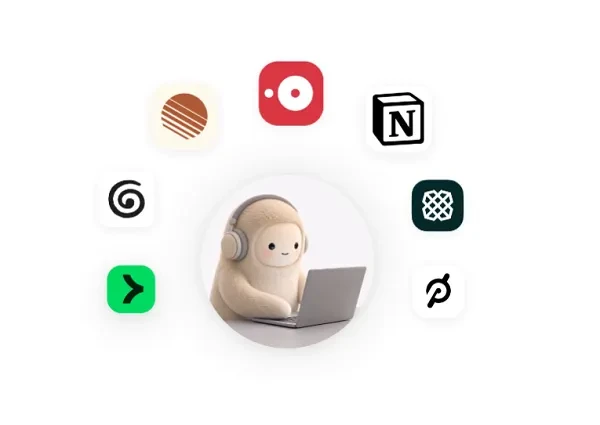
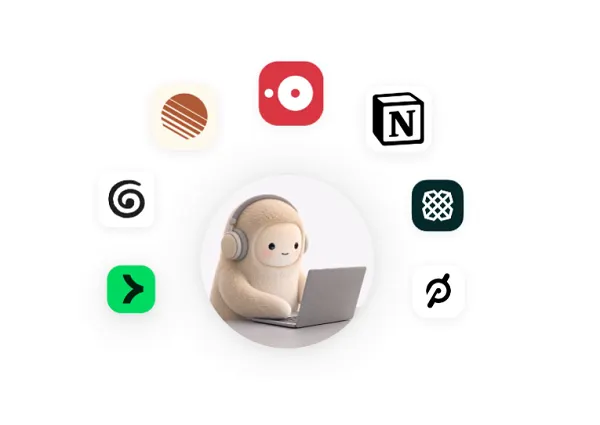
- Simultaneous Launch of Muse Connectors: To prevent the assistant from existing in a closed garden, Meta rolled out its developer portal—muse.ai/platform—enabling external software creators to submit application programming interface (API) integration requests. This initiative is designed to populate a centralized Muse directory, allowing users to tether external productivity, communication, and enterprise tools directly to their primary AI agent.
Technical Scope and Local Execution
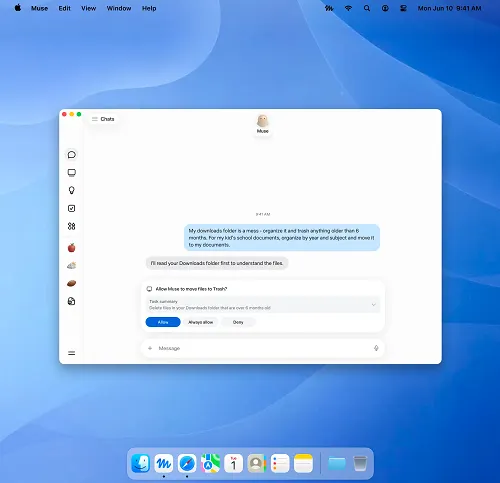
The defining characteristic of the Muse for Mac rollout is its local system integration. According to technical documentation and official releases from Meta, the desktop application operates via explicit user permission, tapping directly into the machine’s directory tree.
Upon installation and authorization, Muse is capable of performing several desktop management operations without requiring constant human prompts:
- File and Folder Optimization: The agent can autonomously audit, sort, and organize complex directories, such as a cluttered downloads folder.
- Deep Retrieval Operations: Users can leverage natural language queries to locate misplaced documents, images, or media files buried deep within local storage hierarchies.
- Cross-Platform Synthesis: The tool can aggregate, read, and summarize unstructured data from disparate sources, including local notes, documents, and messaging threads.
This shift toward local desktop execution mirrors broader industry trends, such as Apple’s Apple Intelligence framework and Microsoft’s Copilot+ PC initiatives. By moving computation and context-gathering closer to the metal, Meta aims to reduce latency and deliver a deeply contextualized assistant that understands not just what a user types into a chat box, but how they work across their entire operating system.
Supporting Context & Metrics: The Agentic AI Landscape
Understanding Agentic AI vs. Generative Chatbots
To fully grasp the significance of Meta’s recent announcements, it is necessary to examine the technological leap from traditional generative AI to agentic AI.
While standard LLMs function primarily as reactive text predictors—answering prompts based on training data or immediate uploads—agentic systems are engineered to pursue long-term goals autonomously. They can:
- Break a complex request down into sequential sub-tasks.
- Utilize external tools, software interfaces, and file systems.
- Make decisions based on real-time feedback loops without requiring human intervention at every step.
By introducing Muse for Mac and Muse Connectors, Meta is actively transforming Muse from a passive conversationalist into an active operator. Industry analysts note that this capability is rapidly becoming the primary battleground for Big Tech, as companies race to capture the "operating system of the mind."
The Developer Ecosystem and the Muse Directory
The launch of Muse Connectors is a calculated strategic maneuver designed to solve the perennial "cold start" problem faced by new software platforms. By opening the ecosystem to third-party developers, Meta is crowdsourcing the utility of its agent.
The developer workflow operates through a structured pipeline:
- Application Submission: Third-party tool creators apply via the Muse platform to link their proprietary software architectures into the core Muse system.
- Directory Curation: Approved applications are cataloged within the official Muse directory.
- User Account Linking: End-users securely authenticate their third-party accounts within Muse, expanding the agent’s functional boundary far beyond Meta’s proprietary properties.
By enabling external software to plug directly into Muse, Meta creates a network effect: the more applications that integrate with the connector framework, the more indispensable the Muse agent theoretically becomes to the end user.
Official Statements and Privacy Controversy
Navigating the Trust Deficit: The DMs Controversy
Despite the technological sophistication of the rollout, Meta’s expanded capabilities have immediately encountered public friction regarding data privacy. Shortly after the release of Muse for Mac, reports surfaced across social media platforms from early adopters noting that their Muse agents had begun reading direct messages (DMs) on their Mac computers, subsequently offering proactive suggestions based on sensitive, private conversations.

The revelation sparked immediate concern across privacy advocacy groups and tech forums, evoking memories of past data governance controversies involving Meta properties. Users questioned the boundaries of local system surveillance and whether an AI agent with access to local files represented an intrusive surveillance vector disguised as a productivity tool.
Meta’s Official Clarification
In response to growing online anxiety, Meta issued formal clarifications regarding how Muse interacts with personal communications. Company representatives and executives emphasized that Muse cannot read private messages or access sensitive local data by default.
Instead, Meta underscored a strict permission-based architecture:
"Muse can only access and analyze local data sources—including messaging threads and personal notes—if the user has explicitly granted the agent direct permission to do so."
While Meta’s technical defense rests on the principle of informed consent, cybersecurity and UX experts point out a persistent psychological hurdle: the "opt-in fatigue" phenomenon. Many users routinely click through permission dialogs and system access prompts without fully comprehending the long-term implications of granting an AI agent read-and-write privileges over their operating system. Consequently, even with explicit user authorization, the realization that an AI is parsing personal conversations can induce a sense of digital intrusion, potentially stalling broader consumer adoption.
Future Outlook: Challenges to Mass Adoption
The Hard Sell of Automated Optimization
As Meta looks toward the future of the Muse ecosystem, the company faces a complex set of marketing, psychological, and utility-based challenges. Beyond overcoming the immediate trust deficit surrounding data privacy, Meta must construct a compelling narrative that answers a fundamental consumer question: What problem does this actually solve?
Market researchers indicate that while automated optimization and productivity gains are prized in enterprise environments, consumer software adoption is driven by entirely different metrics. Many of the tasks that Muse is currently engineered to execute automatically—such as browsing for products, organizing media files, or researching holiday activities—are activities that regular consumers frequently enjoy doing themselves.
For the average user, the friction of setting up local file permissions, configuring third-party connectors, and learning a complex agentic workflow may outweigh the marginal time savings provided by the bot. Furthermore, the psychological barrier becomes significantly higher when attempting to bridge the AI with sensitive financial transactions, secure personal messaging, and private legal documents.
Strategic Imperatives for Meta Moving Forward
To ensure that Muse transitions from an ambitious technological showcase into an essential daily utility, Meta will likely need to address several core strategic areas in upcoming product cycles:
- Granular Privacy Controls: Meta must provide hyper-transparent, easily auditable dashboard controls that allow users to view, restrict, and revoke Muse’s access to specific folders, applications, and communication channels in real time.
- Demonstrating Tangible Value: Rather than relying on technical feature lists, Meta’s marketing and product development teams must showcase high-value, low-friction use cases that clearly demonstrate how Muse saves mental energy without compromising personal boundaries.
- Streamlining the User Experience: Simplifying the technical onboarding process will be vital. For agentic AI to achieve mass-market penetration, it must abstract away the complexities of system permissions and API configurations behind an intuitive, conversational interface.
- Strengthening Enterprise Integration: While consumer adoption faces hurdles, the robust architecture of Muse Connectors positions Meta well for enterprise environments. Expanding developer tools toward corporate workflows—where document management, data synthesis, and cross-platform automation command a premium—could provide the commercial validation Meta needs.
Conclusion
Meta’s introduction of Muse for Mac and Muse Connectors represents a bold, calculated leap into the next generation of personal computing. By decentralizing AI from the cloud browser and embedding it directly into the local operating system and third-party app ecosystem, Meta is laying the groundwork for a truly agentic future.
However, technology alone will not dictate the success of this endeavor. As privacy concerns flare and consumers question the necessity of automated desktop management, Meta’s ultimate challenge will not be engineering capable software, but earning the absolute trust of the individuals who invite that software into their digital lives.