The global race to construct the physical foundation for artificial intelligence represents one of the most astonishing capital investment cycles in modern economic history. Across the globe, technology giants and specialized colocation developers are injecting unprecedented sums of money into cutting-edge AI infrastructure. This colossal buildout involves massive hyperscale campuses packed with advanced computing hardware, complex electrical grids, heavy-duty cooling systems, and specialized utility backbones.
However, beneath the surface of soaring stock prices, multi-billion-dollar financing rounds, and frantic deployment schedules lies a silent, deeply underestimated operational vulnerability: corrosion.
While industry attention remains understandably hyper-focused on power availability, liquid cooling optimization, rack density limits, and raw deployment speed, a critical aspect of asset reliability is systematically being sidelined during project planning: asset preservation. Because corrosion rarely presents immediate, catastrophic problems during the initial construction phase, it is frequently overlooked until equipment is actively commissioned or placed into service.
Industry studies routinely estimate that the global cost of corrosion hovers at an astronomical 3.4% of global GDP each year. A significant portion of this immense financial drain is entirely preventable through established corrosion management and preservation protocols.
Historically, data centers have enjoyed a relatively benign exposure profile regarding corrosion. Yet, the exponential rise of high-density AI infrastructure is fundamentally rewriting this equation. The rapid adoption of direct-to-chip liquid cooling, rear-door heat exchangers (RDHx), complex water chemistry systems, and multi-metal piping loops creates entirely new environmental risks.
To safeguard multi-billion-dollar investments, data center operators must stop treating corrosion merely as a reactive maintenance issue. Instead, asset preservation must be embedded directly into corporate governance, project planning, and lifecycle engineering from day one.
Detailed Chronology of Corrosion Risk: From Factory Floor to Facility Commissioning
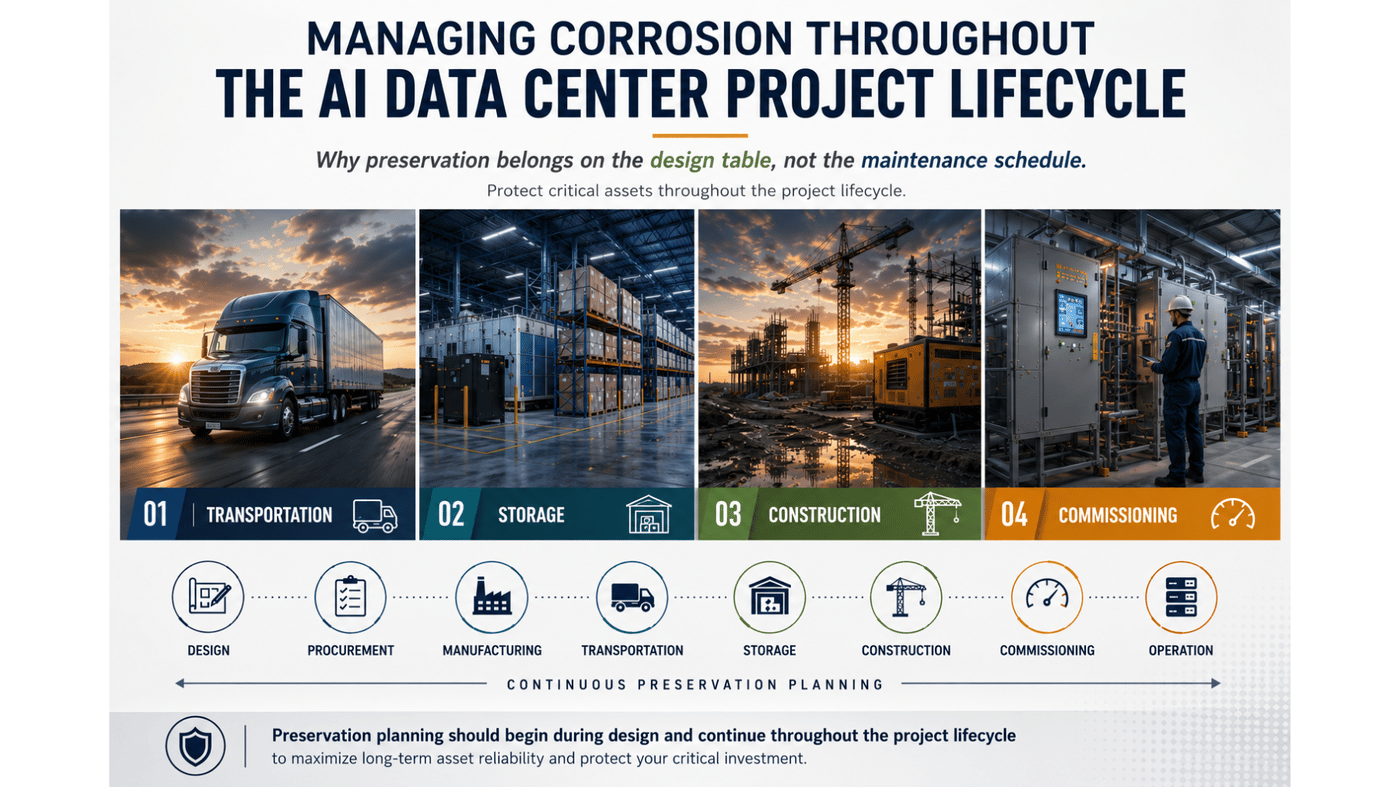
The single greatest misconception surrounding corrosion in the mission-critical sector is that it begins the moment a facility opens its doors. In reality, the timeline of asset degradation often initiates months—sometimes even years—before a data center becomes operational.
Understanding this vulnerability requires tracking equipment through its complete lifecycle journey, which spans manufacturing, international transportation, long-term warehousing, and active construction.
1. Manufacturing and Factory Acceptance Testing (FAT)
Equipment vulnerability begins at the point of origin. Critical components—including pumps, valves, heat exchangers, and electronics racks—are fabricated globally. During manufacturing and subsequent testing, components are routinely exposed to moisture, cleaning chemicals, and atmospheric pollutants. If not properly passivated or treated with volatile corrosion inhibitors (VCIs) immediately following factory acceptance testing (FAT), microscopic oxidation can begin before packaging even takes place.
2. Transportation and Global Logistics
As supply chains stretch across oceans and continents, equipment is subjected to severe environmental fluctuations. Cargo holds, maritime shipping containers, and open-air flatbed trucks expose sensitive electronics and high-precision metal components to saltwater spray, high humidity, condensation, and rapid temperature swings. A transformer or cooling distribution unit (CDU) can spend weeks in transit, accumulating micro-layers of moisture that initiate galvanic or pitting corrosion long before arriving at a construction site.
3. Warehousing and Storage Yards
Because AI infrastructure components are frequently procured far in advance to lock in supply chain allocations, equipment often sits idle for extended periods. This equipment frequently resides in unconditioned warehouses, regional distribution hubs, or outdoor construction laydown yards. Here, fluctuating dew points, rain, dust, and localized industrial pollutants attack unprotected surfaces. Stagnant water left inside piping networks during pressure testing at the factory can stagnate, creating localized oxygen concentration cells that eat through metal walls from the inside out.
4. Construction, Installation, and Exposure
During on-site installation, equipment sits in partially enclosed, unconditioned shell buildings. Drywall dust, concrete efflorescence, welding fumes, and shifting weather conditions contaminate sensitive hardware. Furthermore, as project timelines inevitably slip due to supply chain bottlenecks or permitting delays, equipment remains in these vulnerable states longer than originally planned.
5. Commissioning and Operational Handover
By the time the facility reaches the commissioning phase, internal corrosion may have already compromised structural integrity, reduced heat transfer efficiency, or weakened electrical connections. When systems are finally energized or flooded with cooling fluids, these hidden defects manifest as premature failures, degraded performance, and unexpected downtime.
Supporting Context and Metrics: The Liquid Cooling Paradigm Shift
To appreciate why corrosion management has transformed from a low-priority variable into a critical boardroom issue, one must examine the fundamental architectural changes taking place inside modern AI facilities.
The Power Density Explosion
Traditional cloud and enterprise data centers typically operated at rack power densities ranging from 5kW to 15kW. Cooling these facilities relied primarily on traditional air-handling units (AHUs) and computer room air conditioners (CRACs).
Conversely, high-density AI clusters driven by advanced graphics processing units (GPUs)—such as NVIDIA’s Hopper and Blackwell architectures—regularly demand between 40kW and 100kW+ per rack. At these extreme thermal loads, air cooling becomes physically inefficient and economically unviable.
The Rise of Liquid Cooling Architectures
Consequently, the data center industry is undergoing a massive pivot toward liquid cooling solutions, including:
Direct-to-Chip (Cold Plate) Cooling: Circulating specialized dielectric fluids or treated water directly over processor blocks.
Rear-Door Heat Exchangers (RDHx): Using liquid-filled coils to capture heat directly as it exits the server exhaust.
Immersion Cooling: Submerging entire server blades directly into thermally conductive, non-conductive dielectric liquids.
While liquid cooling dramatically improves thermal transfer efficiency, it introduces complex chemical and metallurgical dynamics.
The Multi-Metal Dilemma and Water Chemistry
Liquid cooling systems require extensive networks of piping, valves, pumps, heat exchangers, and connectors. These networks frequently combine multiple metals—such as copper, aluminum, stainless steel, and brass—into a single closed-loop system.
When these dissimilar metals interact via a shared electrolyte (the cooling fluid), the stage is set for galvanic corrosion. If water chemistry is improperly balanced, or if inhibitors degrade over time, accelerated corrosion can swiftly puncture pipes, foul heat exchangers, and contaminate sensitive electronics with conductive metallic debris.
Furthermore, stagnant flow areas—common during phased data center expansions where certain piping loops remain unused for months—create ideal conditions for microbially influenced corrosion (MIC) and localized pitting.
Governance and Accountability: A Multi-Stakeholder Challenge
The failure to properly manage corrosion is rarely a technological deficiency; rather, it is a structural failure of project governance.
In a typical multi-million-dollar AI data center build, responsibilities are heavily fragmented. The asset lifecycle touches numerous distinct entities:
As equipment transitions from one stakeholder to the next, accountability frequently falls through the cracks. For example:
A manufacturer assumes the buyer will handle preservation upon delivery.
A logistics provider views their job as strictly moving cargo from Point A to Point B without environmental enclosure mandates.
A general contractor focuses on milestone construction schedules rather than long-term asset preservation.
The facility owner assumes everything left the factory in ready-to-use condition.
When project schedules slip—a frequent occurrence in high-stakes AI infrastructure developments—preservation activities are often the first items cut to save time and money. Without clear contractual ownership, documented milestones, and rigorous quality assurance protocols governing asset preservation across every handoff, corrosion is allowed to progress unchecked.
Lessons from Asset-Intensive Industries
While the data center industry is grappling with these challenges for the first time, other asset-intensive sectors solved these exact problems decades ago.
Oil and Gas / Petrochemical: Facilities exposed to aggressive marine and chemical environments routinely enforce strict preservation specifications (such as ISO 12944 or NACE standards) from the initial engineering design phase onward. Equipment cannot be delivered or accepted on-site without certified preservation logs.
Power Generation & Marine: Turbine manufacturers and shipbuilders mandate continuous environmental monitoring, dehumidification blankets, and specialized coating applications during extended storage periods.
As AI data centers achieve the same scale, capital intensity, and mission-critical uptime requirements as offshore oil platforms or power plants, adopting these industrial-grade preservation methodologies is no longer optional—it is a commercial necessity.
Expert Insights and Official Industry Perspectives
Industry leaders with decades of cross-sector experience emphasize that protecting next-generation digital infrastructure requires a cultural shift toward proactive asset stewardship.
"Corrosion is still widely treated as a maintenance issue," explains Gautam Ramdas, Vice President of Global Market Development for ZERUST Integrity Solutions®, a division of Northern Technologies International Corporation (NASDAQ: NTIC). With more than 25 years of experience in corrosion management and critical infrastructure reliability, Ramdas has witnessed firsthand how early-stage oversights plague major industrial projects.
"In reality, it often begins months before a facility becomes operational as equipment moves through manufacturing, transportation, storage, and construction. For facilities expected to operate continuously while supporting billions of dollars in computing infrastructure, preservation decisions made during these early phases can have lasting consequences for reliability and asset life."
Ramdas stresses that preservation must be integrated into the foundational engineering phase of data center design.
"The most effective preservation strategy starts long before construction begins," Ramdas notes. "During project planning, designers can evaluate material compatibility, identify potential risks of galvanic corrosion, specify coolant chemistry, minimize stagnant flow areas, and establish preservation requirements for equipment that may remain in storage for extended periods."
By establishing these parameters early, organizations can embed accountability into procurement contracts, ensuring that suppliers, contractors, and commissioning teams adhere to a unified standard.
Future Outlook: Building Resilience into the Next Trillion-Dollar Wave
As the artificial intelligence boom matures, data center developers and operators face a stark economic reality. The scale of capital deployment is simply too massive, and the demand for uninterrupted computational uptime is too high, to leave asset integrity to chance.
Looking ahead over the next decade, the industry must adopt a comprehensive lifecycle approach to asset preservation that mirrors mature industrial sectors:
Early Engineering Integration: Incorporating corrosion risk assessments, material compatibility matrices, and water chemistry strategies directly into Front-End Engineering Design (FEED) documents.
Contractual Governance: Mandating explicit preservation requirements within procurement contracts, establishing clear handoff protocols between logistics providers, contractors, and owners.
Active Lifecycle Monitoring: Implementing continuous monitoring technologies—such as corrosion coupons, real-time fluid chemistry sensors, and humidity tracking in storage yards—to detect degradation before equipment is energized.
Cultural Transformation: Shifting the executive mindset from reactive maintenance to proactive asset preservation.
The question facing AI data center developers is no longer whether corrosion will occur in increasingly complex, liquid-cooled environments. The definitive question is whether preservation protocols were integrated early enough to prevent it.
Organizations that successfully embed preservation across the design, procurement, construction, and commissioning lifecycle will protect their capital investments, eliminate costly commissioning delays, and ensure the long-term reliability required to power the future of artificial intelligence.