Executive Overview
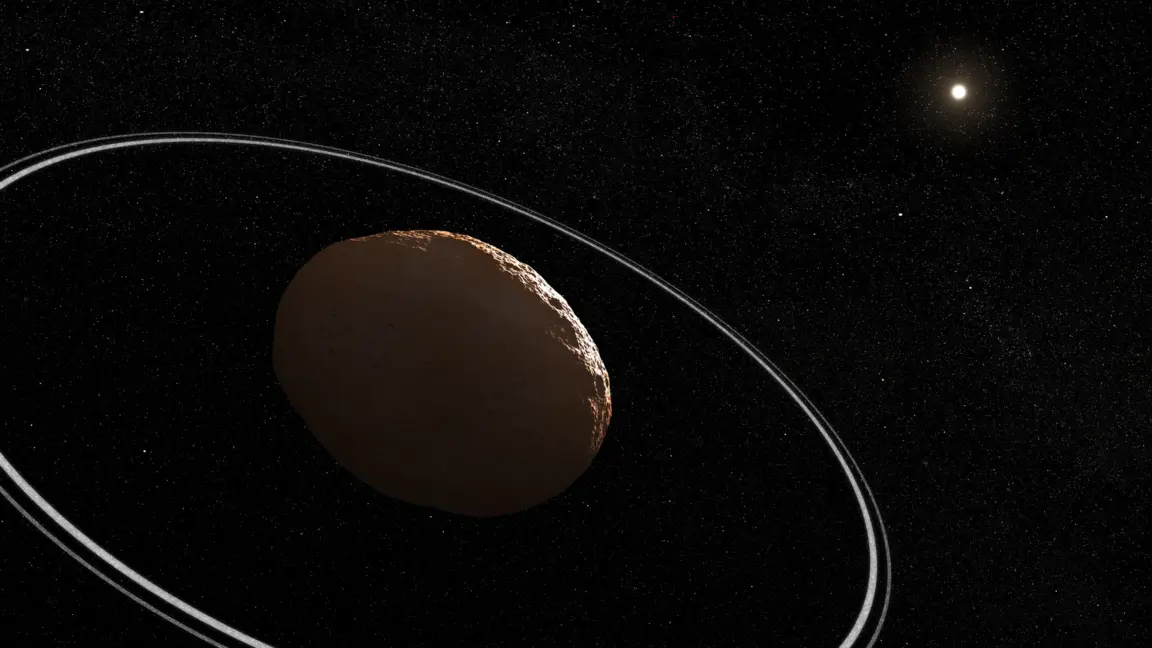
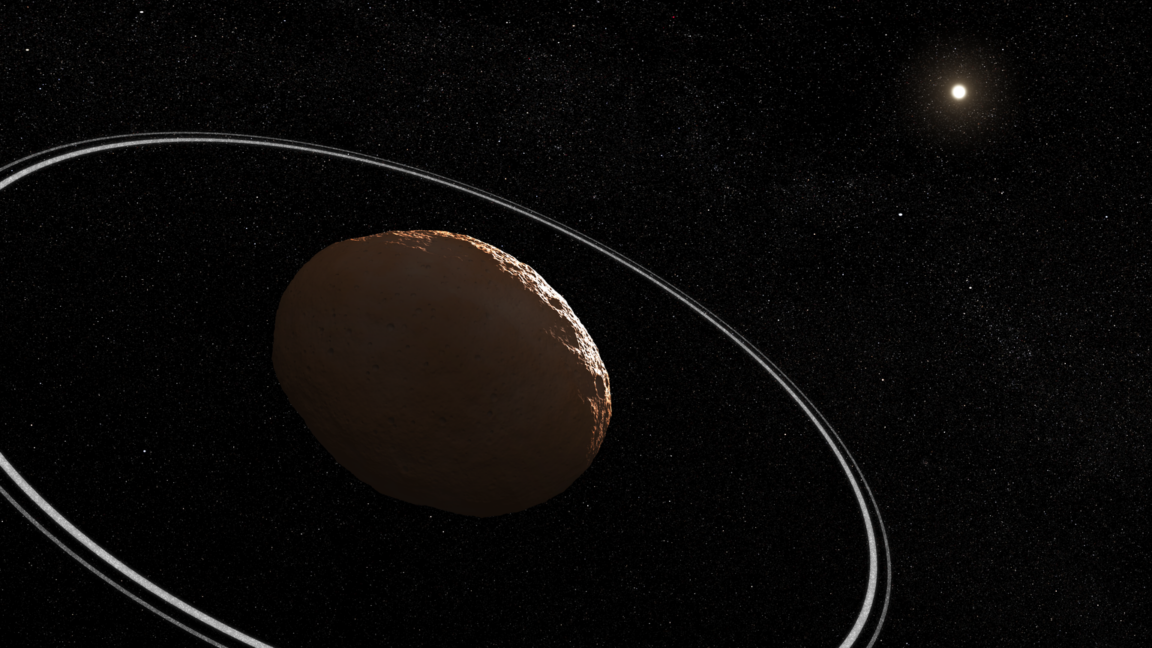
For decades, the prevailing consensus within planetary astronomy was that majestic, complex ring systems were the exclusive domain of cosmic heavyweights. Gas and ice giants like Saturn, Jupiter, Uranus, and Neptune towered as the sole ringed masters of our solar system, with their immense gravitational wells thought necessary to shepherd and retain orbiting debris. That dogma was shattered in 2013 when astronomers, tracking a minor celestial body as it passed in front of a background star, discovered something entirely unexpected: two distinct, razor-thin rings encircling Chariklo, a Centaur asteroid-like body measuring a mere 250 kilometers (155 miles) across.
The revelation forced a radical rethink of planetary dynamics. If a small, dark rock orbiting between Saturn and Uranus could support rings, how common were they, and what kept them stable?
Now, a decade later, the mystery has deepened significantly. Utilizing the unprecedented capabilities of the James Webb Space Telescope (JWST), an international team of astronomers led by Pablo Santos-Sanz of the Instituto de Astrofísica de Andalucía in Granada, Spain, has observed Chariklo pass in front of another background star. The results, published in Science Advances, show that Chariklo’s ring system is not a static relic of the early solar system. It is dynamic, active, and visibly changing.
In the span of roughly ten years, one of Chariklo’s rings has grown substantially denser, while the other has faded to the edge of invisibility. This unexpected evolution challenges existing theoretical models of minor-body ring systems, introducing the compelling possibility of unseen shepherd moons, dynamic mass migration, and physical processes previously thought impossible on bodies of such diminutive scale.
Detailed Chronology: From a 2013 Serendipitous Discovery to JWST’s 2022 Breakthrough
The 2013 Paradigm Shift
The story of Chariklo’s rings began with a technique as elegant as it is challenging: stellar occultation. When a solar system object passes directly between Earth (or a space telescope) and a distant background star, it blocks the starlight. By carefully measuring the precise timing, duration, and light curve of this dimming, astronomers can map the silhouette, size, and atmospheric or surrounding characteristics of the foreground body with astonishing precision.
In 2013, a network of ground-based telescopes mobilized to observe Chariklo—classified as a Centaur, a class of icy planetoids orbiting primarily between Jupiter and Neptune—as it occulted a faint star. Alongside the primary drop in starlight caused by Chariklo’s physical body, observers noticed symmetrical secondary dips in brightness just before and after the main event.
The data revealed two narrow, dense rings, designated C1R and C2R, sitting at distances of roughly 390 and 405 kilometers from the asteroid’s center. Remarkably, these rings were only a few kilometers wide and separated by a sparse gap of just 7 kilometers.
"It was a surprise," recalls Pablo Santos-Sanz. The astronomical community immediately began grappling with fundamental questions: What are these rings made of? How do they persist without coalescing into a moon? And crucially, are they permanent fixtures or transient phenomena?
The October 2022 JWST Campaign
To answer these questions, Santos-Sanz and his colleagues set their sights on a much more powerful tool: the James Webb Space Telescope. Utilizing JWST for a stellar occultation, however, is an exercise in extreme orbital gymnastics.
Stationed at the Sun-Earth Lagrange Point 2 (L2), approximately 1.5 million kilometers from Earth, JWST requires regular station-keeping maneuvers—gentle thruster burns every few weeks—to maintain its delicate halo orbit. Pinpointing the exact trajectory of a tiny, distant Centaur while simultaneously predicting the position of a background star requires hyper-precise astrometric data.
For an occultation event slated for October 18, 2022, Santos-Sanz’s team had to continually refine their predictions in the weeks leading up to the observation. Between their initial calculations and the final window, the projected line of sight shifted by approximately 110 kilometers—a margin of error wide enough to miss the target entirely. Compounding the difficulty, JWST operational protocols require high-priority observations like this to be locked in at least 14 days in advance.
"We did this maybe a bit blindly, because we didn’t know exactly where the line of sight was," Santos-Sanz admits. "I’m going to move one of the biggest, best telescopes in space, and we don’t know if finally we will catch this or not."
The gamble paid off. On October 18, 2022, telemetry and observational data confirmed that JWST’s line of sight to the background star skimmed a mere 7.4 kilometers above Chariklo’s physical surface. While the telescope missed the body itself, it sliced cleanly through its ring system.
Supporting Context & Metrics: Unlocking Infrared Horizons
The JWST observation marked a watershed technological moment for planetary science. The space telescope recorded the occultation simultaneously in two near-infrared photometric bands: 1.5 micrometers and 3.2 micrometers.
This achievement represents the first time humanity has ever captured the rings of a minor solar system body at wavelengths exceeding three micrometers—a spectral range rendered completely opaque by Earth’s atmosphere, placing it forever out of reach for ground-based observatories.
Quantifying the Change: The Inner Ring (C1R)
When the data was processed, the inner ring (C1R) stood out with sharp, abrupt edges, confirming its structural integrity. However, its optical properties had altered dramatically.
- Historical Baseline: Averaged across roughly 10 previous ground-based occultations spanning the decade following its discovery, C1R’s normal opacity—the fraction of background starlight blocked by the ring material—hovered consistently around 0.303.
- JWST Measurement: JWST recorded C1R’s normal opacity at a staggering 0.431.
"We didn’t believe it at the beginning, so we fought a lot with the data," Santos-Sanz notes.
To ensure this spike wasn’t merely an artifact of the telescope cutting through an unusually dense, localized clump of ring material rather than a uniform structure, the research team constructed a rigorous computer model. They simulated 10 million random occultations of a lumpy, non-uniform ring system.
The statistical results were definitive: the probability of randomly encountering an opacity as high as the one recorded by JWST was approximately 1 in 1,000 at 1.5 micrometers, and an even more improbable 4 in 100,000 at 3.2 micrometers for a single measurement. Because the telescope captured the ring twice—once upon entry and once upon exit—the cumulative statistical odds of it being a fluke plummeted close to zero. The inner ring had genuinely grown denser and thicker.
Quantifying the Change: The Outer Ring (C2R)
While the inner ring thickened, the outer ring (C2R) underwent the exact opposite transformation.
During the JWST pass, C2R barely registered at 1.5 micrometers and completely vanished at 3.2 micrometers, despite the telescope observing the exact same structural stretch of the ring simultaneously across both bands.
"At the beginning we didn’t even see the outer ring in the light curve," Santos-Sanz explains. "We had to use models. It was really barely visible, so we said, ‘What is happening here?’"
Official Statements and Hypotheses: Solving the Mystery
Faced with data showing one ring intensifying while its neighbor faded, the research team explored multiple physical scenarios to explain the shift.
Hypothesis 1: Wavelength-Dependent Scattering vs. Physical Evolution
Could the changes be an illusion caused by looking at the rings through new infrared wavelengths? Perhaps the microscopic dust and ice grains scatter light differently in the infrared than they do in the visible spectrum.
However, radiative transfer models constructed by the team heavily discounted this idea. Previous visible-light observations pointed to a ring composition consisting of a stable mixture of water ice and silicates (rocky minerals). When the new JWST infrared data points were integrated into the models, no known combination of material compositions, particle sizes, or distribution ratios could replicate the dual behavior of C1R thickening while C2R faded.
"We are witnessing a real evolution of the rings with time," Santos-Sanz asserts. "Of course it is not a certainty, but for me it is the preferred explanation."

Furthermore, mass-balance calculations revealed a perplexing imbalance: the inner ring gained roughly 10 times more material in equivalent width than the outer ring lost. Material was not simply migrating inward from the outer ring to the inner ring; an external or localized mechanism was actively redistributing or supplying mass.
Hypothesis 2: The "Ghost Moon" Scenario
To account for the extra material and the structural stability of the narrow rings, astronomers are leaning toward a classic celestial mechanic: a shepherd satellite.
In planetary ring systems, small moons embedded within or just outside ring structures use their gravitational pull to herd particles, maintaining sharp edges and preventing the ring material from dispersing into space. Santos-Sanz suggests that an undetected, small shepherd moon could be sharing Chariklo’s orbital environment, periodically shedding debris that replenishes the inner ring (C1R) while dynamically altering the density of the system.
"This satellite has not been detected yet, if it exists," Santos-Sanz cautions.
Preliminary modeling based on the JWST data also offers tantalizing clues regarding the internal composition and particle size distribution of the rings. The team’s simulations suggest that C1R is composed of larger, more robust macroscopic particles, whereas the fading outer ring (C2R) is dominated by finer, more diffuse dust.
"Our feeling after this model is that the inner ring should be composed of bigger particles than the outer ring. The outer ring we think is more dusty," Santos-Sanz explains. "Pero this is a work in progress. I can’t say with certainty, well, this is dusty, this is not."
Future Outlook: A Growing Class of Dynamic Ringed Worlds
Chariklo is no longer an isolated astronomical oddity. In the years since its rings were discovered, astronomers have confirmed ring systems around several other minor solar system bodies, including:
- Chiron: Another member of the Centaur population, exhibiting similar erratic behavior.
- Haumea: A distant, highly elongated dwarf planet located in the Kuiper Belt.
- Quaoar: A trans-Neptunian object whose ring system similarly baffled scientists by sitting far beyond its Roche limit.
Moreover, dynamic shifts are well-documented among the giant planets. Saturn’s delicate D ring has measurably shrunk over the decades, and the complex arcs of Neptune’s Adams ring are known to rearrange themselves on monthly and yearly timescales. Chariklo proves that these complex, fluid dynamical processes are not restricted to planetary behemoths; they occur on minor bodies measuring mere kilometers across.
To definitively separate true physical evolution from complex wavelength-dependent scattering effects, the research team’s next major objective is to capture another stellar occultation of Chariklo using high-resolution visible light.
"We are searching for new occultations," Santos-Sanz says. Pinpointing these fleeting events requires continuous global collaboration, precise astrometry from space missions like Gaia, and dedicated observation campaigns.
As astronomers continue to map the outer solar system, the dynamic rings of Chariklo serve as a reminder of how much remains unknown about our cosmic neighborhood.
"I think this work is just a piece of the puzzle," Santos-Sanz concludes, "but it could be an important clue for broader studies about the rings around minor bodies and around giant planets."
The study detailing these findings, authored by Pablo Santos-Sanz et al., is published in Science Advances under the DOI: 10.1126/sciadv.aeh4794.