Executive Overview
The journey from $1 million to $10 million in Annual Recurring Revenue (ARR) is widely recognized as one of the most perilous dead zones for early-stage software companies. It is a transitional chasm where initial product-market fit collides head-first with the unyielding realities of organizational scaling, operational friction, and market maturation. Founders who successfully navigate the sub-$1M phase—often through sheer force of will, scrappy experimentation, and founder-led sales—frequently find themselves severely bottlenecked as they attempt to scale into a predictable, repeatable revenue engine.
In a retrospective analysis, seasoned software executive and venture expert Jason Lemkin laid out the foundational blunders and strategic missteps that commonly plague CEOs during this critical growth window. Distilling hindsight into a masterclass on capital efficiency, hiring sequencing, and Go-To-Market (GTM) evolution, this deep-dive unpacks the ten pillars required to accelerate past the $10 million ARR threshold with maximum velocity and minimum psychological drag.
Detailed Chronology: The 10 Structural Pillars of Scaling
1. Stop Patching and Start Recruiting: Delegating Ownership to Senior Leadership
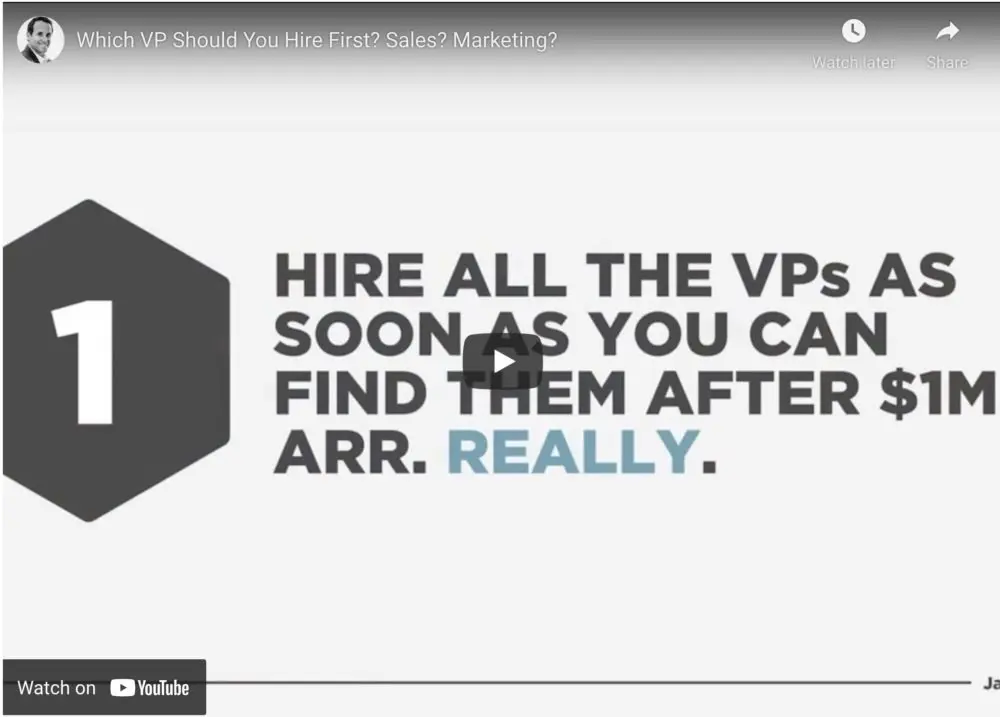
The single most pervasive trap for scaling CEOs is the urge to DIY operational bottlenecks. Whether it is managing the nascent sales team, writing drip marketing copy, or acting as the de facto head of product long after the codebase has outgrown intuitive comprehension, founders routinely convince themselves that “doing it themselves” is the fastest route.
It is not. While a resourceful CEO can manage these departments temporarily, spending hours in the weeds prevents the recruitment of high-caliber VP-level leadership. By the time a startup clears $1M ARR, these divisions require full-time ownership. Treating self-repair as a substitute for strategic hiring creates a compounding time sink, ultimately leading to delayed backfills and an institutionalized reluctance to build a proper executive team.
2. Formalizing the Ecosystem: Hiring a Full-Time Head of Business Development
Founders frequently receive sound advice regarding strategic partnerships only to freeze execution due to tight capital or an unfamiliarity with top-tier talent networks. Consequently, key partnership management falls onto an ad-hoc committee of the CEO, VP of Sales, and VP of Product.
While this team approach guarantees C-level attention for strategic partners, it renders partner management entirely reactive. In competitive markets, waiting for inbound partnership queries is fatal. A dedicated, full-time Head of BizDev is necessary early on to map out shifting stakeholder maps, travel to key accounts, ensure mutual customer satisfaction, and fight for brand mindshare. Even if the workload does not initially mirror a grueling 50-hour week, strategic oversight cannot be treated as a part-time chore.
3. High-Altitude Engagement: The ROI of In-Person Customer Visits
There is no substitute for physical proximity to your end users. Many CEOs excuse themselves from frequent travel under the guise of backfilling operational roles. Yet historical data from high-growth SaaS firms reveals a striking metric: companies rarely lose key enterprise clients when the chief executive takes the time to visit them in person.
Getting on a jet at least twice a quarter—supplemented by a strict minimum of six customer Zoom sessions per week—is one of the most cost-effective scaling strategies available. Customer relationships solidify permanently when leadership invests physical face-time, cementing loyalty that endures for over a decade.
4. Capital Cushioning: The 0.5x Balance Sheet Rule
Achieving cash-flow positivity early—such as hitting positive cash flow around $4M ARR through disciplined MRR collection and secondary revenue generation—grants a startup independence from unpredictable venture capital cycles. However, it introduces a subtle, often misunderstood capital constraint.
If a company hits milestones with a razor-thin cash buffer (e.g., $1.5M in the bank at $4M ARR), leadership invariably experiences cash-scarcity anxiety as revenue climbs. Approaching $8M to $10M ARR with a depleted balance sheet paralyzes executives, preventing bold investments like hiring twenty additional sales reps, opening international hubs, or running major brand campaigns. The golden rule for SaaS scaling: maintain at least $1 in cash reserves for every $2 in ARR to ensure management feels secure enough to aggressively lean into growth opportunities.
5. Maturing the Engineering Org: Transitioning from CTO to VP of Engineering
Most early-stage companies rely heavily on a visionary Chief Technology Officer (CTO) to build the initial product. However, as the organization scales, CTO burnout, friction in managing development teams larger than eight to nine engineers, and mounting technical debt necessitate a leadership evolution.
Beyond operational strain, servicing enterprise-grade clients requires a seasoned Vice President of Engineering (VPE). Large corporations demand rigorous compliance frameworks, rigorous code reviews, data protection guarantees, and enterprise-grade security protocols. A veteran VPE provides the institutional credibility required to close enterprise contracts and proactively refactors internal systems to meet those demands.
6. Aggressive Outbound: Unlocking Additive Pipeline Velocity
Many founders riding a wave of healthy inbound leads neglect traditional outbound sales motions between $1M and $10M ARR. This is a missed opportunity. Outbound sales always work when executed with disciplined focus.
Even if an inbound engine is firing on all cylinders, building an additive outbound team allows companies to proactively target high-value enterprise logos within their ideal customer profile (ICP). Securing these marquee brands early yields long-term customer lifetime value (LTV) that dwarfs acquisition costs. Even breaking even on outbound acquisition spend in Year 1 is a net positive if it establishes foundational enterprise credentials.
7. Community Cultivation: Hosting Customer Conferences Early
Waiting until a company scales to $12M+ ARR to host its inaugural user conference is a strategic miscalculation. Founders often assume their product is either too simple to warrant a full-day agenda or that customers will not travel for a niche software event.
This assumption underestimates how deeply users invest themselves into operational tools. Customers want to meet the team behind the software and network with peers. Even a modest beginning—such as targeted executive dinners or half-day regional meetups—fosters organic advocacy, strengthens retention, and anchors the user community well before massive trade-show scale is achieved.
8. Specializing the Sales Motion: Breaking the "Full-Stack" Rep Habit
In the formative days of a startup, "full-stack" generalist sales reps who prospect, pitch, close, and manage accounts are standard. As the company scales, this approach becomes obsolete.
Modern sales execution demands specialization. Outbound hunters are rarely effective account managers; enterprise closers operate under entirely different velocities than transactional SMB reps. Specializing roles early—such as pairing dedicated appointment setters with mid-market closers to maximize daily meetings—dramatically increases rep productivity, efficiency, and revenue generation per lead.
9. Post-Sale Retention: Institutionalizing Customer Marketing
Marketing does not stop at the point of contract signature. In a subscription-economy business model, post-acquisition customer marketing is just as critical as top-of-funnel prospect generation.
While Customer Success (CS) professionals are invaluable for support, they are fundamentally distinct from marketers. Relying on CS teams to hack together retention campaigns leaves substantial revenue on the table post-$5M ARR. Establishing a dedicated customer marketing budget—allocating 5% to 10% of recurring revenue streams toward retention, competitive displacement, and strategic upsell—is the next frontier for predictable SaaS expansion.
10. Building the Moat: Investing in Brand as You Approach $10M ARR
Early-stage startups rarely possess a brand; they rely instead on raw product utility, gritty hustle, and early adopter enthusiasm. However, as a company approaches the $10M ARR milestone, the market shifts.
Non-early-adopter customers—the mainstream majority—do not want to take vendor risks or evaluate endless feature matrices; they want to be told who the default market leader is. Transitioning from a niche "mini-brand" to an established category-defining brand requires aggressive, intentional investment. Whether through strategic trade-show presence, thought-leadership content, or hiring a dedicated Chief Marketing Officer (CMO), brand equity ultimately ensures that prospective buyers choose your solution simply because it is the preeminent name in the space.
Supporting Context & Metrics
| Scaling Milestone | Operational Focus | Key Capital / Resource Metric | Primary Executive Hire Needed |
|---|---|---|---|
| $1M ARR | Transitioning from Founder-Led to Team Execution | Minimal buffer; initial MRR cash flow | VP of Sales / VP of Product |
| $4M ARR | Achieving Baseline Cash-Flow Positivity | $1 for every $2 in ARR balance sheet rule | VP of Engineering / Head of BizDev |
| $8M – $10M ARR | Enterprise Maturity & Brand Dominance | Strategic debt / equity cushion for expansion | VP of Corporate Marketing / CMO |
Operationalizing these lessons requires acknowledging that speed and structure are not mutually exclusive. As historical SaaS data indicates, companies that aggressively fortify their balance sheets, specialize their sales machinery, and elevate operational leaders early consistently outpace competitors trapped in the DIY loop.
Official Statements & Industry Insights
Industry veterans and venture architects continue to emphasize the delicate balance between capital management and aggressive market expansion.
"To really invest in your team, product, etc. you need at least $1 on the balance sheet for each $2 in ARR. At $20m ARR? You need $10m in the bank to make the hires, burn the tokens, etc. to really get to the next level. Below that… you hesitate."
— Jason Lemkin, Founder of SaaStr
Furthermore, experts highlight that organizational blindness in partnerships often stems from leadership fatigue.
"The #1 mistake founders make in partnerships and business development? They don’t hire anyone full-time to manage the partnership. As CEO, you are great at forging that relationship. But maintaining it? That’s a full time job."
— Jason Lemkin
Future Outlook
Looking toward the horizon of the Software-as-a-Service landscape, the pathway from $1M to $10M ARR is becoming increasingly technical, highly competitive, and intolerant of structural inefficiency. As artificial intelligence and automation compress traditional product-differentiation cycles, enterprise buyers are consolidating around trusted, category-defining brands.
Founders embarking on this trajectory must proactively shed operational tasks, build institutionalized engineering and marketing muscle, and fund their balance sheets adequately to avoid growth-stunting caution. Those who institutionalize these ten core disciplines will not only survive the perilous scaling chasm—they will emerge as the enduring market leaders of the next decade.