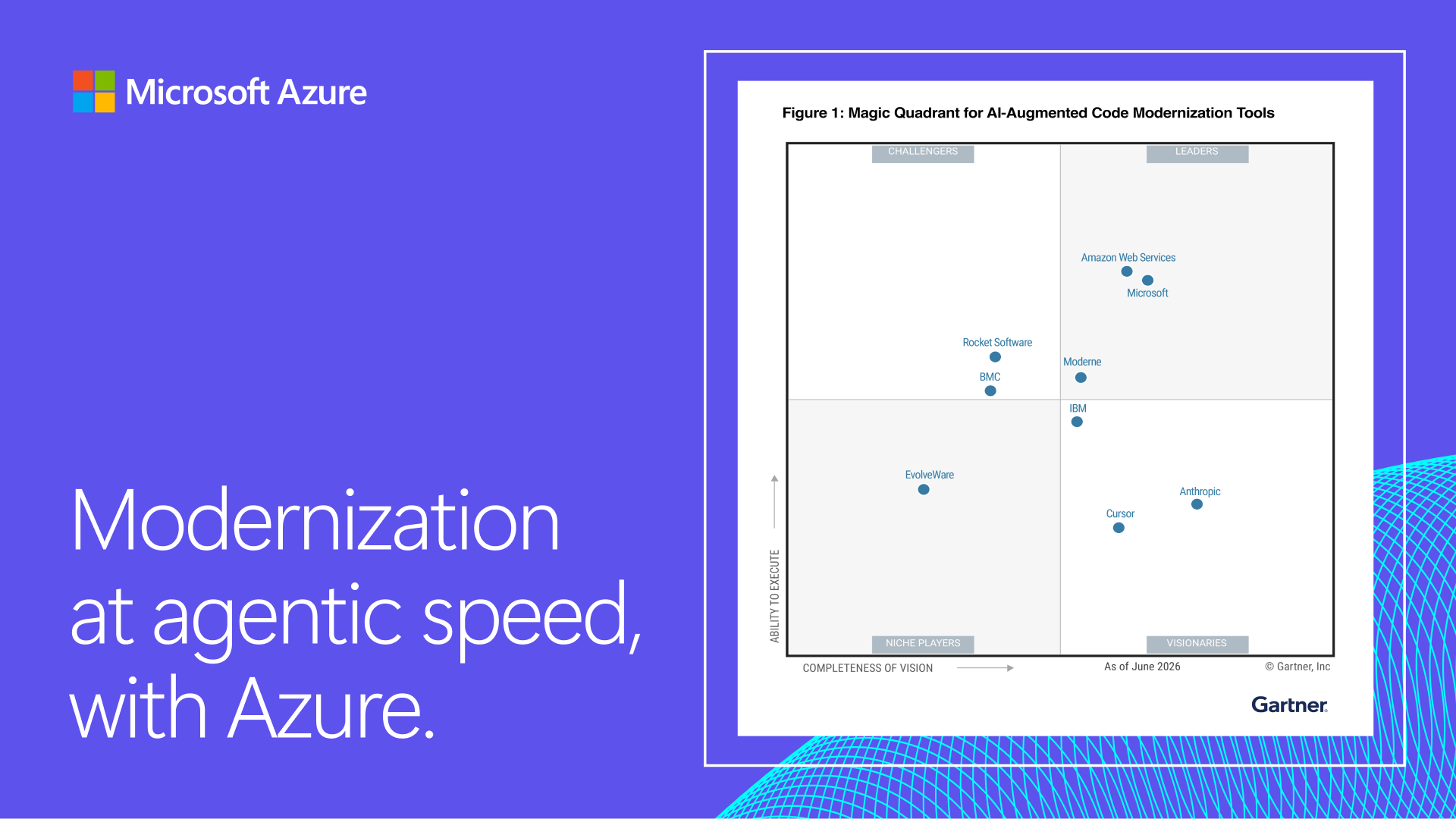
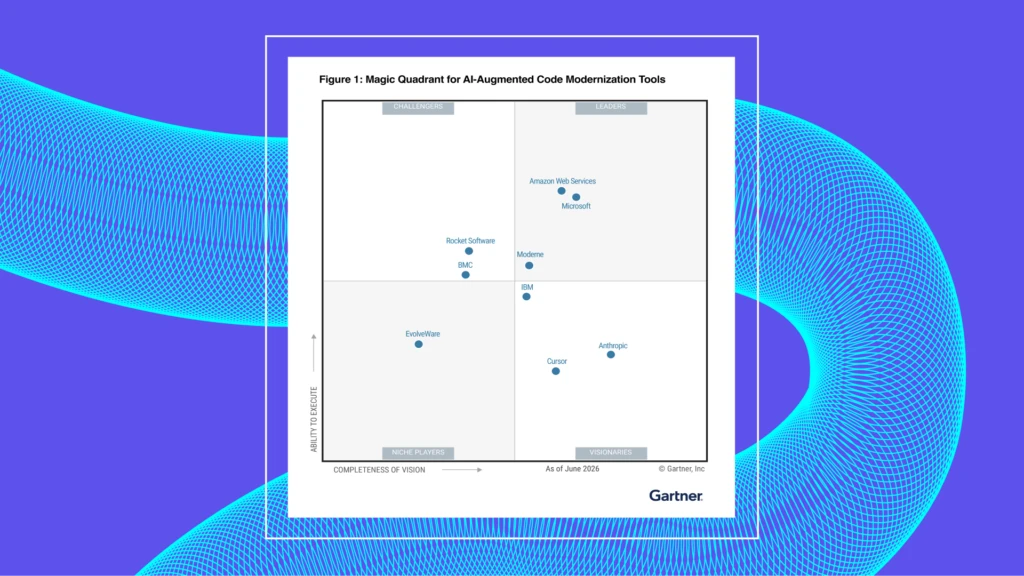
In a milestone recognition that underscores a fundamental shift in software engineering economics, Gartner, Inc. has named Microsoft a Leader in its inaugural 2026 Magic Quadrant for AI-Augmented Code Modernization Tools. Published on August 3, 2026, by analysts Prasanna Lakshmi Narasimha, Erin Khoo, Deacon D.K. Wan, and Wei Jin, the report marks the formal establishment of a new enterprise software category dedicated to replacing legacy refactoring paradigms with intelligent, agentic workflows.
For decades, application modernization has posed a chronic operational dilemma for enterprise technology executives. Critical line-of-business software—frequently built on legacy framework versions such as aging .NET deployments, legacy Java runtimes, and monolithic architectures—accumulated compounding technical debt. Historically, resolving this debt required multi-year budget commitments, manual code rewrites, and high risk of operational disruption. Consequently, application modernization was frequently deferred in favor of immediate feature innovation.
Gartner’s new Magic Quadrant highlights how specialized AI agents, generative AI, and deterministic static analysis are altering these dynamics. By positioning Microsoft in the Leaders quadrant, Gartner acknowledges the vendor’s execution and vision in deploying an agentic ecosystem—primarily powered by GitHub Copilot and Azure Copilot—that compresses transformation timelines from years down to weeks.
Modernization is no longer viewed as a cost burden that precedes innovation; rather, it has emerged as a prerequisite for enterprise AI deployment. Organizations upgrading legacy code bases are simultaneously building the secure, cloud-native application, data, and infrastructure foundations required to deploy generative and agentic AI models effectively.
Detailed Chronology: From Multi-Year Capital Burdens to Rapid AI Acceleration
To appreciate the significance of Microsoft’s placement in the 2026 Gartner Magic Quadrant, one must analyze the structural breakdown of traditional enterprise application lifecycles over the past two decades.
+-----------------------------------------------------------------------------------+
|                           EVOLUTION OF CODE MODERNIZATION                         |
+-----------------------------------------------------------------------------------+
| PHASE 1: Traditional Refactoring (2000s - 2010s)                                 |
| - Manual line-by-line rewrite | Multi-year commitments | High risk of disruption  |
+-----------------------------------------------------------------------------------+
                                         |
                                         v
+-----------------------------------------------------------------------------------+
| PHASE 2: Cloud Rehosting / "Lift and Shift" (2010s - early 2020s)                 |
| - Infrastructure migration without code refactoring | Unresolved technical debt|
+-----------------------------------------------------------------------------------+
                                         |
                                         v
+-----------------------------------------------------------------------------------+
| PHASE 3: Agentic Modernization Era (2026 Gartner Benchmark)                       |
| - AI Agents + Deterministic Analysis | Automated framework upgrades               |
| - Rapid deployment in days/weeks | Human-in-the-loop governance                   |
+-----------------------------------------------------------------------------------+
1. The Era of Manual Modernization and Deferred Debt (2000s–2010s)
Historically, software modernization was characterized by high cost and operational friction. Enterprises attempting to migrate complex codebases to contemporary frameworks faced manual static analysis, manual dependency mapping, and line-by-line code conversions. Because human development capacity was directed toward legacy maintenance, new feature releases stagnated. Risk management teams often vetoed refactoring projects due to missing documentation or lost original source logic, leaving core systems trapped on unsupported runtimes.
2. The Cloud Migration Dilemma and "Lift and Shift" Bottlenecks (2010s–Early 2020s)
As cloud platforms matured, organizations sought to bypass structural rewrites by executing "lift and shift" migrations. While rehosting applications on virtual machines or basic containers reduced on-premises data center footprints, it failed to remediate internal code decay. Applications remained bound to monolithic architectures, incompatible with cloud-native primitives such as serverless computing, autoscaling databases, and modern CI/CD security pipelines.
3. The Emergence of Generative AI Assistance (2023–2025)
The introduction of early generative AI coding assistants accelerated snippet generation and inline code completion. However, initial tools lacked the macroscopic system context needed for structural refactoring. While developers could generate isolated functions faster, orchestrating whole-application dependency upgrades, syntax migrations, and deployment target configurations across thousands of repositories remained largely manual.
4. The Agentic Modernization Paradigm (2026)
By 2026, the convergence of deterministic analysis, stateful AI agents, and deep development environment integrations enabled end-to-end automated modernizations. Rather than relying solely on probabilistic code generation, modern tooling pairs deterministic AST (Abstract Syntax Tree) parsing with specialized AI agents capable of executing complex multi-step transformations across entire solutions. Gartner’s inaugural Magic Quadrant formalizes this shift, establishing AI-augmented code modernization as a core component of enterprise technology management.
Architectural Mechanics: How Agentic AI and Deterministic Analysis Re-engineer Modernization
Microsoft’s modernization architecture relies on a dual-layer operational structure that balances macro-level orchestration across enterprise application portfolios with micro-level execution inside the developer’s integrated development environment (IDE).
At the portfolio scale, enterprise engineering leads utilize the Modernize CLI to run systemic scans across vast source code repositories. The agentic system performs deterministic code scanning combined with LLM-assisted context extraction to deliver:
Automated Dependency and Runtime Discovery: Identifying deprecated libraries, end-of-life framework dependencies (e.g., historical .NET Framework variants or legacy Java SDKs), and incompatible third-party APIs.
Targeted Migration Blueprinting: Generating application-specific execution plans that chart exact upgrade paths, required syntax modifications, breaking change remediations, and cloud-native destination configurations on Azure.
Batch Remediation Planning: Grouping repositories by architectural complexity, enabling engineering leadership to forecast resource requirements and execution sequences accurately.
Micro-Execution within the Developer IDE
Once the macro-level plan is generated, execution transitions directly to developers operating within environments integrated with GitHub Copilot and Azure Copilot.
Code & Framework Refactoring: AI agents automatically execute language and framework upgrades, resolving breaking syntax changes, updating API call patterns, and refactoring deprecated methods into modern syntax structures.
Infrastructure-as-Code (IaC) Generation: The system inspects application resource declarations and automatically generates valid, secure Infrastructure-as-Code scripts (such as Terraform or Azure Bicep modules) customized for deployment into Azure Container Apps, Azure App Service, or Azure Kubernetes Service (AKS).
Dependency Alignment: Legacy dependencies are mapped to secure, managed cloud services—such as migrating localized database connectors to managed Azure SQL instances or Azure Cosmos DB connectors.
Preserving Human Judgment and Enterprise Governance
A critical element of Microsoft’s recognition in the Leader quadrant is its adherence to transparent, inspectable governance models. Fully autonomous, unmonitored code alteration introduces severe business risks. Microsoft’s platform enforces a human-in-the-loop operational paradigm:
Transparent Diff Tracking: All AI-generated refactoring code changes are presented as isolated, reviewable commits or pull requests.
Validation Integration: Generated code must pass pre-existing enterprise test suites, static analysis checks, and security compliance scans embedded within CI/CD pipelines prior to production approval.
Auditability: Every architectural change recommendation includes verifiable contextual references, ensuring software architects can trace why specific refactoring paths were selected over alternatives.
Supporting Context & Empirical Metrics: Quantifying the Impact on Enterprise Systems
Data collected from enterprise deployments confirms that AI-augmented modernization shifts application development metrics, moving refactoring projects from high-risk capital investments to routine engineering workflows.
Industry Performance Benchmarks
Recent metrics from organizations implementing GitHub Copilot modernization capabilities demonstrate substantial savings in time, effort, and deployment timelines:
Performance Indicator
Legacy Manual Modernization
AI-Augmented Modernization (GitHub Copilot)
Operational Improvement
Average Migration Time
Months to Quarters per application
Days to Weeks per application
Up to 70% reduction in total time
Engineering Effort Hours
100% manual allocation
Hybrid AI-drafted / Human-reviewed
Up to 50% reduction in effort
Mass Code Transformation
Limited to small module rewrites
Scalable to 500,000+ lines of code
Multi-quarter backlogs executed in weeks
Developer Adoption Rate
Specialized migration teams only
Broad internal integration
Over 1.4 million developer installations
Case Study: SAP Labs China and Enterprise-Scale Java Transformations
The real-world application of agentic code transformation is illustrated by the results achieved at SAP Labs China, a research and development division of enterprise software provider SAP.
Faced with modernizing legacy Java enterprise applications across critical operations, SAP Labs China implemented GitHub Copilot’s modernization agent to automate framework upgrades and runtime migrations.
"GitHub Copilot’s modernization agent significantly saved time on our Java modernization effort from days down to mere hours at SAP Labs. It runs seamlessly at scale, significantly reducing manual complications for our developers. The modernization agent is now an essential pillar of our modernization effort."
— Dr. Richard Cai, Managing Director, SAP Labs China
Dr. Cai’s assessment highlights a structural change: by compressing task durations from multi-day manual refactoring efforts into automated processes completed in hours, software engineering leaders can redirect developer bandwidth toward high-value feature development.
Industry Implications & Future Outlook: The Gateway to Enterprise AI Readiness
Microsoft’s recognition as a Leader in the inaugural Gartner Magic Quadrant reflects a broader transformation within enterprise IT strategies: every code modernization decision has become an AI decision.
The Strategic Alignment of Modernization and Enterprise AI
Organizations seeking to leverage generative AI models, real-time Retrieval-Augmented Generation (RAG) architectures, and autonomous business agents frequently encounter friction due to legacy backend platforms. Monolithic applications running on obsolete runtimes lack the modular APIs, cloud-native telemetry, and containerized agility required to interface with modern AI infrastructure.
By modernizing legacy applications using agentic tooling, organizations simultaneously accomplish two vital objectives:
Elimination of Technical Debt: System security vulnerabilities, performance bottlenecks, and framework support risks are systematically resolved.
AI Readiness Activation: Refactored applications are instantly positioned to adopt native cloud services on Azure, enabling direct integration with AI models, vector databases, and enterprise governance controls.
Strategic Outlook and Industry Direction
As the market for AI-augmented modernization tools expands, competitive dynamics will focus on several key engineering fronts:
Expanded Language and Framework Coverage: While initial efforts heavily targeted legacy .NET and Java codebases, vendors are extending agentic refactoring models to support COBOL, C/C++, legacy Python frameworks, and specialized database procedural languages (e.g., PL/SQL).
Deepening Deterministic and Probabilistic Hybridization: Future updates will integrate advanced deterministic static code analyzers directly into dynamic LLM memory windows, further minimizing hallucination risks during large-scale code updates.
End-to-End Automated DevOps Pipelines: Modernization agents will increasingly manage post-transformation steps, including automated unit test creation, load testing, telemetry insertion, and automated deployment canary testing.
Conclusion
Microsoft’s position as a Leader in the 2026 Gartner Magic Quadrant for AI-Augmented Code Modernization Tools reflects a strategic shift in enterprise software management. By pairing generative AI agents with deterministic analysis via GitHub Copilot and Microsoft Azure, enterprise code modernization is transitioning from a high-risk operational drag into a fast, manageable process. Organizations that adopt agentic refactoring will secure a lasting advantage, building agile, cloud-native foundations capable of driving the next wave of enterprise AI innovation.
Disclaimers:Gartner does not endorse any vendor, product, or service depicted in its research publications, and does not advise technology users to select only those vendors with the highest ratings or other designation. Gartner research publications consist of the opinions of Gartner’s research organization and should not be construed as statements of fact. Gartner disclaims all warranties, expressed or implied, with respect to this research, including any warranties of merchantability or fitness for a particular purpose.