Executive Overview
The global enterprise technology landscape has reached a pivotal inflection point. Over the past two years, artificial intelligence shifted from exploratory research labs to core boardrooms, transforming from speculative pilot programs into mission-critical infrastructure. However, as organizations transition thousands of generative models and autonomous agents into full production, the central line of questioning among enterprise executives has fundamentally transformed. The era of asking whether AI can perform complex tasks has passed; C-suite leaders are now demanding to know if these deployed systems are paying for themselves.
At the center of this financial reckoning lies a new fundamental unit of enterprise technology expenditure: the token. For the more than 100,000 organizations actively building on Microsoft Foundry, financial discipline—rather than raw model capabilities—has emerged as the primary determinant of whether a promising AI initiative achieves global scale or founders in budget reviews.
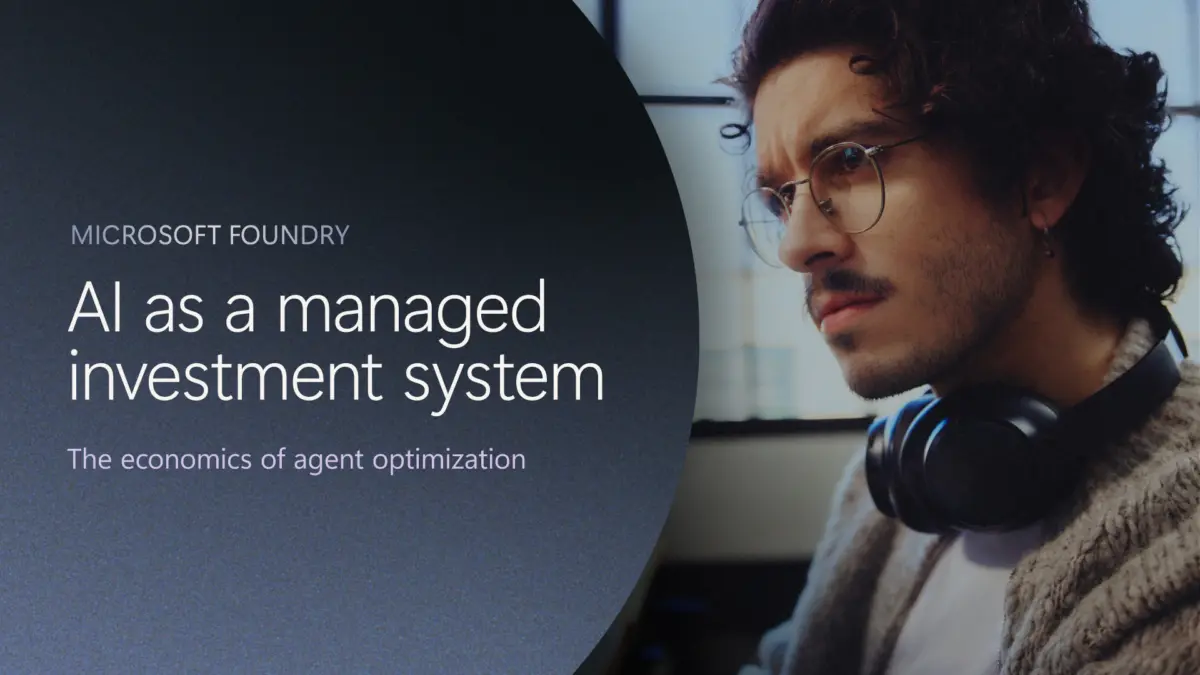
To address this structural challenge, Microsoft has unveiled a strategic framework titled "The Economics of Agent Optimization." Designed as a four-part methodology, the initiative outlines how enterprises can pivot from simply purchasing raw machine intelligence to operating AI as a governed, managed investment system. Anchored by tools within Microsoft Foundry, Microsoft Agent 365, and Azure Cost Management, this platform approach promises to embed Financial Operations (FinOps) directly into the lifecycle of AI agents, providing real-time runtime control, workflow efficiency, and enterprise-wide cost governance.
Detailed Chronology: The Evolution of Enterprise AI Spend
To understand why AI cost management has escalated to an urgent priority, it is essential to trace the rapid evolution of enterprise software adoption over three distinct phases between 2022 and 2025.
+-----------------------------------------------------------------------------------+
|                           ENTERPRISE AI EVOLUTION                                 |
+------------------------------------+----------------------------------------------+
| Phase 1: Exploration (2022–2023)  | • Unconstrained pilot spending               |
|                                    | • Focus on model size & raw capabilities     |
+------------------------------------+----------------------------------------------+
| Phase 2: Production Scaling (2024) | • Token volume explosion & budget shocks     |
|                                    | • Stateless context overhead realized         |
+------------------------------------+----------------------------------------------+
| Phase 3: AI FinOps Era (2025+)     | • Shift from "buying" to "managing" spend    |
|                                    | • Dynamic routing, runtime governance        |
+------------------------------------+----------------------------------------------+
Phase 1: The Frontier Pilot Frenzy (2022–2023)
In the immediate wake of commercial Large Language Model (LLM) breakthroughs, enterprise strategy was driven by fear of missing out (FOMO). Technology budgets were allocated flexibly, often drawn from innovation slush funds. Engineering teams prioritized raw model reasoning capability over efficiency, defaulting to the largest, most expensive "frontier" models available. During this phase, cost metrics were obscured by low transaction volumes and contained pilot groups.
Phase 2: The Production Wall and Token Shock (2024)
As pilots transitioned into operational enterprise workflows—powering customer service automation, internal knowledge retrieval (RAG), and software engineering assistants—transaction volumes exploded. IT departments faced unexpected bill shocks. Unlike traditional Software-as-a-Service (SaaS) models built on predictable per-seat licensing, AI workloads exhibited variable, usage-based consumption patterns that scaled non-linearly with user engagement.
Phase 3: The FinOps and Agentic Era (2025 and Beyond)
Today, enterprise software design is shifting from simple single-prompt applications to complex, multi-step autonomous agents. Agents do not merely answer prompts; they reason, loop, call external APIs, evaluate responses, and retry failed actions. This architectural shift creates exponential token multipliers. Consequently, enterprise finance leaders are demanding that AI architecture align with cloud FinOps principles—establishing clear cost attribution, departmental chargebacks, and runtime optimization controls.
Supporting Context & Metrics: Deconstructing Token Economics
Managing AI expenditure requires a granular understanding of the mechanics behind token generation and consumption. Cost in a generative AI system is rarely a static figure; it fluctuates dynamically based on input volume, output length, context engineering, and agent system architecture.
               +-------------------------------------------------+
               |              SINGLE USER PROMPT                 |
               +------------------------+------------------------+
                                        |
                                        v
               +-------------------------------------------------+
               |             AGENT WORKFLOW ENGINE               |
               +---+--------------------+--------------------+---+
                   |                    |                    |
                   v                    v                    v
          +-----------------+  +-----------------+  +-----------------+
          | Tool Call #1    |  | Memory Lookup   |  | Self-Correction |
          | (Search/DB)     |  | (RAG Context)   |  | Evaluation Loop |
          +--------+--------+  +--------+--------+  +--------+--------+
                   |                    |                    |
                   +--------------------+--------------------+
                                        |
                                        v
               +-------------------------------------------------+
               |         AGGREGATED TOKEN EXPENDITURE            |
               | (Multiple model calls for a single interaction) |
               +-------------------------------------------------+
The Technical Drivers of Token Inflation
- Stateless Model Architecture: Large language models are inherently stateless. They do not retain long-term memory across isolated API calls. To maintain continuity in a multi-turn conversation, application developers must resend the entire message history alongside system instructions and tool definitions with every single new request. As a user interaction progresses, the input token load grows cumulatively, making simple follow-up questions exponentially more expensive than initial prompts.
- Context Window Expansion and RAG Overhead: Enterprise Retrieval-Augmented Generation (RAG) systems inject external documentation, database records, and enterprise search results directly into the prompt context to ground responses. While this minimizes hallucinations, it inflates input token counts dramatically.
- Agent Orchestration Loops: Unlike deterministic software code, an autonomous agent operates via iterative decision loops. A single user query might trigger an agent to call a database, evaluate the output, encounter an error, reformulate its query, execute a second call, and synthesize a final output. A task that appears simple on the front-end can generate dozens of background model requests.
Data Analysis: The 2025 Enterprise AI Capital Landscape
According to a comprehensive study conducted by International Data Corporation (IDC) and commissioned by Microsoft—surveying over 4,000 global business and technology executives—enterprise commitment to artificial intelligence remains robust despite cost pressures:
- 71% of business leaders confirmed plans to increase their dedicated AI budgets over the next 12 months.
- Capital allocations are no longer derived solely from central IT budgets; cross-functional funding is increasingly drawn from operational units, HR, marketing, and line-of-business customer service budgets.
- Enterprise adoption on Microsoft Foundry has crossed the threshold of 100,000 active organizations, demonstrating that software deployment is occurring at unprecedented global scale.
However, the survey data highlights a sharp dichotomy: while funding is accelerating, enterprise profitability hinges entirely on financial governance. Organizations operating without granular allocation frameworks risk exhausting their budgets on low-value automated tasks.
Official Framework & Strategic Rationale: The Microsoft Platform Approach
To solve the systemic challenges of variable AI costs, Microsoft has constructed a dedicated ecosystem designed to operationalize FinOps across every layer of the enterprise technology stack. Rather than relying on disparate third-party monitoring plugins, Microsoft’s approach embeds visibility, allocation, and control directly into the execution runtime.
+-----------------------------------------------------------------------------------+
|                         MICROSOFT AI FINOPS PLATFORM ARCHITECTURE                  |
+-----------------------------------------------------------------------------------+
|  BUILD & RUN           | Microsoft Foundry  |  GitHub                             |
|  GOVERN & METER        | Azure API Management                                     |
|  TENANT MANAGEMENT     | Microsoft Agent 365                                      |
|  COST ALLOCATION       | Microsoft Cost Management | Azure Pricing Commitments    |
+-----------------------------------------------------------------------------------+
The Core Components of Microsoft’s AI FinOps Ecosystem
- Microsoft Foundry: The centralized foundation where enterprise models and agents are built, evaluated, deployed, and optimized.
- Microsoft Agent 365: A unified management plane extending financial control across both native Microsoft agents and third-party platform deployments. It governs organizational agent estates with cross-departmental chargebacks, tenant-level spending policies, and budget caps.
- Azure API Management (APIM): Functions as the central API gateway that meters, throttles, and governs raw AI network traffic, preventing runaway infinite loops and enforcing token quotas.
- Microsoft Cost Management & Azure Commitments: Connects AI usage metrics directly to enterprise accounting tools, enabling precise departmental cost allocation and leveraging reserved capacity savings.
The Three Operational Speeds of AI Optimization
The Microsoft framework divides cost management into three operational cadences, balancing real-time automated controls with long-term strategic adjustments:
| Operational Cadence | Strategic Objective | Platform Capability |
|---|---|---|
| 1. Runtime Request Optimization | Right-size every model call dynamically so routine inquiries never incur high-end frontier model pricing. | Dynamic request routing, model cascading, prompt context compression. |
| 2. Workflow Optimization Over Time | Refine agent topologies and system instructions to make workloads systematically cheaper as usage increases. | Automated evaluation metrics, prompt optimization, semantic caching. |
| 3. Continuous Spend Governance | Enforce programmatic policy limits and budget caps that prevent anomalous cost spikes. | Departmental chargebacks, tenant budget limits via Agent 365, automated throttling via Azure APIM. |
Strategic Audit: The Four Core Questions for AI Leadership
As enterprise leadership teams convene for quarterly budget evaluations, Microsoft highlights four critical operational questions that executives must demand from their technology and engineering teams:
1. Do we have exact cost visibility by application, agent, workflow, and user?
- The Strategic Context: Aggregated cloud bills hide inefficiency. Without granular attribution, leadership cannot discern whether a high monthly bill represents high-value customer interactions or an unoptimized internal research tool running in an infinite loop.
2. Are we dynamically matching individual requests to the right model tier?
- The Strategic Context: Sending every user interaction to a top-tier frontier model is the financial equivalent of using a commercial transport truck to deliver a small envelope. Simple intent classification, data formatting, or basic summaries should automatically route to smaller, lower-cost models or specialized fine-tuned endpoints.
3. Is our agent architecture generating redundant or inflated context?
- The Strategic Context: Engineering teams often overlook context efficiency. By implementing semantic caching, pruning historical chat buffers, and compressing system instructions, organizations can slash input token consumption by significant margins without degrading output quality.
4. Are programmatic spending guardrails and budget caps active across the tenant?
- The Strategic Context: Real-time visibility is useless if it only alerts management after a budget overrun has occurred. Organizations require automated circuit breakers that pause or downgrade agent capabilities when departmental spending thresholds are breached.
Future Outlook & Industry Impact
The launch of The Economics of Agent Optimization methodology marks a maturing enterprise software market. As autonomous agent deployments expand across industries—ranging from automated financial auditing to complex healthcare diagnostics—the capacity to run AI models cost-effectively will distinguish industry leaders from laggards.
Looking ahead, several structural transformations are expected to redefine enterprise AI management:
- Algorithmic Model Cascading: Enterprise runtime environments will increasingly rely on intelligent router models that evaluate user prompt complexity in milliseconds, dispatching the work to the cheapest capable endpoint automatically.
- Standardization of Agent Financial Governance: Tools like Microsoft Agent 365 will establish universal standards for monitoring agent activity, bringing third-party and multi-cloud agents under unified policy controls.
- The Rise of ROI-Driven AI Portfolios: Enterprise leaders will manage AI agents much like capital investment portfolios, routinely sunsetting low-performing, token-heavy agents while doubling down on workflows that demonstrate measurable productivity gains.
Ultimately, the shift toward AI FinOps represents a natural evolution in technology management. Organizations that master the mechanics of token economics, enforce rigorous governance, and leverage platform-native tools like Microsoft Foundry will scale their artificial intelligence operations sustainably—turning raw machine intelligence into long-term commercial value.