Executive Overview
For over a decade, the core tenet of application security has been "shift-left." Organizations have poured unprecedented capital, engineering hours, and tooling into pre-deployment pipelines—scanning source code, running static and dynamic application security testing (SAST/DAST), and auditing container images long before a single line of code reaches end users. Yet, despite these rigorous gating mechanisms, catastrophic data breaches continue to plague enterprises operating at scale.
The root cause of this paradox is a fundamental mismatch in focus. While DevSecOps teams meticulously fortify staging and development environments, malicious actors systematically target the production environment—a living, highly dynamic ecosystem where applications, APIs, microservices, third-party integrations, and user behaviors are in a state of perpetual flux. When security validation halts at the moment of deployment, critical risks remain hidden, quietly festering until they are discovered and exploited by bad actors.
This architectural oversight is far more pervasive than many executive boards realize. Industry data reveals a startling reality: over 70% of applications harbor active, exploitable vulnerabilities after spending five years in production. Meanwhile, traditional security paradigms dictate that manual or automated penetration testing occurs only quarterly—or even less frequently. In an era where high-performing engineering teams execute multiple deployments daily, periodic security assessments are dangerously obsolete.
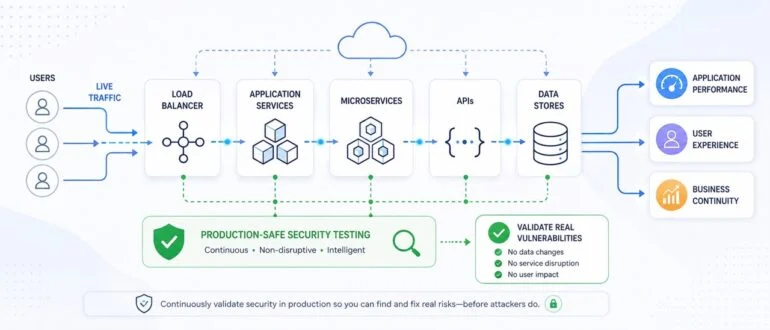
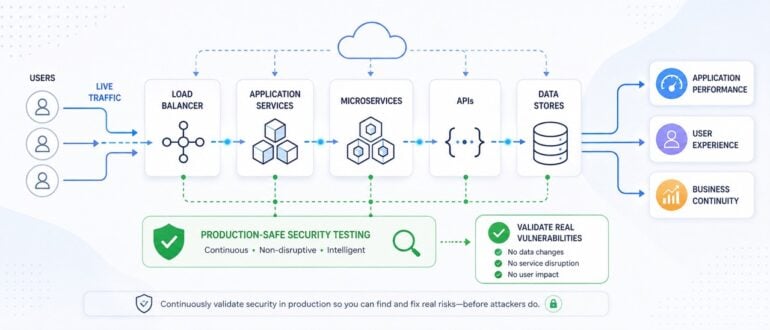
Enter production-safe testing: a paradigm shift that redefines how organizations approach application security. By enabling continuous, non-disruptive security validation directly in live environments without risking downtime, performance degradation, or data corruption, production-safe testing closes the final, most dangerous gap in the DevSecOps lifecycle. It transforms security from a static checkpoint into a dynamic, continuous capability, proving conclusively whether vulnerabilities are exploitable where it matters most.
Detailed Chronology: The Evolution of Application Security and the Production Gap
To understand why production-safe testing has become an existential necessity for modern enterprises, it is vital to trace how software delivery models and security practices have evolved over the last twenty years.
The Era of Waterfall and Monolithic Releases (Early 2000s)
In the era of traditional waterfall development, applications were monolithic and deployment cycles spanned months or even years. Security was treated as a terminal phase—a gatekeeper event occurring just before general availability. Penetration testers were brought in during the final weeks of a release cycle to manually comb through code and infrastructure. While disruptive and time-consuming, this model matched the slow cadence of software delivery.
The Agile and DevOps Revolution (2010s)
The advent of Agile methodologies and the subsequent DevOps movement shattered monolithic architectures. Organizations embraced continuous integration and continuous deployment (CI/CD), shrinking release cycles from annual updates to bi-weekly, daily, or even hourly deployments. To prevent security from becoming an insurmountable bottleneck, the industry championed the "shift-left" movement. Security tools were integrated into CI/CD pipelines to catch bugs early in development, dramatically reducing the cost and effort required to remediate them.
The Cloud-Native Complexity and the Production Void (Present Day)
While shift-left security successfully mitigated many pre-production flaws, it inadvertently created a dangerous blind spot: the production void. Modern cloud-native applications rely on container orchestration platforms like Kubernetes, sprawling API ecosystems, serverless functions, and intricate multi-cloud networking.
As a result, an application’s attack surface is no longer static. It changes constantly due to runtime configurations, dynamic traffic patterns, ephemeral infrastructure, and third-party dependencies. Staging environments frequently fail to mirror these complex production realities. Consequently, vulnerabilities born from configuration drift, runtime anomalies, and complex business logic flaws routinely bypass pre-production gates, leaving organizations exposed in the wild. Production-safe testing emerged in response to this crisis, bridging the divide between pre-deployment theory and post-deployment reality.
Supporting Context & Metrics: The Scale of the Crisis
The argument for production-safe testing is heavily underscored by sobering empirical data regarding application vulnerability lifecycles and modern development velocity.
- The Five-Year Vulnerability Tail: According to comprehensive cybersecurity benchmarks, more than 70% of applications retain active vulnerabilities after operating in production for five years. Pre-deployment testing catches initial coding errors, but it cannot account for degradation over time.
- The Testing Frequency Deficit: Despite the explosive growth in deployment velocity, empirical surveys indicate that 30% to 40% of organizations still perform comprehensive security testing only on a quarterly basis—or even less frequently.
- The DORA Benchmark: The 2024 State of DevOps Report highlights that elite engineering teams deploy software continuously and on-demand. When contrasted with quarterly or annual security assessments, the velocity gap becomes glaringly unsustainable.
The Five Hidden Risks of Avoiding Production Security Testing
Organizations that rely exclusively on pre-production security exposing themselves to five distinct, high-impact risks:
- Production-Only Vulnerabilities: Live environments possess configurations, cloud services, and user permissions that are notoriously difficult to replicate in staging. These operational discrepancies create unique attack paths that remain invisible until exploited.
- Configuration Drift: As infrastructure undergoes continuous updates, infrastructure-as-code (IaC) drift occurs. Firewalls, access control lists (ACLs), and cloud IAM policies gradually deviate from security baselines, introducing silent exposures.
- Complex Business Logic Flaws: Automated pre-production scanners excel at identifying known software bugs (e.g., SQL injection, buffer overflows), but they are fundamentally blind to business logic flaws—such as authorization bypasses or multi-step transaction manipulation—which only manifest under real-world usage conditions.
- Third-Party Integration Decay: Modern applications lean heavily on external APIs, identity providers, and microservices. When these third-party services update their endpoints or authentication schemas, unexpected security gaps are frequently introduced.
- Delayed Detection and Amplified Business Impact: Without continuous production validation, security flaws are typically uncovered only after a data breach, regulatory audit failure, or ransomware incident. The longer a vulnerability persists undetected, the exponentially higher the financial loss, legal liability, and brand degradation.
What Makes a Security Test Truly "Production-Safe"?
A common hesitation among Chief Information Security Officers (CISOs) and Operations Directors is the fear that running active security tests in live environments will trigger outages, corrupt databases, or degrade user experience. This apprehension validates why traditional invasive penetration testing cannot be run continuously in production.
However, production-safe testing is engineered specifically to eliminate these operational risks. It relies on a sophisticated triad of characteristics:
1. Non-Destructive Validation
Production-safe testing utilizes payloads and request patterns that verify the existence of a vulnerability without executing malicious actions. For instance, rather than executing a destructive database drop query to prove a SQL injection flaw, a production-safe test confirms vulnerability through time-delay mechanics or safe, non-altering assertions.
2. Intelligent Request Handling and Rate Limiting
To ensure business continuity, production-safe tools incorporate application awareness. They respect rate limits, throttle execution speeds during peak traffic hours, and mimic legitimate user behavior to prevent web application firewalls (WAFs) or intrusion detection systems (IDS) from inadvertently blocking critical services.
3. Context-Aware Adaptation
Modern production-safe solutions understand complex authorization frameworks, API schemas, and microservice topologies. By contextualizing the testing process against real-time application behavior, these systems drastically reduce false positives—ensuring that engineering teams spend their time remediating verified, high-risk exposures rather than chasing ghosts.
Official Industry Perspectives and Expert Analysis
Security and DevOps leadership across the technology sector are increasingly vocal about the necessity of integrating continuous runtime validation into organizational workflows.
"We have spent the last decade building exceptionally sophisticated gates at the front door of software delivery, while leaving the back door wide open," notes a prominent DevSecOps architect and enterprise security advisor. "Shift-left is necessary, but it is incomplete. If you are not validating your security controls where the adversary actually attacks—in production—you are practicing compliance theater rather than true risk reduction."
Industry analysts point out that the traditional friction between development, operations, and security teams—often referred to as the "security versus speed" trade-off—is neutralized by production-safe testing.
- Faster Feedback Loops: Developers receive immediate, contextualized insights into real-world risks without waiting for scheduled penetration testing windows.
- Eradication of Alert Fatigue: By verifying exploitability before flagging an issue, production-safe testing filters out the relentless noise of false positives, restoring developer trust in security alerts.
- Streamlined Compliance Readiness: Continuous production validation provides automated, audit-ready evidentiary trails, sparing compliance teams from frantic pre-audit scrambling.
Future Outlook: The Next Frontier of DevSecOps
As artificial intelligence and automated tooling accelerate the speed of both software development and cyber attacks, the margin for human error in security is vanishing. Threat actors increasingly leverage automated agents and large language models to scan live web assets for zero-day exposures within minutes of a public disclosure.
Looking forward, production-safe testing will no longer be viewed as an advanced security add-on; it will serve as the foundational feedback mechanism for autonomous, self-healing DevSecOps pipelines. Integrating automated, non-disruptive validation into every stage of a cloud-native architecture ensures that security posture scales dynamically alongside business growth.
Organizations that embrace this transition will achieve a profound competitive advantage: the ability to innovate at breakneck speed without sacrificing resilience, trust, or operational stability. Those that cling strictly to outdated, pre-deployment security models will continue to find themselves vulnerable to the dynamic, shifting realities of the modern threat landscape.