Executive Overview
In the rapidly evolving landscape of enterprise data platforms and generative artificial intelligence, organization leaders face a persistent challenge: converting complex technical infrastructure into measurable, scalable business value. While modern data lakehouse architectures promise to democratize analytics and accelerate machine learning workflows, the operational friction of integrating third-party software into cloud environments often erodes projected returns. Multi-vendor management, fragmented identity governance, egress fees, and custom pipeline maintenance regularly bloat total cost of ownership (TCO) and delay time-to-value.
To evaluate whether deep native cloud integration alters this financial equation, Microsoft commissioned an independent Total Economic Impact™ (TEI) study by Forrester Consulting. The findings quantify the business value delivered by Microsoft Azure Databricks—a platform co-engineered directly by Microsoft and Databricks as a native, first-party Azure service.
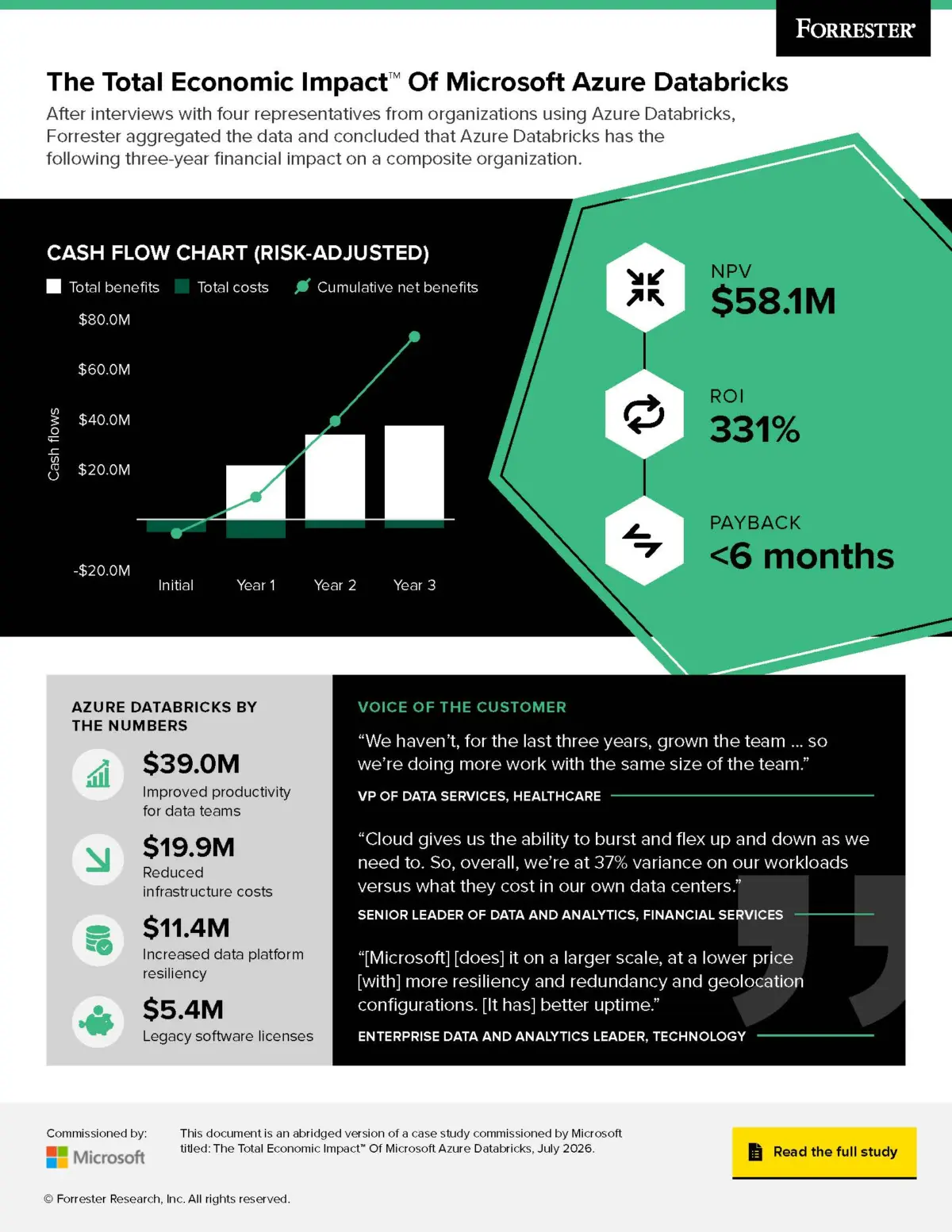
According to the study, a composite enterprise modeled on real-world customer interviews achieved a 331% return on investment (ROI) over three years. The platform yielded a Net Present Value (NPV) of $58.1 million, with the original investment fully recovered in less than six months. Driven by $75.6 million in total quantified benefits against $17.5 million in implementation and operational costs, the study highlights how first-party architectural alignment converts technical efficiency into bottom-line performance.
Detailed Chronology: The Strategic Evolution of the First-Party Architecture
The integration between Microsoft and Databricks represents a structural shift from traditional software-as-a-service (SaaS) marketplace integrations toward a unified, native cloud offering. Understanding this trajectory reveals why the solution achieves operational economics distinct from standard third-party deployments.
       Phase 1: Multi-Vendor Friction
   [ Fragmented Data ] ---> [ Egress/Integration Tax ] ---> [ High TCO ]
                                     |
                                     v
       Phase 2: First-Party Engineering Co-Development
   [ Shared Roadmap ] ---> [ Unified Control Plane ] ---> [ Single Billing ]
                                     |
                                     v
       Phase 3: Deep AI & Governance Convergence
   [ Unity Catalog ] ---> [ Copilot / Genie Integration ] ---> [ Realized 331% ROI ]
1. The Era of Multi-Vendor Data Friction
Historically, enterprises running analytics workloads across distinct cloud and software ecosystems faced structural inefficiencies:
- Governance Silos: Maintaining separate access control matrices across data platforms and cloud identity providers created compliance risks and required redundant policy management.
- Network & Ingress/Egress Tax: Moving data across external SaaS environments and primary cloud storage buckets introduced latencies, higher network transport charges, and security perimeters that were difficult to audit.
- Procurement Overhead: Organizations managed disparate licensing agreements, distinct support tiers, and separate billing schedules, complicating financial forecasting.
2. Strategic Co-Engineering and First-Party Integration
To address these friction points, Microsoft and Databricks established a joint engineering commitment. Rather than hosting Databricks as a secondary layer, the platform was embedded natively within the Azure resource provider framework:
- Unified Control Plane: Azure Databricks was engineered to launch directly within Azure Virtual Networks (VNets), native storage architectures (Azure Data Lake Storage Gen2), and standard compute families.
- Shared R&D Roadmaps: Microsoft and Databricks aligned product development teams, synchronizing kernel optimizations, security updates, and AI capability rollouts.
- Single Motion Commerce: The service was designated as a first-party Azure product, allowing enterprises to draw down against existing Azure Consumption Commitments (MACC) through a single bill and utilize unified Microsoft enterprise support.
3. Convergence with Modern AI and Workplace Workflows
As enterprise priorities shifted toward Generative AI and Large Language Models (LLMs), the platform expanded its capabilities. Recent developments integrate natural-language querying tools—such as Azure Databricks Genie—directly into enterprise workplace applications including Microsoft 365 Copilot, Microsoft Teams, and Copilot Cowork. Grounded in unified semantic definitions and governed by Unity Catalog, insights now flow securely into daily productivity software without exposing raw underlying data.
Supporting Context & Metrics: Deconstructing the Total Economic Impact
To establish a standard evaluation baseline, Forrester Consulting constructed a composite organization based on detailed interviews with enterprise customer leaders. The composite profile represents a global company generating $6 billion in annual revenue, operating within a highly regulated industry (such as financial services, healthcare, or retail), and actively managing 10 petabytes (PB) of structured and unstructured data.
Financial Summary of the TEI Findings
| Metric | Quantified Outcome (3-Year Horizon) |
|---|---|
| Return on Investment (ROI) | 331% |
| Net Present Value (NPV) | $58.1 Million |
| Payback Period | < 6 Months |
| Total Quantified Benefits | $75.6 Million |
| Total Cost of Implementation & Operation | $17.5 Million |
Quantified 3-Year Financial Impact ($ Millions)
+-----------------------------------------------------------------------+
| Total Benefits: $75.6M                                                |
| [===================================================================] |
| Total Costs: $17.5M             | Net Present Value (NPV): $58.1M     |
| [==================]            | [=================================] |
+-----------------------------------------------------------------------+
The Four Pillars of Value Generation
The Forrester study attributes the $75.6 million in financial benefit to four primary enterprise operational areas:
                          TOTAL VALUE GENERATION ($75.6M)
                                       |
    +------------------+---------------+------------------+------------------+
    |                  |                                  |                  |
    v                  v                                  v                  v
Pillar 1:          Pillar 2:                          Pillar 3:          Pillar 4:
Legacy Compute     Data Team                          Infrastructure &   Risk Mitigation
Decoupling         Productivity                       Pipeline Efficiency & Compliance
1. Decoupling and Retirement of Legacy Data Infrastructure
Prior to adopting Azure Databricks, interviewed organizations maintained legacy, on-premises, or monolithic cloud data warehouses that were expensive to scale and difficult to maintain. By migrating workloads to a open lakehouse pattern, organizations eliminated redundant software licenses, reduced high maintenance contracts, and legacy hardware refresh cycles.
2. Acceleration of Data Engineering and Data Science Productivity
By standardizing on automated compute provisioning, Collaborative Notebooks, optimized Delta Lake tables, and integrated CI/CD workflows, data engineers and data scientists cut setup, pipeline creation, and maintenance times significantly. Teams redirected saved hours toward high-value analytics and custom machine learning deployments.
3. Optimized Infrastructure, Storage, and Compute Efficiency
The co-engineered runtime—featuring automated cluster autoscaling, spot instance management, and performance-tuned execution engines—reduced compute consumption costs compared to unoptimized, hand-rolled cloud infrastructure. Enterprise data teams avoided over-provisioning resource capacity for batch processing runs.
4. Operational Risk Mitigation and Reduced Auditing Costs
By applying centralized identity and data governance through Unity Catalog and Azure Entra ID (formerly Active Directory), organizations standardized fine-grained access policies across all data assets. This native security model reduced compliance review hours, simplified data lineage tracking, and mitigated risks associated with ungoverned shadow analytics.
Quantitative Performance Benchmarks
In addition to financial impact modeling, performance evaluation validates the structural foundation driving these economic outcomes. Independent technology testing firm Principled Technologies conducted industry-standard, TPC-DS-like decision-support benchmarks on a 10-terabyte (TB) dataset to assess query performance and compute efficiency across cloud environments.
Query Stream Execution Time (TPC-DS-like Benchmark, 10TB)
------------------------------------------------------------------------
Single Query Stream:
Azure Databricks [===============> 21.1% Faster ] AWS Alternative [========]

Concurrent Streams (4 Workloads):
Azure Databricks [====== >9 Minutes Faster Total Execution ======] AWS
------------------------------------------------------------------------- Single Query Stream Performance: Azure Databricks executed single analytical query streams up to 21.1% faster than equivalent Databricks deployments on competing public clouds (with autoscale disabled for static control).
- Concurrent Workload Efficiency: When processing four concurrent query streams simulating multi-user enterprise analytics workloads, Azure Databricks completed execution more than nine minutes faster than comparative benchmarked configurations.
These execution speeds translate directly into reduced compute instance hours, lowering direct cloud execution costs while allowing downstream business users to access time-critical reporting and real-time dashboarding faster.
Technical Deep-Dive: Native Architecture and Operational Flow
The advantages reported in both the Forrester and Principled Technologies studies stem from deep technical integrations across the Azure ecosystem. Rather than treating components as discrete services connected via public APIs, Azure Databricks bridges governance, compute, security, and workplace tooling into a single operational architecture.
+-------------------------------------------------------------------------------+
|                           WORKPLACE INTERACTION LAYER                         |
|   Microsoft Teams    |    Microsoft 365 Copilot    |    Copilot Cowork    |
+-------------------------------------------------------------------------------+
                                        | (Natural Language / Genie)
                                        v
+-------------------------------------------------------------------------------+
|                           GOVERNANCE & SEMANTIC LAYER                         |
|   Unity Catalog (Entitlement Scoping)  |  Genie Ontology (Context Mapping)    |
+-------------------------------------------------------------------------------+
                                        | (Zero-Trust Identity Sync)
                                        v
+-------------------------------------------------------------------------------+
|                            ANALYTICS & COMPUTE ENGINE                         |
|   Azure Databricks Photon Engine  |  Delta Lake  |  Azure NVMe Virtual Memory |
+-------------------------------------------------------------------------------+
                                        | (Native Storage Connector)
                                        v
+-------------------------------------------------------------------------------+
|                            STORAGE & IDENTITY CORE                            |
|   Azure Data Lake Storage Gen2 (ADLS)    |    Azure Entra ID (Identity)       |
+-------------------------------------------------------------------------------+
Unified Governance via Unity Catalog and Azure Entra ID
Traditionally, maintaining zero-trust architecture across disparate data lakes required double-mapping permissions—once in the cloud IAM and again in the analytics engine. In Azure Databricks:
- Access control lists (ACLs) synchronize directly with Azure Entra ID.
- Security admins apply column-level, row-level, and tag-based attribute policies once within Unity Catalog.
- These policy rules enforce identity constraints whether data is accessed via SQL queries, Python scripts, or natural language prompts in Microsoft workplace tools.
Natural Language Analytics: Azure Databricks Genie and Copilot Cowork
A key driver of ROI beyond core IT operations is the democratization of analytics for non-technical enterprise teams.
- Genie Ontology: Serves as a semantic translation layer, translating broad corporate jargon, metadata definitions, and business logic into structured SQL queries.
- Workplace Integration: Business executives can prompt Azure Databricks Genie directly inside Microsoft Teams or Microsoft 365 Copilot to evaluate business performance metrics.
- Governed Answers: Because Genie respects the user’s active Entra ID tokens and Unity Catalog security boundaries, query responses return only the specific metrics and underlying rows that the individual user is authorized to inspect.
Official Statements and Industry Perspectives
The convergence of native engineering and independent financial validation highlights a broader shift in how enterprise technology leaders evaluate core data architecture investments.
Reflecting on the native partnership model, executives from both engineering organizations emphasize that deep co-engineering removes historical trade-offs between software performance and system governance:
"The value proposition of Azure Databricks centers on eliminating architectural friction. By engineering the platform as a first-party Azure service, we allow organizations to apply unified security, seamless identity, and aligned operational roadmaps across their entire data estate. The financial outcomes identified by Forrester demonstrate that deeply integrated engineering yields compounding business savings."
— Joint Engineering Leadership, Microsoft & Databricks Integration Practice
Industry analysts note that as enterprises accelerate Generative AI initiatives, native architecture becomes a mandatory prerequisite rather than a simple preference:
"Enterprise decision-makers are shifting away from fragmented multi-vendor stacks that require complex internal orchestration. The ability to deploy generative tools and LLMs directly against governed data lakes—without incurring network penalties or policy duplication—is emerging as a key differentiator for cloud platforms. Achieving a full return on investment in under six months signals that native platform integration is actively reshaping cloud spend efficiency."
— Enterprise Cloud Infrastructure Analyst
Future Outlook & Strategic Enterprise Implications
The empirical findings of the Forrester TEI study and independent performance benchmarks signal a significant operational standard for enterprise technology strategies moving forward.
       HISTORICAL APPROACH                       MODERN FIRST-PARTY PARADIGM
+---------------------------------+        +---------------------------------+
| • Siloed SaaS Analytics Engine  |        | • Unified First-Party Service   |
| • Duplicated Security Policies  |  --->  | • Single Identity & Governance  |
| • High Egress/Integration Costs |        | • Optimized Photon Execution    |
| • Delayed ROI & Unclear Value   |        | • <6 Months Investment Payback  |
+---------------------------------+        +---------------------------------+
1. Shift Toward First-Party Native Services
As CIOs and CFOs tighten control over cloud spending, raw feature velocity is no longer evaluated in isolation. Cloud platforms will increasingly be judged by how natively they fit within existing enterprise footprints. The ability to route compute billing through standard cloud commitments while maintaining single-pane support channels provides direct financial control that enterprise CFOs favor.
2. Pervasive AI Without Security Compromise
The integration of tools like Azure Databricks Genie with Microsoft Copilot marks the beginning of broad, enterprise-wide natural language data interfaces. As business users rely on generative tools to make operational decisions, enforcing granular data governance at the underlying engine level will remain critical to preventing accidental data leakage or compliance breaches.
3. Sustainable Execution at Scale
With enterprise data estates regularly crossing petabyte thresholds, raw computational efficiency directly affects annual balance sheets. Optimization technologies—such as the Photon execution engine combined with tailored Azure hardware drivers—ensure that query execution times decrease while compute infrastructure consumption remains sustainable as data volumes grow.
Conclusion
The independent Forrester Total Economic Impact™ study confirms that platform selection influences far more than IT performance—it directly drives enterprise financial health. By combining the data processing and machine learning strengths of Databricks with the native identity, compute, and productivity ecosystems of Microsoft Azure, Azure Databricks delivers a validated strategy for modern enterprise data strategy: a 331% ROI, $58.1 million in Net Present Value, and a payback period under six months.
Resource Summary & Further Exploration
- Full Research Report: Access the complete commissioned study: Forrester Total Economic Impact™ of Microsoft Azure Databricks
- Performance Testing: Review the independent testing methodologies: Principled Technologies Decision-Support Benchmark Report
- Product Documentation & Demos: Explore first-party architectural features: Microsoft Azure Databricks Platform Documentation