







Executive Overview
For over four decades, the iconic yellow-coned monitors of KRK Systems have been a ubiquitous sight in recording studios worldwide. While the brand has achieved massive commercial success in the project-studio market, its flagship professional offering—the V Series—has quietly served as the high-precision monitoring backbone for world-class tracking, mixing, and mastering engineers. Today, the professional audio landscape is undergoing a profound paradigm shift. Studios are transitioning from traditional stereo configurations to complex immersive formats like Dolby Atmos, and the demand for rapid, precise room calibration has never been more urgent.
In response to these evolving workflows, KRK has unveiled its fifth-generation V Series Studio Monitors (V Series Five). This latest iteration represents far more than an incremental acoustic update. By integrating proprietary "KRK Mesh" wireless networking technology with an advanced onboard digital signal processing (DSP) engine, KRK has transformed the traditional nearfield monitor into a connected, software-defined audio node.
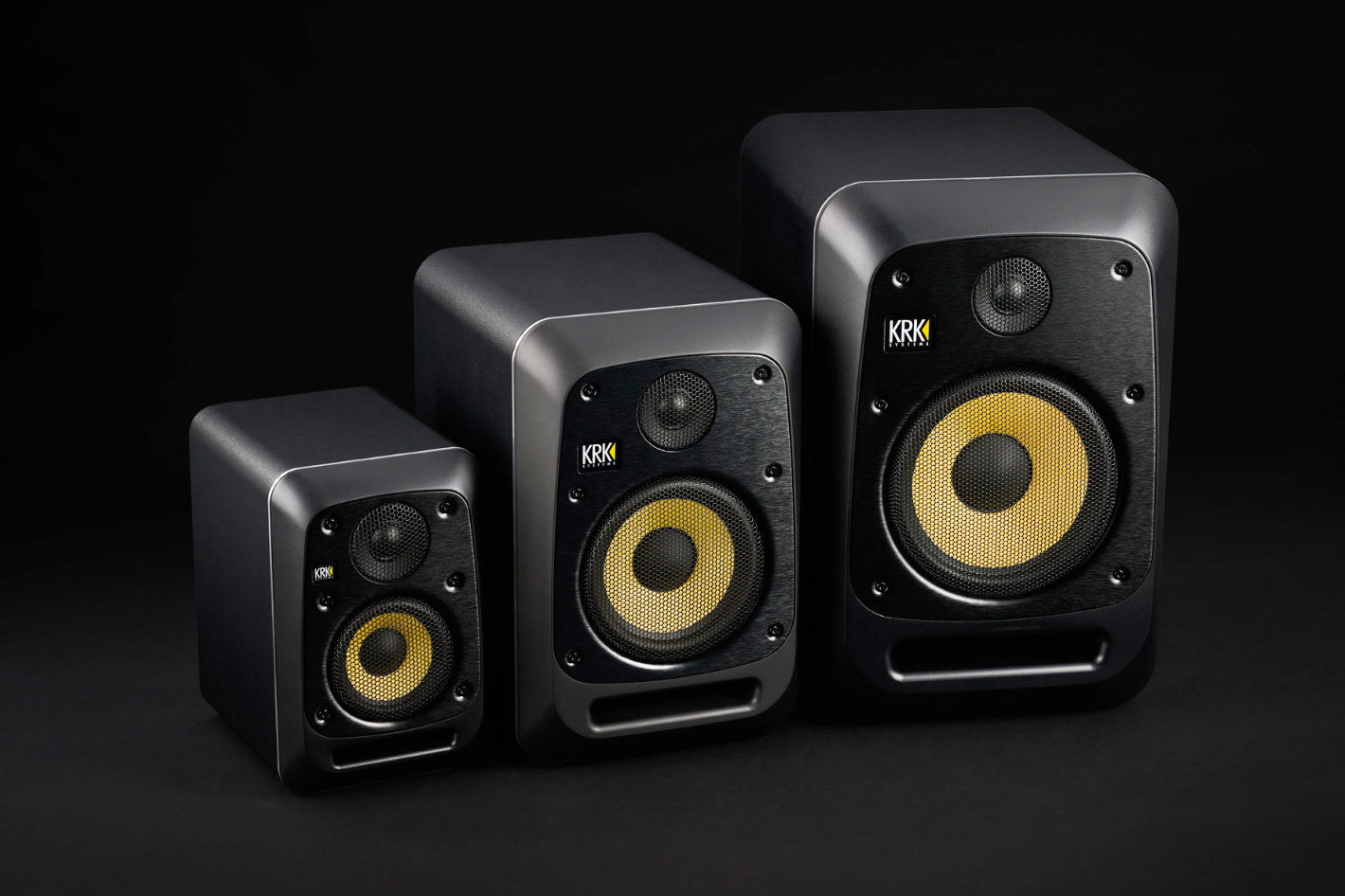
The V Series Five lineup—comprising the compact V4, the mid-sized V6, and the powerful V8—combines hand-selected premium hardware components, such as custom Kevlar transducers and Pascal Class D amplification, with a sophisticated control app. This integration allows audio professionals to wirelessly calibrate, group, and manage complex monitoring environments directly from a mobile device, eliminating the physical bottlenecks that have plagued control room tuning for decades.
Detailed Chronology: The Evolution of KRK’s Flagship Platform
To understand the technological leap represented by the V Series Five, it is essential to trace the historical trajectory of KRK’s monitoring philosophy. Founded in 1986 by visionary engineer Keith R. Klawitter, KRK was born out of a frustration with the lack of clarity and translation in the studio monitors of the era. Klawitter’s design philosophy emphasized low-distortion transducers, highly rigid enclosures, and precise crossover networks—principles that quickly earned KRK a spot in the control rooms of legendary producers and engineers.
[1980s: Foundation] -> Focus on low-distortion transducers & rigid cabinet designs.
         │
[1990s: Active Bi-amplification] -> Integration of custom amplifiers matched to specific drivers.
         │
[2010s: V Series Gen 4] -> Introduction of onboard DSP and LCD back-panel menu navigation.
         │
[Present: V Series Five] -> Launch of KRK Mesh technology and wireless DSP control ecosystems.
Throughout the 1990s and 2000s, active bi-amplified monitoring became the industry standard, and KRK’s V Series established itself as a premier tool for critical listening. However, as home studios proliferated and commercial spaces downsized, acoustic environments became increasingly unpredictable. Monitors were no longer placed solely in acoustically perfect, purpose-built control rooms; they were squeezed into bedrooms, post-production suites, and mobile broadcast vans.
The fourth-generation V Series addressed this challenge by introducing onboard DSP, allowing users to adjust the monitor’s frequency response to compensate for room anomalies via a series of manual DIP switches and a small LCD screen on the back panel. While highly effective acoustically, this implementation presented distinct workflow challenges. Calibrating a stereo pair—or worse, an 11-speaker Dolby Atmos array—required engineers to physically access the rear of each cabinet, navigate complex menus, and make blind adjustments before returning to the mix position to evaluate the results.
The development of the V Series Five represents a direct response to this operational bottleneck. Over a multi-year development cycle, KRK’s engineering team set out to decouple physical monitor placement from calibration accessibility. The result is the implementation of KRK Mesh, a proprietary wireless communication protocol that links all monitors in a studio into a unified, responsive network, controllable in real-time from the listener’s sweet spot.
Under the Hood: Hardware Architecture and Component Engineering
At its core, a studio monitor is only as good as its physical transduction. No amount of DSP can compensate for poor driver geometry, insufficient power, or cabinet resonance. KRK’s engineers designed every component of the V Series Five from the ground up to establish an uncompromising analog foundation.
+------------------------------------------------------------------------+
|                      V SERIES FIVE ARCHITECTURE                       |
+------------------------------------------------------------------------+
|  [Analog/AES3 Input] -> [ESS DAC] -> [Analog Devices DSP]              |
|                                                  |                     |
|  +-----------------------------------------------+                     |
|  |                                                                     |
|  v (LF Signal Path)                               v (HF Signal Path)   |
| [Pascal Class D Amp: 280W]                       [Pascal Class D: 175W]|
|  |                                                |                    |
|  v                                                v                    |
| [Kevlar Woofer / Cast Alum]                      [1" Silk Dome Tweeter]|
+------------------------------------------------------------------------+
Transducer Technology and Enclosure Design
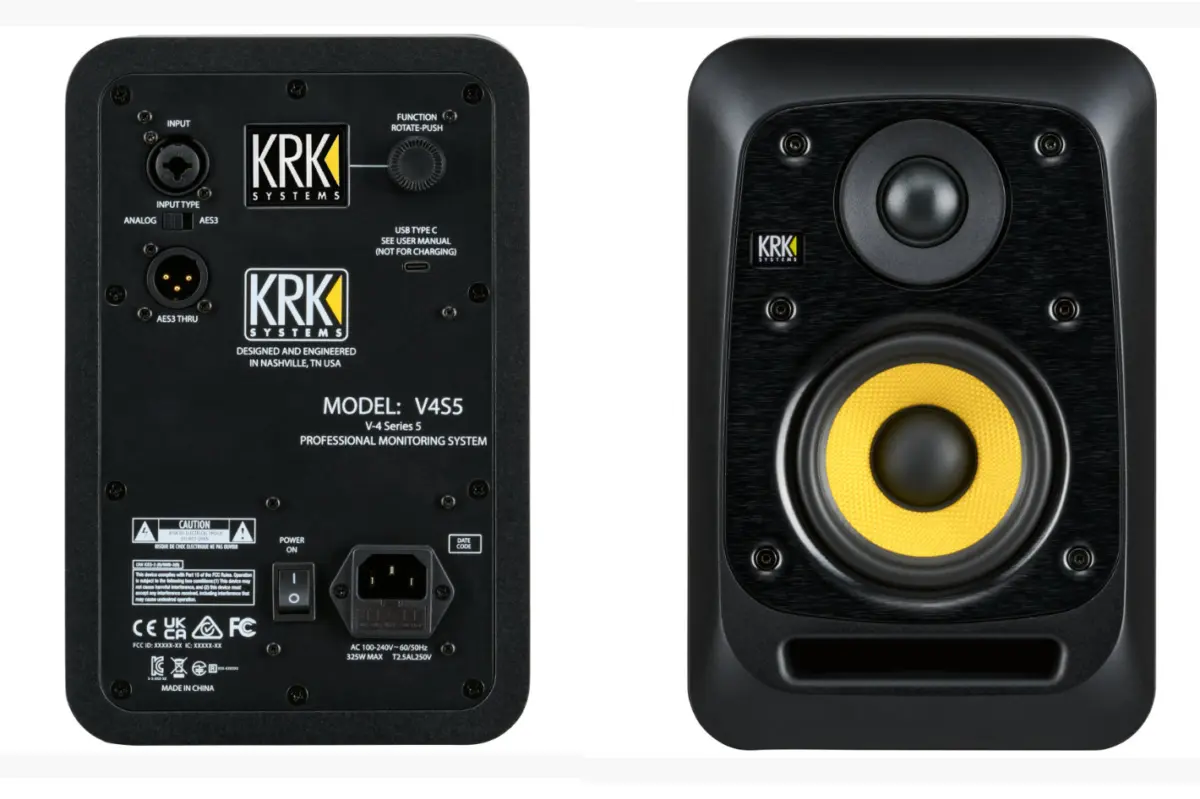
The V Series Five utilizes KRK’s signature yellow woven Kevlar® woofers, housed in rugged cast aluminum frames. Kevlar is celebrated in transducer design for its exceptional strength-to-weight ratio and high internal damping. This stiffness ensures that the cone moves in a linear, piston-like fashion even under extreme excursion, minimizing intermodulation distortion and delivering highly accurate transient reproduction in the low and low-mid frequencies.
Complementing the woofer is a specially engineered one-inch silk dome tweeter. Unlike metal dome tweeters, which can exhibit harsh resonant peaks at high frequencies, silk domes offer a smoother, more natural high-frequency roll-off. This characteristic is critical for professional engineers who spend 8 to 12 hours a day mixing, as it significantly reduces ear fatigue. The tweeter is set back in a computer-optimized waveguide designed to maximize off-axis consistency and widen the stereo sweet spot, ensuring that the phantom center image remains intact even if the engineer moves laterally along the console.
The cabinet itself is constructed from high-density materials and features an optimized front-ported bass-reflex design. Front-porting is highly advantageous in modern studios, as it prevents the low-frequency buildup and phase cancellation that occurs when rear-ported monitors are placed close to front walls.
Premium Amplification and Converters
To drive these custom transducers, KRK partnered with industry-leading electronics manufacturers to build a state-of-the-art power and processing platform:
- ESS Technology Converters: Premium Digital-to-Analog Converters (DACs) ensure that the digital-to-analog transition occurs with ultra-low distortion and an exceptionally wide dynamic range.
- Analog Devices DSP: High-performance digital signal processors handle the crossover networks, time alignment, and system protection algorithms with microsecond precision.
- Pascal Class D Amplification: Renowned for their high efficiency, thermal stability, and immense power delivery, Pascal amplifier modules provide the muscle for the V Series Five. Each monitor delivers a robust 280 watts to the low-frequency driver and 175 watts to the high-frequency driver. This combined 455 watts of bi-amplified power per monitor provides massive dynamic headroom, ensuring that transient peaks (such as snare hits or kick drums) are reproduced with absolute fidelity without inducing amplifier clipping or compression.
The Wireless Revolution: KRK Mesh and the Control App
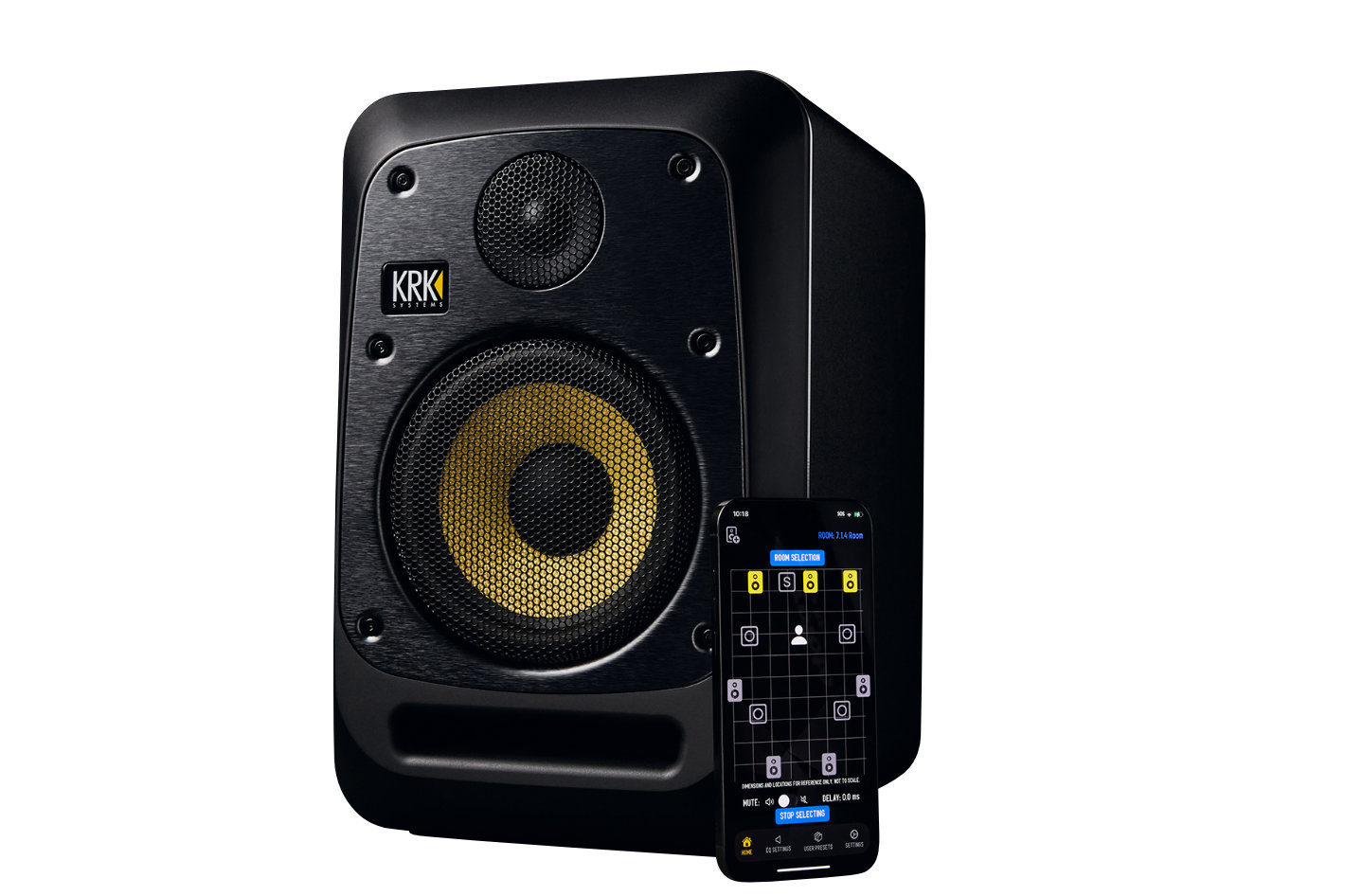
While the hardware components of the V Series Five are formidable, the true differentiator is the integration of KRK Mesh technology and the KRK Control App (available for iOS and Android). This ecosystem fundamentally alters how engineers interact with their monitors.
                   +-----------------------+
                   |  KRK Control App      |
                   |  (iOS / Android)      |
                   +-----------+-----------+
                               |
                       (Wireless Link)
                               |
                               v
                     +-------------------+
                     |  Monitor 1 (Left) | <--- KRK Mesh ---> [Monitor 2 (Right)]
                     +-------------------+
                               ^
                               | (Mesh Network)
                               v
                     [Sub / Surround Nodes]
Real-Time Calibration from the Sweet Spot
In traditional studio setups, adjusting a monitor’s EQ to match the room is a tedious, iterative process. The engineer makes an adjustment at the back of the speaker, walks back to the listening position, plays a reference track, notes the acoustic anomalies, and repeats the process.
With the KRK Control App, this friction is entirely eliminated. Operating over a secure, low-latency wireless network established by the monitors’ internal wireless chips, the app allows users to sit at their precise mixing position and adjust settings in real-time. Engineers can:
- Adjust global system levels and input sensitivity.
- Compare different EQ profiles on the fly to hear immediate results.
- Manage mute and standby states.
- Store and instantly recall custom tuning profiles.
Immersive Audio and Speaker Grouping
As Dolby Atmos and other spatial audio formats become mandatory deliverables for streaming platforms, multi-speaker setups are becoming the norm. Calibrating a 7.1.4 immersive array (consisting of seven bed channels, one subwoofer, and four overhead channels) is an acoustic and logistical nightmare.
The KRK Control App solves this by allowing users to group monitors. If an engineer needs to dim the entire system, adjust the level of the overhead height channels, or apply a global high-pass filter, they can do so with a single slider in the app. The monitors communicate with each other via the KRK Mesh network, executing commands simultaneously and maintaining perfect system phase and gain alignment.
Supporting Context & Performance Metrics
The V Series Five is available in three distinct models, each engineered to address specific room sizes, listening distances, and low-frequency reproduction requirements.
| Metric / Feature | KRK V4 Series Five | KRK V6 Series Five | KRK V8 Series Five |
|---|---|---|---|
| Low-Frequency Driver | 4-inch Woven Kevlar | 6.5-inch Woven Kevlar | 8-inch Woven Kevlar |
| High-Frequency Driver | 1-inch Silk Dome | 1-inch Silk Dome | 1-inch Silk Dome |
| Amplifier Power (LF/HF) | 280W / 175W | 280W / 175W | 280W / 175W |
| Frequency Response | 48 Hz – 40 kHz | 40 Hz – 40 kHz | 32 Hz – 40 kHz |
| Maximum Peak SPL | 113 dB SPL | 118 dB SPL | 121 dB SPL |
| Acoustic Optimization | 49 Boundary EQ / 7 Parametric | 49 Boundary EQ / 7 Parametric | 49 Boundary EQ / 7 Parametric |
| Digital Connectivity | AES3 Digital Input | AES3 Digital Input | AES3 Digital Input |
Acoustic Customization Options
Every room presents unique acoustic challenges. Sound waves bouncing off mixing desks, walls, and ceilings create constructive and destructive interference, resulting in colored monitoring. To combat this, the V Series Five offers unprecedented onboard DSP tuning options:
- 49 Boundary EQ Combinations: Pre-configured filters designed to correct for common speaker placements, such as corner loading, wall proximity, or console-top mounting.
- 7 Parametric PRO EQ Filters: For surgical room correction, the app provides seven bands of fully parametric EQ, allowing engineers to target precise resonant frequencies or nulls caused by physical room dimensions.
- User Presets: Up to three unique user-defined presets can be saved directly to the monitors’ internal flash memory, allowing for instant switching between different tuning targets (e.g., a flat mixing curve, a high-frequency roll-off for long sessions, or a consumer curve simulation).
Connectivity and Professional Integration
The V Series Five is built to integrate seamlessly into high-end professional signal chains. The rear panel features a premium NEUTRIK combo XLR/TRS input for robust analog connections.
Additionally, the inclusion of AES3 digital inputs allows engineers to feed digital audio directly from their audio interfaces or monitor controllers into the speakers, bypassing unnecessary digital-to-analog and analog-to-digital conversion stages. This direct digital signal path preserves the absolute integrity of the audio signal, ensuring the lowest possible noise floor and phase distortion.
Other professional-grade utilities include user-configurable standby modes to conserve energy when the studio is idle, a ground lift switch to eliminate troublesome hums caused by ground loops, and a dimmable, illuminated front-panel KRK logo that serves as a visual status indicator.
Official Statements and Strategic Positioning
The launch of the V Series Five represents a highly strategic move for KRK Systems and its parent company, Gibson Brands. By elevating the V Series to a highly connected, software-defined ecosystem, KRK is positioning itself to compete directly with premium European monitoring brands in the commercial and educational sectors.
Andrew Ladner, KRK Marketing Manager, highlights the legacy and future trajectory of the V Series:
"The V Series has long been KRK’s flagship studio monitor, trusted by engineers and producers around the world for its precision and reliability. V Series Five builds on that legacy, delivering the sonic accuracy for which V Series is known, while evolving to meet the demands of today’s modern workflows. The latest generation represents a significant leap forward in both performance and functionality."
Ladner emphasizes that the addition of wireless control transforms the monitors from isolated hardware units into an interactive network:
"With the addition of the Control App and KRK Mesh, V Series Five expands beyond exceptional monitoring into a more connected, intelligent studio ecosystem. For more than 40 years, KRK has earned the trust of everyone from first-time mixers to Grammy®-winning professionals. We’re proud to carry that legacy forward with V Series Five, setting a new benchmark for the performance, innovation, and sonic accuracy that define the KRK name."
Industry analysts note that by combining premium Pascal amplification and ESS conversion with wireless control, KRK is addressing a critical market gap. While other manufacturers offer networked DSP calibration, they often rely on expensive, proprietary hardware interfaces, proprietary measurement microphones, and complex Ethernet wiring. KRK’s decision to utilize a mobile-friendly wireless mesh network democratizes advanced DSP tuning, making it accessible to independent producers and commercial facilities alike.
Future Outlook: The Software-Defined Control Room
As music production, sound design, and film scoring continue to decentralize, the environments in which audio is created will remain highly variable. The traditional notion of a static control room is giving way to modular, agile production spaces that must adapt to different tasks on a daily basis.
In this context, the future of studio monitoring lies in software-defined hardware. The V Series Five is a pioneer in this category. Because the monitors’ DSP and wireless communication protocols are firmware-upgradable, KRK has created a platform that can evolve over time. Future software updates could introduce advanced features such as:
- Automated, guided room calibration using a mobile device’s internal microphone or a calibrated measurement mic plugged directly into a phone.
- Integration with third-party room correction software.
- Dynamic bass management that automatically coordinates crossover points between V Series satellites and subwoofers over the wireless mesh network.
Furthermore, the rise of spatial audio formats like Dolby Atmos, Apple Spatial Audio, and Sony 360 Reality Audio will continue to drive the demand for multi-channel monitoring configurations. By simplifying the routing, grouping, and EQ calibration of high-channel-count systems, KRK’s V Series Five lowers the barrier of entry for studios looking to upgrade to immersive capabilities.
With its uncompromising hardware foundation, massive power reserves, and forward-thinking wireless control ecosystem, the fifth-generation V Series does not merely reproduce sound with clinical accuracy—it intelligently adapts to the space it occupies, ensuring that the engineer’s creative vision translates perfectly to the outside world.