Executive Overview
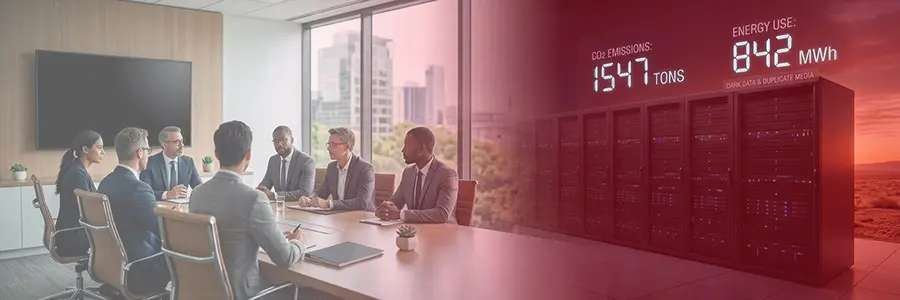
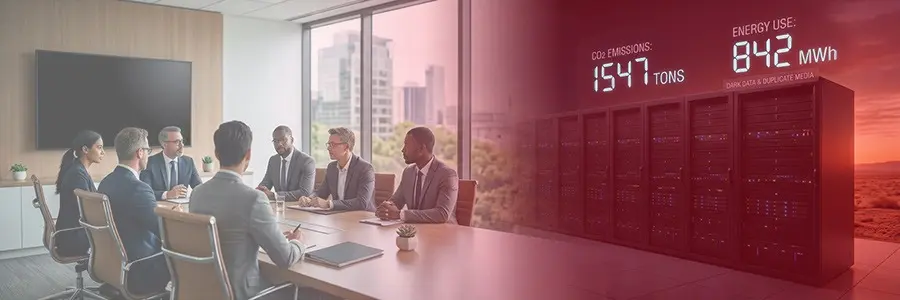
For decades, the core narrative of Digital Asset Management (DAM) has been defined by efficiency, accessibility, and valuation. The industry’s primary objective has always centered on asset discovery, security compliance, brand governance, and velocity—ensuring that the right creative file reaches the right channel at precisely the right moment. Yet, a critical metric has remained glaringly absent from the modern DAM ledger: the environmental cost of keeping those assets alive.
Every master file, high-resolution video, layered design project, archived marketing campaign, and synthetic AI-generated variant sits on storage infrastructure that demands continuous power, requires intensive cooling, and traverses complex networks spanning the globe. Despite this heavy operational footprint, carbon consumption almost never appears in a metadata schema, a budgetary business case, or a vendor selection review.
As corporate digital libraries expand exponentially—driven by 4K/8K video, 3D modeling, and generative AI proliferation—the cumulative weight of dark data, redundant renditions, and neglected archives is becoming impossible to ignore. Simultaneously, regulatory frameworks are tightening. Governments worldwide are shifting from voluntary corporate social responsibility metrics to mandatory reporting obligations that target data center emissions, water consumption, and energy efficiency.
In light of these pressures, DAM News is issuing a formal call to action for the global DAM community. We are inviting practitioners, enterprise architects, software vendors, and academic researchers to share their insights, methodologies, and real-world case studies regarding the environmental impact of digital asset management. This article explores the hidden dimensions of DAM sustainability, examines the emerging regulatory landscape, and outlines how industry professionals can contribute to an ongoing investigative series aimed at greening our digital supply chain.
Detailed Chronology: From Infinite Storage to the Carbon Crisis
To understand how the DAM industry arrived at this ecological crossroads, it is necessary to examine the evolution of digital storage and asset management over the past thirty years.
The Era of Abundance (Late 1990s – 2010s)
In the early days of enterprise DAM deployment, the focus was on liberation. Organizations were moving away from physical slide libraries, disjointed local hard drives, and fragmented FTP servers. Cloud storage providers and on-premises storage arrays promised near-infinite scalability. During this period, disk space prices plummeted while capacity soared. The prevailing technological philosophy was simple: save everything just in case. Deletion carried a psychological and operational risk—what if a campaign needed to be resurrected? What if legal required an old asset?
Consequently, DAM repositories became digital landfills. Assets were ingested with multiple renditions automatically generated for web, print, and broadcast, often duplicating terabytes of data without lifecycle policies or automated purging mechanisms.
The Big Data and AI Explosion (2020s – Present)
The transition to high-definition video, immersive 3D spatial computing assets, and rich media formats exponentially increased file sizes. Compounding this is the modern generative AI boom. Teams now generate hundreds of synthetic iterations, prompt variations, and AI-upscaled assets for a single campaign.
While these tools boost creative output, they multiply the underlying infrastructure requirements. Every synthetic image or video model trained and stored demands compute cycles. Headlines regarding data center grid connections, water usage for liquid cooling, and surging electricity demands are now daily fixtures in mainstream business media. Yet, within enterprise boardrooms and marketing operations meetings, the operational footprint of the DAM platform itself remains a blind spot.
The Regulatory Awakening (2024 and Beyond)
The historical disconnect between digital workflows and environmental accountability is rapidly closing. Governments are no longer treating digital infrastructure as an invisible utility. Regulatory mandates are penetrating deeper into the tech stack, forcing organizations to account for the energy consumed not just by heavy manufacturing, but by the data pipelines that power modern enterprises.
Supporting Context & Metrics: The Anatomy of a Digital Footprint
To measure the environmental impact of a DAM system, one must look beyond the user interface and examine the physical and logical layers that keep the platform running.
1. Storage Tiers and Energy Draw
Not all storage is created equal. High-performance Solid State Drives (SSDs) used for active, immediate-access DAM environments consume significant power and have intensive manufacturing footprints. Conversely, nearline storage and deep archive tiers (such as tape or glacier cloud storage) draw less active power but still require climate-controlled facilities. Multiply this across millions of enterprise assets—many of which have not been viewed, downloaded, or referenced in years—and the baseline energy consumption becomes staggering.
2. The Multiplier Effect of Renditions
A single raw 8K video file ingested into a DAM does not sit quietly. Automated workflows often generate a dozen derivative renditions—proxy files, web-optimized MP4s, thumbnail grids, and format-specific conversions for various social channels. If that asset is replicated across multiple regional cloud regions for faster Content Delivery Network (CDN) access, its carbon footprint multiplies exponentially.
3. Network Transit and CDN Overhead
Moving files across global networks consumes energy at every network hop, router, and switch. While edge caching and CDNs optimize user experience, they also distribute cached copies of assets across hundreds of edge data centers worldwide. When these assets are obsolete or rarely accessed, that energy expenditure represents pure waste.
Official Regulatory Standards and Compliance Shifts
The regulatory landscape governing digital carbon footprints is shifting from a patchwork of voluntary guidelines into stringent legal requirements. Enterprise DAM teams can no longer afford to operate in a sustainability vacuum.
European Union Regulations
In the EU, the Corporate Sustainability Reporting Directive (CSRD) has vastly expanded the scope of what companies must disclose regarding their environmental impact. Furthermore, specific legislation targeting data center operators—particularly those with an IT power demand of 500 kW or more—now requires mandatory reporting of energy consumption, waste heat utilization, water usage, and renewable energy procurement to central databases. As enterprise clients fall under these reporting umbrellas, they are beginning to audit their entire software supply chain, including SaaS DAM vendors and cloud hosting providers.
United Kingdom and Global Frameworks
In the UK, Sustainability Reporting Standards are increasingly serving as benchmarks for organizations preparing for mandatory adoption phases. Similar legislative winds are blowing across various North American states and Asia-Pacific economies.
These regulatory shifts prompt an uncomfortable question for enterprise technology leaders: If an auditor asks for the carbon cost of your digital asset supply chain, can your DAM team provide an answer? Most organizations currently lack the telemetry, metadata schemas, or vendor reporting tools required to calculate these figures accurately.
Future Outlook: The Path Toward Sustainable DAM
Addressing the environmental impact of digital asset management will require a collaborative effort across the entire ecosystem—involving enterprise practitioners, software developers, cloud providers, and industry analysts.
What DAM News Is Looking For
To foster a transparent, constructive dialogue on this critical issue, DAM News is actively seeking contributions from professionals across the industry. We want to hear from those who are measuring, questioning, or actively reducing the environmental impact of their digital asset operations.
We welcome submissions addressing, but not limited to, the following areas:
- Methodologies for Measurement: How are forward-thinking teams calculating the carbon cost or energy consumption of their DAM storage and delivery pipelines?
- Lifecycle Management and Archival Policies: Practical strategies for identifying and purging "dark data," redundant renditions, and obsolete assets without violating legal retention requirements.
- Vendor Accountability: Evaluating SaaS and on-premises DAM vendors on their green hosting practices, renewable energy commitments, and energy-efficient software architecture.
- The Creative vs. Sustainability Trade-Off: Honest accounts of friction points where corporate sustainability goals collide with legal retention mandates, intensive creative requirements, or aggressive marketing demands.
Editorial Guidelines and Submission Details
To maintain the highest standards of journalistic integrity, submissions must adhere to the following criteria:
- Length: Articles must be a minimum of 800 words (though comprehensive deep dives exceeding this length are strongly encouraged).
- Exclusivity: Content must be original and exclusive to DAM News.
- Tone: Submissions must be strictly non-promotional, focusing on objective analysis, case studies, and industry advancement rather than marketing specific products or services.
- Editorial Standards: All articles must adhere to our published editorial guidelines.
A Special Note on AI Assistance: Given the thematic focus of this series on resource conservation and authentic human insight, extra kudos and editorial preference will be given to contributors who draft their articles entirely without the use of generative AI writing assistants.
How to Submit
Please send your completed pitches, outlines, or article drafts directly to Russell McVeigh at [email protected].
DAM News reserves the right to modify submissions as necessary to comply with our editorial guidelines, and we will collaborate closely with authors on any required revisions. Upon publication, we will proudly provide reciprocal backlinks to your personal website, corporate platform, and/or professional LinkedIn profile, ensuring your thought leadership is recognized across the global DAM community.
The digital infrastructure we build today will define our environmental legacy tomorrow. It is time to bring the hidden carbon ledger of Digital Asset Management into the light.