Executive Overview
In the rapidly shifting landscape of digital marketing and B2B communication, the currency of trust has never been more volatile—or more valuable. Traditional corporate advertising, once the undisputed king of brand awareness, faces a growing wall of skepticism from modern consumers and decision-makers alike. Audiences have become adept at tuning out polished, overly sanitized corporate messaging. Instead, they are turning toward peer recommendations, individual insights, and organic endorsements to guide their professional and purchasing decisions.
Recognizing this seismic shift in buyer behavior, professional networking giant LinkedIn has continually refined and expanded one of its most potent advertising tools: Thought Leader Ads. Designed to bridge the gap between organic advocacy and paid reach, this format allows brands to amplify user-generated content (UGC) and organic posts originating from real people—ranging from internal employees to external industry experts and satisfied customers.
Recently, LinkedIn released an updated suite of strategic tips aimed at helping brands maximize the efficacy of these campaigns. By leveraging these insights, marketers can reinforce brand messaging, humanize their corporate presence, and drive significantly higher engagement rates than those achieved through traditional promotional channels.
This deep-dive report explores the mechanics of LinkedIn’s Thought Leader Ads, traces the chronological evolution of the feature from its inception to its latest iterations, analyzes the compelling data supporting its use, and offers an authoritative look at the future of influencer-driven B2B marketing.
Detailed Chronology: The Evolution of LinkedIn Thought Leader Ads
To understand the current utility and strategic weight of LinkedIn’s Thought Leader Ads, one must examine how the feature has systematically evolved over time. LinkedIn did not introduce this capability overnight; rather, it has been built through a deliberate, phased rollout designed to test, learn, and expand the boundaries of paid advocacy.
Phase 1: The Employee-Centric Foundation
In its initial iterations, LinkedIn’s ad ecosystem heavily favored brand-owned pages. While sponsored content and single-image ads drove baseline awareness, they lacked the raw authenticity that modern buyers craved. Recognizing that employees are often a company’s greatest brand ambassadors, LinkedIn introduced early frameworks allowing companies to sponsor posts originating directly from their workforce. This allowed organizations to put paid backing behind thought-leadership articles, milestones, and personal reflections shared by their staff. The results were immediate: engagement rates climbed as audiences interacted with real faces and distinct professional voices rather than faceless corporate logos.
Phase 2: Opening the Floodgates to Any User (March 2025)
A watershed moment for the platform occurred in March 2025. In a move that fundamentally democratized the ad format, LinkedIn expanded Thought Leader Ads to enable brands to sponsor organic posts from any user on the platform, moving well beyond the confines of internal employees.
This update broke down the artificial barrier between internal corporate advocacy and external customer delight. Suddenly, brands had the technical capability to amplify glowing testimonials, critical industry commentary, or product reviews written by external stakeholders, partners, or industry leaders. By backing these independent voices with advertising dollars, companies could borrow instant credibility from voices outside their direct corporate payroll.
Phase 3: The Integration of Live Events (August 2025)
Building on the momentum of the March expansion, LinkedIn rolled out another critical update in August 2025: the integration of Thought Leader Ads for live events. Recognizing that professional webinars, conferences, and virtual roundtables are massive drivers of community engagement, LinkedIn allowed brands to sponsor member posts that specifically linked to live events.
This enhancement transformed how companies drove event registrations. Instead of relying solely on standard event-invite ads—which often felt like cold solicitations—brands could now amplify organic posts where attendees or speakers discussed, anticipated, or reviewed live sessions. This peer-driven social proof dramatically increased sign-ups by framing attendance not as a corporate obligation, but as a community-driven imperative.
Phase 4: Modern Best Practices and Strategic Optimization
Today, the feature stands as a sophisticated cornerstone of LinkedIn’s ad suite. With the release of its latest strategic tips, LinkedIn is pushing brands to move past basic boosting and focus on deliberate curation. The modern iteration of Thought Leader Ads requires marketers to act less like traditional ad buyers and more like community curators—identifying high-value organic conversations, securing permissions, and strategically placing paid weight behind the voices that matter most.
Supporting Context & Metrics: Why Peer Advocacy Outperforms Corporate Messaging
The strategic pivot toward Thought Leader Ads is not based on guesswork; it is firmly rooted in hard data and shifting psychological paradigms within the B2B buyer’s journey.
The Death of the Hard Sell
For decades, B2B marketing relied on a top-down model: the brand speaks, the audience listens, and the sales funnel converts. However, contemporary research paints a vastly different picture. Modern decision-makers are inundated with digital noise. They do not want to be sold to; they want to be educated, guided, and reassured by peers who have walked the same path.
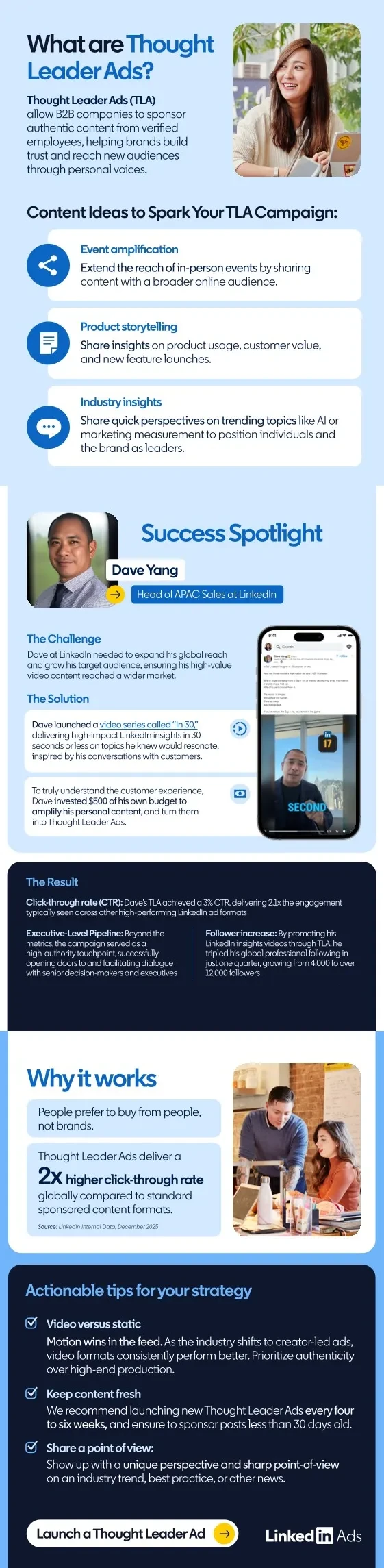
Data compiled by LinkedIn and research partner Edelman highlights this profound psychological shift. According to their findings, an overwhelming 71% of business decision-makers find thought leadership content to be more effective than conventional advertising approaches in demonstrating the capabilities and trustworthiness of an organization. When individuals see an industry peer articulate a nuanced business challenge or praise a transformative solution, their guard drops. They are no longer evaluating a marketing pitch; they are evaluating a peer review.
The Power of Engagement: The 1.6x Multiplier
From a media-buying efficiency standpoint, Thought Leader Ads have consistently outperformed traditional display formats. Recent platform metrics indicate that B2B marketers utilizing Thought Leader Ads see 1.6 times higher engagement rates compared to standard single-image promotions.
To put this into perspective within a media planning budget:
- Single-Image Ads: While reliable for broad visual reach, these ads often trigger banner blindness. Users instantly recognize them as paid placements and scroll past unless the creative is exceptionally striking.
- Thought Leader Ads: Because these ads retain the native look and feel of an organic user post—complete with the author’s personal profile picture, name, and headline—they disarm the user’s skepticism. The engagement is not merely passive viewing; it manifests as meaningful comments, thoughtful shares, and direct profile interactions.
Tapping into Individual Endorsement
The psychological engine driving these metrics is the power of individual endorsement. When a brand simply says, "Our product is industry-leading," the audience expects bias. However, when an independent industry practitioner says, "We integrated this solution into our workflow, and it solved X, Y, and Z challenges," the dynamic changes entirely. Thought Leader Ads allow brands to operationalize this phenomenon at scale. By investing ad spend behind organic advocacy, companies transform individual voices into scalable brand assets.
Official Guidelines: Best Practices for Maximizing LinkedIn Thought Leader Ads
To help marketers capitalize on these dynamics, LinkedIn recently outlined key strategic recommendations. Success with Thought Leader Ads requires a delicate balance of content curation, ethical outreach, and precise audience targeting. Below is an exhaustive breakdown of how to operationalize these tips effectively.
1. Identifying and Curating High-Value Content
The foundation of a successful Thought Leader Ad campaign is the quality of the underlying organic post. Brands should not sponsor mediocre content simply because it mentions their name or product.
- Hunt for Nuance: Look for posts that offer deep insights, address complex industry pain points, or tell a compelling transformation story.
- Monitor Brand Mentions and Tags: Utilize social listening tools and native platform alerts to track when industry experts, clients, or employees organically discuss your brand, sector, or relevant macro-trends.
- Prioritize Sentiment: Ensure that the sentiment of the post aligns seamlessly with your brand values and overarching marketing objectives.
2. Establishing Ethical and Collaborative Partnerships
Unlike traditional sponsored content where creative assets are generated internally, Thought Leader Ads require human collaboration. You are dealing with real people’s personal profiles and intellectual property.
- Secure Clear Consent: Always reach out to the author of the post before initiating an ad campaign. Explain your intention to amplify their voice, discuss how it aligns with mutual goals, and ensure they are comfortable with their post receiving paid backing.
- Maintain Authenticity: Do not attempt to heavily edit or rewrite the user’s original words. The primary value of the ad format is its raw, unvarnished authenticity. If a post feels overly corporate or sanitized by the brand, it loses its psychological edge.
- Build Long-Term Advocacy Loops: Treat content creators and employee advocates as true partners. When individuals see their content successfully amplified and engaging wide audiences, they are far more likely to continue creating high-value content relevant to your ecosystem.
3. Strategic Alignment with Campaign Objectives
Thought Leader Ads should not exist in a vacuum. They must be woven into your broader omnichannel marketing strategy.
- Map to the Funnel: Use thought leadership posts authored by technical experts or engineers for top-of-funnel educational campaigns. Conversely, leverage customer testimonials, case studies, and live-event recaps for mid-to-bottom-funnel consideration stages.
- Complement Event Marketing: With the introduction of live-event sponsorships, brands should actively scan for organic posts surrounding webinars or conferences. Sponsoring these posts creates an organic community buzz that drives registrations far more effectively than sterile registration landing page ads.
4. Precision Targeting and Iterative Optimization
Even the most authentic, brilliant piece of thought leadership will underperform if placed in front of the wrong audience.
- Leverage LinkedIn’s Targeting Parameters: Utilize job titles, industry filters, company sizes, and account-based marketing (ABM) lists to ensure the sponsored post reaches the exact decision-makers you intend to influence.
- A/Test Author Dynamics: Experiment with running ads from different types of authors. Compare the performance of posts written by C-suite executives versus frontline practitioners or external industry analysts. You may find that practitioner voices drive significantly higher engagement among technical buyers.
- Monitor Key Performance Indicators (KPIs): Look beyond vanity metrics like impressions. Focus on engagement rate, click-through rate (CTR), cost-per-click (CPC), and downstream pipeline impact to accurately gauge the return on ad spend (ROAS).
Future Outlook: The Next Frontier of B2B Advertising
As we look toward the future of digital marketing, the trajectory of LinkedIn’s Thought Leader Ads offers a clear window into where the industry is heading. The era of the monolithic corporate brand shouting into the void is rapidly giving way to networked, human-centric ecosystems.
The Rise of the Decentralized Brand
In the coming years, brands will increasingly realize that their most powerful marketing assets do not sit inside their marketing department—they are distributed across their entire ecosystem of employees, customers, partners, and industry influencers. Thought Leader Ads provide the technological bridge required to harness this decentralization. Rather than building brand authority from the top down, successful companies will cultivate it from the ground up, using paid media not to invent narratives, but to pour fuel on authentic conversations already happening in the wild.
Integration of Advanced AI and Curation
As the volume of user-generated content continues to explode, identifying the right posts to sponsor will become increasingly complex. Future iterations of platform tools will likely incorporate advanced artificial intelligence and natural language processing (NLP) to help brands automatically surface high-performing organic mentions, gauge sentiment at scale, and predict which user posts possess the highest probability of driving conversion. However, even as automation increases, the human element—the genuine relationship between brand and creator—will remain irreplaceable.
Evolving Consumer Expectations
Ultimately, buyers are becoming increasingly sophisticated at filtering out manufactured corporate narratives. They crave transparency, vulnerability, and real-world proof. Formats that blend organic social proof with targeted paid distribution will no longer be considered a "novel" marketing tactic; they will become the baseline standard for effective B2B communication.
For modern marketers, the message is unequivocal: embrace authenticity, empower the voices within and around your ecosystem, and leverage tools like LinkedIn’s Thought Leader Ads to turn genuine human insight into your most scalable competitive advantage.