Executive Overview
The landscape of enterprise software security is undergoing a seismic shift. Over the past few months, security operations teams have been caught in an escalating arms race, watching frontier artificial intelligence models surface vulnerabilities faster than most traditional organizations can patch them. In response to this compounding threat matrix, Oracle has unveiled Java 27, a release designed not merely to iterate on the world’s most widely deployed programming language, but to fundamentally alter how the platform handles security cadence, cryptographic resilience, and architectural scaling.
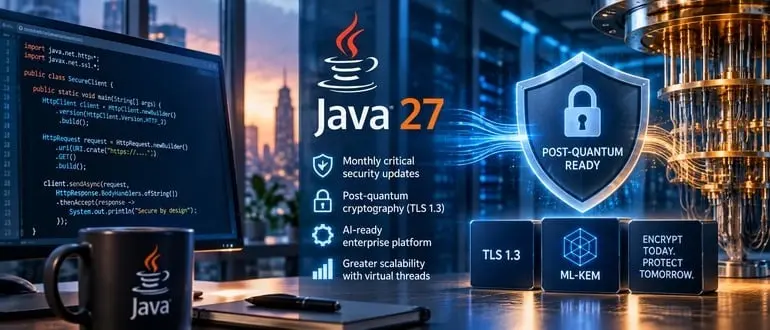
Released on September 15, Java 27 introduces two primary paradigms: an acceleration of Oracle’s critical security patching schedule—moving toward a monthly cadence to close the remediation window—and the platform’s most significant cryptography milestone in years. Specifically, Java 27 integrates post-quantum hybrid key exchange into Transport Layer Security (TLS) 1.3. This forward-looking feature is engineered to protect sensitive enterprise data from being harvested today and decrypted tomorrow once quantum computing matures.
Beyond security, Java 27 brings critical optimizations for the modern enterprise. By aligning its release schedule with Helidon 27, introducing advanced virtual-thread capabilities, and updating core rendering and compliance tooling like JavaFX 27 and Oracle Jipher 20, Oracle is attempting to future-proof the Java ecosystem. However, industry analysts note that while the technology is groundbreaking, the operational realities—particularly the staggered backport timeline for legacy enterprise environments—will present significant challenges for IT leaders worldwide.
Detailed Chronology & Core Technical Features
To understand the scope of Java 27, one must examine its technical architecture and the deliberate sequencing Oracle has engineered for its deployment across the enterprise ecosystem.
The Post-Quantum Leap: JEP 527 and ML-KEM
The headline feature of Java 27 is designated as JEP 527. This specification integrates ML-KEM (Module-Lattice-Based Key-Encapsulation Mechanism) hybrid key exchange natively into TLS 1.3. Crucially, Oracle has implemented this cryptographic upgrade with minimal disruption for existing applications. Standard Java TLS clients and servers can leverage these post-quantum protections with virtually zero code changes required.
This capability directly addresses the burgeoning enterprise anxiety surrounding the "harvest now, decrypt later" attack vector. Malicious actors, nation-states, and sophisticated criminal syndicates are routinely intercepting and storing encrypted network traffic today. When cryptanalytically relevant quantum computers finally arrive, this archived data can be retrospectively decrypted. By embedding post-quantum cryptography directly into the runtime environment, Java 27 allows organizations to establish a defensive posture years ahead of the quantum threat materializing.
The Staggered Backport Dilemma
While Java 27 introduces native post-quantum defenses immediately, the vast majority of enterprise workloads do not run on bleeding-edge Java versions. Recognizing this, Oracle has published an extensive backport roadmap to push ML-KEM capabilities into older Long-Term Support (LTS) releases:
- JDK 25: Scheduled to receive the capability during its October critical patch update.
- JDK 21 and JDK 17: Slated for the first half of 2027.
- JDK 8 and JDK 11: Slated for the second half of 2027.
This staggered rollout exists because older LTS releases operate on legacy foundational architectures. They predate modern innovations like virtual threads and the Java Platform Module System, both of which are required to cleanly integrate complex cryptographic primitives without introducing regressions.
Microservices and Concurrency: Helidon 27 and Virtual Threads
Java 27 also marks a major milestone for microservices architecture by shipping alongside Helidon 27, Oracle’s native microservices framework. For the first time, Helidon and the Java Platform are operating on a synchronized release schedule—a goal the development team spent nearly a year achieving.
Helidon 27 leans heavily into Project Loom’s virtual threads, layering Scoped Values on top of the existing virtual-thread foundation. This architectural synergy allows developers to write straightforward, traditional synchronous code while retaining the extreme scalability previously reserved for complex asynchronous programming models.
In legacy environments, developers faced a trade-off: blocking I/O requests meant pinning a physical OS thread, severely limiting concurrent connection handling. With virtual threads, the Java Virtual Machine (JVM) dynamically parks and resumes lightweight virtual threads as I/O operations complete. Consequently, a Kubernetes-hosted microservice running on Helidon 27 can handle exponentially more concurrent connections while maintaining a lean memory footprint.
Ecosystem Additions: JavaFX 27 and Oracle Jipher 20
The Java 27 release train extends its reach into desktop rendering and highly regulated compliance sectors:
- JavaFX 27: Features a new Metal-based rendering pipeline optimized for macOS, alongside enhanced text-editing controls tailored for dense analytics dashboards and operational tooling.
- Oracle Jipher 20: A FIPS 140-3-validated cryptographic provider delivered through Oracle’s Java Verified Portfolio, offering critical compliance guardrails for organizations operating in government, financial, and healthcare sectors.
Supporting Context & Industry Metrics
The release of Java 27 arrives against a backdrop of mounting operational pressure on software development and security teams. The proliferation of AI-driven vulnerability discovery tools has fundamentally compressed the timeline between the identification of a software flaw and its weaponization by threat actors.
Transitioning to a Monthly Security Cadence
Historically, Java security updates followed an annual schedule, which eventually compressed into a predictable quarterly cadence. With Java 27, Oracle is initiating a gradual transition toward monthly critical security patch updates issued between the traditional quarterly cycles.
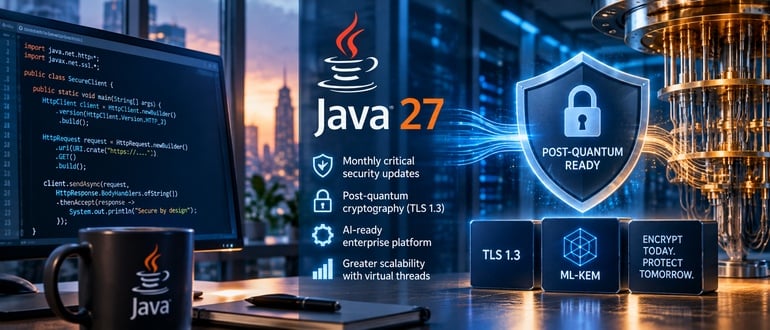
Crucially, these monthly patches will be strictly scoped to security fixes and stability improvements, containing zero new features. This measured approach aims to alleviate the operational fatigue of enterprise patch management while closing the exploitation window that malicious AI agents routinely exploit.
The Inversion of Enterprise Risk
Industry experts have pointed out a fascinating irony in Oracle’s rollout strategy. Mitch Ashley, vice president and practice lead for CIO & Technology Buyers and Software Lifecycle Engineering at The Futurum Group, highlighted that the backport schedule carries greater long-term consequences than the initial Java 27 release itself.
"The backport schedule matters more than the release," Ashley observed. "Post-quantum protection arrives first on the version with the least production code behind it, and last on JDK 8 and 11, where a large share of enterprise Java still runs. That inverts the risk. Teams carrying the oldest estates hold the traffic most exposed to harvest-now-decrypt-later capture, and they wait the longest for a platform fix. Those teams should inventory which TLS endpoints they can protect another way before 2027."
Ashley’s analysis underscores a harsh reality for enterprise architects: organizations relying on deeply entrenched, older Java estates cannot simply wait for a platform patch to solve their quantum vulnerability. They must proactively evaluate network-level mitigations, such as edge proxies or specialized cryptographic gateways, to shield legacy applications during the multi-year wait for backports.
Official Statements and Industry Perspectives
Leadership figures across the Java ecosystem have contextualized Java 27 as a pivotal stepping stone for the enterprise application landscape, particularly regarding the intersection of artificial intelligence and advanced security architecture.
Georges Saab, senior vice president of Oracle Java Platform and chair of the OpenJDK governing board, emphasized the continuity of Java’s mission while acknowledging the forward-looking nature of the new release:
"Java 27 continues that proud tradition by providing a stable foundation for today’s enterprise workloads and innovative AI and post-quantum cryptography capabilities," said Saab. "With Java 27, Oracle delivers a major post-quantum cryptography milestone and is executing on a roadmap to bring comparable capabilities to JDK releases with long-term support offered by Oracle."
Adding to this perspective, Arnal Dayaratna, research vice president for software development at IDC, underscored Java’s evolving role in the era of autonomous software systems:
"Java’s security, reliability, and enterprise scale make it a critical foundation for AI agents that require trusted access to business systems and sensitive data," Dayaratna noted. "Java 27’s tools for AI development and post-quantum cryptography strengthen its role at the center of enterprise application development and help organizations prepare for a new generation of applications and security threats in the agentic era."
As enterprise architectures increasingly pivot toward autonomous AI agents querying databases, executing API calls, and orchestrating cloud resources, the underlying runtime must guarantee absolute cryptographic integrity. Java 27 positions itself as the foundational trust layer for this agentic future.
Future Outlook: What Enterprise Teams Must Do Next
For organizations running Java in production, Java 27 presents a straightforward upgrade path, provided systems are not overly dependent on preview features. Oracle describes the release as a drop-in replacement for existing applications, minimizing friction during routine migration cycles.
However, platform and security teams must strategic plan their next moves carefully:
- Evaluate Post-Quantum Readiness Programs: Organizations with active cryptographic modernization initiatives have the clearest incentive to adopt Java 27 immediately. Early adoption allows internal security teams to validate interoperability and test ML-KEM hybrid key exchanges in staging environments before mandates take hold.
- Mitigate Legacy Exposure: For enterprises bound to JDK 8 or JDK 11, the wait until late 2027 for native post-quantum backports demands alternative risk mitigation. Security leaders should audit TLS endpoints handling sensitive data and consider deploying external network encryption layers (such as post-quantum service meshes or load balancers) to intercept and secure traffic flow.
- Prepare for Operational Shifts: As Oracle phases in its monthly patch cadence, IT operations teams must adjust their deployment pipelines, testing frameworks, and change-management protocols to handle more frequent, security-focused updates without disrupting business continuity.
None of these developments are occurring in a vacuum. Oracle has signaled that post-quantum readiness and enterprise AI integration will remain core themes throughout the remainder of the calendar year, with major announcements expected at upcoming industry gatherings like Oracle AI World in November.
For platform engineers and security officers already juggling AI-driven vulnerability disclosures alongside traditional maintenance tasks, Java 27 is far more than a routine version update—it is an essential roadmap for navigating the next decade of enterprise computing threats.