Executive Overview
In an era dominated by high-resolution digital sensors, real-time virtual production volumes, and sophisticated artificial intelligence workflows, it is easy to overlook the physical, analog components that keep a motion picture set functioning. Yet, behind every multi-million-dollar production lies a fragile ecosystem of physical commodities—commonly referred to in the industry as "expendables." These single-use or high-depletion items are the operational glue of the entertainment industry.
At the center of this supply chain stands Pacific Radio Electronics (popularly known as PacRad), an enterprise that industry professionals frequently term the "filmmaker’s hardware store." While PacRad is globally recognized for its deep inventory of high-end broadcast cables, signal converters, and specialized connectors, the company’s strategic inventory of everyday expendables reveals a fundamental truth about media production: the most advanced technological systems are utterly dependent on low-tech support structures.
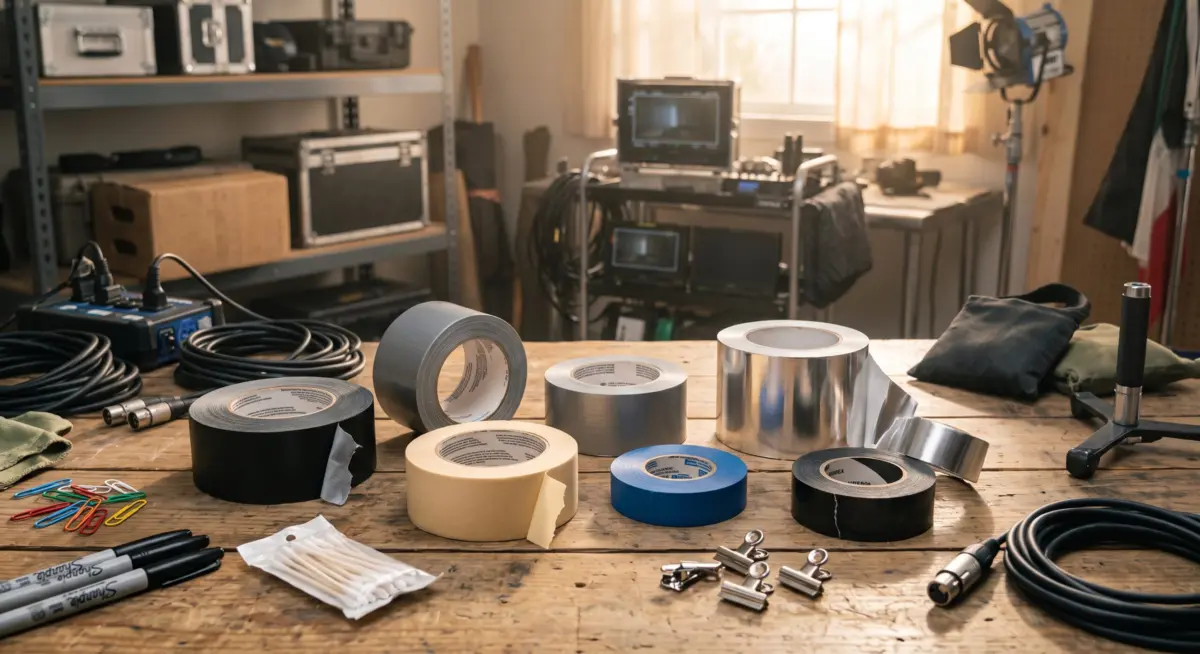
From specialized cotton swabs designed to clear dust from a $50,000 camera sensor to highly engineered adhesive tapes designed to withstand the thermal output of high-wattage lighting, expendables are critical to risk mitigation on set. This investigative report explores the technical specifications, chronological workflows, economic impacts, and future directions of the adhesive tapes and expendables that serve as the silent infrastructure of modern filmmaking.
Detailed Chronology: A Day in the Life of On-Set Expendables
To understand why a distributor like PacRad stocks hundreds of variations of tape, one must trace the chronological progression of a standard production day. Each phase of a shoot demands distinct physical properties from adhesives, demonstrating that tape is not merely a utility, but a highly specialized toolset.
[06:00] Gear Prep & Labeling ──> [08:00] Rehearsals & Marking ──> [10:00] Rigging & Cable Management ──> [13:00] Troubleshooting & Effects ──> [19:00] Wrap & Strike
       (Masking Tape)                  (Masking / Gaffer)                 (Gaffer / Electrical)                  (Duct / Mylar)                   (Clean Removal)
Phase 1: 06:00 – Gear Prep, Inventory, and Initial Labeling
Before a single camera sensor is powered on, the camera, grip, and electric departments must organize hundreds of thousands of dollars in rental equipment. This phase relies heavily on Masking Tape (crepe paper tape).
- The Workflow: Camera assistants (ACs) use color-coded masking tape to label battery charge states (e.g., green for fully charged, red for depleted), designate camera bodies ("A-Camera" vs. "B-Camera"), and label media card cases.
- The Technical Need: Masking tape features a low-tack, pressure-sensitive adhesive that allows it to be written on with permanent markers and peeled off metal, plastic, or carbon fiber without leaving behind sticky residue that could attract grit into sensitive lens mounts or electronic contacts.
Phase 2: 08:00 – Blocking and Rehearsals
As directors and actors walk through the blocking of a scene, the physical space must be mapped out to ensure repeatable focus pulls and precise framing.
- The Workflow: Camera assistants and script supervisors place small strips of colored masking tape or gaffer’s tape (often called "T-marks" or "toe-marks") on the floor.
- The Technical Need: These marks tell actors where to stand and show the focus puller exactly where to measure distance. The tape must adhere instantly to carpet, concrete, or polished wood, yet release cleanly without stripping the location’s varnish or paint when the camera setup changes.
Phase 3: 10:00 – Rigging and Cable Management
Once the blocking is locked, the lighting and grip departments begin routing power distribution cables (stingers) and data lines (DMX and SDI cables). This is the domain of Gaffer’s Tape.
- The Workflow: Gaffers and best boys use wide rolls of matte-finish cloth tape to secure heavy cables along floors to prevent trip hazards, wrap cable bundles to clean up the visual environment, and temporarily secure light modifiers to C-stands.
- The Technical Need: The tape must possess high tensile strength to hold heavy rubber cables under tension, yet be easily tearable by hand in both horizontal and vertical directions to maintain speed on a fast-moving set.
Phase 4: 13:00 – Active Production and Real-Time Troubleshooting
During active filming, unforeseen problems inevitably arise. This is where specialized adhesives like Duct Tape, Electrical Tape, and Mylar Tape are deployed.
- The Workflow: If a piece of background scenery cracks, or if a temporary outdoor cable run needs to be weatherproofed against sudden rain, crew members reach for heavy-duty duct tape. If a low-voltage signal cable shows signs of shielding wear, or if a cable bundle needs tight, elastic binding, electrical tape is used. If the art department needs to repair the reflective interior of a softbox light or add metallic accents to a sci-fi prop, Mylar tape is deployed.
- The Technical Need: These tapes are chosen for their specific chemical and physical properties—waterproofing for duct tape, dielectric insulation for vinyl electrical tape, and high reflectivity and thermal stability for Mylar.
Phase 5: 19:00 – Wrap and Strike
At the end of the production day, every piece of tape applied over the previous 12 to 14 hours must be removed.
- The Workflow: Grips and PAs pull up hundreds of yards of tape from floors, walls, and equipment.
- The Technical Need: The choice of tape during the day dictates the speed of the wrap. High-quality gaffer’s and masking tapes peel away cleanly, leaving no residue. Low-quality or misapplied tapes (such as using duct tape on a hardwood floor) can result in hours of scraping, ruined surfaces, and thousands of dollars in location damage fees.
Supporting Context & Metrics: The Engineering and Economics of Adhesives
To appreciate why professional suppliers stock such a highly segmented array of tapes, it is necessary to examine the underlying materials science and the micro-economics of film production.
| Tape Type | Backing Material | Adhesive Type | Tensile Strength | Residue Risk | Primary On-Set Application |
|---|---|---|---|---|---|
| Masking Tape | Crepe Paper | Natural Rubber / Synthetic Blend | Low (~20 lbs/in) | Very Low | Labeling, focus marks, actor placement |
| Gaffer’s Tape | Vinyl-Coated Cotton Cloth | Synthetic Rubber (Non-transferring) | High (~45 lbs/in) | Low (Engineered for clean removal) | Cable down-stripping, rigging, light masking |
| Duct Tape | Polyethylene over Scrim | Aggressive Natural Rubber | Very High (~50 lbs/in) | High (Leaves sticky residue) | Emergency structural repair, weatherproofing |
| Electrical Tape | Plasticized PVC | Rubber-Based | Medium (~15 lbs/in) | Medium | Wire insulation, color-coding, connector protection |
| Mylar Tape | Polyester (PET) Film | Acrylic | High (~30 lbs/in) | Medium-Low | Reflective light repair, scenic design accents |
The Physics of the Matte Finish
A critical metric for on-set tape—particularly gaffer’s tape—is its gloss index. Standard industrial duct tape has a high-gloss polyethylene backing that highly reflects light. If used near a camera, these reflections can cause lens flares, ruin lighting setups, or reveal the location of hidden equipment.
Professional gaffer’s tape, by contrast, features a vinyl-coated cotton cloth backing with a microscopic texture designed to scatter light. This matte finish ensures that even under intense production lights, the tape remains virtually invisible to the camera sensor.
Specular Reflection (Duct Tape):
Light Source ───>  ───> Blinding Flare (Camera Lens)
                  ============= (Glossy PE Surface)

Diffuse Scattering (Gaffer's Tape):
Light Source ───>  ───> /  |  (Scattered Light)
                  ============= (Matte Cloth Surface)
The Financial Metrics of Set Delays
The economic justification for purchasing premium expendables from specialized distributors like PacRad is rooted in the high cost of production downtime. On a unionized commercial, television, or feature film set, the burn rate (the cost of crew, equipment rentals, location fees, and talent per hour) can range from $5,000 to over $50,000 per hour.
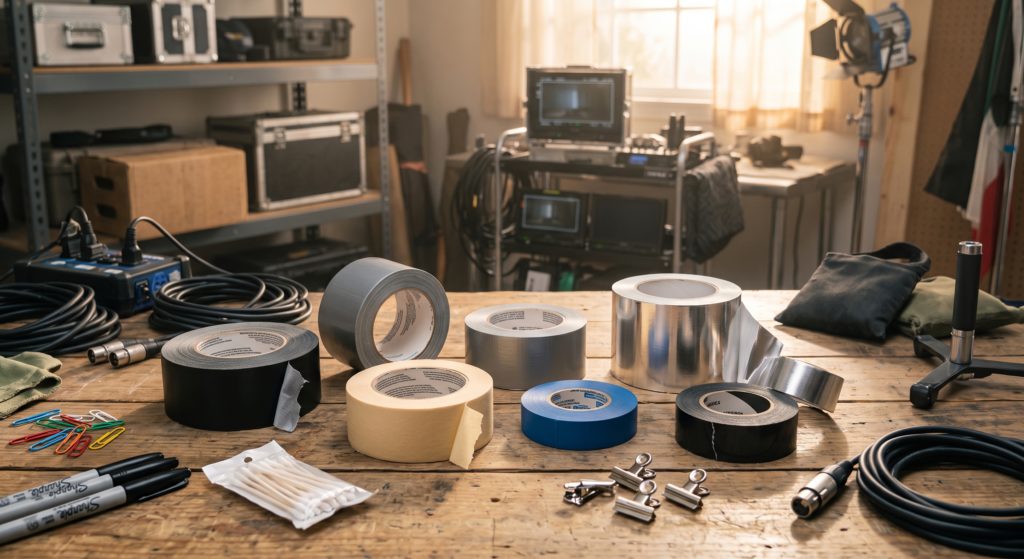
- The $10,000 Swab: If a speck of dust settles on an Alexa 35 sensor during a lens change, it will appear as a soft, dark spot on every frame. If the camera department does not have a specialized, lint-free cotton swab and sensor-safe cleaning fluid on hand, the camera must be shut down and potentially sent to a rental house. A 15-minute delay while a crew member runs to a local convenience store to find substandard cleaning supplies can cost a production upwards of $10,000 in lost labor time.
- The Adhesive Failure: Using cheap, non-branded cloth tape instead of professional-grade gaffer’s tape to secure cables can lead to catastrophic failures. If the adhesive warms up under the heat of staging lights, it can slip, causing a heavy cable run to fall from a truss. This not only risks damaging expensive lighting fixtures but also poses a severe liability hazard to cast and crew.
Official Statements: Industry Perspectives
The operational reality of on-set expendables is best articulated by the professionals who rely on them daily, as well as the suppliers who manage their distribution.
The Camera Assistant’s Perspective
Elena Rostova, a veteran First Assistant Camera (1st AC) working in the Los Angeles commercial industry, emphasizes that tape is a language of its own:
"People who don’t work in production think tape is just tape. But on set, color-coded masking tape is our primary communication system. When I write ‘A-CAM ROLLING’ or mark a battery with red tape, it’s a universal signal that every department understands instantly. If that tape peels off prematurely because of heat or humidity, or if the adhesive leaves a sticky film on a $40,000 Cooke anamorphic lens barrel, it ruins our workflow. We depend on suppliers like PacRad to provide consistent, high-grade tape stocks because we cannot afford to use adhesives that fail under pressure."
The Gaffer’s Perspective
Marcus Vance, a lighting director and gaffer with over two decades of television experience, highlights the safety and logistical aspects of gaffer’s tape:
"My department is responsible for miles of high-voltage cabling running through high-foot-traffic areas. We use gaffer’s tape not just to keep things neat, but to prevent people from tripping and hurting themselves or pulling down expensive lights. True gaffer’s tape is expensive for a reason: it has incredible tensile strength, but when we wrap at midnight, I can pull up fifty yards of it from a historic location’s marble floor and it leaves absolutely zero residue. If you try that with cheap hardware-store duct tape, you’ll strip the finish and end up with a massive bill from the location manager."
The Supplier’s Perspective
A logistics and procurement representative from PacRad notes the strategic importance of maintaining a diverse inventory of seemingly mundane items:
"Our customers come to us for high-end digital infrastructure—fiber optics, specialized SDI patch bays, and Neutrik connectors. But we quickly realized that a filmmaker cannot run a digital set without analog support. That is why we treat expendables with the same level of quality control as our high-end electronics. Whether it is sourcing paperclips for script supervisors, cotton swabs for camera technicians, or stocking twenty different colors of gaffer’s tape, we position ourselves as a one-stop-shop. If a crew has to stop at three different stores to get their cables, their tape, and their cleaning supplies, they are losing valuable pre-production time."
Future Outlook: The Green Transition and Technical Integration
As the entertainment industry faces mounting pressure to reduce its environmental impact and adapt to new technologies, the expendables market is undergoing a quiet revolution.
Traditional Expendables ───────────────> Future Eco-Friendly Alternatives
- Single-use plastic-coated tapes        - Biodegradable cotton-cloth backings
- Petroleum-based adhesives              - Water-soluble, organic starch adhesives
- Non-recyclable vinyl wraps             - Recyclable paper-based cable organizers
The Push for Sustainable Adhesives
The traditional film set is incredibly wasteful. A single television series can consume hundreds of rolls of tape per week, the vast majority of which ends up in landfills. In response, manufacturers are developing more sustainable options:
- Biodegradable Backings: Companies are experimenting with natural cotton fibers and paper backings that decompose quickly without releasing microplastics.
- Starch-Based Adhesives: Research is underway to replace petroleum-based synthetic rubbers with organic, starch-based adhesives that offer comparable shear strength and clean release properties but have a significantly lower carbon footprint.
Thermal Adaptations for LED Lighting
The industry-wide shift from high-heat tungsten and HMI lighting fixtures to energy-efficient LED systems (such as those manufactured by ARRI, Aputure, and Creamsource) has also changed the physical demands placed on on-set adhesives.
- Lower Thermal Thresholds: Historically, gaffer’s tape had to withstand surface temperatures exceeding 200°F (93°C) when applied near hot lighting housings.
- New Formulation Focus: With cooler-running LEDs, tape manufacturers can shift their focus from extreme heat resistance to optimizing shear strength, moisture resistance, and flexibility, allowing for lighter-weight backings and more specialized adhesive formulas.
Smart Inventory and the Digital Expendables Cart
Looking further ahead, the tracking and management of expendables are becoming increasingly digitized. Large-scale productions are beginning to employ RFID-enabled expendables carts.
- Real-Time Tracking: Every time a roll of gaffer’s tape, a pack of cotton swabs, or a can of compressed air is removed from the cart, the system automatically logs the item and updates the production’s digital inventory.
- Automated Restocking: This integration allows suppliers like PacRad to automatically dispatch restocking shipments directly to the production’s stage or location truck before the crew runs out of critical supplies, ensuring that physical logistical bottlenecks become a thing of the past.
In conclusion, while the digital revolution continues to reshape the creative tools of filmmaking, the physical realities of production remain firmly grounded in the material world. The success of a multi-million-dollar shoot will always depend on the reliability of its simplest components. By understanding the unique properties and roles of these humble tools, crews can work more safely, efficiently, and creatively—proving that on a modern film set, even the smallest roll of tape plays a vital role.