Executive Overview
The global race to construct next-generation artificial intelligence (AI) infrastructure represents one of the most aggressive, capital-intensive investment cycles in modern history. Hyperscalers, technology giants, and enterprise colocation providers are pouring unprecedented sums into cutting-edge data centers designed to meet an insatiable global demand for advanced computing capacity. Every new hyperscale campus stands as a monument to modern engineering, comprising billions of dollars in high-density computing hardware, robust electrical transmission infrastructure, advanced cooling systems, and intricate supporting utilities.
Yet, amidst this explosive growth and relentless focus on deployment speed, a critical vulnerability is quietly overlooked during project planning and execution: corrosion.
While industry headlines remain dominated by power availability, rack density limits, liquid cooling designs, and the sheer race to bring facilities online, asset reliability teams are raising alarms over a factor that directly undermines long-term operational integrity. Corrosion is rarely visible or destructive during the initial construction phase, making it remarkably easy to dismiss until equipment is actively commissioned or placed into high-load production.
Traditionally relegated to the status of a routine "maintenance issue," corrosion actually begins months—and sometimes years—before a data center ever processes its first token of AI inference. As expensive hardware winds its way through global manufacturing facilities, maritime transport, remote storage yards, and dynamic construction sites, it is exposed to corrosive environmental elements. For mission-critical facilities expected to operate continuously under extreme thermal and electrical stress, these early oversight decisions can trigger catastrophic premature failures, short-circuiting billions in capital investments.
Detailed Chronology: The Lifecycle of a Corrosion Risk
To understand how corrosion threatens modern AI data centers, one must trace the asset lifecycle from its genesis in manufacturing to its daily operation under heavy AI workloads. Unlike legacy enterprise data centers—which relied primarily on air-cooled perimeters and stable atmospheric conditions—AI infrastructure introduces complex vulnerabilities at every single phase of development.
[Manufacturing] ➔ [Transit & Logistics] ➔ [Extended Storage] ➔ [Construction/Assembly] ➔ [Commissioning] ➔ [Active Operations]Phase 1: Manufacturing and Initial Fabrication
The lifecycle of data center hardware begins globally, with components sourced from specialized manufacturers worldwide. During fabrication, metals such as copper, aluminum, and various steel alloys are exposed to machining fluids, ambient humidity, and airborne contaminants. Without immediate, proactive preservation treatments, microscopic oxidation can initiate at the microscopic level before the component ever leaves the factory floor.
Phase 2: Transportation, Logistics, and Maritime Transit
Once manufactured, hyperscale computing racks, heat exchangers, pumps, and specialized cooling distribution units (CDUs) embark on complex, multi-modal supply chains. Crossing oceans in shipping containers exposes sensitive electronics and metal alloys to aggressive salt-fog, extreme temperature fluctuations, and condensation cycles (commonly known as "container rain"). If packaging lacks proper vapor corrosion inhibitors (VCIs) or desiccant integration, transit becomes a primary breeding ground for early-stage rust and galvanic reactions.
Phase 3: Intermediate Storage and Laydown Yards
Because AI construction schedules are notoriously volatile—often hampered by supply chain bottlenecks, local zoning disputes, or permitting delays—equipment frequently sits idle for months. Warehouses, outdoor laydown yards, and partially completed data center shells rarely offer climate-controlled perfection. Here, fluctuating humidity, dust, and particulate exposure accelerate atmospheric corrosion on critical electrical contacts and cooling piping networks long before installation crews uncrate the hardware.
Phase 4: Construction, Assembly, and Site Integration
As equipment is moved into the data center shell, it enters a chaotic construction environment. Dust from drywall, concrete curing byproducts, welding fumes, and moisture from ongoing architectural work create a microclimate rife with corrosive potential. Furthermore, as different sub-contractors handle installation, responsibility for maintaining protective wrappings or temporary preservation measures often falls through the cracks.
Phase 5: Commissioning and the Introduction of Complex Water Chemistry
The transition from construction to operations involves rigorous testing, particularly for liquid-cooled architectures. High-density AI chips generate thermal loads that traditional air cooling simply cannot manage, necessitating direct-to-chip or immersion liquid cooling systems.
This shift introduces complex water chemistry, closed-loop piping networks, and mixed-metal systems (such as copper and aluminum interacting within the same coolant stream). If pre-commissioning flushing, passivation, and chemical treatment protocols are mismanaged, localized pitting and galvanic corrosion can compromise cooling loops within weeks of go-live.
Phase 6: Active AI Operations and Continuous Load Stress
Once operational, AI data centers run under continuous, high-intensity compute cycles. Minor internal corrosion vulnerabilities formed during any of the preceding phases rapidly expand under thermal stress, leading to coolant leaks, blocked heat exchangers, electrical resistance spikes, and, ultimately, unexpected downtime for multi-million-dollar AI clusters.
Supporting Context & Metrics: The Scale of the Problem
The financial and operational implications of ignoring corrosion are staggering. According to comprehensive global industry studies, the direct and indirect cost of corrosion amounts to approximately 3.4% of global Gross Domestic Product (GDP) annually. Crucially, industrial engineering analyses consistently demonstrate that a significant percentage of these losses are entirely preventable through the implementation of standardized corrosion management and asset preservation frameworks.
Historically, traditional enterprise and cloud data centers faced relatively limited exposure to severe corrosion risks. Their standard atmospheric server rooms maintained controlled relative humidity and ambient temperatures, while air-handling units filtered out most airborne contaminants.
However, the rapid, mandatory adoption of liquid cooling to support high-density AI infrastructure has completely rewritten the playbook:
- Exponential Heat Generation: Modern AI server racks routinely exceed 40kW to 100kW+ per rack—densities that render traditional computer room air conditioner (CRAC) units obsolete.
- Mixed-Metal Interactions: Liquid cooling distribution systems incorporate diverse metallurgical components, including stainless steel, carbon steel, copper, brass, and aluminum. When exposed to untreated or improperly managed heat-transfer fluids, these dissimilar metals spark galvanic corrosion cells.
- Aggressive Water Chemistry: Closed-loop cooling systems require precise biocides, pH buffers, and corrosion inhibitors. Variations in local water sources used during initial filling or routine makeup cycles can introduce chlorides and sulfates that rapidly attack piping welds and pump seals.
Governance and Responsibility: A Fragmented Supply Chain
According to industry experts, the persistence of data center corrosion is rarely a technological failure; rather, it is a governance failure.
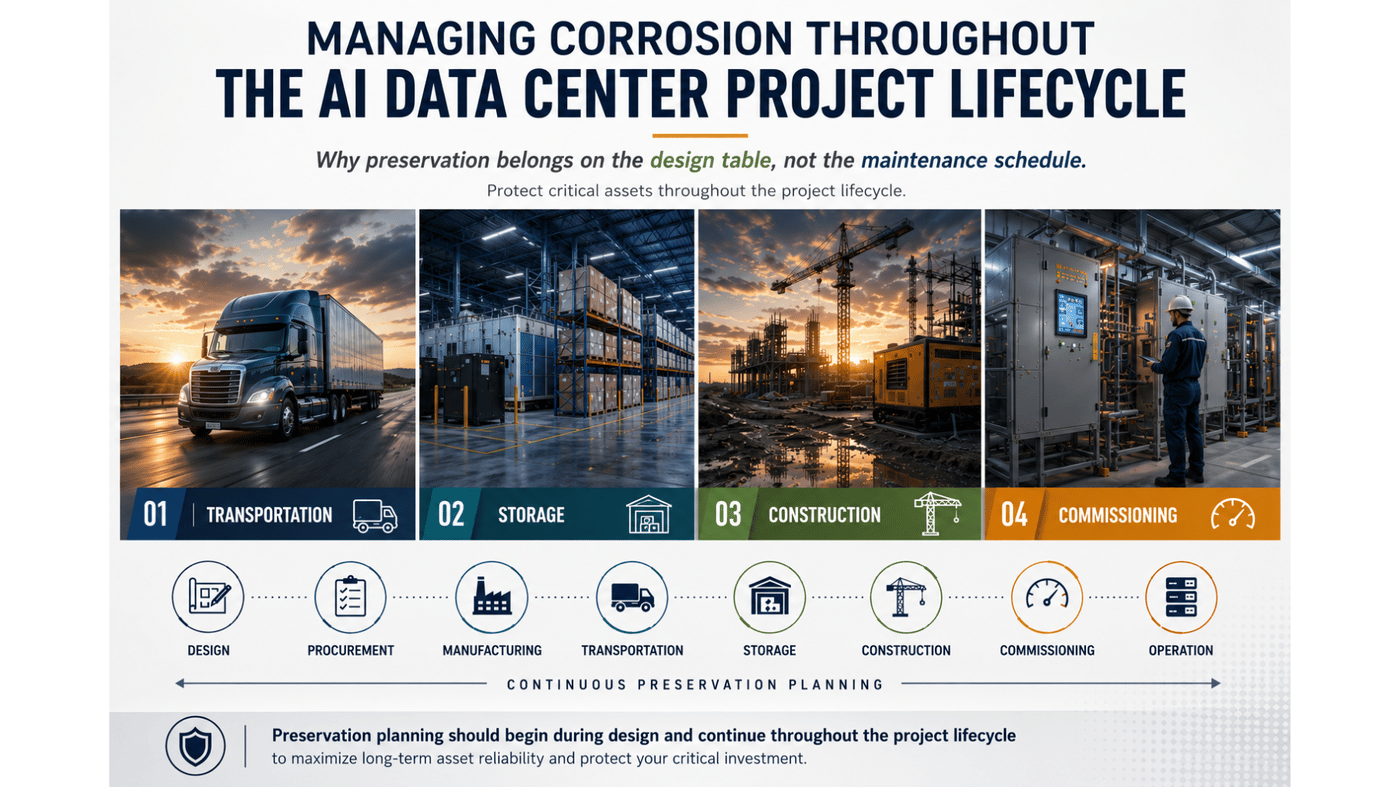
Most hyperscale construction projects feature exhaustive, highly formalized governance frameworks covering structural safety, electrical engineering quality assurance, regulatory compliance, and rapid commissioning milestones. Yet, structured asset preservation frameworks are frequently omitted entirely from these master contracts.
As heavy equipment migrates from component manufacturers to third-party logistics providers, maritime carriers, local warehousing agents, general contractors, and finally to the end-owner’s facilities, the legal and operational responsibility for asset preservation shifts hands multiple times.
- The Accountability Void: When no single stakeholder is contractually mandated to monitor and maintain corrosion protection across every handoff, preservation activities become inconsistent, ad-hoc, or ignored altogether.
- Schedule Compression Pressures: When data center delivery timelines are compressed to capture surging AI demand, preventative steps—such as applying temporary coatings, maintaining dry-gas purges, or inspecting internal piping integrity—are often bypassed to save days on the schedule, only to cost millions in catastrophic failures later.
By the time hidden corrosion manifests as a pressure drop in a cooling manifold, an electrical short, or a catastrophic coolant leak, the opportunity for proactive prevention has long since passed, leaving operators scrambling for reactive, expensive remediation.
Lessons from Asset-Intensive Industries
The data center sector’s current growing pains regarding asset integrity are not unprecedented. Other asset-intensive industries solved similar multi-billion-dollar challenges decades ago.
Sectors such as oil and gas, petrochemical processing, conventional power generation, marine engineering, and heavy industrial manufacturing operate in environments far more punishing than a climate-controlled data hall. In these industries, asset preservation is embedded into the corporate DNA from day one:
- Mandatory Design Standards: Preservation requirements are established during the initial engineering design phase, long before procurement orders are signed.
- Traceable Quality Documentation: Preservation activities are meticulously documented throughout manufacturing and transit, verified through rigorous inspection milestones during construction, and formally handed over as part of the asset’s permanent operational history.
- Total Cost of Ownership (TCO) Perspective: Maintaining equipment condition is viewed not as an optional maintenance line-item, but as an indispensable pillar of capital protection and risk mitigation.
As AI infrastructure scales to rival the capital intensity, scale, and complexity of large-scale energy projects, adopting these battle-tested industrial preservation disciplines has transformed from a best practice into an absolute operational necessity.
Strategic Framework: How to Implement Proactive Preservation
Mitigating corrosion across the AI data center lifecycle requires a structured, multi-phase methodology that integrates engineering design, rigorous procurement standards, and continuous lifecycle governance.
1. Integration During the Design Phase
Effective preservation starts on the drawing board. Design engineers must evaluate material compatibility to prevent galvanic reactions, carefully specify closed-loop coolant chemistries, eliminate stagnant flow zones in piping layouts, and establish clear preservation protocols for equipment destined for extended storage.

2. Enforceable Procurement Standards
Preservation requirements must be explicitly embedded into procurement contracts and master service agreements. When suppliers, logistics providers, and general contractors share a single, documented standard for packaging, handling, and environmental control, ambiguity is eliminated.
3. Lifecycle Governance and Independent Verification
Organizations should develop internal asset preservation standards or partner with independent corrosion engineering specialists. Independent third-party audits during transit, storage yard check-ins, and pre-commissioning phases ensure that asset condition is verified at critical project milestones.
Future Outlook: Beyond Maintenance to Holistic Asset Management
The narrative surrounding data center reliability must evolve. As AI computational clusters scale upward in both power density and financial value, corrosion management can no longer be treated as an afterthought or a reactive maintenance chore.
The central question facing data center developers, hyperscalers, and enterprise operators is no longer whether corrosive forces will act upon their facilities, but whether preservation was engineered into the asset early enough to neutralize them.
Organizations that successfully integrate holistic preservation planning across design, procurement, construction, and commissioning will safeguard their capital investments, eliminate costly commissioning delays, and ensure the unbroken, long-term reliability demanded by the modern artificial intelligence revolution.
About the Authors
Gautam Ramdas is the Vice President of Global Market Development for ZERUST Integrity Solutions®, a division of Northern Technologies International Corporation (NASDAQ: NTIC). With more than 25 years of extensive professional experience in industrial corrosion management, asset preservation, and critical infrastructure reliability, Ramdas advises global enterprises on mitigating environmental risks across complex, capital-intensive supply chains.