Executive Overview
For years, the sprawling digital landscape of Telegram has operated as a double-edged sword for global communications. Valued for its commitment to user privacy, end-to-end encrypted messaging, and vast channels capable of broadcasting to millions, the platform has also evolved into an ideal haven for illicit activities. While the company maintains policies against copyright infringement, the sheer volume of content and the decentralized nature of the network have largely kept widespread piracy beyond the purview of automated moderation and traditional enforcement teams.
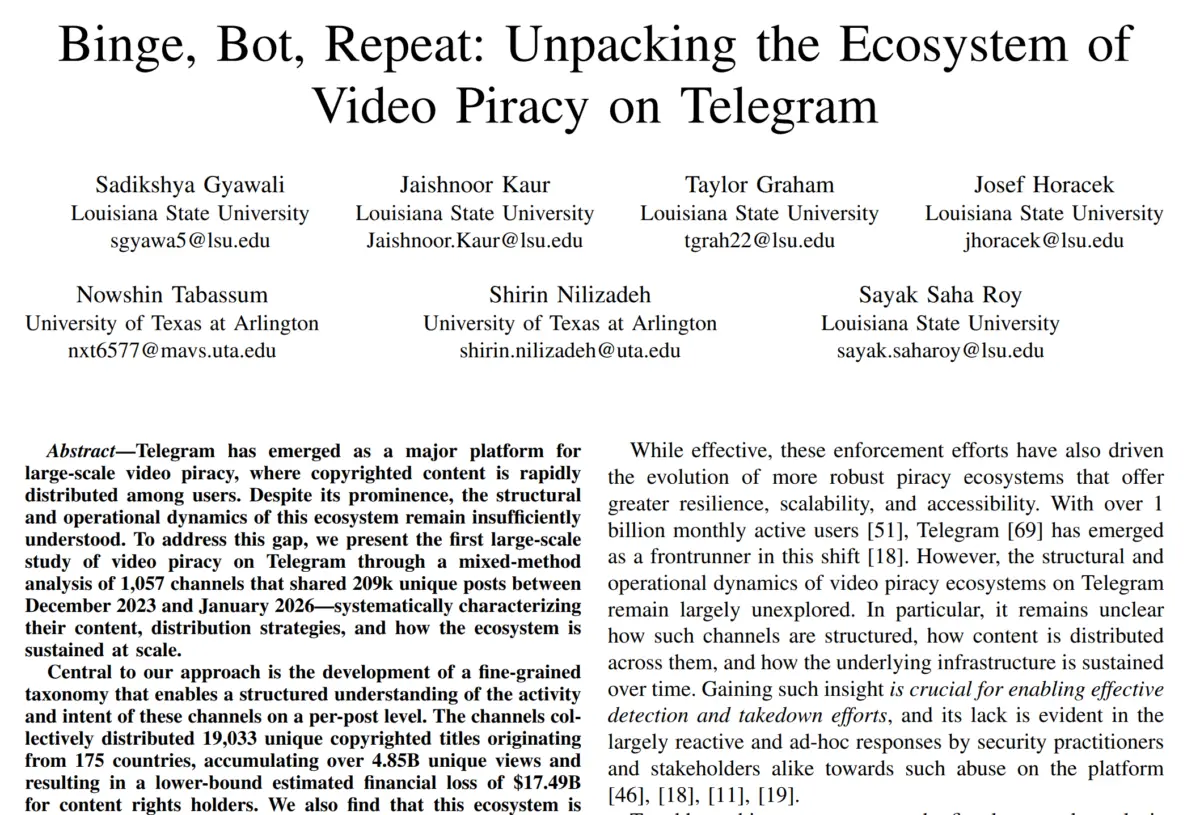
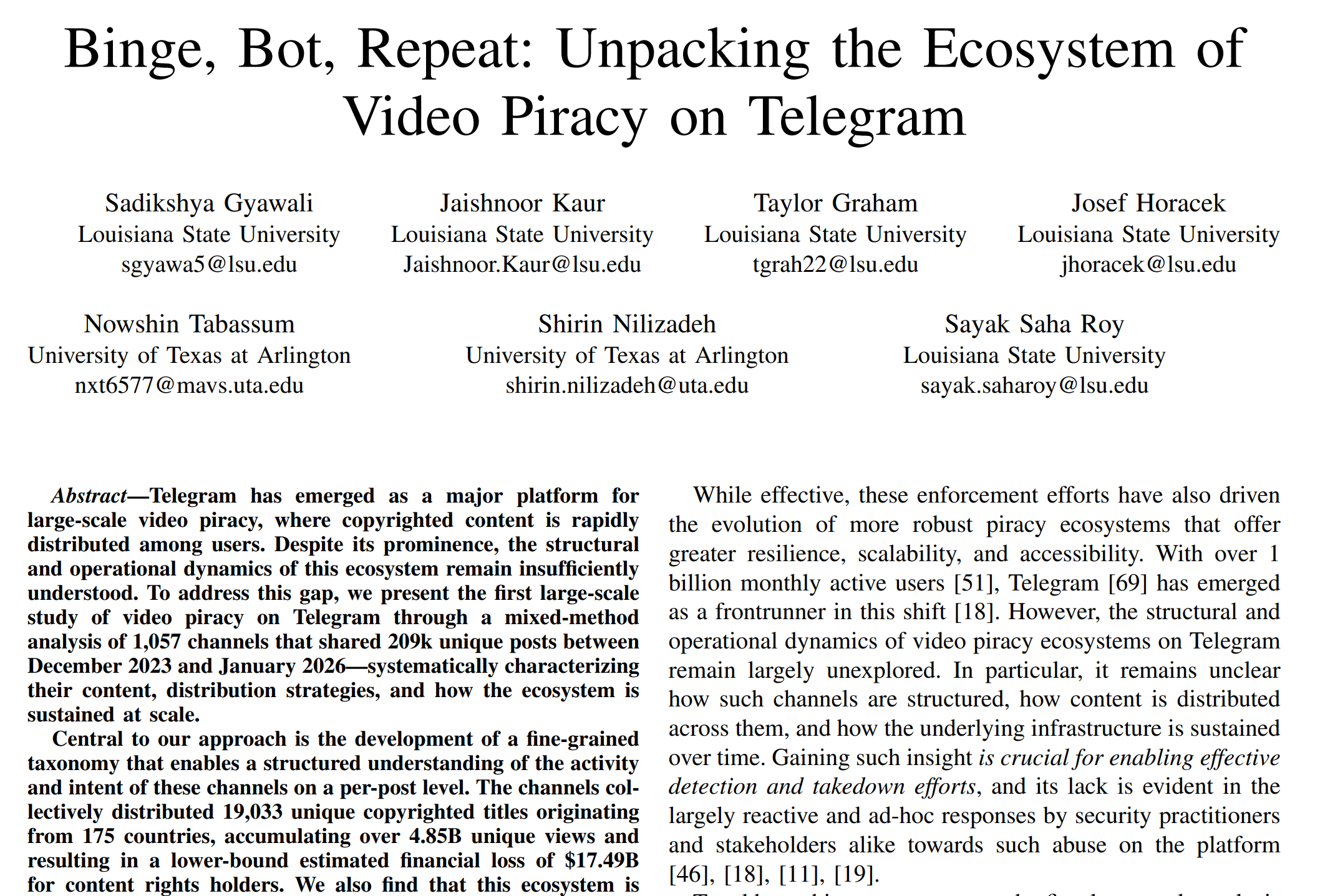
Now, a groundbreaking academic study has peeled back the layers of this clandestine economy. Titled “Binge, Bot, Repeat: Unpacking the Ecosystem of Video Piracy on Telegram,” the comprehensive research paper was conducted by computer science and security teams at Louisiana State University and the University of Texas at Arlington. Spanning a data collection window from December 2023 to January 2026, the study represents the first large-scale, systematic mapping of video piracy on the messaging platform.
The findings paint a picture of an industrial-scale operation. Armed with locally run large language models (LLMs) to scan and categorize text, images, and metadata, the researchers uncovered a staggering ecosystem comprising over 1,000 active piracy-centric channels, nearly 20,000 unique titles, and a cumulative viewership exceeding 4.8 billion. Furthermore, the study estimates that this underground network has cost content creators and major media conglomerates an astonishing $17.49 billion in theoretical lost revenue.
Yet, the research goes far beyond mere statistical documentation. Recognizing the structural resilience of Telegram’s piracy syndicates—which utilize complex webs of interconnected channels, automated bots, and external cloud-storage mirrors—the academic team developed an active defense mechanism. Named “Anti-RIP,” this real-time, AI-powered framework is designed to hunt down emerging piracy hubs before they scale, automatically generating evidence-backed abuse reports. In a live test run, the tool successfully facilitated the takedown of hundreds of previously unknown channels and bots, offering a blueprint for how artificial intelligence can level the playing field in the ongoing war against digital copyright theft.
Detailed Chronology of the Research & Methodology
Understanding the mechanics of Telegram piracy required a methodical, multi-stage approach. Because Telegram’s search functionality is limited and channels are often hidden behind private invite links or obfuscated names, the researchers had to deploy automated scraping and linguistic analysis tools to chart the ecosystem from the ground up.

Phase One: Mapping the Underground (December 2023 – January 2026)
The research began in late 2023 as an exploratory effort to quantify how audiovisual media is illegally distributed on Telegram. Over a span of more than two years, the team monitored 1,057 distinct channels dedicated to or heavily featuring pirated content. During this period, these channels published roughly 209,000 individual posts.
To make sense of this massive influx of unstructured data, the researchers utilized a locally hosted large language model. This AI was tasked with parsing post contents, cross-referencing titles, and identifying media metadata without leaking sensitive data to third-party cloud APIs. Through this automated text classification, the system successfully identified 19,033 unique pirated titles, which included 14,632 feature films and 4,401 television series, originating from 3,941 distinct production companies and rightsholders.
Phase Two: Probing and Proactive Hunting (February – April 2026)
Having mapped the existing ecosystem, the researchers shifted from passive observation to active detection. Between February 3 and April 10, 2026, they deployed Anti-RIP, a custom-built scanning framework.
Anti-RIP operates by generating candidate Telegram handles using algorithmic permutations and systematically probing them to determine whether they lead to active piracy communities. In just over two months, the tool scanned 249,133 newly discovered, unindexed channels.
Of those hundreds of thousands of newly minted handles, Anti-RIP flagged 802 primary piracy channels—notably characterized by a median age of less than five days, proving how rapidly syndicates spin up new infrastructure. The scan also identified 299 secondary or bridge channels and 108 automated bots designed to funnel users toward media repositories.

Phase Three: Coordinated Disruption (Spring 2026)
Rather than simply logging these discoveries, the research team operationalized their findings. They compiled structured evidence reports that paired each flagged channel with specific contextual labels. These labels categorized the illicit activities taking place—such as direct media hosting, intermediary redirection, or monetization through subscription links and donations.
These comprehensive dossiers were submitted directly to Telegram’s abuse operations department, as well as to 17 major United States-based media conglomerates and rightsholders. The intervention yielded immediate results: over a strict 61-day tracking period, the framework successfully facilitated the complete takedown of 524 previously unknown piracy channels and 71 specialized bots, alongside the deletion of thousands of individual copyright-infringing posts.
Supporting Context & Metrics: The Scale of Telegram Piracy
The metrics published in the LSU and UTA study dispel any notion that piracy on Telegram is a fringe or amateurish endeavor. Instead, it operates with the efficiency of a commercial streaming enterprise, albeit one completely unbound by legal or ethical constraints.
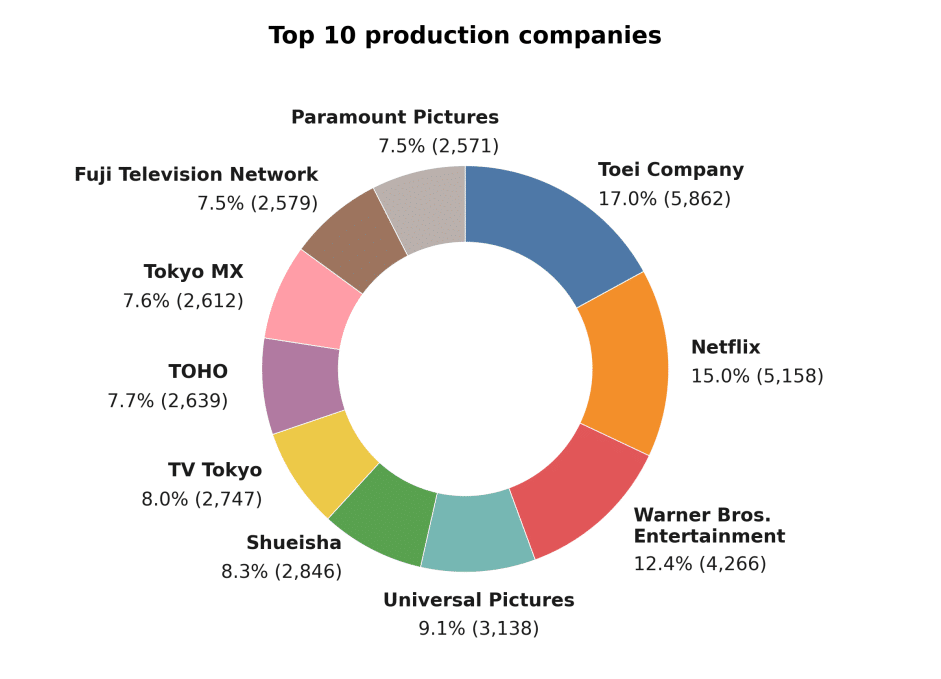
Top Rightsholders Targeted
Much like traditional web-based torrent indices and illegal streaming sites, Telegram’s pirate networks exhibit a strong demand for specific genres, most notably anime and premium Hollywood blockbusters.
- Toei Company: Japan’s legendary animation studio, responsible for global cultural phenomena such as One Piece and Dragon Ball, topped the list as the most pirated rightsholder, accounting for 17% of all identified titles.
- Netflix: The streaming giant secured second place, representing 15% of the targeted catalog.
- Warner Bros.: Rounding out the top three, Warner Bros. content made up 12.4% of the pirated titles mapped by the AI model.
Viewership and Economic Impact
Among the 1,057 channels studied, 983 were found to be actively hosting or linking to media that accumulated a staggering 4.85 billion post views. While a single post frequently contained multiple titles or links, the sheer volume of user engagement underscores the mainstream visibility of these operations.
To calculate the financial damage, the researchers adopted a conservative economic model. They assumed that a mere 1% of total views translated directly into lost sales, utilizing the cheapest legal subscription or purchase option available for each piece of content. Furthermore, to prevent inflation of the figures, lost sales were capped at a single subscription cost when multiple titles from the same streaming service were bundled in a post.
Even under these conservative parameters, the estimated financial fallout is staggering:
- Total Global Loss: $17.49 billion
- United States Content Loss: $8.17 billion
- Japanese Content Loss: $3.72 billion
Architectural Resilience: Built to Survive Takedowns
One of the most revealing insights of the study is the sophisticated engineering behind Telegram piracy networks. Unlike older peer-to-peer networks that rely on direct swarms, or early websites that hosted files locally, Telegram pirates leverage an interconnected, modular architecture designed explicitly to withstand administrative crackdowns.
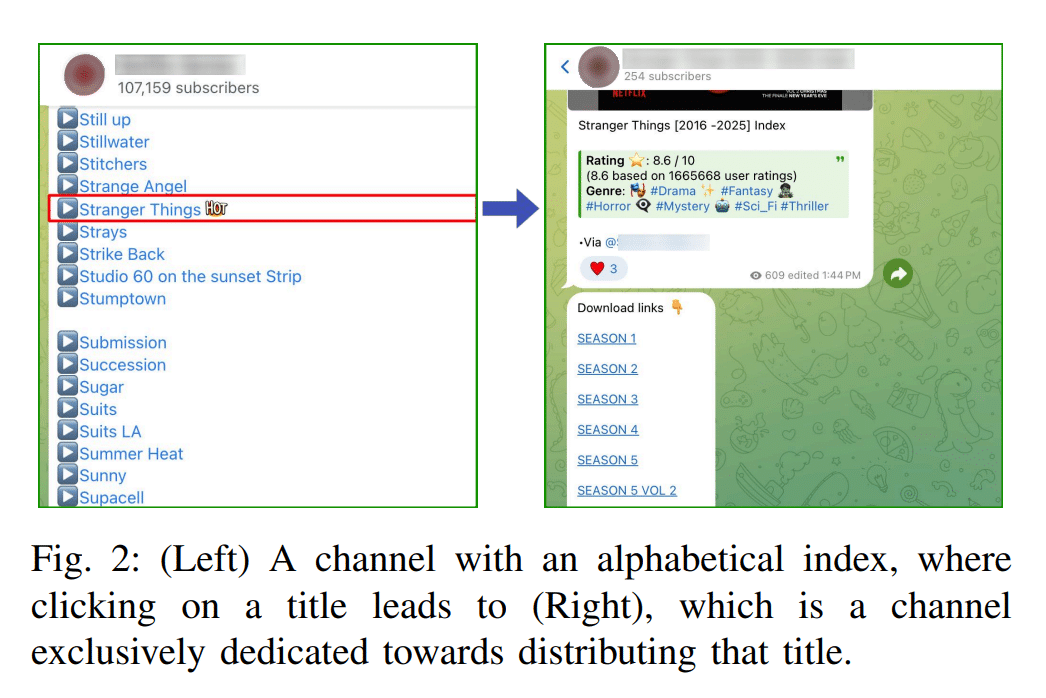
- Interconnected Webs: Roughly 94% of the AI-mapped channels were linked to at least one other channel, creating complex webs of redundancy. Many of these nodes were completely unfindable via Telegram’s internal search bar, relying instead on off-platform promotion, social media invites, or private web forums.
- The Funnel System: The study mapped distinct distribution chains where users are systematically redirected through a series of intermediary channels and automated bots. These specialized bots collectively manage hosting links, access control, user authentication, and monetization.
- External Cloud Mirrors: Interestingly, direct video files are rarely uploaded natively to Telegram channels in massive quantities due to file-size caps and platform scrutiny. Instead, 94% of pirate links pointed to external third-party cloud-hosting platforms, such as TeraBox, Terashare, and GoFile. Traditional torrent and magnet links proved to be virtually extinct within these channels, with researchers spotting only nine such links during the entire multi-year study.
- Value-Added Illicit Services: Beyond media distribution, the study revealed that certain high-tier piracy channels diversify their offerings. Operators frequently share compromised, cracked logins for mainstream platforms—including Netflix, Hulu, Disney+, and Crunchyroll—alongside specialized VPN tutorials designed to help users bypass regional ISP blocks.
Official Statements and Industry Reception
The release of the “Binge, Bot, Repeat” paper has sent ripples through both academic security circles and the corporate entertainment sector. By bridging the gap between theoretical computer science and practical anti-piracy enforcement, the researchers have opened a new dialogue on platform accountability.
The response from the entertainment industry has been notably receptive. When the research team dispatched their AI-generated evidence reports to 17 major U.S. film and television studios, 14 of those organizations formally acknowledged receipt of the data. Crucially, four major studios explicitly stated that the inclusion of granular contextual labels—detailing whether a specific channel was functioning as a primary host, a secondary redirect, or a monetization hub—dramatically improved their ability to assess, process, and prioritize their DMCA takedown notices.
However, the findings also highlight ongoing friction regarding platform responsibility. While Telegram maintains standard reporting mechanisms and cooperates with valid abuse notices, the platform’s architectural design makes proactive policing exceptionally difficult without specialized tools like Anti-RIP. Critics argue that messaging apps offering public broadcast channels with subscriber counts reaching into the hundreds of thousands must adopt more robust, proactive moderation standards rather than relying purely on reactive, user-submitted takedown requests.
Future Outlook: The AI Arms Race in Digital Copyright Enforcement
As the digital rights landscape enters a new era defined by artificial intelligence, the release of Anti-RIP marks both a breakthrough and a warning.
The Open-Source Dilemma
In the spirit of academic transparency and collaborative defense, the researchers have open-sourced the Anti-RIP framework and released their entire dataset publicly via GitHub. This grants rightsholders, independent security researchers, and platform administrators direct access to the detection models, enabling them to deploy automated sweeps of their own.
However, open-sourcing security tools is inherently a double-edged sword. Just as rightsholders and academic institutions can utilize AI to hunt down and dismantle illicit networks, pirates and syndicate operators are equally capable of leveraging generative AI and machine learning to evade detection.
Security analysts predict an escalating, automated cat-and-mouse game. As AI-powered crawlers become better at generating candidate handles and spotting behavioral anomalies associated with piracy, illicit networks will likely adapt by deploying more sophisticated obfuscation techniques, decentralized routing, and dynamic domain generation algorithms.
Limitations and the Problem of False Positives
Despite its impressive 98% accuracy rate in controlled laboratory testing, the researchers are careful to emphasize that Anti-RIP is not flawless. Like all machine learning models operating on natural language and contextual metadata, the system is susceptible to error.
When human coders reviewed a random sample of 1,000 posts used to validate the system during testing, they discovered that the model had wrongfully flagged four legitimate, non-pirate posts as copyright infringement. While a 0.4% false-positive rate in a sample sounds minor, scaling such a tool across millions of daily messages means that legitimate creators, fan communities, and independent commentators could occasionally become collateral damage in automated sweeps.
Consequently, the study stresses that AI-powered tools should serve as force multipliers for human analysts rather than autonomous executioners. The inclusion of human-in-the-loop verification remains critical to ensure that freedom of expression and legitimate media discussions are not stifled by overzealous automated enforcement.
Conclusion
The LSU and UTA study fundamentally shifts our understanding of modern digital piracy. It proves that platforms like Telegram are no longer just peripheral message boards, but sophisticated, industrialized distribution hubs generating billions of views and billions of dollars in theoretical losses. Yet, by pioneering proactive, AI-driven frameworks like Anti-RIP, the security community has demonstrated that the tide can be turned. As the technology evolves and rightsholders adopt these automated defenses, the underground syndicates operating in the shadows of encrypted chat apps will find that anonymity is no longer guaranteed.