








Executive Overview
The landscape of online intellectual property enforcement has entered a remarkably aggressive phase, where domestic regulatory bodies routinely exercise extraterritorial muscle through third-party technical intermediaries. A prime case study of this evolving dynamic is the recent ordeal faced by Series.ly, once a cornerstone of Spain’s digital pirate-link ecosystem, and subsequently resurrected by an entirely new administration.
What began as a routine regulatory complaint by major Spanish audiovisual rightsholders culminated in a dramatic global domain seizure orchestrated by a Libyan registry, catalyzed by Spanish judicial authorization, and bolstered by a sweeping array of ISP and search engine blocks.
This comprehensive report details how the resurrected Series.ly—operating under a non-profit, community-driven ethos—fell victim to a sweeping anti-piracy resolution enacted by Spain’s Intellectual Property Commission. It examines the mechanics of the takedown, the international ripple effects of cross-border enforcement, the immediate pivot of the site’s operators to a new brand identity (Cinubo), and the surprising tactical retreat that ultimately restored the original domain to its owners as a historical archive rather than a streaming portal.
Detailed Chronology of an Enforcement Action
From Infamy to Rebirth: The History of Series.ly
To understand the current legal friction, one must briefly revisit the lineage of the Series.ly domain. Originally launched in the early 2010s, Series.ly established itself as one of Spain’s most prominent social cataloging and link-sharing platforms for television series and films. Its notoriety peaked during a turbulent era of Spanish copyright enforcement, leading to high-profile arrests of its original administrators in 2015. Notably, those founders were eventually acquitted for a second time in 2023, but the damage to the original operation’s infrastructure had long since been settled; the platform dropped its outbound piracy links as early as late 2014.
Fast forward to 2021: the dormant domain name was acquired at a commercial auction by an entirely new team of developers and entrepreneurs who maintained no legal or structural continuity with the original creators. Operating under a corporate entity registered in the Caribbean island nation of Nevis, the new team transformed Series.ly into a gated community. Access required explicit user registration and login credentials.

Despite operating as a closed ecosystem, the site quickly regained significant traction. By mid-2023, Series.ly was pulling in nearly two million monthly visits, with roughly 90% of its traffic originating domestically from Spain. This resurgence inevitably drew the attention of local rightsholder groups, setting the stage for a high-stakes legal confrontation.
The Regulatory Trigger: EGEDA and the Intellectual Property Commission
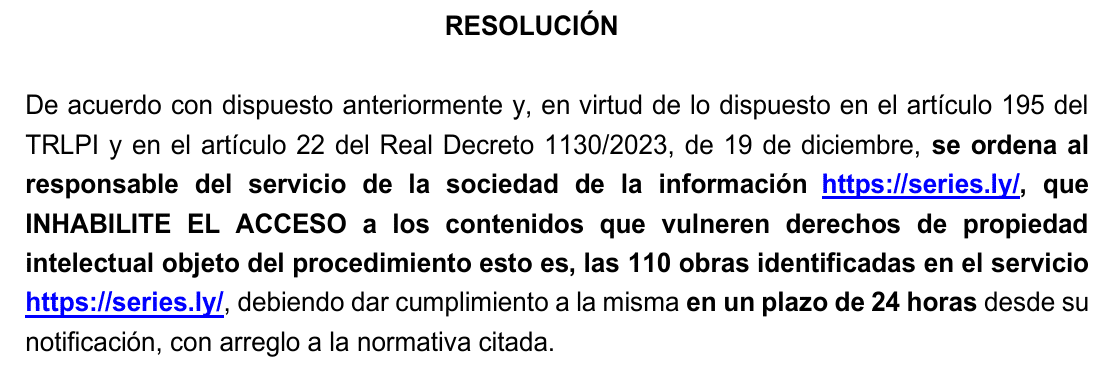
In May, the influential Spanish film and TV producers’ collective EGEDA (Entidad de Gestión de Derechos de Audiovisual) formally filed a copyright infringement complaint with the Second Section of Spain’s Intellectual Property Commission (Sección Segunda de la Comisión de Propiedad Intelectual), which operates under the aegis of the Ministry of Culture. The petition was unequivocal: EGEDA demanded the total shutdown of Series.ly for facilitating unauthorized access to copyrighted audiovisual works.
Acting on the complaint, an investigator appointed by the Commission evaluated a random sample of 42 titles out of a broader list of 110 works cited in EGEDA’s dossier. The findings were damning for the site’s legal defense: 35 of the 42 sampled titles could be directly streamed or downloaded via links hosted or shared on Series.ly.
In July, the Commission issued a formal administrative order commanding Series.ly to purge the infringing material. According to regulatory filings, the site’s operators never responded to the directive—a miscommunication later attributed by the operators to an oversight regarding administrative email routing, as formal notifications were sent to an address distinct from the primary contact listed publicly on the platform.
Judicial Green Light and Intermediary Sanctions
With administrative orders ignored, the Commission escalated its posture at the end of July by sanctioning a comprehensive suite of anti-piracy countermeasures. Rather than targeting the elusive operators directly, the Commission turned its focus to the complex web of technical intermediaries that allow modern websites to function:

- Search Engines: Major visibility gateways, specifically Google and Bing, were ordered to completely delist the Series.ly domain from their search indices.
- Internet Service Providers (ISPs): Telecommunication providers operating in Spain with a market share exceeding 1% were mandated to implement strict DNS and IP-level blocks against the domain. Furthermore, these ISPs were instructed to redirect any Spanish user attempting to access Series.ly to an official government landing page. This interstitial page explicitly informed visitors that the domain had been blocked “for having illegally facilitated access to content protected by intellectual property rights.”
- Infrastructure and Registrar Targets: The resolution explicitly named cloud infrastructure giant Cloudflare, Ukrainian hosting provider Virtual Systems (whose data centers in Kyiv had coincidentally suffered physical damage from Russian missile strikes around the same period), and the site’s domain registrar, the Libyan Spider Network.
Crucially, under Spanish administrative law, these sweeping preventive measures required explicit judicial sign-off before they could be legally enforced. On September 28, a judge presiding over the Central Court of First Instance in Madrid reviewed the case, concluded that the requested measures were both necessary and strictly proportionate, and authorized their immediate execution.
The Libyan Registrar’s Hammer Falls
The judicial authorization provided the international leverage required to disable the site’s core infrastructure. Just over a week after the court’s decision, the cascading effect of the order hit home.
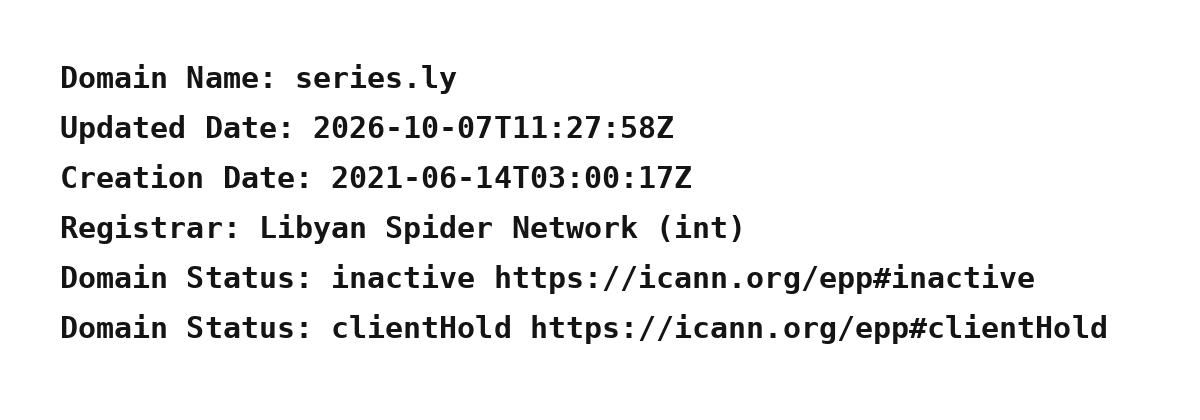
Without prior public warning, Series.ly suddenly lost operational control of its web address. WHOIS registration records revealed that the domain series.ly had been placed on clientHold status by its registrar, Libyan Spider. This administrative flag effectively suspends a domain within the .ly country-code top-level domain zone, stripping it from global DNS routing tables and rendering the website entirely unreachable.
While Libyan Spider issued no public commentary regarding the administrative action, the operators of Series.ly confirmed to digital rights journalists that they had received notice through the auction house that originally sold them the domain (which functions as a local reseller for the Libyan registrar). The justification cited was direct: a Spanish copyright enforcement resolution backed by a formal judicial warrant authorizing worldwide domain suspension.
Supporting Context & Metrics: The Anatomy of a Modern Borderless Takedown
The enforcement action against Series.ly highlights several critical structural realities of contemporary digital copyright enforcement.
| Enforcement Vector | Target Entity / Corporation | Nature of Action Required |
|---|---|---|
| Search Discovery | Google, Bing | Complete algorithmic delisting from search results. |
| Network Access | Spanish ISPs (>1% Market Share) | DNS/IP blocking and mandatory redirection to government warning landing pages. |
| Core Infrastructure | Cloudflare, Virtual Systems | Service termination and compliance with administrative takedowns. |
| Registry Control | Libyan Spider Network (.ly Registry) | Application of clientHold status, removing domain from global zone files. |
The case underscores the immense jurisdictional friction inherent in modern domain management. Although the domain extension (.ly) is managed within Libya, and the corporate entity controlling Series.ly is legally domiciled in the offshore tax haven of Nevis, Spanish regulatory authorities successfully leveraged intermediate commercial channels and foreign registrar partnerships to achieve a global blackout of the property. This demonstrates that geographical incorporation in offshore jurisdictions offers diminishing practical protection when rightsholders target core infrastructural chokepoints like domain registries and foundational DNS providers.
Official Statements and Operator Defense
Faced with the total immobilization of their flagship domain, the administrators of Series.ly mounted a robust philosophical and structural defense, though they ultimately chose a path of pragmatic retreat rather than protracted litigation.
The Non-Profit, Community-Driven Defense
Speaking anonymously through translated statements, the Series.ly operator maintained that the platform was entirely non-profit in nature, asserting that the project had generated precisely zero revenue since its 2021 relaunch. Furthermore, the operators emphasized a core tenet of modern platform liability: Series.ly never physically hosted, stored, or distributed any infringing video files on its own servers.
"Our position is that complaints about those video files should be directed at the services that host or distribute them," the operator explained. "We think it’s disproportionate that a complaint about content hosted by third parties ends up getting our entire domain suspended, including email and the personal library features."
The administrators underscored the collateral damage caused by broad domain-level seizures. By seizing the root domain, administrative authorities also disabled personal user library features, community messaging channels, and critical communication infrastructure, including corporate and support email accounts that had no operational connection to the disputed media content.
Questioning Extraterritorial Reach
Addressing the international dimensions of the case, the operator questioned the legal legitimacy of a localized Spanish administrative body enforcing global penalties against a corporate entity based in Nevis.
“We question whether a procedure handled in Spain justifies suspending our domain worldwide, which also affects email and services that have nothing to do with the works in question,” the operator noted.
Despite these strong reservations regarding jurisdiction and proportionality, the operators elected not to formally appeal the Spanish court order, citing the prohibitive legal costs and structural complexities of fighting an entrenched domestic regulatory apparatus from an offshore corporate base.
Future Outlook: The Pivot to Cinubo and the Surprising Series.ly Resolution
The closure of Series.ly did not mark the end of its operators’ digital footprint; rather, it triggered an immediate tactical adaptation that has become a hallmark of modern anti-piracy cat-and-mouse dynamics.
The Birth of Cinubo
Almost instantaneously following the suspension of the series.ly domain, a structurally identical successor platform emerged under the brand name Cinubo (cinubo.com). Demonstrating the seamless continuity of the underlying community, the official Telegram and Discord channels previously utilized by Series.ly were rapidly rebranded to reflect the new Cinubo identity.

This rapid mutation illustrates the profound limitation of traditional domain-seizure strategies: while disabling a domain inflicts immediate economic and operational friction, it rarely eradicates the underlying technical talent, community base, or intent of platform operators, who can easily migrate to fresh domains and alternative top-level extensions.
A Surprising Postscript: The Return of Series.ly
In a twist that highlights the fluid and sometimes unpredictable nature of domain governance, developments in late 2026 revealed a surprising reversal. A few days after the initial enforcement sweep, the series.ly domain was mysteriously restored to the control of its original owners.
The domain registrar ultimately lifted the clientHold restriction, allowing the domain to resolve once more. However, this resurrection came with a profound structural transformation: the domain no longer hosts or links to any streaming portals, community databases, or media catalogs.
Instead, the newly revived series.ly functions strictly as a historical archive and static memorial page documenting the turbulent history and regulatory evolution of the domain itself. This outcome effectively transforms a battleground asset into a digital monument, bringing a definitive end to Series.ly’s active role in the online streaming ecosystem while leaving its ideological successors—such as Cinubo—to navigate the treacherous waters of international copyright enforcement.