By Investigative Tech Desk
Published: September 2026
Executive Overview
The modern enterprise is locked in a silent, high-stakes battle between rigid corporate compliance and the relentless velocity of creative production. According to a striking new industry survey published by digital asset management (DAM) tool provider Santa Cruz Software, a staggering 96% of organizations are currently enforcing formal, strict AI restrictions. Yet, in an astonishing act of parallel defiance, 96% of creative employees are actively bypassing those very rules on a daily basis.
This isn’t merely a localized compliance hiccup or an employee training failure; it is a profound structural crisis. When enterprise-approved tools lag behind the blistering pace of deadlines, and when unauthorized, external AI applications can save a designer hours of grueling manual labor every week, policy papers inevitably lose to pragmatism.
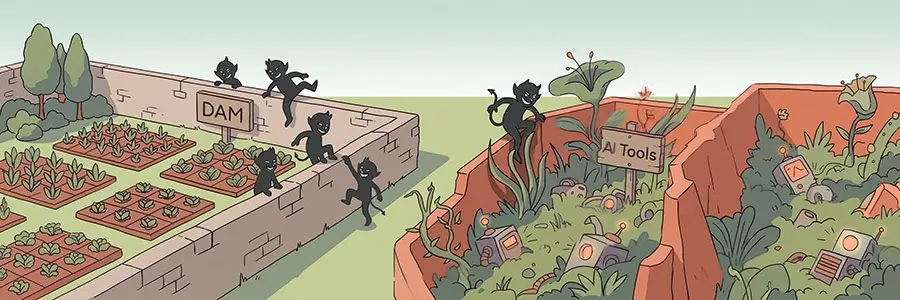
Industry analyst Ralph Windsor, writing for Santa Cruz Software, argues that this phenomenon is a high-stakes carbon copy of the early cloud storage saga, during which rogue personal Dropbox and Google Drive accounts bridged the functionality gaps left wide open by sluggish enterprise IT departments. Today, "Shadow AI" is rewriting the rules of corporate risk. By introducing unsanctioned external AI tools into the digital asset supply chain, creatives are inadvertently stripping away critical metadata—such as copyright terms, embargo statuses, model releases, and usage rights.
The result is a corporate nightmare: files returning to the central repository as untracked "File Zeros" devoid of provenance, version history, or legal permissions. To resolve this existential threat to digital asset management, experts suggest that organizations must abandon the illusion of token governance and instead engineer frictionless compliance directly into the native software tools creatives already use every day.
Detailed Chronology & Evolution of the Conflict
To fully understand how modern creative departments arrived at this precarious juncture, it is necessary to trace the timeline of digital enablement, corporate risk aversion, and the sudden explosion of generative artificial intelligence.
Phase 1: The Pre-AI Precedent – The Shadow IT Era
Long before large language models and diffusion-based image generators dominated desktop screens, enterprises faced an eerily similar crisis: Shadow IT. In the early 2010s, cloud storage platforms like Dropbox, Box, and Google Drive revolutionized file sharing and remote collaboration. However, corporate IT departments—paralyzed by security anxieties and legacy infrastructure—were slow to adopt or approve these tools.
Faced with clients demanding instantaneous file transfers, designers, marketers, and copywriters took matters into their own hands. They registered personal accounts, uploaded company intellectual property to external servers, and bypassed internal firewalls entirely. Organizations responded with heavy-handed bans, threatening disciplinary action against anyone caught using unapproved cloud solutions. Ultimately, these bans failed. Enterprises were eventually forced to realize that prohibition does not curb demand; it merely drives it underground. They had to pivot toward secure, enterprise-managed cloud integrations.
Phase 2: The Generative AI Gold Rush and the Regulatory Tsunami
Fast forward to the mid-2020s. Generative AI tools transformed from experimental novelties into hyper-efficient industrial powerhouses capable of generating complex assets, vector graphics, copy, and visual modifications in seconds.
Recognizing the immense legal, ethical, and brand-reputational risks—ranging from copyright infringement lawsuits to data privacy violations and algorithmic bias—governments and corporate boards rushed to erect legal guardrails. Landmark legislation, most notably the European Union’s comprehensive EU AI Act, sent shockwaves through global markets, demanding strict transparency, governance, and auditing of AI-generated content.
In response, corporate compliance officers and legal teams scrambled to draft ironclad internal AI policies. Documents spanning dozens of pages were distributed to creative departments, explicitly forbidding the upload of corporate assets to public, unvetted AI models.
Phase 3: The 96% Disconnect (Present Day)
The Santa Cruz Software survey exposes the catastrophic failure of these paper-based fortifications. While 96% of companies officially mandate strict AI bans or highly restrictive approval workflows, an equal 96% of the creatives working within those walls ignore them.
Faced with grueling workloads and tightening deadlines, designers and copywriters turn to external AI tools because they offer immediate, undeniable productivity gains. A task that might take an illustrator three hours of manual retouching can often be accomplished by a specialized AI utility in under sixty seconds. In the calculus of modern production schedules, the abstract, distant threat of a corporate reprimand loses out every single time to the immediate, tangible relief of hitting a 5:00 PM deadline.
Supporting Context & Metrics: The Anatomy of Shadow AI
The numbers compiled in the Santa Cruz Software research point to an unsustainable operational reality. When examining why this compliance gap exists—and why it stubbornly persists—several core friction points emerge:
- The Velocity Gap: Enterprise software procurement and vetting cycles often take months, whereas the AI software ecosystem evolves on a weekly basis. Creatives cannot wait for bureaucratic approval to adopt tools that give them a competitive edge.
- The Policy-Practice Disconnect: Organizations frequently mistake the act of publishing a policy for the act of enforcing security. As Windsor notes, assuming a company is safe simply because an AI policy document exists is akin to assuming a smoke alarm is operational merely because it is bolted to the ceiling.
- The "File Zero" Phenomenon: The true danger of Shadow AI is not malicious data theft or industrial espionage; it is operational amnesia. When a digital asset leaves the controlled environment of a Digital Asset Management (DAM) system to be processed by an external AI service, it undergoes a transformation. When it returns, it frequently arrives stripped of its extrinsic metadata.
[ DAM Repository ] ---> (Asset Exported) ---> [ Unsanctioned External AI ]
                                                      |
                                                      v
[ Untracked "File Zero" ] <--- (Asset Re-imported) <--- (Metadata Stripped)
 (No Provenance, No Rights, No Audit Trail)
As Windsor articulates in the core findings:
"When the modified derivative is eventually re-imported into the production pipeline, it arrives as a ‘file zero’ — a piece of untracked media with no recorded provenance, no version history and no linked permissions."
Without this crucial data layer, an enterprise loses track of whether a visual asset is cleared for commercial use, whether model releases have been signed, or whether geographic usage limits apply. Once that contextual knowledge is stripped away during external AI processing, no internal audit trail—not even the most sophisticated DAM system—can recover it.
Official Statements & Expert Analysis
The structural misalignment between probabilistic AI models and deterministic corporate governance has drawn sharp commentary from industry analysts and software architects alike.
Ralph Windsor, a prominent authority in the digital asset management space, emphasizes that the fundamental flaw lies in treating AI adoption as a behavioral or disciplinary problem rather than a systemic engineering challenge:
"The problem arises when the existence of a policy is mistaken for evidence that the activity is being governed — rather like assuming a smoke alarm works simply because one is fitted to the ceiling."
Windsor highlights a fundamental operational paradox at the heart of the modern creative workflow: the clash between artificial intelligence and structured data management.
"Generative models operate entirely on visual probability — governance requires deterministic rules."
While generative AI models calculate pixels and tokens based on probabilistic mathematical predictions, enterprise governance, rights management, and legal compliance demand absolute, predictable, and deterministic frameworks. You cannot negotiate copyright compliance with a probabilistic algorithm.
Furthermore, software usability experts point out that human nature dictates the path of least resistance. If the compliant path requires logging into a legacy portal, filling out three separate approval forms, and waiting 48 hours for review, while the non-compliant path involves a simple drag-and-drop into an external browser window that yields instant results, human beings will choose the latter. Security that impedes work will always be routed around.
Future Outlook: Engineering Compliance into the Workflow
As the enterprise landscape looks toward the remainder of the decade, industry leaders agree that doubling down on punitive measures, expanded training modules, and stricter policy documents will yield zero improvement. Building higher perimeter walls around a central DAM repository is futile if creative professionals can effortlessly tunnel beneath or climb over them to reach the tools they need.
The path forward requires a fundamental paradigm shift: moving from prohibition to seamless, native integration.
1. API-First Native Connectivity
The durable fix to the Shadow AI crisis is to embed approved AI capabilities and DAM connectivity directly into the native creative applications that professionals already use—such as Adobe Photoshop, Illustrator, InDesign, and Figma. By leveraging robust APIs, organizations can ensure that sanctioned AI tools and approved models live directly inside the designer’s workspace.
2. Automated Metadata Preservation
When AI processing occurs through an enterprise-approved, API-connected gateway rather than a random browser window, the workflow changes entirely. Assets pulled from the DAM, processed via integrated AI enhancements, and checked back into the system retain their complete metadata payload. Rights, embargo statuses, and version histories remain unbroken, preventing the creation of dangerous "File Zeros."
3. Making the Compliant Route the Fastest Route
Ultimately, human behavior in the workplace is governed by efficiency. The moment that the secure, policy-compliant workflow becomes faster, smoother, and more rewarding than the shadow alternative, adoption rates will skyrocket naturally.
Written policy alone was never equipped to solve the complexities of the generative AI revolution. By abandoning token governance and embedding systemic, intelligent controls precisely where creative work happens, organizations can finally bridge the 96% gap, securing their digital asset supply chains without stifling innovation.