Executive Overview
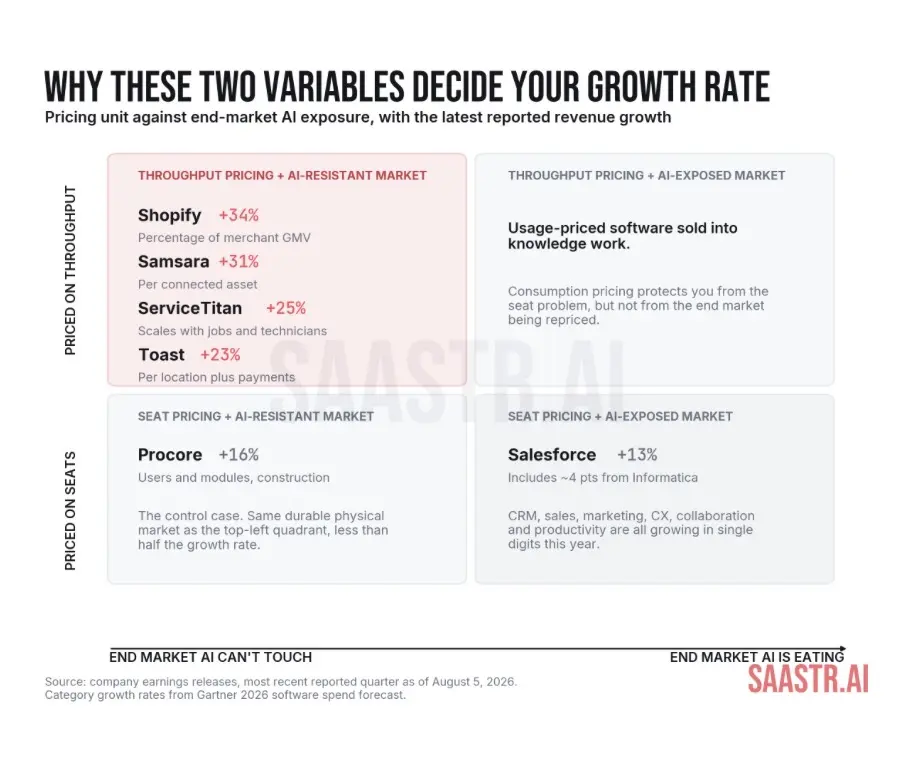
While the broader public software sector absorbs the compounding shockwaves of generative artificial intelligence, a distinct category of B2B technology companies is experiencing a period of historic acceleration. Heavyweight operators servicing the physical world—such as Shopify, Toast, and Samsara—are posting quarterly revenue growth figures that outpace the median public B2B software company by two to three times.
While the median software-as-a-service (SaaS) provider hovers around a modest 13% year-over-year growth rate, firms embedded in physical commerce, restaurant operations, and freight logistics are compounding at 25% to 34% at multi-billion-dollar scales.
This divergence is not an anomaly. It is the result of a structural shift in how software creates and captures value. Traditional enterprise software built around knowledge work is facing a deflationary pricing crisis as AI compresses human labor requirements. Conversely, physical-world software has insulated itself through two foundational defenses:
- Value-based throughput pricing models that avoid the per-seat trap.
- End-markets anchored to the physical world, where AI can direct traffic and optimize logistics, but cannot manufacture, serve, or transport actual goods.
Detailed Chronology and Earnings Performance
The divergence between knowledge-work software and physical-world tech became starkly apparent during the recent quarterly earnings cycle. A review of leading performers illustrates how operational velocity in the physical economy continues to defy broader macroeconomic tech headwinds.
Shopify’s Accelerated Surge
Shopify delivered an exceptional quarter that triggered a nearly 20% single-day surge in its stock price. Total revenue hit $3.58 billion, representing a 34% year-over-year increase (33% in constant currency). Gross Merchandise Volume (GMV) reached $115.6 billion, marking a 32% jump and representing the fifth consecutive quarter of greater than 30% GMV growth. Operating income nearly doubled to $488 million, up from $291 million in the prior-year period, while free cash flow expanded to $654 million—pushing the free cash flow margin to 18%, up from 16%.
Toast’s Record-Breaking Restaurant Additions
Restaurant management platform Toast reported zero deceleration in its core operations, securing a record-shattering 9,500 net new restaurant locations in a single quarter. Revenue grew 23% to $1.91 billion, while Annual Recurring Revenue (ARR) climbed 25% to $2.4 billion. Notably, recurring gross profit streams outpaced headline revenue growth, rising 28%. This underlying profit strength prompted management to raise its full-year recurring gross profit growth guidance from a previous window of 21–23% up to 23–25%.
Samsara’s Fleet Momentum
Samsara, which supplies connected operations and IoT infrastructure to the global transportation and logistics sector, maintained its aggressive growth trajectory. ARR expanded 30% year-over-year to $1.99 billion, supported by a 31% increase in total revenue. Net new ARR of $101 million represented a 30% acceleration over the prior year. Most significantly, ARR derived from enterprise customers generating over $1 million annually surged 62%, marking the fourth consecutive quarter of accelerating high-end growth alongside the company’s third straight quarter of GAAP profitability.
The Contrast: CRM and Knowledge Software
For context, these figures tower over the median public B2B SaaS benchmark, which is currently stagnating around 13% growth. Enterprise CRM bellwether Salesforce reported a recent quarterly growth rate of 13%—with roughly 4 percentage points of that figure artificially contributed by its Informatica acquisition. Salesforce’s full-year guidance sits at an anaemic 11%, inclusive of inorganic contributions.
Supporting Context & Metrics: The Death of the Per-Seat Model
The market capitalization erosion seen across collaboration tools, marketing automation suites, and customer experience platforms is rooted in a fundamental mismatch between pricing architecture and modern macroeconomic pressures.
+-----------------------------------------------------------------+
|               TOTAL SOFTWARE SPEND FORECAST (15.5%)             |
+-----------------------------------------------------------------+
                         /
                        /
                       v                             v
      +---------------------------------+   +---------------------------------+
      |    PHYSICAL / THROUGHPUT TECH   |   |   KNOWLEDGE / SEAT-BASED SaaS   |
      |  (Shopify, Toast, Samsara, etc.)|   | (CRM, Marketing, Collaboration) |
      |       GROWTH: 25% - 34%         |   |      GROWTH: Single Digits      |
      +---------------------------------+   +---------------------------------+
1. The Per-Seat Trap vs. Throughput Economics
Total global software spend is forecasted to rise 15.5% this year to reach $1.468 trillion. However, this growth is bifurcated. Categories tied directly to human headcounts—such as CRM, sales automation, marketing tech, customer experience, and productivity suites—are growing in the single digits.
The primary culprit is the per-seat pricing model. When a software vendor prices its product based on the number of human employees using it, the vendor’s financial growth is inextricably bound to the customer’s organizational chart. In a corporate environment where enterprises are under immense pressure to hold headcount flat or reduce staff while driving higher output via automation, per-seat software models face a hard ceiling.
In stark contrast, physical-world platforms do not rely primarily on human headcounts:
- Shopify extracts a percentage of GMV, processing $78 billion through Shopify Payments in a single quarter at a 68% penetration rate, pushing its cumulative payment volume past the $1 trillion milestone.
- Toast charges a fee per physical restaurant location combined with payment processing volume, allowing it to scale alongside food-service output.
- Samsara meters its software based on physical, connected assets—such as heavy trucks, trailers, and heavy machinery.
When your pricing unit is a transaction, a physical location, or an industrial vehicle, your software captures the upside of operational productivity. If a trucking fleet increases its delivery efficiency or a merchant increases sales volume, the software vendor captures that expansion without needing the customer to hire a single new worker.
2. Room for Expansion
The physical platform model also leaves substantial room for long-term monetization. Shopify’s $3.58 billion in quarterly revenue represents roughly 3.1% of the $115.6 billion in GMV crossing its platform. Toast’s $1.91 billion captures approximately 3.1% of the $60.7 billion in gross payment volume passing through its terminals. Similarly, field-service platform ServiceTitan earns roughly 1.2% of the $21.7 billion in transaction volume invoiced by its contractors, against a theoretical ceiling closer to 2% under full platform adoption.
Growth in these models is driven by a powerful twin engine: the customer’s underlying physical volume increasing organically, coupled with the software platform capturing a slightly larger percentage slice of that volume over time.
The AI Threat Vector: Why Physical Assets Cannot Be Prompted
The deeper existential threat facing traditional SaaS companies is the deflationary impact of generative AI on knowledge work.
+-------------------------------------------------------------------+
|                   AI DISRUPTION BOUNDARY                          |
+-------------------------------------------------------------------+
          /
         /
        v                                                   v
+-------------------------------+           +-------------------------------+
|     AI-VULNERABLE SECTORS     |           |    PHYSICAL-WORLD SECTORS     |
| (Text, Code, Tickets, Docs)   |           | (Meals, Warehousing, Freight) |
+-------------------------------+           +-------------------------------+
| • Support Software            |           | • Restaurant Dining (Toast)   |
| • Content Generation Tools    |           | • Shipped Goods (Shopify)     |
| • Developer Seat Licenses     |           | • Truck Fleets (Samsara)      |
| • Knowledge-Work Productivity |           | • Field Services (ServiceTitan|
+-------------------------------+           +-------------------------------+
| RESULT: Buyers questioning    |           | RESULT: AI acts as a demand   |
| whether agents replace seats. |           | tailwind; physical execution  |
|                               |           | cannot be tokenized.          |
+-------------------------------+           +-------------------------------+
The Compression of Knowledge Deliverables
AI is compressing software categories where the fundamental deliverable consists of text, code, support tickets, and documents. Buyers of traditional knowledge-management tools are actively asking whether they can slash their seat licenses or deploy autonomous AI agents to entirely replace the workflows those applications wrap.
None of these vulnerabilities apply to a restaurant, a shipping warehouse, or a long-haul logistics fleet.
- AI does not reduce the number of physical meals a restaurant must cook and serve.
- AI does not reduce the number of cardboard boxes that must be picked, packed, and shipped.
- AI does not reduce the physical mileage a semi-truck must drive to deliver freight across a continent.
The ServiceTitan and Shopify Test Cases
ServiceTitan, which provides operational software for home-services contractors (plumbers, HVAC technicians, electricians), illustrates where the line of disruption is drawn. While ServiceTitan’s pricing scales with technician counts—making it superficially resemble a seat model—a technician represents a unit of physical operational capacity, not a knowledge worker. No large language model can crawl under a residential floorboards to fix a burst pipe. Consequently, technician counts rise with real-world demand for essential trades, a sector immune to software-code deflation.
Shopify demonstrates this resilience from the perspective of demand generation. Merchants utilizing Shopify are reporting a dramatic surge in traffic originating from AI-driven shopping assistants and agentic search engines. Far from threatening the platform, agentic commerce acts as a demand tailwind. An AI agent can discover, compare, and purchase a product autonomously, but at the end of that digital transaction, an actual physical object must be manufactured, warehoused, and physically shipped to a customer’s doorstep.
Addressing Industry Pushback: The "Payments vs. Software" Debate
A recurring counterargument leveled against platforms like Shopify and Toast is that they are essentially low-margin payment processors masquerading as high-multiple software companies. For instance, in Shopify’s recent earnings report, merchant solutions revenue accounted for $2.78 billion, dwarfing its $802 million in pure subscription solutions revenue.
A forensic examination of corporate profit lines refutes this criticism. Toast’s recurring gross profit streams expanded by 28%—faster than its headline revenue growth—allowing management to raise its profit-focused guidance.
Similarly, while Shopify’s headline gross margins compressed slightly from 48.6% to 47.8% due to a heavier payments mix, its operating income surged 68% year-over-year, and its free cash flow margin expanded to 18%. The integration of payment rails introduces a minor friction point at the gross margin level, but it pays substantial dividends further down the income statement by cementing customer lock-in and monetizing platform throughput directly.
The accurate framing is not that these are payment companies with software multiples; rather, they have made the transaction their pricing unit. Payments are not a bolted-on ancillary business; they are the literal mechanism by which the software is monetized.
Future Outlook: Risks and Strategic Imperatives
While the outlook for physical-world B2B technology remains remarkably robust, executives and investors must monitor several structural risks that could disrupt this trajectory:
- Consumer Spending Vulnerability: Because platforms like Toast and Shopify are deeply levered to consumer purchasing power and discretionary spending, a broad macroeconomic downturn or consumer contraction would impact these businesses faster than multi-year enterprise SaaS contracts.
- Agentic Disintermediation: While AI shopping agents currently drive traffic to merchants, an over-consolidation of the agent layer could eventually allow aggregator platforms to dictate terms to merchants, compressing merchant margins and squeezing infrastructure providers.
- Deceleration Pressures: Maintaining compound growth rates north of 25% at multi-billion-dollar revenue scales is historically difficult. Both Samsara and Toast have experienced valuation deratings over recent cycles despite strong underlying business execution.
Strategic Takeaways for Tech Leadership
For technology operators evaluating their own business models, the current market dynamic offers two essential diagnostic questions:
- What is your pricing unit a proxy for? If your pricing model scales with customer headcount, you are fighting against the most intense cost-cutting and automation pressure in a decade. If it scales with transactions, physical locations, or asset utilization, you are aligned with your customer’s growth engine.
- Can an AI agent synthesize your customer’s end product? If software agents can autonomously generate the economic output your customers produce, your Total Addressable Market (TAM) is being actively repriced beneath you.
As the enterprise software market continues to stratify, the gap between seat-based knowledge tools and throughput-driven physical platforms is poised to widen. In an era defined by artificial intelligence, the safest harbor for software is no longer inside the computer screen—it is firmly anchored in the physical world.