





Executive Overview
In the rapidly evolving landscape of digital search, the traditional rules of Search Engine Optimization (SEO) are undergoing a radical metamorphosis. As consumers increasingly bypass traditional search engine results pages (SERPs) in favor of conversational artificial intelligence, brands are confronted with a new imperative: optimizing for AI-generated search results and chatbot recommendations.
A comprehensive new study conducted by digital marketing platform SE Ranking sheds light on this emerging frontier, revealing a critical nexus between social media presence and AI visibility. According to the research—which analyzed an expansive dataset of 100,000 keywords across diverse brand niches—maintaining an active, strategic presence on social media platforms is no longer just a tactic for community engagement; it is a vital mechanism for increasing a brand’s footprint within AI-generated search responses.
The study’s findings demonstrate that AI chatbots routinely cite links to social media posts when answering user queries, though the frequency and platform preferences vary significantly between tech ecosystems like Google and OpenAI’s ChatGPT. For modern marketers, these insights signal a paradigm shift. Navigating the AI-driven discovery ecosystem requires more than targeted web copy and structured data schema; it demands an integrated, cross-platform social media strategy designed to feed the large language models (LLMs) powering the future of search.
Detailed Chronology of AI Search and Social Citations
To understand how social media became a cornerstone of AI visibility, it is necessary to examine the chronological convergence of search engines, generative AI, and platform partnerships over recent years.
The Shift from Links to Answers
For over two decades, digital visibility was synonymous with ranking on Google’s traditional SERP. Brands invested heavily in keyword optimization, backlink acquisition, and technical site performance to capture blue links. However, the paradigm shifted dramatically with the introduction of generative AI tools.
When OpenAI launched ChatGPT and Google rolled out its Search Generative Experience (SGE)—subsequently evolving into AI Overviews and AI Mode—the user experience transitioned from a list of disparate web links to synthesized, conversational summaries. Almost immediately, digital analysts noticed that these AI tools were not pulling exclusively from traditional corporate websites or encyclopedic databases. Instead, they were scraping, indexing, and citing user-generated content, forums, and social media platforms to provide authentic, real-time answers to consumer queries.
The Rise of Platform Data Partnerships
Recognizing the immense value of conversational data and community discourse, AI developers began forging formal alliances with major social and forum platforms. In early 2024, a landmark commercial data-sharing agreement was struck between Google and Reddit. This high-profile partnership granted Google real-time access to Reddit’s vast repository of human conversations, ensuring that Google’s AI models would have a continuous, authorized feed of authentic consumer sentiment and peer-to-peer reviews.
Conversely, relationships between AI platforms have proven to be more volatile. While Google’s integration of social platforms—particularly YouTube and Reddit—has remained robustly stable due to commercial agreements and ecosystem ownership, other platforms have experienced sudden algorithmic disenfranchisement.
The August 2024 Volatility Event
The precarious nature of relying on AI referral paths was starkly illustrated in August 2024. Industry reporting from Search Engine Land revealed a startling anomaly: Reddit’s share of ChatGPT search citations plummeted by a staggering 86.4% over the course of just four days.
While neither OpenAI nor Reddit provided an official public post-mortem explaining the sudden evaporation of Reddit links within ChatGPT, the event sent shockwaves through the digital marketing community. It served as a definitive reminder that AI tools can drastically alter their retrieval-augmented generation (RAG) parameters and citation algorithms with little to no warning. This inherent volatility underscores the danger of putting all digital eggs in one AI basket, emphasizing instead the need for a diversified, resilient social media footprint that spans multiple ecosystems.
Supporting Context & Metrics: Decoding the SE Ranking Data
The SE Ranking study provides empirical weight to what digital marketers have long suspected: social media platforms are heavily relied upon by AI models to fill the knowledge gaps left by traditional corporate websites. By evaluating 100,000 keywords across various niches, the researchers uncovered exact metrics regarding how frequently and where social links appear in AI-generated answers.
Breakdown of AI Citation Frequencies
The research highlights a stark variance in how different AI search interfaces incorporate social media links:
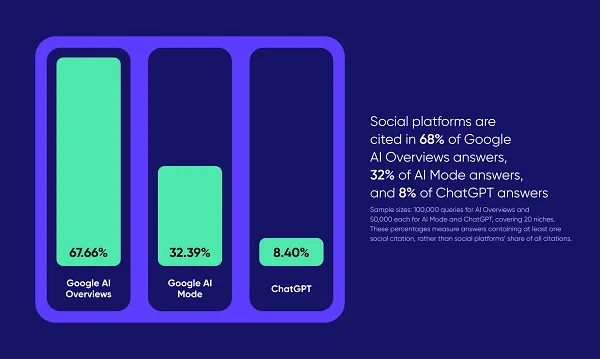
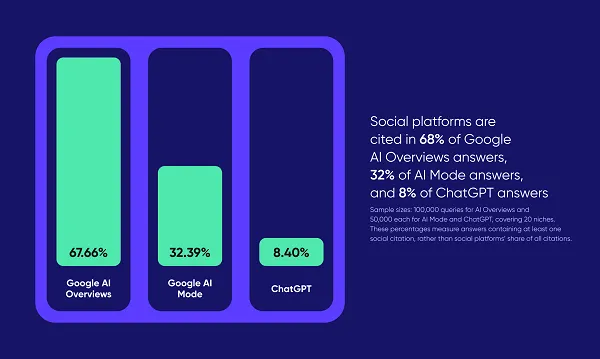
- Google AI Overviews: Social platform links appeared in an overwhelming 67.66% of responses. This massive percentage indicates that Google heavily weights its own ecosystem (such as YouTube) alongside community-driven platforms (like Reddit) when constructing synthesized summaries for users.
- Google AI Mode: Social links were present in 32.39% of replies. While lower than AI Overviews, this still represents nearly a third of all interactions, proving that social content is foundational to Google’s broader conversational search initiatives.
- ChatGPT (OpenAI): Social platform links appeared in 8.4% of answers. While significantly lower than Google’s surfaces, an 8.4% appearance rate across broad queries demonstrates that OpenAI still turns to social networks when users seek subjective, experiential, or community-vetted information.
Platform-Specific Preferences
Crucially, the data reveals that not all social platforms are treated equally by different AI engines. The utility of a platform depends entirely on which AI model is parsing the data:
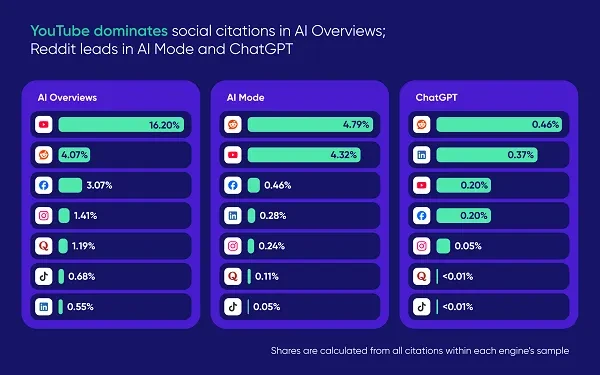
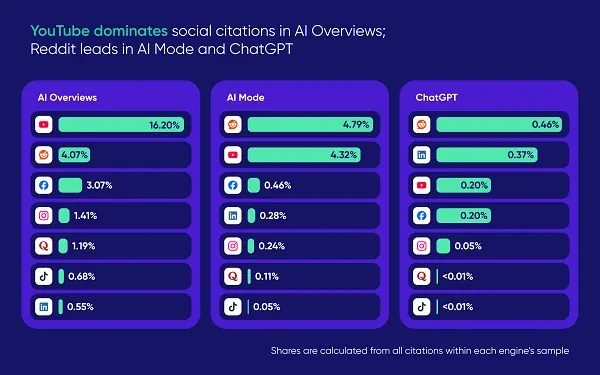
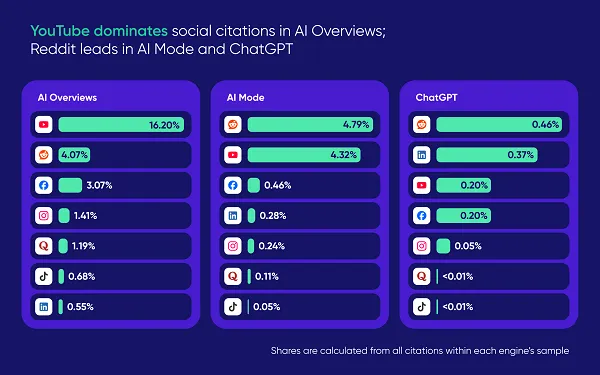
- Google’s Ecosystem Dominance: Predictably, Google-owned YouTube stands as the single most commonly cited source within Google’s AI Overviews. Video content, transcripts, and metadata within YouTube are indexed at an unprecedented scale, making video optimization an indirect form of AI search optimization.
- OpenAI’s Preferences: ChatGPT leans heavily toward text-heavy, conversational platforms like Reddit and LinkedIn for professional, contextual, and peer-reviewed queries.
However, a nuanced look at the data shows that while Reddit, LinkedIn, and Facebook citations appear in fewer than 1% of all general ChatGPT answers, their presence spikes dramatically when users input queries specifically seeking product reviews, troubleshooting advice, or comparative shopping insights.
Branded vs. Non-Branded Query Analysis
SE Ranking’s deep dive into Google’s AI Mode further illuminated how user intent dictates social media citations by categorizing queries into branded and non-branded searches:
- Branded Queries: Social media sources were referenced in 39.34% of responses where a specific brand name was included in the search string. Consumers asking about a brand often trigger AI models to pull customer service threads, social complaints, or brand-sponsored discussions from platforms like Facebook and Reddit.
- Non-Branded Queries: Social media sources climbed to an even higher 48.58% in searches for generic categories or solutions (e.g., "best project management software for remote teams"). When users search for broader industry solutions, AI engines turn to social media discussions, user forums, and professional networks to compile unbiased, crowdsourced recommendations.
Across both categories, Facebook, YouTube, and Reddit emerged as the dominant cited platforms, proving that active community management and public social visibility directly influence how an AI perceives and recommends a brand in a crowded market.
Industry Perspectives and Strategic Implications
The findings from SE Ranking have prompted a fundamental reassessment of digital marketing strategies. Industry leaders are increasingly warning that traditional SEO silos must be dismantled in favor of holistic visibility frameworks that encompass social media, public relations, and content marketing.
The Death of the One-Size-Fits-All Approach
For decades, mastering Google meant mastering a singular dominant algorithm. Brands could apply a uniform set of SEO best practices—keyword density, meta descriptions, technical schema—and achieve predictable results across the search landscape.
The rise of generative AI shatters this monopoly. Because different LLMs rely on disparate training data, distinct retrieval mechanisms, and varying partnership agreements (such as Google’s exclusive deal with Reddit), optimizing for AI requires a highly variable, platform-specific approach. A strategy that secures high visibility in Google AI Overviews through YouTube optimization may yield entirely different results on ChatGPT, which favors structured textual discourse found on professional and forum networks.
Redefining Brand Authority
Experts emphasize that AI models are fundamentally designed to mimic human trust and consensus. When a user asks an AI chatbot for a recommendation, the model does not simply look for the company with the biggest advertising budget; it scans the digital ecosystem for consensus. It looks for where real people are talking about the product, reviewing its flaws, praising its features, and debating its value.
Active social media profiles, vibrant community subreddits, and active professional discussions on LinkedIn serve as proxies for real-world validation. Consequently, modern brand reputation management is inextricably linked to AI optimization. Negative sentiment left unmanaged on social platforms can be scraped by LLMs, potentially poisoning a brand’s AI-generated reputation. Conversely, an engaged, positive, and widely distributed social footprint acts as a powerful trust signal to conversational search engines.
Future Outlook: Navigating the AI-Driven Discovery Era
As we look toward the horizon of digital marketing, several critical trends and strategic imperatives emerge for brands seeking to maintain visibility in an AI-dominated world.
The Convergence of Social Media and Search
The line separating social media marketing from search engine optimization is officially blurring. In the era of AI search, social media managers are effectively acting as front-line SEO specialists. Ensuring that brand mentions, product launches, and customer support discussions are visible, public, and indexable across platforms like Reddit, LinkedIn, YouTube, and Facebook is now a core requirement of technical and tactical marketing.
Preparing for Algorithmic Volatility
As demonstrated by the sudden fluctuation of Reddit citations within ChatGPT, the rules governing AI discovery are fluid. Brands must prepare for ongoing volatility as tech giants renegotiate data-sharing partnerships, refine their RAG pipelines, and adjust their legal stances regarding web scraping and copyright.
To hedge against this volatility, organizations must adopt a diversified multi-platform strategy. Relying on a single social network or a solitary AI search engine is a high-risk endeavor. Brands should aim for ubiquitous, high-quality digital footprints across all major ecosystems that AI models are known to mine.
Final Recommendations for Marketers
To thrive in the age of conversational AI, marketing executives should immediately incorporate the following actions into their strategic roadmaps:
- Audit Social Visibility for Branded and Non-Branded Terms: Analyze how your brand currently appears in AI search tools. Identify which social platforms are driving citations for your core product categories.
- Optimize for Conversational and Community Content: Shift resources toward platforms where authentic consumer discourse occurs. Encourage customer reviews, foster community engagement on forums, and maintain active, professional profiles on LinkedIn and Facebook.
- Embrace Video and Multimedia SEO: Given YouTube’s dominance in Google AI Overviews, ensure that video content is thoroughly optimized with descriptive transcripts, timestamps, and targeted keywords.
- Adopt a Holistic Cross-Platform Mindset: Recognize that SEO, social media management, and PR are no longer separate disciplines. In the world of generative AI, they form a single, interconnected ecosystem where every public-facing digital asset contributes to how a machine perceives, evaluates, and recommends your brand.