







Executive Overview
In the crosshairs of international copyright enforcement, the illicit streaming application MovieBox has emerged as one of the most prolific digital piracy operations in the modern media landscape. Surging past a staggering 300 million downloads, the application has ignited a high-stakes regulatory dispute that stretches from the tech corridors of Shenzhen and Hong Kong to the policymaking halls of Brussels, and across the dynamic consumer markets of Africa.
The controversy centers on the Palm Store, an official application marketplace preinstalled on millions of mobile devices manufactured by Transsion Holdings—the dominant smartphone vendor behind popular brands such as Tecno, Infinix, and itel. While independent app marketplaces frequently grapple with rogue uploads, the scale of MovieBox’s distribution on a proprietary, manufacturer-backed app store has elevated the issue from a standard intellectual property enforcement challenge to a complex corporate governance and regulatory flashpoint.
Prominent global entertainment stakeholders, including the Motion Picture Association (MPA) and French pay-TV titan Canal+, have formally flagged MovieBox to the European Commission. In detailed submissions for the Commission’s upcoming 2027 Counterfeit and Piracy Watch List, these rightsholders not only document the unprecedented reach of the pirate platform but also allege systemic ties connecting the application’s infrastructure directly to the broader Transsion ecosystem. As European regulators prepare to review the evidence, the case exposes the vulnerabilities inherent in OEM-controlled app distribution models and underscores the globalized, borderless nature of contemporary digital piracy.
Detailed Chronology: From Regional Crackdown to Brussels Watchlist
The trajectory of MovieBox illustrates the classic "whack-a-mole" dynamic that has defined digital copyright enforcement for decades. Despite aggressive legal interventions by national authorities, the platform has repeatedly mutated, shifting domains and bypassing traditional app stores while maintaining explosive user acquisition.
The Nigerian Enforcement Crackdown (2025)
The roots of the current international regulatory battle trace back to regional enforcement efforts in West Africa. Throughout 2024 and early 2025, MovieBox operated heavily via its primary web portal, MovieBox.ng, drawing tens of millions of monthly visits and serving as a major hub for unauthorized streaming in the region.

Recognizing the platform’s devastating impact on local and international creative industries, Nigeria’s copyright watchdog initiated a high-profile crackdown. In mid-2025, authorities celebrated the formal suspension of the MovieBox.ng domain—a move hailed by local rights defenders as a landmark victory against intellectual property theft.
The Pivot to moviebox.ph and Exponential Growth
Anticipating legal pressure, the operators of MovieBox executed a swift contingency plan. Rather than folding operations, the service migrated its web infrastructure to a new domain, moviebox.ph, ensuring uninterrupted access for its web-based user base. More importantly, its native Android application remained entirely insulated from the domain seizure, staying continuously available through the Palm Store.
Rather than stunting the platform’s growth, the enforcement action appeared to catalyze it. According to empirical data cited by Canal+ in its regulatory filings, the application experienced an astronomical surge in user adoption following the 2025 domain shift.
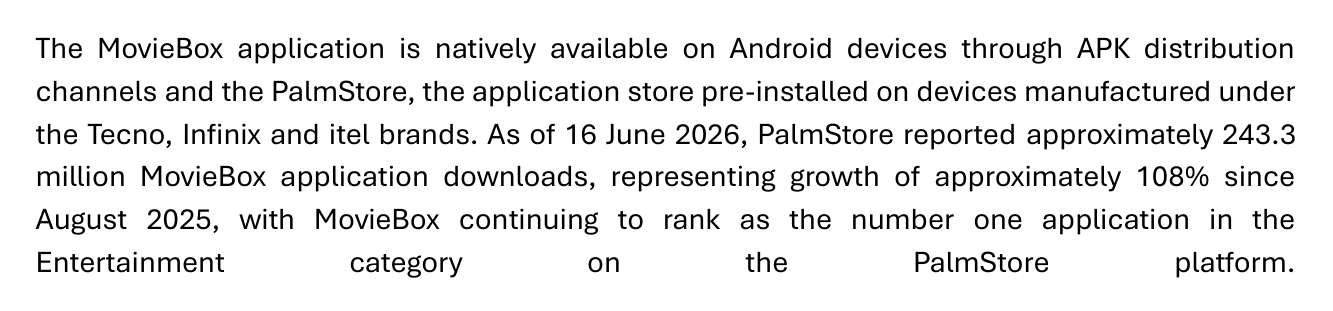
- August 2025: Palm Store metrics registered approximately 243 million downloads of the MovieBox application.
- June 16, 2026: Canal+ formally documented that download figures had climbed to approximately 243.3 million—representing a staggering 108% growth trajectory in less than a year. At this juncture, MovieBox proudly maintained its standing as the number one application within the Entertainment category on the Palm Store platform.
- Late 2026 (Present): The growth trajectory accelerated even further. Recent audits of the Palm Store listing reveal that download counts have shattered previous thresholds, soaring past 305.6 million installs—an addition of more than 60 million active users in a span of barely four months.
Escalation to the European Commission
Faced with domestic and regional limitations in dismantling an operation purportedly orchestrated from overseas, rightsholders shifted their strategic focus to international trade mechanisms. In late 2026, both the MPA and Canal+ submitted formal dossiers to the European Commission, petitioning for MovieBox and its primary distribution channels to be prominently featured on the 2027 Counterfeit and Piracy Watch List. By leveraging European trade instruments, rightsholders aim to apply indirect diplomatic and economic pressure on the entities facilitating the dissemination of infringing content on a global scale.
Supporting Context & Metrics: Inside the MovieBox Ecosystem
To fully comprehend the regulatory alarm raised by the MPA and Canal+, one must examine the operational mechanics and promotional transparency of the MovieBox platform. Far from disguising its infringing nature, the application openly markets itself as a one-stop shop for unauthorized premium entertainment.

Content Offerings and Promotional Posturing
An audit of the current Palm Store listing for MovieBox reveals explicit marketing copy that flagrantly violates foundational copyright principles. The application’s official description promises users uninhibited, zero-cost access to copyrighted intellectual property:
"Enjoy free access to sports live streams right in our app," the promotional text declares, going on to explicitly highlight coverage of Europe’s five elite domestic football leagues (the English Premier League, La Liga, Serie A, Bundesliga, and Ligue 1).
Furthermore, the application’s visual branding and promotional artwork routinely incorporate high-value intellectual property. Listings feature unauthorized promotional assets from major Hollywood studios, including prominent imagery and categorized collections tied to Marvel and Disney franchises. Users are promised immediate, on-demand streaming of blockbuster feature films and serialized television dramas mere moments after—or even before—their official commercial release windows close.
The Transsion Infrastructure and Palm Store Economics
The operational backbone enabling MovieBox to achieve its massive scale is the Palm Store. Unlike open-source repositories or independent third-party APK sites, the Palm Store is a proprietary, closed-loop application marketplace. It comes preloaded as a default software component on millions of mobile devices manufactured by Transsion Holdings.
According to corporate filings and market intelligence data, Transsion solidified its grip on the African telecommunications market in 2024, capturing an eye-watering 61.5% market share of all mobile phone shipments across the continent. Because the Palm Store is hardcoded into the operating systems of Tecno, Infinix, and itel devices shipped to these regions, MovieBox enjoys frictionless, systemic distribution straight out of the box—bypassing the stringent security audits and content moderation policies enforced by mainstream distribution channels like the Google Play Store.
In a draft prospectus filed in connection with a planned public listing on the Hong Kong Stock Exchange, Transsion outlined the financial mechanics of its proprietary app ecosystem. The company disclosed that the Palm Store commanded an average of more than 180 million monthly active users over the preceding year. Crucially, Transsion’s business model for the marketplace involves monetizing developer distributions, typically charging third-party software creators based on the sheer volume of installations facilitated through its platform. While direct financial linkages regarding whether Transsion extracts per-install fees specifically from MovieBox remain unproven in the public record, the monetization structure highlights an inherent commercial incentive tied to high-volume app downloads.
Official Statements and Investigations: Unraveling the Transsion Connection
While the availability of an infringing app within a commercial marketplace often draws mild remediation requests, the submissions lodged by Canal+ argue that the relationship between MovieBox and the broader Transsion ecosystem transcends passive hosting.
The Canal+ Dossier: Deeper Institutional Ties
In its comprehensive submission to the European Commission, Canal+ presents technical and historical evidence suggesting that the operational boundaries between the creators of MovieBox and corporate entities linked to Transsion are porous, if not overtly intertwined.
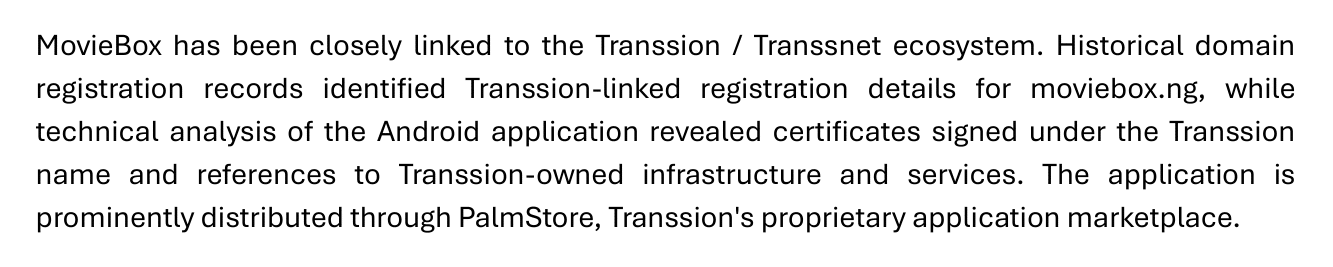
- Historical Domain Registrations: Forensic investigations into the registration history of the defunct
moviebox.ngdomain uncovered registration metadata directly connecting the asset to individuals or entities within the Transsion-linked corporate network. - Cryptographic Signatures: Technical code audits of the MovieBox Android application (
.apk) package revealed that the software binaries were signed using digital certificates bearing the Transsion name. Furthermore, runtime analysis identified internal code references pointing toward backend infrastructure and cloud services owned or operated by Transsion. - The Shell Company Proxy: Canal+ further identified Excellent Innovation Limited, a corporate entity registered in Hong Kong. According to domain registration trails, SSL certificate allocations, trademark filings, and developer attributions on the Palm Store, this entity acts as the formal publisher of the MovieBox application. Canal+ links this corporate shell directly back to the operational apparatus servicing the Transsion ecosystem.
Despite these pointed technical allegations, Canal+’s regulatory submission stops short of explicitly declaring that Transsion corporate ownership directly manages or sanctions the day-to-day operations of MovieBox. Instead, the findings frame Transsion as a primary infrastructural enabler whose proprietary network was utilized to incubate and scale a massive global piracy enterprise.
The MPA Perspective and Regional Commercial Dynamics
In contrast to the granular technical and corporate attribution presented by Canal+, the Motion Picture Association’s submission takes a broader macro-level approach. The Hollywood trade group abstains from directly implicating Transsion in its documentation, choosing instead to categorize MovieBox simply as a major, highly organized commercial piracy syndicate operated primarily out of China, capitalizing on international distribution vectors to exploit Western and African content.

Adding another layer of commercial complexity is the regional market positioning of Canal+. The French media conglomerate maintains a direct economic stake in the territories most heavily impacted by MovieBox’s proliferation. Through its corporate holdings, Canal+ owns MultiChoice, the dominant pay-TV provider operating the DStv satellite and streaming service across sub-Saharan Africa. The unchecked, free availability of premium sports broadcasting and first-run cinematic content via a preinstalled mobile application presents a direct, existential threat to MultiChoice’s paid subscriber base in these crucial developing markets.
Future Outlook and Regulatory Implications
As the European Commission processes the submissions from the MPA, Canal+, and other global rightsholders, the case of MovieBox stands as a litmus test for the evolving scope of international intellectual property enforcement.
The European Commission Review Process
In accordance with standard administrative protocols governing the Counterfeit and Piracy Watch List, the European Commission will not unilaterally issue findings of legal liability or judicial guilt based solely on the preliminary submissions. Instead, the administrative body is bound by due process to facilitate a balanced review.
- Right of Reply: The Commission has committed to making reasonable administrative efforts to contact the service providers and application developers highlighted in the filings—including representatives for MovieBox and Transsion—inviting them to submit formal written responses and counter-arguments addressing the allegations.
- Watch List Publication: Following the collection and review of evidence and rebuttal statements, the updated Counterfeit and Piracy Watch List is scheduled for official publication in the spring of 2027.
Broader Industry Ramifications
Although inclusion on the European Commission’s Watch List carries no direct civil fines or criminal penalties, the designation serves as a powerful diplomatic and economic tool. It acts as an official naming-and-shaming mechanism designed to compel foreign governments, multinational technology conglomerates, and payment processors to sever ties with chronic infringers.
For Transsion Holdings, the scrutiny surrounding the Palm Store presents a critical strategic juncture. As the company continues its international expansion and seeks capital through public market listings, association with a 300-million-user piracy platform threatens to complicate its regulatory standing in Western jurisdictions and invite closer oversight from institutional investors adhering to strict Environmental, Social, and Governance (ESG) standards.
Ultimately, the MovieBox saga underscores a sobering reality for the digital entertainment sector: as long as proprietary hardware ecosystems and preinstalled app marketplaces can monetize high-volume traffic without stringent upstream content moderation, rogue applications will continue to find fertile ground. Whether the mounting pressure from Brussels and Hollywood can force a systemic cleanup of the Palm Store remains one of the most closely watched regulatory storylines heading toward 2027.