Executive Overview
As the video game industry counts down the months toward one of the most anticipated entertainment releases in history, the legal apparatus surrounding Grand Theft Auto VI has shifted into overdrive. Take-Two Interactive, the parent company of Rockstar Games, has informed a U.S. federal court that its ongoing investigation into a massive pre-release security breach is "rapidly evolving."
The legal confrontation entered a dramatic new phase following Rockstar’s latest promotional push—an extended digital preview streamed via Netflix. Capitalizing on the momentum of that reveal, Take-Two filed a fresh Digital Millennium Copyright Act (DMCA) subpoena request in a New York federal court. Crucially, the publisher has asked the judiciary to keep the details of this new filing strictly under seal. The goal: prevent tipping off the alleged copyright infringers before investigators can secure digital evidence and unmask the culprits.
At the same time, the publisher officially dropped its parallel DMCA subpoena targeting Google and YouTube, signaling a tactical pivot in its multi-front hunt. The unfolding saga underscores the extreme measures major publishers will deploy to protect their multi-billion-dollar intellectual properties, the intricate dance between legal discovery and digital platforms, and the high-stakes cat-and-mouse game being played across the darker corners of Discord, X, and independent creator communities.
Detailed Chronology: From First Leak to Federal Court Filings
The Breach and the Backlash
The crisis began unfolding weeks ago when an anonymous actor operating under the online moniker "Cyberleek" began disseminating unauthorized gameplay footage from Grand Theft Auto VI. The leaks surfaced months ahead of the game’s scheduled November launch window, threatening to upend Rockstar’s carefully orchestrated marketing schedule, leak vital narrative and mechanical details, and disrupt community anticipation.
Rockstar and Take-Two responded with swift, aggressive defensive measures. Within hours of the initial leaks, a wave of DMCA takedown notices flooded video hosting platforms, social media feeds, and independent forums. Recognizing that takedowns only treat the symptoms rather than the source, Take-Two’s legal teams turned to the U.S. federal court system, deploying DMCA subpoenas in a wide-reaching effort to unmask the perpetrators.
The Power of the DMCA Subpoena
For the uninitiated, Section 512(h) of the Digital Millennium Copyright Act provides a powerful, expedited legal tool for copyright holders. It permits rightsholders to request a court clerk to issue a subpoena directly to an Internet Service Provider (ISP) or online platform—requiring them to hand over identifying information (such as names, addresses, IP addresses, and billing details) associated with an alleged infringer. Crucially, this can be executed without the rightsholder having to file a full-scale, formal copyright infringement lawsuit out of the gate.

Take-Two weaponized this mechanism to cast a wide net, targeting thousands of Discord users, alongside requests directed at Microsoft, X (formerly Twitter), and Google’s YouTube.
The Shift to Secrecy
By late August, the initial public subpoena had already borne fruit—at least in terms of public visibility. News outlets reviewing the unredacted federal court filings were able to map out the contours of Take-Two’s investigation, identifying specific Discord servers targeted by the subpoena, including a community hub tied to prominent content creator DarkViperAU.
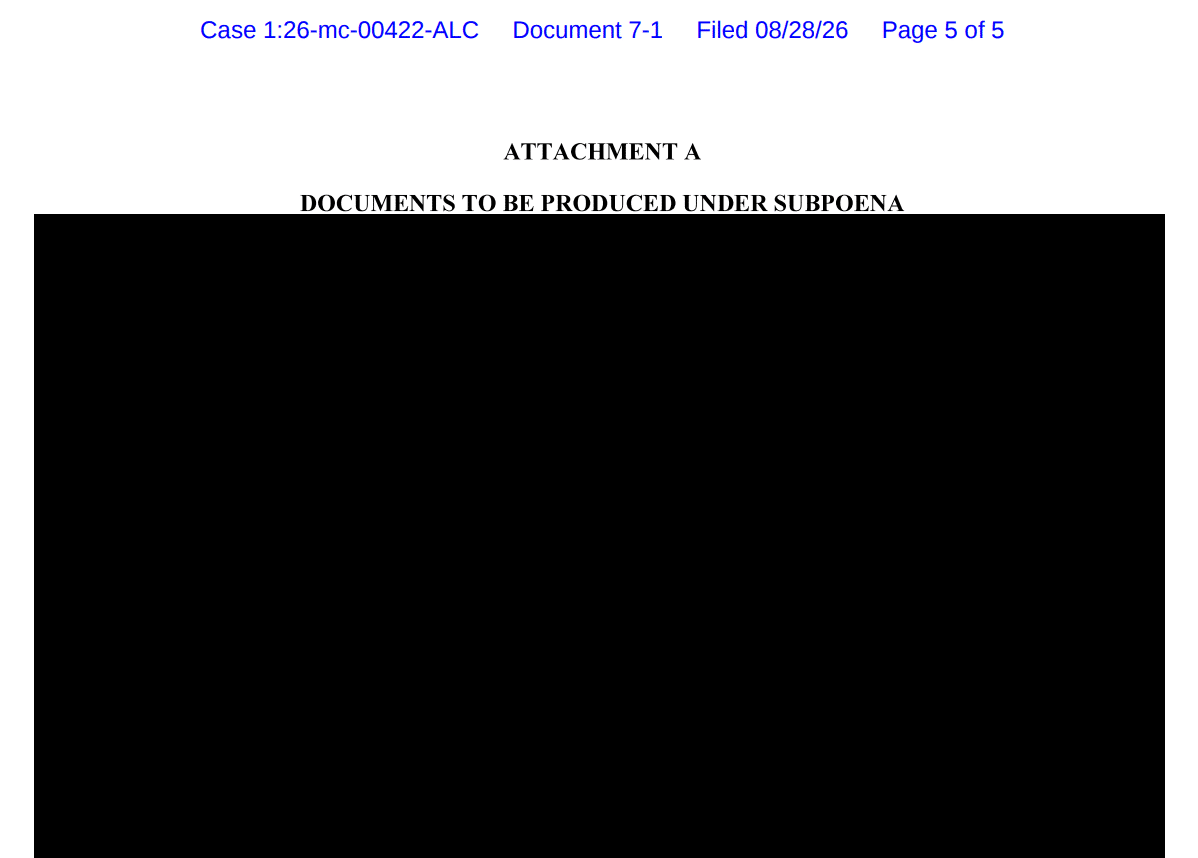
However, recognizing that public transparency was tipping off targets and potentially endangering the integrity of digital evidence, Take-Two altered its strategy. On Friday—just one day after Rockstar streamed its extended look at GTA 6 on Netflix—Take-Two returned to the U.S. District Court for the Southern District of New York. This time, the company filed a motion requesting that a secondary Discord subpoena be placed under a complete legal seal, blacking out the identities of the targets and the specific parameters of the request.
Supporting Context & Metrics: Platforms, Subpoenas, and the Digital Battleground
The legal maneuvers highlight a growing friction point between major tech platforms and corporate intellectual property holders. The battle lines have been drawn across three primary ecosystems: Discord, YouTube, and independent community servers.
The Discord Battleground
Discord has emerged as ground zero for the GTA 6 leak investigation. The platform’s server-based structure, private messaging features, and large gaming communities make it an attractive vector for sharing early build files, code snippets, and unauthorized video clips.
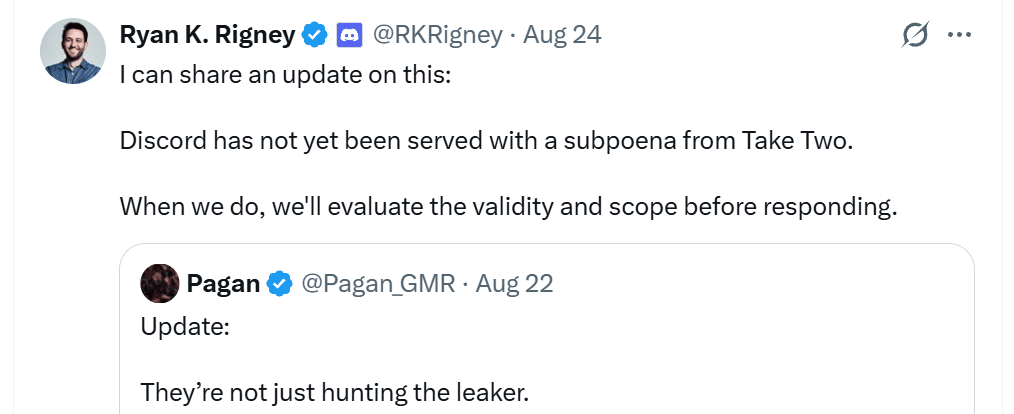
Take-Two’s first public Discord subpoena, issued on August 21, was ostensibly served on the platform, though procedural hiccups complicated the timeline. Ryan Rigney, a prominent communications representative for Discord, took to X (formerly Twitter) on August 24 to publicly clarify that the platform had not yet been formally served with a subpoena from Take-Two. Rigney added that Discord intended to carefully evaluate the validity and scope of the legal demand before issuing any user data—a standard protective stance for major platforms guarding user privacy.
Whether Discord’s pushback or general corporate caution influenced Take-Two’s subsequent strategy is a matter of speculation. What is clear, however, is that Take-Two’s second subpoena request is drastically different. Rather than casting a wide net over community servers, the sealed filing hones in tightly on specific individuals. According to court papers, the request targets "one additional Discord user and obtained additional identifying information for a previously identified Discord user, as well as additional information concerning the community servers identified in its prior subpoena."
The YouTube Pivot and Tactical Retreat
While the Discord dragnet tightens, Take-Two’s approach to Google and YouTube has experienced a notable contraction.
In earlier filings, Take-Two attempted to compel Google to reveal the identities behind three distinct YouTube personas allegedly tied to the distribution of leaked video content: CyberLeeks, Surfer24k, and CyberLeek_ar_io.
However, U.S. District Judge John P. Cronan pumped the brakes on the request, declining to sign off on the initial subpoena without firmer, more explicit documentation demonstrating how those specific YouTube accounts were directly linked to the leaked material. Although Take-Two submitted supplemental details in an attempt to satisfy the court’s evidentiary requirements, the publisher ultimately chose to withdraw the subpoena request entirely.
In its filing with Judge Cronan, Take-Two noted that because its investigation is "rapidly evolving," the company had "determined it no longer needs the particular information requested." Consequently, Take-Two respectfully withdrew the YouTube subpoena—though it explicitly reserved the right to return to Google with a fresh, more refined request should future investigative leads warrant it.
Official Statements and Legal Justifications
The legal core of Take-Two’s latest maneuver rests on its motion to seal the second Discord subpoena. Under federal procedural rules, judicial documents are presumed to be open to the public; overcoming this presumption requires a compelling justification demonstrating that the harm of disclosure outweighs the public’s right to access court records.
Preventing the Destruction of Evidence
Take-Two’s legal counsel argued forcefully that public transparency would directly undermine the ongoing investigation. In the motion to seal, the company asserted that the subpoena attachments reveal "highly sensitive, confidential information about an ongoing investigation into copyright infringement and the misappropriation of Take-Two’s confidential information."
The filing continues with a warning that resonates deeply in digital forensics and anti-piracy law:
"Public disclosure of this information could compromise Take-Two’s ongoing investigation and even tip off the alleged infringers as to the nature and progress of Take-Two’s investigation and information Take-Two has gathered about the infringement."
Furthermore, Take-Two articulated a very real fear common in digital leak investigations: that the alleged infringers—referred to in the plural—would use public court documents as an early warning system to purge communication logs, delete server histories, wipe hard drives, or otherwise conceal and destroy critical forensic evidence before platforms can preserve or surrender server logs.
The "Rapidly Evolving" Standard
By characterizing the entire operation as "rapidly evolving and ongoing," Take-Two’s legal team successfully framed the investigation not as a static fishing expedition, but as a dynamic criminal or civil tracing operation. This fluidity explains why the second subpoena requests fundamentally different categories of information compared to the broad, clumsy sweeps attempted in the initial weeks following the leak.
Future Outlook: What Lies Ahead for Take-Two and the Leakers?
As the legal dust settles on the latest round of filings, several key questions remain unanswered, setting the stage for the coming months leading up to the launch of Grand Theft Auto VI.
Will the Court Maintain the Seal?
The immediate hurdle for Take-Two is whether Judge Cronan or the presiding magistrate will permanently endorse the motion to seal or eventually require public redactions. While courts frequently grant temporary seals to protect active law enforcement or private investigative operations, prolonged secrecy often faces pushback from media organizations and legal transparency advocates. For now, the new demands remain hidden behind a judicial wall, and the subpoena has yet to be formally issued to Discord.
The Ultimate Cost of Leaks
The GTA 6 leaks represent more than just a marketing annoyance; they strike at the heart of corporate valuation and trade secret protection. Take-Two’s aggressive posture—transitioning from mass takedowns to targeted, sealed federal subpoenas—signals a zero-tolerance policy toward pre-release security breaches.
Even as the publisher dropped its Google/YouTube subpoena, the pivot toward deep digital forensics on Discord proves that the company is willing to play the long game. Whether these sealed subpoenas will successfully unmask the masterminds behind "Cyberleek" and the wider leak syndicate remains to be seen. However, one thing is certain: anyone thinking of trading, sharing, or hosting unauthorized GTA 6 code or footage is operating on borrowed time, as Take-Two’s legal machinery continues to grind forward in the shadows.