Executive Overview
For the better years of the modern software engineering lifecycle, the industry mantra has been absolute and unwavering: "Shift left."
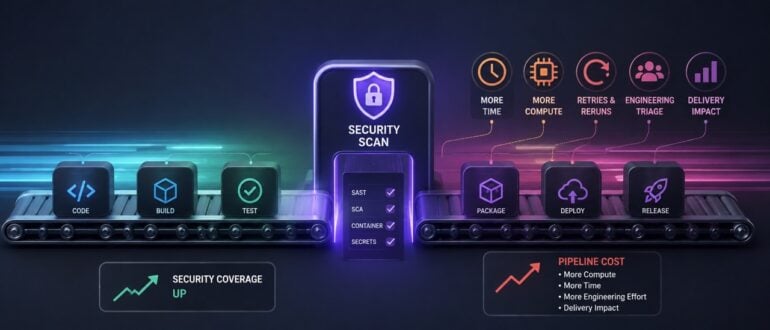
The core philosophy is elegantly straightforward—catch security vulnerabilities earlier in the development lifecycle, fix them when they are cheapest to remediate, and build a more resilient product by baking safety directly into the continuous integration and continuous deployment (CI/CD) pipeline. By embedding security gates into the very fabric of code delivery, organizations have dramatically altered their vulnerability exposure. Security coverage has gone up, and catastrophic late-stage breaches have, in theory, been headed off at the pass.
Yet, as engineering organizations rush to embrace this paradigm, a quieter, less discussed metric is being systematically ignored. While the industry meticulously tracks vulnerability burndown rates, mean-time-to-remediate (MTTR) metrics, and compliance scorecards, it rarely subjects the delivery pipeline itself to the same rigorous accounting.
When security tooling—such as Static Application Security Testing (SAST), Software Composition Analysis (SCA), container image scanning, and secret detection—is injected into a CI/CD pipeline, it changes the fundamental economics of software delivery. It is an alteration that is rarely measured with the same rigor as the security posture it aims to improve.
"Shift left" is frequently treated as a frictionless, free upgrade: catch problems earlier, at a lower cost, with no real downside. While this remains fundamentally true regarding the remediation cost of a software vulnerability, it is not automatically true for the operational cost of running the pipeline itself. A security control can be entirely worth adding to a codebase and still alter delivery economics in ways that warrant honest, unvarnished naming rather than blind assumptions that the hidden costs simply net out to zero.
Detailed Chronology: The Evolution and Friction of Pipeline Security
To understand how modern engineering pipelines arrived at this juncture, it is necessary to trace the historical progression of software security delivery models over the past two decades.
Phase One: The Late-Stage Gateway (Pre-2015)
In the era of monolithic applications and waterfall-to-agile transitions, security was traditionally a distinct, terminal phase. Code was written, tested for functionality, and then thrown "over the wall" to a dedicated InfoSec or security assurance team. This team would run manual penetration tests, review compliance checklists, and execute heavy, lengthy security audits shortly before a major release.
- The Cost: Delivery velocity was throttled. Releases happened quarterly or semi-annually, and finding a critical vulnerability late in the cycle meant delaying a release by weeks or months, costing hundreds of thousands of dollars in engineering and business delays.
Phase Two: The CI/CD Boom and Initial Automation (2015–2018)
As DevOps matured, organizations began automating their build and deployment pipelines. Continuous integration servers became the nervous system of engineering teams. Security, however, lagged behind this automation boom. Security teams realized that manual reviews could not keep pace with agile, daily deployments. The industry rallied around the rallying cry of "Shift Left," aiming to pull security checks out of the final release gate and push them earlier into the commit-and-build phase.
Phase Three: The Proliferation of Point Tools (2018–Present)
This era gave rise to the modern DevSecOps tooling ecosystem. Rather than relying on a single, monolithic security scanner, pipelines were increasingly populated by a diverse array of specialized tools:
- SAST (Static Application Security Testing): Analyzes source code for internal vulnerabilities before compilation.
- SCA (Software Composition Analysis): Inspects third-party libraries and dependencies for known Common Vulnerabilities and Exposures (CVEs).
- Container Scanning: Inspects base images, layers, and packages for misconfigurations and vulnerabilities.
- Secret Scanning: Scans commits and PRs for hardcoded API keys, passwords, and tokens.
While these tools successfully reduced systemic risk, they also transformed the CI/CD pipeline from a streamlined assembly line into a congested, multi-stage clearance center. Each new security control added its own distinct execution profile, resource footprint, and friction layer to the build process.
Supporting Context & Metrics: The Anatomy of Hidden Pipeline Costs
When engineering leaders evaluate the addition of a new security scanner, their financial and operational models typically account for only the software license or subscription cost of the tool itself. However, practitioner observation across modern enterprise pipelines reveals that the true cost of a security control is cumulative, compounding across several non-trivial vectors:
$$textIncremental DevSecOps Cost = textTool Cost + textCI/CD Compute + textExecution Time + textRetry/Rebuild Overhead + textTriage Effort + textVelocity Impact$$
Let us break down these compounding elements to understand how security tooling quietly reshapes pipeline economics.
1. Compute and Execution Scale
None of the modern security scanners are computationally free. Each scanner represents an independent pipeline stage with its own execution time. Crucially, while some scanners maintain a flat resource footprint, many scale dynamically with codebase size, file count, or dependency depth.
- A SAST or SCA scan that executes in seconds on a lightweight, micro-service repository can take meaningfully longer when applied to a sprawling enterprise monorepo.
- Container image scanning scales with the number and size of layers in a container, meaning that bloated base images or frequent image rebuilds incur exponentially higher compute consumption.
2. The Multiplier Effect of Blocked Builds and Retries
Security scanners do not just run; they actively gate builds. When a new scanner flags a vulnerability or a suspected compliance violation, it frequently blocks the pipeline.
- Blocked builds trigger retries. When a developer fixes the issue and pushes a new commit, the entire pipeline often has to re-run from the beginning—or at least re-execute resource-intensive upstream stages that had already successfully passed.
- This hidden retry loop consumes valuable runner minutes and compute clusters, an overhead that is easily overlooked if teams only measure the isolated duration of the security scanning stage itself rather than its macroeconomic effect on the entire pipeline ecosystem.
3. Engineering Triage and False Positives
Perhaps the most expensive component of pipeline security is human attention. Automated scanners inevitably generate false positives, low-priority warnings, or ambiguous flags.
- Every time a build is flagged, an engineer or a security champion must pause their core delivery work to perform triage, review the finding, determine whether it represents a genuine risk, and decide whether to suppress, remediate, or request an exception.
- This context-switching tax fragments engineering focus and eats into the available capacity for feature delivery.
4. The Trap of Redundant Engineering Processes
Before introducing a new security control into a pipeline, organizations frequently skip a fundamental architectural question: Does this new tool replace an existing process, or does it simply sit alongside it?
Consider an organization that introduces a modern SCA tool to catch vulnerable open-source dependencies. Too often, this tool is layered on top of an existing manual dependency review checklist that the team was already required to execute. If the manual review is not formally retired, the organization has merely introduced duplicated engineering effort dressed up as enhanced security.
These redundancies do not materialize overnight through deliberate choice; they accumulate one well-intentioned addition at a time. Because it is rarely anyone’s explicit job to audit and decommission legacy processes made redundant by new tooling, organizations end up paying a double tax: the compute cost of automation combined with the human labor of manual verification.
Official Industry Perspectives and Practitioner Observations
Conversations with platform engineers, CI/CD architects, and security leaders reveal a growing consensus: the industry must mature past the simplistic binary of "secure vs. fast" and begin treating the delivery pipeline as an integrated, measurable ecosystem.
"Security belongs firmly in the software delivery pipeline. That is no longer up for debate. The harder, more nuanced question is precisely where it belongs, how often it should run, and at what structural cost to our delivery velocity," notes a Principal Platform Architect at a global cloud-native enterprise.
Practitioner observations consistently point out that while adding robust security tooling inevitably increases overall pipeline workload, delays artifact production, and drives up cloud infrastructure (compute) costs, these negative trade-offs are rarely tracked on the same dashboards used to monitor security posture.
Crucially, industry veterans emphasize that this observation is not an indictment of security tooling itself. It is a call for precision.
- What this observation is NOT: It is not a benchmark asserting that every organization will experience a fixed percentage drop in velocity, nor is it an argument that security investments yield a negative return.
- What this observation IS: It is a consistent pattern observed across real-world pipelines—one significant enough to warrant transparent naming, careful modeling, and deliberate system design rather than wishful thinking.
Mature DevSecOps organizations are beginning to recognize that security coverage and delivery speed are not opposing, zero-sum forces. Instead, they are two outputs generated by the exact same socio-technical system. Optimizing one while quietly ignoring the operational degradation of the other leads to systemic friction, developer burnout, and inflated infrastructure expenditures.
Future Outlook: Five Questions Before the Next Tool
As organizations look toward the future of software supply chain security, the path forward does not lie in retreating from automated security controls. The threat landscape is far too complex, and regulatory pressures are far too high, to abandon automated vulnerability scanning.
Instead, the maturation of DevSecOps requires a shift toward holistic pipeline economics. Before introducing the next shiny security scanner, platform teams and security leaders must pause to ask five critical, foundational questions:
- What existing process, tool, or manual check does this new control officially replace? (If the answer is "nothing," and it simply runs alongside legacy checks, you are paying a duplication tax.)
- How does this tool scale as our codebase grows? (Will its execution time remain flat, or will it degrade exponentially as our monorepo or container footprint expands?)
- What is our projected false-positive and triage burden? (Who is going to review the alerts, and do we have the human engineering capacity to absorb that operational load without sacrificing delivery velocity?)
- How do blocked builds and retry loops impact our total CI/CD compute budget? (Have we modeled the cost of re-running upstream pipeline stages when a security gate fails?)
- How will we measure the success of this control beyond just "number of vulnerabilities caught"? (Are we tracking its impact on time-to-artifact, pipeline duration, and developer feedback loops?)
None of these questions are designed to argue against the implementation of necessary security controls. Rather, they are frameworks for ensuring that teams enter into architectural trade-offs with their eyes wide open.
The ultimate lesson for modern software engineering is remarkably simple: Measure the whole delivery system, not just the isolated metrics you were already tracking. A security control that successfully closes a genuine operational gap is almost always worth the pipeline cost it introduces. But to manage that investment wisely, an organization must fully understand and account for that cost before the first build ever runs.