Executive Overview
Sixty-six million years ago, a mountain-sized space rock slammed into what is now the Yucatán Peninsula in Mexico, delivering a catastrophic blow that forever altered the trajectory of life on Earth. The Chicxulub impact wiped out the non-avian dinosaurs, collapsed marine ecosystems, and triggered a global winter by blanketing the atmosphere in sulfur, ash, and soot. For decades, the narrative of the Chicxulub event has been exclusively one of total annihilation—a cosmic tragedy that reset the planetary clock.
However, beneath the smoldering ruins of destruction, a quieter, more constructive geological drama was unfolding. Recent scientific breakthroughs reveal that the colossal energy released by the impact did more than destroy; it also engineered. Deep beneath the ocean floor, the cataclysm generated an immense, subterranean hydrothermal system—a vast network of superheated, mineral-rich water circulating through fractured, molten rock.
While scientists previously believed this underground oasis was a short-lived anomaly lasting roughly 2 million years, groundbreaking geochemical analysis published in Communications Earth & Environment led by Dr. Annemarie Pickersgill reveals a staggering revision. Through precise potassium-argon dating of drill cores retrieved from the impact zone, researchers have established that this mineral-laden thermal system persisted for at least 8 million years.
This quadrupling of the estimated lifespan of the Chicxulub hydrothermal system fundamentally changes our understanding of the immediate post-impact environment. Far from being a sterile wasteland, the subterranean depths of the crater provided an extraordinarily long-lived refuge. With abundant heat, chemical nutrients, and stable thermal niches, this hidden biosphere may have served as a vital crucible for prebiotic chemical reactions, microbial evolution, and the resilient propagation of life in the direct aftermath of Earth’s most infamous mass extinction.
Detailed Chronology: From Cataclysm to Subterranean Oasis
To comprehend how an extinction-level impact could simultaneously foster an incubator for life, scientists must reconstruct a multi-stage timeline that spans from the initial seconds of the collision to millions of years of subterranean evolution.
T-Minus Zero: The Chicxulub Impact (66 Million Years Ago)
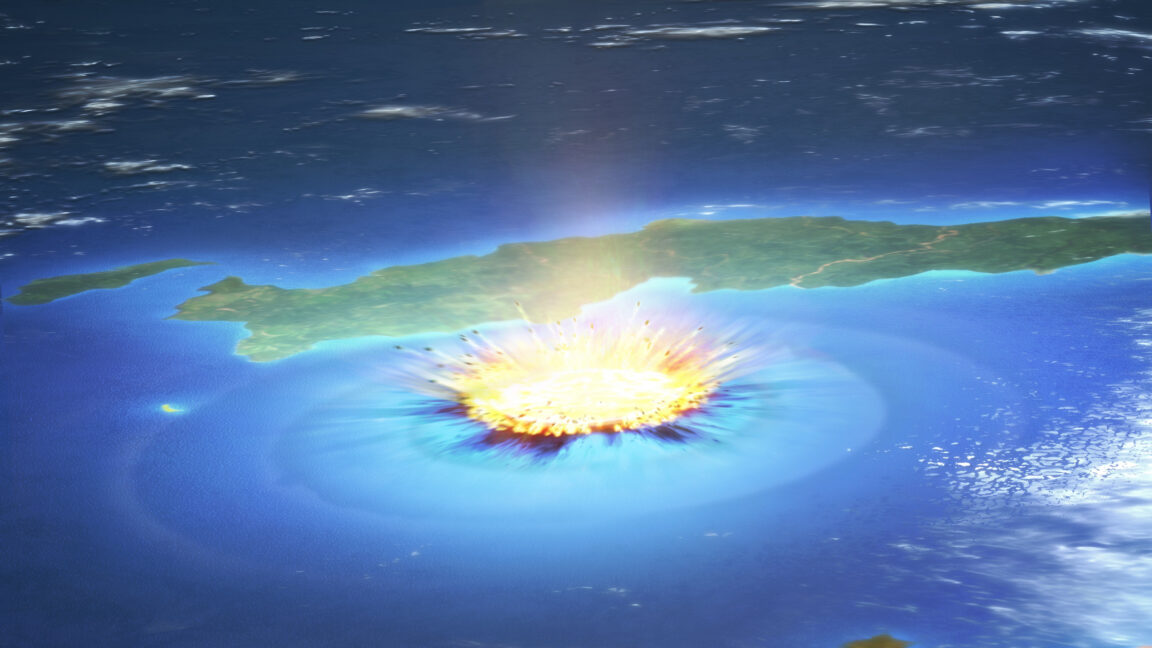
The impact event was unfathomably violent. Traveling at hypersonic speeds, the roughly 6-mile-wide (10-kilometer-wide) asteroid penetrated Earth’s crust in a matter of seconds, excavating a massive transient cavity. The kinetic energy released was equivalent to billions of atomic bombs, vaporizing rock, launching megatsunami waves across global oceans, and showering the planet with incandescent ejecta.
At ground zero in the shallow seas of the proto-Caribbean, the shockwaves deformed the Earth’s crust to depths reaching 35 kilometers (nearly 22 miles). This cataclysmic fracturing liquefied and superheated vast volumes of planetary crustal rock, creating a chaotic mixture of molten material, shattered minerals, and displaced sediment.
The Immediate Aftermath: Fracturing and Fluid Influx
In the days, decades, and centuries following the impact, the crater began to settle, though it remained intensely hot. The immense thermal energy melted enormous quantities of target rock. As the surrounding ocean water rushed back into the collapsing basin, it encountered this superheated, freshly fractured subterranean matrix.
The thermal contrast was extreme. Seawater seeped deep into the subterranean cracks—reaching depths of up to a kilometer or more—where it was instantly heated by the residual thermal energy of the impact melt sheet. This initiated a classic convective loop: superheated water, rich in dissolved minerals and chemical nutrients, rose toward the surface of the crater floor, while cooler, dense seawater sank to take its place.
The Long-Term Stabilization: A 5-Million-Year Thermal Sweet Spot
While surface environments plunged into darkness and cold during the impact winter, conditions deep within the crater’s hydrothermal veins were remarkably hospitable. Computer simulations of the Chicxulub hydrothermal activity model this long-term stabilization process with striking precision:
- 0 to 2.3 Million Years Post-Impact: At a depth of one kilometer, the temperatures within the fractured rock slowly cooled from magma-adjacent extremes down to approximately 90°C (194°F).
- Up to 5 Million Years Post-Impact: Temperatures continued their gradual descent, dropping below 50°C (122°F). This thermal bracket is a noted "sweet spot" for many extremophilic microorganisms, providing ideal conditions for thermophilic (heat-loving) and mesophilic (moderate-temperature) microbes to form dense colonies.
- 6 to 8 Million Years Post-Impact: Hydrothermal fluid flow began to wane significantly as the remaining impact heat finally dissipated into the surrounding mantle and crust. By the 8-million-year mark, the active hydrothermal circulation had effectively ceased, aligning perfectly with isotopic cooling curves extracted from the core samples.
Supporting Context & Metrics: Decoding the Rocks
Unlocking the timeline of an event that occurred 66 million years ago requires forensic geology of the highest order. Because direct observation of the crater’s interior is impossible, scientists rely on deep-sea drilling projects to bring the history of the underworld back to the surface.
The 2016 International Ocean Discovery Program (IODP) Expedition
In 2016, an international team of scientists aboard the liftboat MS Myrtle drilled deep into the peak ring of the Chicxulub crater, recovering continuous core samples from depths of 500 to 1,300 meters below the seafloor. These cylinders of rock offered an unprecedented cross-section of the impact’s aftershocks, revealing how shocked granite, melted basement rock, and fallback breccia interacted with circulating fluids over millions of years.
The Precision of Potassium-Argon Dating
To determine precisely how long the hydrothermal system remained active, Dr. Annemarie Pickersgill and her team at the SUERC Center for Isotope Sciences at the University of Glasgow turned to potassium-argon (K-Ar) dating.
Feldspar, a common rock-forming mineral recovered abundantly from the drill cores, contains naturally occurring radioactive potassium-40 ($^40textK$). Over vast spans of time, potassium-40 decays at a known, constant rate into argon-40 ($^40textAr$).
Potassium-40 (40K) ----[ Radioactive Decay ]----> Argon-40 (40Ar)Because argon is a noble gas, it escapes easily as a vapor when rock is completely molten. However, once the rock solidifies and cools below a specific threshold temperature, the crystal lattice traps the accumulating argon gas. By measuring the ratio of remaining potassium-40 to the accumulated argon-40 within the feldspar crystals, researchers can accurately calculate the age of the mineral and determine when the hydrothermal conduits finally cooled enough to lock the gas inside.
The argon signatures extracted from the Chicxulub core samples revealed that the hydrothermal system retained enough heat to drive fluid circulation uninterrupted from 66 million years ago all the way to approximately 58 million years ago.
Official Statements and Expert Insights
The implications of an 8-million-year hydrothermal window extend far beyond the history of our own planet, offering crucial analogues for astrobiology and the search for extraterrestrial life.
In their published study in Communications Earth & Environment, Dr. Pickersgill and her colleagues emphasized the evolutionary significance of extended thermal activity:

"Longer periods of hydrothermal activity will generate extended windows of opportunity for prebiotic chemical reactions to occur, life to develop, and micro-organisms to thrive and propagate beyond their point of origin," noted Dr. Annemarie Pickersgill.
While hydrothermal systems created by impact craters are relatively common across the solar system, finding direct evidence of life inside them has historically proven exceptionally difficult. To date, active microbial colonization has been verified in only 8 out of roughly 70 known underwater impact craters worldwide. Pickersgill’s research does not claim to have found direct fossilized microbes within every inch of the Chicxulub core, but rather establishes that the physical and thermal parameters necessary to sustain such life existed for a duration four times longer than previously modeled.
Expanding on the broader cosmic implications, Pickersgill noted:
"Chicxulub is still relatively small compared to the impact basins expected on early Earth and observed on other planetary bodies. It is therefore possible that these larger impacts could have created even longer-lived hydrothermal systems and, hence, could have been able to maintain the temperatures and fluid flux required for habitable environments for a minimum of several million years."
Future Outlook: Implications for Earth’s History and Astrobiology
The discovery that the Chicxulub impact crater harbored a multi-million-year subterranean ecosystem reframes how scientists think about mass extinctions and the cradle of life.
Rethinking Impact Craters as Nurseries
Traditionally, asteroid impacts are viewed exclusively as agents of destruction. However, planetologists now recognize that heavy bombardment periods in planetary evolution—such as the Late Heavy Bombardment in the early inner solar system—did not just sterilize planetary surfaces. By fracturing planetary crusts and initiating widespread, long-lasting hydrothermal networks, impacts may have acted as massive thermal pumps, driving the chemical reactions necessary to kickstart or preserve primitive life.
Direct Parallels for Mars and Beyond
This paradigm shift is particularly relevant to the exploration of Mars and icy moons like Europa and Enceladus. Mars is heavily scarred by ancient impact basins that once interacted with subsurface water ice. If impacts like Chicxulub are capable of sustaining warm, nutrient-rich hydrothermal environments for nearly a decade of millions of years, similar ancient craters on the Martian surface represent prime drilling targets in the ongoing search for fossilized microbial biosignatures.
Furthermore, as NASA, ESA, and private space agencies look toward future deep-space missions, understanding the thermodynamics of impact-induced hydrothermal systems provides a robust theoretical framework. It suggests that even after a world suffers a catastrophic cosmic impact, nature possesses deep, resilient mechanisms to nurture life against the odds—transforming the scars of destruction into cradles of creation.