Executive Overview
Across the landscape of mature Business-to-Business (B2B) software companies, a defining trend is reshaping executive leadership: the triumphant, sometimes desperate return of original founders. This is not the standard corporate narrative of a board panicking over a disastrous fiscal quarter. Rather, it represents what industry insiders describe as The Last Stand—a systemic, high-stakes movement driven by the existential shockwave of generative artificial intelligence and agentic workflows.
The pattern typically emerges within organizations that have crossed the threshold of scale: businesses boasting at least $50 million in Annual Recurring Revenue (ARR) that possess a strong enough baseline to survive, yet find themselves structurally too slow to capture the agentic future. While consumption-priced infrastructure giants (such as Twilio, which recently saw organic growth surge and full-year guidance lifted under a professional CEO) welcomed AI as an immediate expansion of traffic and volume, the story for seat-priced application software has been radically different. For these legacy SaaS providers, AI materialized not as a tailwind, but as a severe, structural headwind.
When legacy pricing models, seat-based moats, and predictable multi-year subscriptions are abruptly threatened by autonomous AI agents, professional chief executives frequently falter. Bound by strategic blueprints, multi-year compensation metrics, and public market guidance, hired CEOs are rarely equipped—or willing—to cannibalize their core revenue streams. Consequently, founders are stepping back into the hot seat. From Daniel Dines at UiPath and Aneel Bhusri at Workday to Eoghan McCabe at Intercom, these visionary leaders are returning because no one else possesses the psychological and operational liberty required to orchestrate a complete enterprise reinvention.
Detailed Chronology: The Rebound of the Visionaries
The return of the founders is marked by swift, decisive interventions against a backdrop of decelerating growth and plunging market valuations.
Daniel Dines and UiPath: A Four-Month Interregnum
The vanguard of this trend was Daniel Dines, co-founder of UiPath. Having launched the robotic process automation (RPA) pioneer in 2005, Dines successfully guided the company through its hyper-growth phase and IPO as CEO and co-CEO. On January 31, 2024, he stepped aside, handing the sole chief executive mantle to enterprise software veteran Rob Enslin while transitioning to Chief Innovation Officer and Executive Chairman.
The handoff proved catastrophically short-lived. By May 29, 2024—a mere four months later—UiPath announced that Enslin was resigning effective June 1, and Dines was immediately reassuming the top post. The catalyst was a brutal fiscal reality check: while reporting a nominally healthy ARR of $1.508 billion (up 21%) and revenues of $335 million (up 16%), management slashed guidance for both the upcoming quarter and the full year. Wall Street punished the miss, sending the stock tumbling roughly 35% to under $12 per share, down from a February high of nearly $27. AI had dismantled the traditional RPA value proposition overnight, and Dines was forced to return before the transition’s second full quarter had even closed.
Aneel Bhusri’s Re-entry at Workday
A similar drama unfolded at human capital management and financial software giant Workday. Carl Eschenbach, brought in as co-CEO in December 2022, took over as sole chief executive in February 2024. Yet, on February 9, 2026, Workday confirmed that co-founder Aneel Bhusri was permanently stepping back into the CEO chair.
Bhusri framed the move squarely around the technological imperative of the era, declaring that artificial intelligence represents a transformation vastly larger than the advent of SaaS itself—one that will ruthlessly dictate the next generation of market leaders. The numbers underwriting his return told a sobering story: Workday’s stock had shed roughly 15% of its value in early 2026 alone, sitting more than 40% below its 2024 peak. By the time Q2 fiscal 2027 results were published in late August, subscription revenue stood at $2.471 billion (up 13.9%), but management’s forward guidance projected fiscal 2028 subscription growth slowing down to an anemic 11%. For a $10 billion revenue juggernaut boasting 97% gross retention, a 13% growth rate signaled a slow, irreversible plateau.
Eoghan McCabe and the Radical Birth of Fin at Intercom
Perhaps the most radical execution of the founder’s last stand occurred at Intercom. Eoghan McCabe stepped away from the CEO role in 2020, only to return at the end of 2022—coincidentally just weeks before OpenAI launched ChatGPT. Recognizing the existential threat posed by foundational large language models, McCabe and his team pivoted aggressively, ditching legacy roadmaps to pioneer the customer agent category.
In May 2026, McCabe executed a move that a professional, hired CEO would virtually never be permitted to make: he completely rebranded a 15-year-old company—whose iconic chat bubble graced millions of websites globally—after its flagship AI product, renaming the entire enterprise "Fin."
The gamble paid off spectacularly. Just weeks later, on June 15, software titan Salesforce announced a definitive agreement to acquire Fin for approximately $3.6 billion. At the time of the deal, the company boasted roughly 30,000 customers and over $400 million in recurring revenue. While early-stage AI startups command hyper-inflated venture multiples, Fin secured a solid B2B software exit of under 9x revenue—a testament to real execution, painful product cannibalization, and a founder’s willingness to burn the ships behind him.
Supporting Context & Metrics: The Anatomy of a Slow Death Spiral
To understand why professional CEOs fail in the face of generative AI, one must analyze the cold calculus of enterprise SaaS metrics.
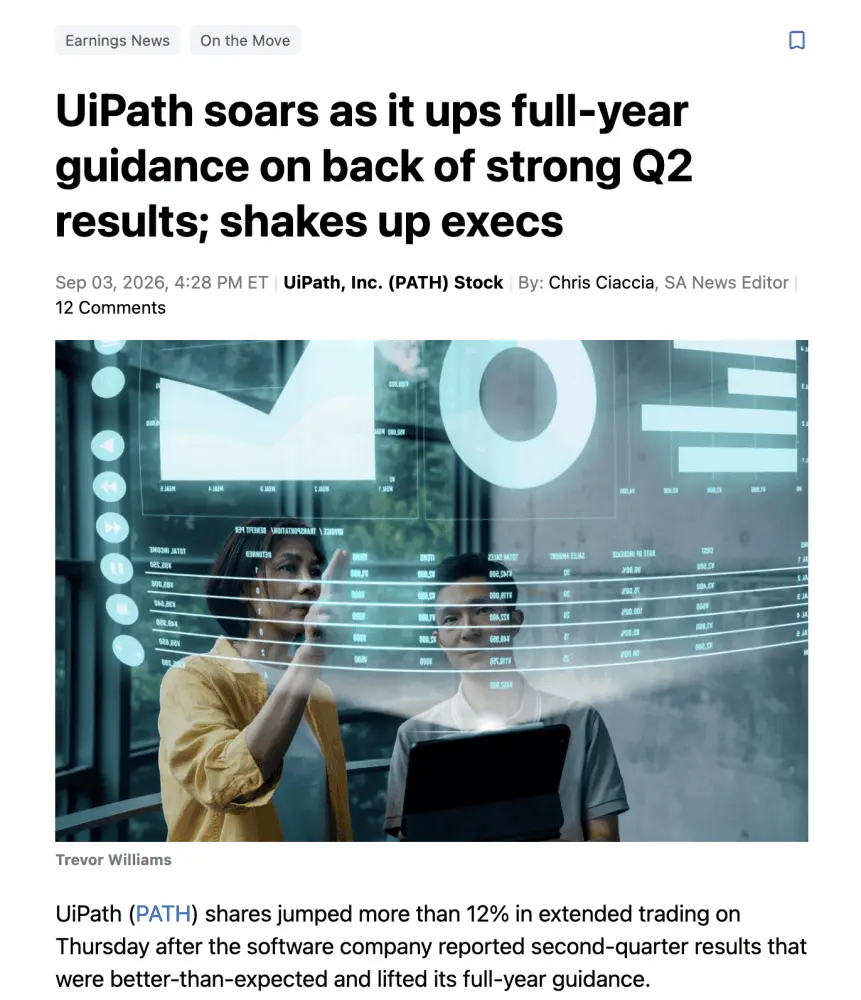
At UiPath, Dines’ return initiated a sweeping operational and technological overhaul. By the time UiPath reported its Q2 FY27 results in September 2026—27 months into his second tenure—the company had achieved four consecutive quarters of GAAP profitability, expanded its operating margins, and defended its 97% gross retention rate. Furthermore, its base of customers generating over $1 million in ARR climbed by 21%.
However, a critical nuance remains: stopping the decline is not the same as reaccelerating growth. Despite Dines’ heroic efforts, UiPath’s overall growth rate remains in the low double digits—lower than the day he walked back into the office. The founder’s return halts the erosion of enterprise value and re-engineers the product foundation, but restarting hyper-growth in a commoditized, AI-disrupted market requires an entirely different playbook that takes years to execute.
Conversely, professional executives frequently achieve the exact metrics they were hired to deliver, yet still fail to save the company from strategic obsolescence. At Workday, external stakeholders readily credited Carl Eschenbach with driving global expansion, sharpening operational discipline, and expanding industry-specific solutions. Eschenbach succeeded in every traditional executive metric. Yet, none of those achievements constituted a product rebuild.
A hired CEO operates within strict institutional boundaries: a strategic plan approved by the board, compensation packages tethered to predictable forecasts, and public markets demanding smooth, linear quarterly progress. The AI paradigm shift shatters every line of that contract. True reinvention requires a company to willingly cannibalize its own lucrative pricing models before a nimbler competitor does, burn gross margins for six to eight quarters, kill flagship legacy products that still generate millions in billings, and look public investors in the eye to announce that short-term revenues must drop before long-term value can rise.
A professional executive who attempts this risks swift termination without gratitude. A founder, by contrast, treats the crisis like day one of the startup.
Official Statements and Strategic Insights
The governance mechanics behind these transitions reveal a stark divide in modern corporate structure. The Last Stand is fundamentally dependent on boardroom arithmetic: does the founder possess the voting power or institutional leverage required to stage a comeback?
At Workday, Aneel Bhusri and co-founder Dave Duffield maintain control over 68% of the voting stock, ensuring that Bhusri’s re-appointment faced zero internal resistance. Furthermore, Bhusri never fully vacated the premises, retaining his position as Executive Chairman throughout Eschenbach’s tenure. Similarly, Daniel Dines occupied the role of Chief Innovation Officer and Executive Chairman when he seized the CEO reins back at UiPath, turning what could have been a debilitating nine-month executive search into a seamless four-day transition.
When founders are entirely divorced from the cap table, the board of directors, and daily operations, this option vanishes. They are left at the mercy of search committees and private equity firms.
This dynamic was vividly illustrated by Silver Lake’s maneuvers regarding Workday. On August 13, 2026, Reuters reported that private equity giant Silver Lake had spent months engaged in confidential buyout talks to take Workday private. The news triggered an 18% surge in Workday’s stock price—its largest single-day gain since 2016—inflating its market capitalization from roughly $43 billion to nearly $51 billion. Wall Street’s enthusiastic response signaled a clear message to the market: investors increasingly believe that the painful, necessary AI rebuild has a higher probability of success away from the hyper-scrutiny of public quarterly guidance.
Private equity is emerging as the ultimate fallback plan for legacy software companies whose founders are absent or unwilling to wage the war. Even with Bhusri back at the helm aggressively driving AI integration—propelling AI to account for over $100 million of new ACV in Q2 (exceeding 25% of the total), growing AI SKU ARR by over 200% to roughly $600 million, and onboarding more than 5,500 customers onto agentic workflows—the company is still wrestling with the legacy gravity of a decade of seat-based revenue.
Future Outlook: The Window is Closing
The overarching lesson from the wave of founder returns is both urgent and unforgiving. UiPath was growing at a healthy 21%, generating positive cash flow, and boasted a co-founder serving as Executive Chairman, yet Dines still recognized that nothing short of total executive reclamation would suffice.
For leaders of pre-AI B2B companies currently sleepwalking toward single-digit growth while their founders watch passively from board seats, the illusion of stability is dangerous. Waiting until the revenue growth turns negative is a fatal miscalculation.
The return of the founder buys a precious commodity: time. It stops the bleeding, forces a technological reboot, preserves core retention, and keeps the company in the game. But true reacceleration remains an arduous, protracted uphill battle.
As the enterprise software ecosystem races deeper into the agentic era, the message to legacy SaaS boards and aging management teams is unmistakable. It is not yet too late to pivot, but the twilight window of opportunity is rapidly slamming shut. When the final reckoning arrives, companies without their original founders at the helm may find that no hired executive is willing to make the ultimate sacrifice to save them.