A seismic shift is coming to the post-production industry. Avid Technology is preparing to release Media Composer 2026.8, an update that will fundamentally alter how collaborative editing environments interact with non-Avid storage. According to leaked reseller communications, social media disclosures, and an official Avid Knowledge Base publication, the developer plans to disable third-party NEXIS/ISIS storage emulation. This move threatens to disrupt established shared-storage and bin-locking workflows for thousands of boutique facilities, enterprise post-houses, and independent environments worldwide.
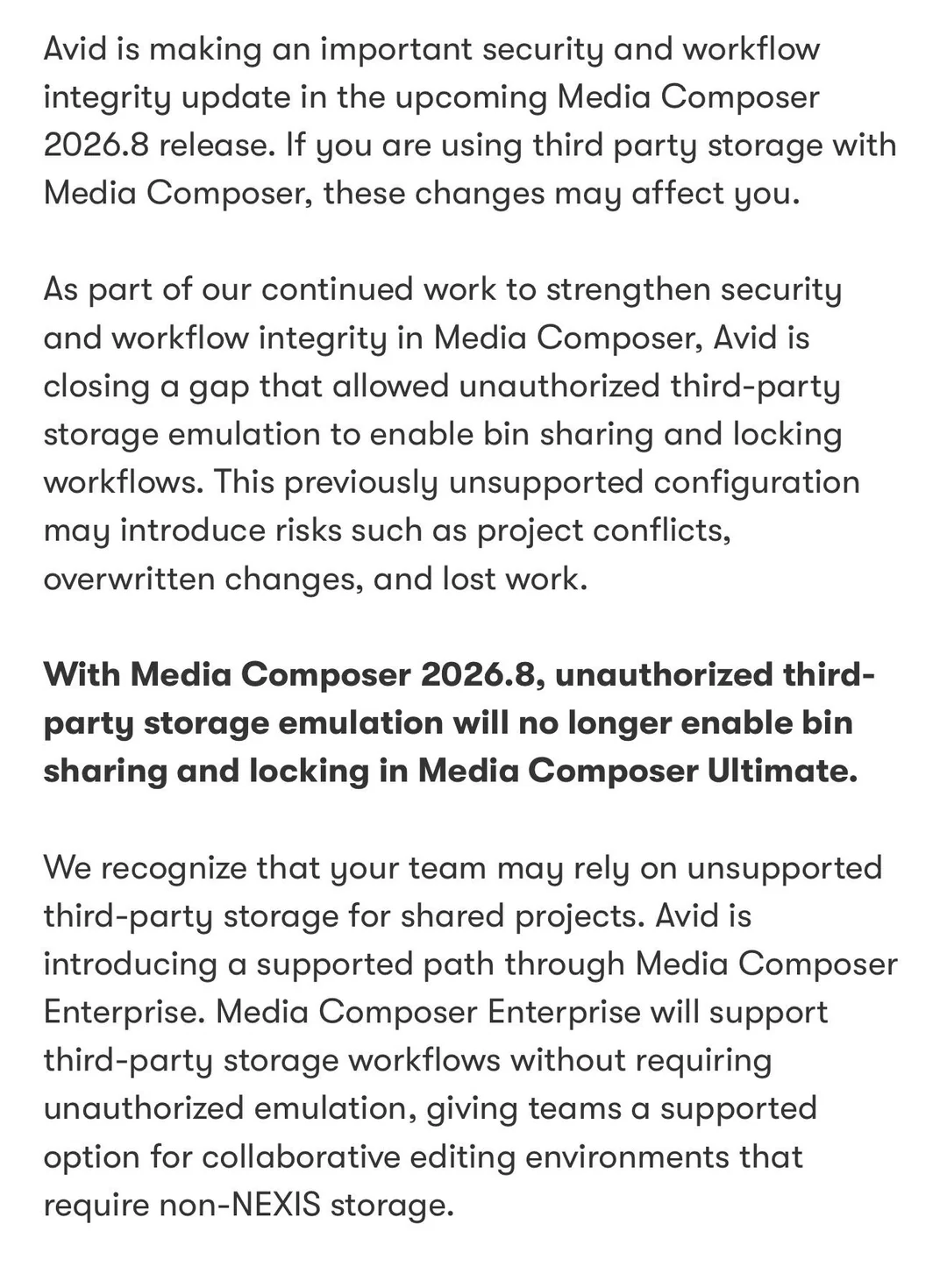
For over a decade, facilities seeking to avoid the premium price tag of proprietary Avid NEXIS hardware relied on third-party storage solutions (such as EditShare, Facilis, or custom NAS setups) paired with emulation software—most notably Mimiq (developed by Hedge). These utilities fooled Media Composer into believing it was connected to an official Avid storage system, unlocking the software’s legendary collaborative features: shared projects, shared bins, and active bin locking.
With the release of version 2026.8 (slated for late August 2026), this emulation-based backdoor will be closed. However, Avid is not completely abandoning third-party storage. Instead, the company is shifting the technical architecture of collaborative editing. Rather than relying on hardware-level emulation, Avid is building native, software-level project sharing and bin locking directly into the application.
The catch is commercial: this native third-party storage support will be restricted exclusively to the high-tier Media Composer Enterprise subscription. Facilities running the standard Media Composer Ultimate tier on non-Avid hardware face a stark choice: pay to upgrade their software licenses to the Enterprise tier, freeze their software updates indefinitely, or invest in proprietary Avid NEXIS hardware.
Detailed Chronology: The Evolution of Avid’s Shared Storage Paradigm
To understand the gravity of the 2026.8 update, one must examine the history of collaborative editing. Avid’s dominance in long-form television and feature film editing is largely built on its robust project-sharing capabilities.
The Era of Proprietary Lock-In (Unity, ISIS, and NEXIS)
Historically, to have multiple editors working inside the same project without overwriting each other’s work, facilities had to purchase Avid’s proprietary hardware. From early Unity systems to ISIS and the modern NEXIS line, Avid’s hardware ran specialized file systems (such as AvidFS or NEXIS FS). This system communicated directly with Media Composer to manage file permissions, project metadata, and bin locking (creating .lck files to prevent simultaneous write access to a single bin).
Because Media Composer was hardcoded to look for these specific network file protocols, standard Network Attached Storage (NAS) units operating on traditional SMB, AFP, or NFS protocols could not support collaborative workflows.
The Rise of Third-Party Emulation
As high-performance, low-cost 10GbE and 25GbE NAS systems proliferated, the post-production market demanded more affordable storage alternatives. This gave rise to third-party storage systems designed specifically for video editing, alongside software utilities like Mimiq.
Mimiq acted as a translation layer. By intercepting Media Composer’s queries, it emulated the behavior of an Avid NEXIS environment over standard network storage protocols. This enabled seamless bin locking and project sharing on everything from high-end EditShare servers to budget-friendly TrueNAS builds and modern cloud-native storage systems.
The Paradigm Shift in Version 2026.8
With the upcoming 2026.8 release, Avid is decoupling the collaborative logic from the hardware layer and moving it entirely into the Media Composer software application.
Under this new architecture:
With Avid Storage: If a facility uses official Avid NEXIS hardware, collaborative tools (bin locking and project sharing) will remain supported across all paid tiers of Media Composer (Standard, Ultimate, and Enterprise).
With Third-Party Storage: If a facility uses non-Avid storage (on-premise NAS/SAN or cloud-native platforms), Media Composer will no longer accept third-party emulation. Instead, collaborative workflows must use Avid’s native software-level project sharing, which is only unlocked via a Media Composer Enterprise license.
Supporting Context & Metrics: The Cost of Collaboration
This architectural shift introduces significant financial and operational considerations for post-production facilities. The transition from third-party emulation to native Enterprise-tier support alters the Total Cost of Ownership (TCO) for editing workgroups.
The Software Licensing Cost Delta
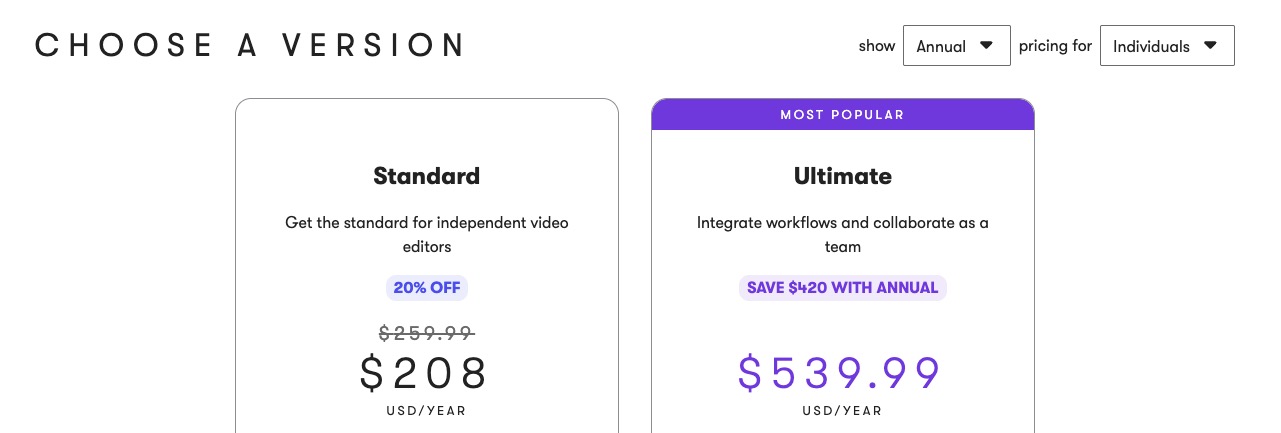
Most professional collaborative environments currently run Media Composer Ultimate, which is tailored for collaborative environments using Avid storage (or third-party storage via emulation).
Metric / Feature
Media Composer Ultimate
Media Composer Enterprise
Annual Subscription Cost (MSRP)
~$540 per year
~$900 per year (via authorized resellers)
Price Premium (Per Seat/Year)
Base Tier
+$360 per year
Bin Locking on Avid NEXIS
Yes (Native)
Yes (Native)
Bin Locking on Third-Party Storage
No (Emulation blocked in 2026.8)
Yes (Natively supported in 2026.8)
Admin & Security Controls
Standard
Advanced (Interface customization, user restrictions)
For a mid-sized post-production facility operating a 20-seat offline editing suite on third-party storage, the transition to the Enterprise tier represents a substantial budget increase:
$$textAnnual Increase = 20 text seats times $360 = $7,200 text per year$$
Over a typical five-year hardware amortization cycle, this software licensing premium adds $36,000 in operational expenditure—a cost that was previously avoided by using a one-time software utility.
The Mimiq Offset
Historically, utilizing Mimiq required a one-time license fee of up to $500 per seat. Under the new Avid model, while the need for Mimiq is eliminated for facilities upgrading to Media Composer Enterprise, the recurring annual subscription premium of the Enterprise license will quickly surpass the one-time cost of an emulation utility.
Storage arrays represent some of the most capital-intensive investments in a post-production facility. High-performance SAN and NAS systems from vendors like Facilis, EditShare, and Studio Network Solutions are often run for seven to ten years.
Because facilities cannot easily replace their entire storage infrastructure to match a software update, Avid’s policy change will force many IT directors to freeze their entire OS and Media Composer software ecosystems at version 2025.x or earlier to preserve their current hardware investments.
Official Statements & Industry Reaction
The post-production community has reacted to the leaked changes with a mix of frustration and pragmatic calculation.
Avid’s Official Position
In an official Knowledge Base article titled "Shared Project Workflows with Third-Party Storage," Avid framed the transition as an evolution toward a more stable, natively supported, and unified user experience. The company states:
"Media Composer Enterprise 2026.8 will provide shared projects on third-party storage without requiring the third-party NEXIS-emulation approach used by earlier workflows."
Avid asserts that by eliminating "unauthorized third-party storage emulation," they can guarantee system stability, streamline technical support, and offer a validated path for storage hardware. Reports indicate that Avid is actively working with major third-party storage vendors to officially test and validate their hardware systems for compatibility with the new native workflow in Media Composer Enterprise.
The Reseller and Upgrade Pipeline
To ease the transition, rumors circulating within reseller networks suggest Avid may offer a promotional $99 upgrade path per license to transition existing Media Composer Ultimate subscribers to Media Composer Enterprise. However, details remain unconfirmed regarding how long this promotional pricing will last, and whether it will apply to annual renewals or only the initial transition period.
Community Backlash and Technical Skepticism
On industry forums such as Reddit’s r/editors and r/Avid, reactions have been highly critical of the commercial stratification. Many lead editors and post-production supervisors view the locking of third-party bin support behind the Enterprise paywall as a regressive step designed to extract recurring subscription fees from mid-tier boutique facilities.
One prominent system integrator commented:
"This isn’t about stability; it’s about control. Mimiq has been rock-solid for years, proving that standard SMB storage can handle bin locking perfectly. Forcing us to pay double the subscription rate just to use our existing, non-Avid hardware feels like a penalty for not buying NEXIS."
Future Outlook: Navigating the New Storage Landscape
As the late-August release window for Media Composer 2026.8 approaches, post-production decision-makers must evaluate their options and formulate a transition strategy.
                          ┌──► 1. Freeze Ecosystem (Stay on Media Composer < 2026.8)
                          │
Decision Path for ───────┼──► 2. Upgrade to Enterprise (Pay the $360/seat annual premium)
Ultimate Subscribers      │
                          ├──► 3. Migrate to Proprietary Hardware (Invest in Avid NEXIS)
                          │
                          └──► 4. Platform Migration (Evaluate Premiere Pro / DaVinci Resolve)
Option 1: The Legacy Freeze
For many long-form offline editorial houses, the most logical immediate step is to freeze their software ecosystem. It is common practice for network television and feature film workflows to remain on legacy operating systems and older, proven versions of Media Composer (such as 2018.12 or 2021.12) for years. Facilities using Mimiq can continue to operate indefinitely on their current Media Composer versions, provided they do not update to 2026.8.
Option 2: Upgrading to Enterprise and Embracing Native Cloud Workflows
For facilities looking to modernize, upgrading to Media Composer Enterprise opens up native, emulation-free collaboration. This is particularly beneficial for cloud-hybrid workflows.
By handling bin locking at the software application level, Media Composer Enterprise will natively support collaborative editing on cloud-native virtual file systems like LucidLink, Suite Studios, and Shade. This eliminates the complex software configurations previously required to make cloud volumes emulate physical NEXIS hardware, offering a cleaner, more reliable remote editing pipeline.
Option 3: Competitive Platform Evaluation
Avid’s decision to gate third-party storage collaboration behind its most expensive tier may accelerate the adoption of alternative Non-Linear Editors (NLEs). Both Adobe Premiere Pro (via Productions) and Blackmagic Design DaVinci Resolve (via DaVinci Resolve Project Server and Blackmagic Cloud) offer robust, multi-user collaborative workflows and bin-locking paradigms. Crucially, both Adobe and Blackmagic Design provide these features natively, without charging a subscription premium based on the brand of storage hardware connected to the system.
Ultimately, Avid Media Composer 2026.8 represents a calculated risk by Avid. By trading hardware-level restrictions for software-level tiering, the company aims to monetize the vast market of editors using third-party storage. Whether this strategy succeeds in driving Enterprise-tier upgrades or backfires by pushing budget-conscious facilities toward competing NLE platforms will be a defining narrative of the post-production industry over the coming years.