Executive Overview
The global race for artificial intelligence supremacy has unlocked one of the most explosive periods of infrastructure expansion in modern history. As hyperscalers, colocation providers, and enterprise operators race to deploy dense clusters of specialized high-performance computing (HPC) hardware, data centers are evolving at a breakneck pace. These modern facilities are no longer mere warehouses for rows of blinking servers; they are hyper-dense, power-hungry engines driving unprecedented operational and technological challenges.
However, this rapid transformation carries a hidden cost. Beneath the pursuit of exascale computing and lightning-fast AI training workloads lies a rapidly escalating risk profile, particularly concerning facility safety and fire protection. Modern AI hardware packs unprecedented electrical loads into increasingly compact spaces, forcing fire protection engineers to confront thermal dynamics, electrical hazards, and battery chemistry risks that were virtually nonexistent a decade ago.
While the fundamental tenets of fire protection engineering—early detection, containment, and rapid suppression—remain steadfast, the environments in which they are deployed have fundamentally changed. High-density rack configurations, advanced lithium-ion energy storage systems (BESS), and innovative liquid-cooling architectures are rewriting the rulebook for data center safety. To prevent catastrophic outages, facility owners, designers, and safety engineers must move beyond rigid code compliance and embrace holistic, integrated fire protection strategies tailored to the unique hazards of the AI era.
Detailed Chronology: The Evolution of High-Density Data Center Risks
To understand the urgency facing modern fire protection engineers, it is necessary to examine how data center infrastructure has transformed over the past two decades—and how real-world incidents have exposed the vulnerabilities of legacy safety frameworks.
The Shift Toward Hyper-Density
- Early 2000s to 2010s (The Air-Cooled Era): Traditional enterprise and early cloud data centers typically operated at power densities ranging from 3 kW to 7 kW per equipment rack. Heat dissipation was managed primarily through standard raised-floor hot-aisle/cold-aisle containment configurations, and electrical infrastructure relied heavily on centralized, legacy lead-acid uninterruptible power supply (UPS) systems. Fire protection was standardized, straightforward, and largely prescriptive, relying on conventional ionization or photoelectric smoke detection coupled with pre-action sprinkler systems or clean-agent gas suppression.
- The Mid-2010s to 2020 (The Cloud Acceleration): The rise of big data and cloud computing pushed rack densities upward to between 15 kW and 25 kW. Cooling architectures began adapting with row-based cooling units, containment pods, and higher-capacity air-handling systems. Fire protection engineers adjusted air-sampling smoke detection (such as VESDA systems) to account for faster airflow rates, but overall safety paradigms remained largely reactive rather than predictive.
- 2021 (The Turning Point in Strasbourg): A major wake-up call for the industry occurred when a catastrophic fire struck a multi-building data center campus in Strasbourg, France. Investigators later determined that the blaze originated from an electrical fault involving a UPS system and its associated batteries. Compounding the issue, the affected building lacked an automatic fire suppression system, relying solely on early detection. Furthermore, building construction vulnerabilities and tight spatial proximities between structures allowed the fire to jump boundaries. Approximately 90 minutes after the initial alarm, the facility was fully engulfed, destroying one data center entirely and severely disrupting operations across the entire campus. The Strasbourg incident provided a stark industry lesson: localized safety measures are insufficient if facility-wide structural resilience, fire barriers, and comprehensive suppression are overlooked.
- 2023–Present (The Generative AI Explosion): The commercialization of generative AI and large language models (LLMs) shattered historical benchmarks. AI training workloads require massive clusters of power-dense GPUs, pushing standard rack densities past 40 kW, with bleeding-edge AI installations routinely exceeding 100 kW per rack. This exponential concentration of thermal and electrical energy has introduced unprecedented failure modes, forcing an immediate reevaluation of global fire safety codes, standards, and engineering practices.
Supporting Context & Metrics: Power Densities, Lithium-Ion Shifts, and Liquid Cooling
The convergence of artificial intelligence and high-performance computing has created a tripartite technical challenge for facility designers: extreme power density, shifting energy storage chemistries, and the transition to fluid-based thermal management.
1. The Physics of Extreme Power Density
Traditional data center designs distributed thermal loads relatively evenly across vast square footages. In contrast, modern AI clusters concentrate immense processing power into tight physical footprints.
- The Metric Shift: While legacy facilities averaged 5 kW to 10 kW per rack, modern AI-centric nodes frequently scale from 40 kW to upwards of 100 kW per rack.
- The Thermal and Electrical Consequence: Concentrating this much power into a single cabinet alters convective airflow patterns, increases localized ambient temperatures, and elevates short-circuit and arc-flash fault risks.
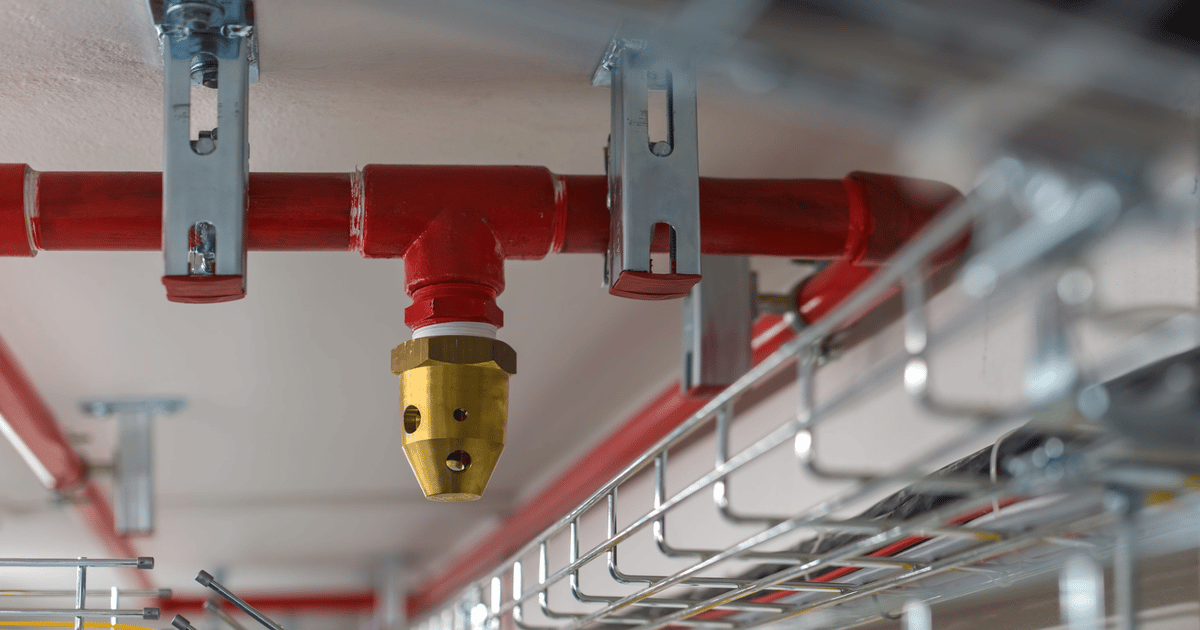
- Engineering Interventions: Fire protection engineers can no longer view detection and suppression in isolation. Air-sampling smoke detection systems must be meticulously calibrated to account for high-velocity cooling air streams that can dilute smoke or delay its arrival at the sensor. Furthermore, suppression discharge patterns must be carefully mapped to ensure that overhead cable trays, high-density busways, and closely packed server cabinets do not create physical obstructions that shield fire zones from water or clean-agent delivery.
2. Lithium-Ion Batteries and Energy Storage Realities
To guarantee uninterrupted uptime—a non-negotiable requirement for mission-critical AI training runs that can take weeks to complete—operators are increasingly turning to lithium-ion batteries for UPS systems. While lithium-ion chemistries offer superior energy density, smaller physical footprints, and better performance metrics than traditional lead-acid alternatives, they introduce complex fire protection challenges.
- Thermal Runaway: Unlike stable lead-acid batteries, lithium-ion cells carry a distinct risk of thermal runaway—an unstoppable exothermic chain reaction where a single damaged or overheated cell can ignite adjacent cells, producing flammable, toxic gases and intense, self-sustaining heat.
- Regulatory and Testing Frameworks: Engineers must navigate a complex web of industry standards that go far beyond traditional battery room guidelines. Equipment must comply with UL 1778 for UPS units and UL 9540 for stationary energy storage systems (BESS). Additionally, UL 9540A provides critical testing methodologies to evaluate thermal runaway fire propagation in battery installations, while NFPA 855 dictates the standard for the installation of stationary energy storage systems.
3. The Fluid Revolution: Liquid Cooling
As air-cooling systems reach their physical limits in managing 100 kW+ racks, the data center industry is rapidly adopting advanced liquid-cooling technologies, including direct-to-chip liquid cooling and immersion cooling.
- New Hazard Profiles: While highly efficient at transferring heat away from dense GPU silicon, these systems introduce new variables for fire safety professionals. Designers must evaluate the flammability ratings and dielectric properties of specialized cooling fluids.
- Leak and Arc Risks: The presence of large volumes of fluid in close proximity to energized electrical equipment raises concerns regarding fluid leaks, short circuits, and localized electrical fires. Moreover, changes in room-level airflow resulting from the removal of heavy air-handling units can inadvertently alter the dispersion characteristics of traditional smoke and fire detection systems.
Official Perspectives and Industry Insights
Industry experts emphasize that addressing these emerging risks requires a fundamental cultural shift in how data center projects are planned, engineered, and commissioned.
Altay Uzel, Senior Fire Protection Consultant at Telgian Engineering & Consulting, highlights the necessity of early interdisciplinary collaboration:
"The fundamentals of fire protection have not changed, but the environments in which they are being applied are evolving rapidly. Fire protection designers must now account for how these emerging technologies affect the fire risk within a facility and whether traditional detection and suppression strategies remain appropriate."
Uzel stresses that adding more suppression equipment is rarely the correct solution. Instead, safety strategies must be custom-engineered to match the specific technological hazards present within each facility zone. This philosophy is echoed by international safety organizations and code-making bodies, which increasingly advocate for performance-based design models over rigid, prescriptive checklists.

Furthermore, post-incident analyses from disasters like the Strasbourg fire have prompted major hyperscalers to reassess their real estate and site selection criteria. Industry associations now strongly recommend comprehensive third-party design reviews, rigorous failure mode and effects analysis (FMEA), and integrated testing during the commissioning phase to bridge the gap between theoretical compliance and real-world operational resilience.
Future Outlook: The Next Decade of Data Center Safety
Looking ahead over the next five to ten years, the trajectory of data center growth is clear. Driven by the insatiable demands of generative AI, quantum computing adjuncts, and edge-cloud expansion, data centers are projected to consume an increasingly massive share of national electrical grids.
To meet these energy demands while satisfying strict corporate sustainability mandates, operators will increasingly deploy on-site power generation assets, including microreactors, hydrogen fuel cells, and large-scale renewable microgrids integrated directly into data center campuses. These decentralized power sources will introduce industrial-grade fuel and electrical hazards directly adjacent to mission-critical IT spaces.
To successfully navigate this high-stakes future, the data center industry must adopt several key strategies:
- Early Integration in the Design Lifecycle: Fire protection engineers must be seated at the table during the initial conceptual design phase, rather than being brought in retroactively for code sign-off. Collaborative coordination among electrical, mechanical, structural, and fire safety disciplines is paramount.
- Advanced Multi-Sensor Detection: Relying on single-parameter smoke or heat detectors is obsolete. Future facilities will increasingly rely on smart, AI-driven multi-criteria detection systems capable of distinguishing between harmless ambient dust, steam, humidity fluctuations, and the early off-gassing signatures of failing lithium-ion cells or overheating electronics.
- Holistic Risk Management and Compartmentalization: As demonstrated by historical failures, protecting individual racks is meaningless if fire barriers, exterior wall ratings, and spatial separations between buildings are compromised. Asset protection must be balanced with life safety and business continuity planning.
- Continuous Commissioning and Training: Fire protection systems are living systems. Routine re-testing, advanced thermal imaging audits, and rigorous emergency response drills for facility personnel are essential to ensuring that safety infrastructure performs flawlessly under crisis conditions.
The AI revolution has forever changed the technological landscape of the data center. By marrying tried-and-true fire protection fundamentals with cutting-edge engineering methodologies, the industry can successfully secure the physical infrastructure powering the digital future.