Executive Overview
The role of Artificial Intelligence in Site Reliability Engineering (SRE) has undergone a fundamental transformation. No longer confined to the periphery as a read-only chatbot summarizing log files, AI agents are increasingly stepping into the shoes of operational teammates. Modern DevOps tooling—such as Aiden for SRE, the AWS DevOps Agent, and Azure DevOps Agent—can ingest alerts, query traces, correlate complex deployment events, consult operational runbooks, and either recommend or execute targeted remediation workflows.
Yet, this technical capability introduces a profound governance challenge. An AI agent that excels at explaining an ongoing production incident is not automatically equipped to alter live production environments. Restarting a stateless container pod, rolling back a customer-facing payment gateway, and responding to a suspected credential compromise are materially distinct decisions. Each demands a vastly different threshold of evidence, human accountability, and execution control.
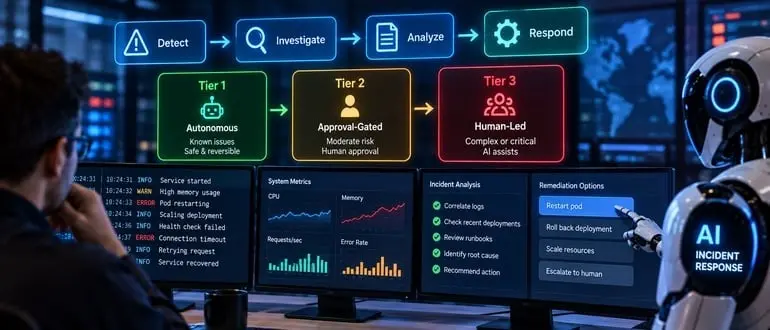
To bridge the gap between unchecked automation and sluggish manual toil, modern engineering organizations are adopting a framework known as tiered autonomy. Rather than framing artificial intelligence adoption as a binary choice between "full automation" or "no automation," tiered autonomy binds an AI agent’s operational permissions directly to incident familiarity, blast radius, reversibility, and diagnostic confidence. By establishing rigid guardrails and deterministic policy enforcement engines, engineering teams can dramatically reduce Mean Time to Resolution (MTTR) without sacrificing safety, compliance, or human oversight.
Detailed Chronology: The Evolution of Automated Operations
To understand how modern Site Reliability Engineering arrived at tiered autonomy, it is necessary to examine the historical trajectory of operational automation.
Phase 1: Static Scripts and Threshold Alerts (Early 2010s)
In the early days of microservices and cloud-native architecture, automation was largely bound to static monitoring scripts and rigid threshold-based alerts (e.g., paging an engineer when CPU utilization exceeded 90% for five consecutive minutes). While effective at detecting blunt failures, these systems frequently generated massive volumes of alert fatigue. Runbooks were static markdown documents, and remediation required manual shell access, human typing, and high cognitive load under intense pressure at 3:00 AM.
Phase 2: ChatOps and Initial Generative Summarization (Late 2010s–Early 2020s)
The rise of ChatOps introduced collaborative incident response platforms where bots could fetch metrics or trigger predefined Jenkins jobs via chat commands. However, the diagnostic phase remained entirely human-driven. With the advent of large language models (LLMs), operations teams gained the ability to rapidly summarize error logs and trace anomalies. While this lowered the barrier to understanding complex telemetry, it left the core operational bottleneck untouched: human engineers still had to manually correlate evidence, evaluate risk, and execute remediation steps.
Phase 3: The Rise of Agentic Workflows (Present Day)
Today, AI has evolved from a passive summarizer into an active agentic participant. Modern DevOps agents can independently query distributed tracing systems, parse multi-gigabyte log files, map service dependencies, and formulate hypotheses.
However, raw agentic capability without bounded permissions quickly leads to operational disasters. A model hallucinating a root cause could inadvertently trigger a destructive sequence across production clusters. Consequently, the industry is converging on structured governance frameworks—specifically, the three tiers of agentic incident response—to ensure that automation is earned, observable, bounded, and easily reversible.
Supporting Context & Metrics: The Three Tiers of Agentic Incident Response
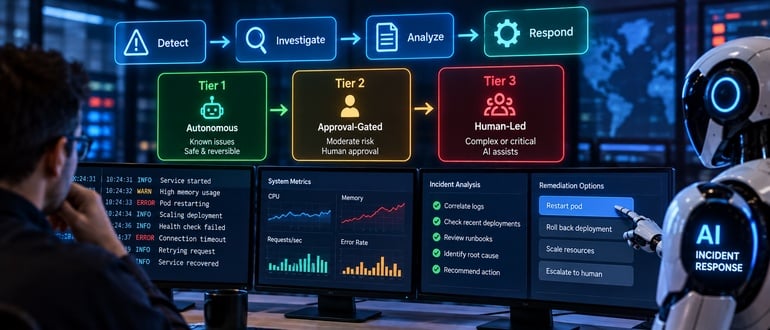
The core architecture of tiered autonomy maps an agent’s operational permissions directly to four critical vectors: incident familiarity, blast radius, reversibility, and diagnostic confidence.
| Decision Factor | Tier 1: Autonomous | Tier 2: Approval-Gated | Tier 3: Human-Led |
|---|---|---|---|
| Familiarity | Frequent, repeatable pattern | Known pattern with meaningful variation | Novel, ambiguous, or conflicting signals |
| Blast Radius | Single workload or bounded component | Single service or limited customer impact | Cross-service, security, regulatory, or business-critical |
| Reversibility | Fast and automated rollback | Reversible but needs observation | Difficult, costly, or irreversible |
| Confidence | High and evidence-backed | Moderate; competing explanations exist | Low or no validated precedent |
| Human Role | Review after the event | Approve the proposed action | Lead decisions and direct investigation |
Tier 1: Autonomous Response (Known-Knowns)
Tier 1 covers common failures that feature an explicit, thoroughly tested, and easily reversible remediation path. The AI agent executes within a remarkably narrow contract.
- Sample Use Case (Bad Container Image Rollback): An orders API deployment introduces an invalid image tag. Kubernetes reports an
ImagePullBackOfferror; the new ReplicaSet cannot achieve a ready state, while the prior revision remains verified and healthy. In a stateless service where rollback is pre-approved, an autonomous agent can detect the failure, trigger the rollback, and verify cluster health in minutes rather than forcing a paged engineer to spend 30 to 60 minutes gathering context. - Sample Use Case (Bounded Scale-Out): A checkout service experiences a predictable traffic spike, causing queue depth to swell. The agent is explicitly authorized to scale replicas from three to a maximum of eight, but is strictly barred from modifying cluster capacity or autoscaler configurations.
Tier 2: Collaborative Diagnostics (Known-Unknowns)
Tier 2 addresses incidents where the agent has gathered compelling evidence and formulated a plausible remediation strategy, but inherent uncertainty, customer impact, or a non-trivial rollback demands explicit human validation.
- Sample Use Case (Database Connection-Pool Exhaustion): An orders service begins returning HTTP 503 errors. Connection-pool utilization sits at 100%, and database wait times have spiked. However, the root cause could stem from a slow query, a connection leak, or a sudden surge in legitimate user traffic. Because terminating database sessions autonomously carries severe risks, the agent packages its diagnostic findings into a structured approval card, allowing an engineer to review and authorize the fix in seconds.
- Sample Use Case (Payment-Service Rollback): A new release of a core payment microservice causes error rates to climb from 0.1% to 4%. The agent correlates the metric spike with the recent deployment, inspects dependent service health, and drafts a rollback proposal. Because payment flows are directly tied to revenue, a human must review the evidence timeline and grant explicit approval before execution.
Tier 3: Human-Led Investigation (Unknown-Unknowns)
Tier 3 is invoked when an incident is entirely novel, ambiguous, high-impact, or potentially irreversible. Here, the AI agent shifts from an autonomous actor to an elite investigative analyst.
- Sample Use Case (Cascading Microservice Failure): The primary checkout workflow begins throwing 500 errors, quickly cascading into payment, inventory, and notification service degradation. Telemetry shows mixed resource utilization across workloads without any recent deployments. The agent acts as a force multiplier, rapidly searching and correlating thousands of telemetry streams to surface hidden patterns, while the human incident commander retains absolute control over scope, communication, and risk mitigation.
- Sample Use Case (Suspected Credential Compromise): An unfamiliar application identity executes bulk queries against user-data tables outside its normal operational window. The agent compiles identity histories, audit logs, and network egress signals. However, it is strictly forbidden from independently declaring a security breach or revoking credentials, preserving a human-led security response.
Official Industry Insights & Quantitative Impact
Quantifying the value of agentic incident response requires looking beyond speculative benchmarks to examine empirical efficiency gains across the software lifecycle. Industry data highlights that the primary benefit of automation varies significantly depending on the tier deployed:
- Tier 1 Workloads: Eliminates response delays for repetitive, highly deterministic tasks. MTTR improvements regularly range between 80% and 95% (reducing resolution times from 30–60 minutes down to 2–5 minutes). For example, published case studies on autonomous recovery workflows for Azure Kubernetes Service (AKS) demonstrate baseline MTTR reductions from eight minutes down to roughly four minutes.
- Tier 2 Workloads: Compresses diagnosis and approval cycles, yielding 70% to 85% improvements in MTTR by synthesizing scattered telemetry into instant, actionable approval requests.
- Tier 3 Workloads: Accelerates time-to-understanding during complex, multi-system outages, delivering 40% to 75% reductions in overall triage duration through advanced correlation and hypothesis testing.
| Tier | Primary Value Driver | Illustrative Manual Baseline | Illustrative Automated State | Typical MTTR Improvement |
|---|---|---|---|---|
| Tier 1 | Automated detection, remediation, & verification | 30–60 minutes | 2–5 minutes | 80–95% |
| Tier 2 | Fast evidence synthesis & approval-gated execution | 30–90 minutes | 8–15 minutes | 70–85% |
| Tier 3 | Advanced correlation & guided investigation | 90–180 minutes | 20–60 minutes | 40–75% |
Future Outlook: The Roadmap to Intelligent Operations
As organizations mature in their adoption of artificial intelligence for Site Reliability Engineering, the implementation of tiered autonomy will shift from experimental sandboxes to core enterprise infrastructure.
1. Deterministic Policy Engines
Organizations are moving away from relying solely on Large Language Models to govern their own permissions. Future architectures will place rigid policy evaluation engines outside the LLM. While an AI model may recommend a specific tier based on diagnostic confidence, a deterministic policy layer will independently verify whether the target service is allowlisted, whether the action is destructive, and whether explicit cryptographic tokens are present.
2. Transitioning Runbooks into Contracts
The future of operations demands that human-readable markdown runbooks evolve into machine-executable contracts. An agent-ready runbook must explicitly define triggers, allowed tools, mandatory verification checks, scope boundaries, stop conditions, and automated rollback paths. Vague instructions such as "restart the service if it looks unhealthy" will be replaced by strict, verifiable schemas.
3. Embracing Shadow Mode Deployments
Before granting agents operational authority, engineering teams will increasingly rely on extended shadow-mode deployments. In this phase, AI agents investigate live incidents in real time without execution rights. By comparing agentic diagnoses and proposed remediations against actual human resolutions, organizations can rigorously measure precision, evaluate false-positive rates, and build data-driven trust before promoting workflows from Tier 3 to Tier 2 or Tier 1.
Ultimately, the goal of agentic incident response is not to hand the keys of production over to an opaque model. Rather, it is to strategically deploy artificial intelligence where it effectively eliminates operational toil and accelerates recovery, while rigorously preserving safety, human accountability, and architectural integrity.