Executive Overview
For decades, the software industry’s battle cry against vulnerability overload was simple, relentless, and largely reactive: Find issues earlier, prioritize them better, and fix them faster.
It was a strategy born out of necessity. As applications grew increasingly modular, relying on sprawling webs of third-party open-source components and external libraries, the attack surface expanded exponentially. To combat this, security and engineering organizations poured billions of dollars into automated dependency updates, policy-driven continuous integration/continuous deployment (CI/CD) workflows, and advanced scanning tools.
On paper, this strategy has yielded undeniable victories. Recent longitudinal data indicates that the median age of unresolved Critical and High vulnerabilities has plummeted—falling an impressive 59% from its peak in January 2024. Furthermore, more than half of all newly discovered security violations are now remediated within a single business day.
Yet, a profound and paradoxical crisis persists: applications continue to accumulate systemic risk.
Despite unprecedented remediation velocity, security backlogs remain stubbornly full, and engineering teams find themselves trapped on a perpetual treadmill of triage, patching, and regression testing. The root cause of this imbalance lies in a fundamental flaw in the modern software development lifecycle (SDLC). While the industry has optimized the remediation of vulnerabilities, it has largely ignored the inception of risk.
Now, the advent of generative artificial intelligence and autonomous coding agents is thrusting this flaw into sharp relief. AI is compressing months of dependency selection and architectural decision-making into mere seconds. If organizations do not fundamentally pivot their security strategies from downstream firefighting to upstream prevention, the sheer volume of AI-generated code and component choices threatens to completely overwhelm modern security operations.
Detailed Chronology: From Static Defense to the Age of AI Acceleration
To understand how the software industry arrived at this critical juncture, it is necessary to trace the evolution of application security over the past twenty years—a timeline defined by an escalating race between the speed of development and the velocity of threat discovery.
Phase 1: The Era of Perimeter Defense and Manual Audits (Early 2000s–2010s)
In the early days of modern web and enterprise software development, security was largely treated as a gate at the end of the pipeline. Applications were built monolithically, and third-party dependencies were sparse, carefully vetted, and infrequently updated. Security assessments—often executed via manual code reviews and annual penetration tests—occurred right before a major release.
While this model was sustainable in an era of slow release cycles, it buckled under the weight of cloud computing and Agile methodologies. As companies moved from shipping software twice a year to twice a day, traditional security gates became intolerable bottlenecks.
Phase 2: The Rise of DevSecOps and Automated Remediation (2015–2023)
Recognizing that security could no longer be a final gatekeeper, the industry pioneered the "Shift Left" movement. Security practices, Static Application Security Testing (SAST), Software Composition Analysis (SCA), and Dynamic Application Security Testing (DAST) were integrated directly into CI/CD pipelines.
During this phase, the primary metric of success was time to remediate. Software supply chain security tools evolved to automatically open pull requests, flag outdated libraries, and suggest patches. This era saw remarkable technological achievements: automated dependency updaters like Dependabot and Renovate became standard, and developers gained real-time visibility into the known vulnerabilities lurking within their package managers (npm, Maven, PyPI, NuGet).
Phase 3: The Inflection Point—The AI Coding Revolution (2023–Present)
Today, the software assembly line is undergoing its most radical transformation since the invention of open-source software: the integration of AI coding assistants and autonomous agents.
Tools like GitHub Copilot, Cursor, Devin, and various LLM-powered agents have fundamentally changed how code is written. Developers are no longer just writing boilerplate functions; they are orchestrating entire features, bootstrapping microservices, and selecting complex dependency trees with simple natural language prompts.
What used to take a human developer days of research—evaluating licensing models, checking compatibility matrices, and weighing security trade-offs—now takes an AI agent milliseconds. However, these autonomous agents operate with a myopic focus on functional completion. Their primary directive is to make the code work, not necessarily to make the code secure or maintainable.
Consequently, AI is accelerating dependency decisions at an unprecedented scale. Without embedded policy guardrails, coding agents can introduce dozens of risky, outdated, or poorly maintained libraries into a codebase in a single afternoon. By the time downstream security scans catch these violations, the developer has moved on to an entirely new project, turning what should have been a simple, proactive choice into costly, frustrating rework.
Supporting Context & Metrics: The Math of the Risk Imbalance
The urgency of this upstream shift is underscored by hard data from recent software supply chain research. While engineering metrics tend to celebrate how quickly vulnerabilities are closed, they often obscure the alarming rate at which new risk is introduced.
The Remediation Paradox
Longitudinal studies tracking enterprise codebases reveal a fascinating dichotomy:
- 59% Reduction: The median age of unresolved Critical and High vulnerabilities has dropped by more than half since January 2024.
- <24 Hours: More than 50% of all resolved security violations are now remediated within a single day, thanks to hyper-efficient automated patch management.
At first glance, these numbers suggest that the industry is winning the war against vulnerabilities. Yet, enterprise risk dashboards tell a different story. Total vulnerability volume continues to climb year-over-year. Why? Because the velocity of discovery and the rate of introduction are vastly outpacing even the most streamlined remediation pipelines.
When a developer or an AI agent selects a vulnerable dependency, a chain reaction of operational friction is set into motion:
- Detection: A downstream SCA scan flags the component.
- Alerting: An alert is generated, creating a ticket in Jira or GitHub Issues.
- Triage: A security engineer or developer must stop what they are doing to evaluate whether the vulnerability is actually exploitable in the context of the application.
- Remediation: If the vulnerability is deemed a risk, the developer must context-switch back to completed work, identify a safe version, update the dependency, and run local regression tests.
- Deployment: The patch must travel back through the entire CI/CD pipeline.
Studies show that context-switching away from primary development tasks to fix security bugs can cost a developer up to 25 minutes of focus time per interruption. When multiplied across hundreds of developers and thousands of AI-generated dependencies, this downstream rework represents a staggering drain on engineering productivity.
The Availability of Safer Alternatives
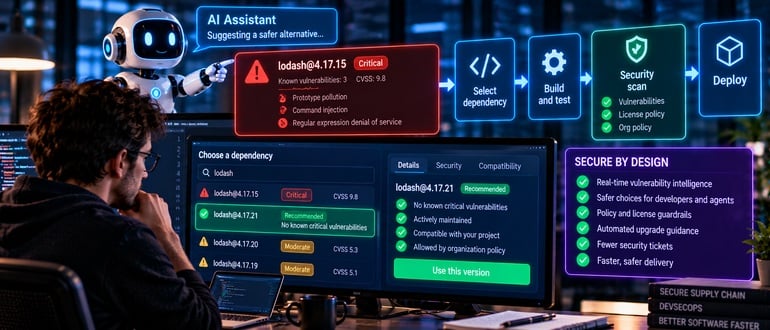
Crucially, research indicates that a significant percentage of downstream security findings are entirely avoidable at the moment of inception. In many cases, when a developer or AI agent selects a component with a critical vulnerability, a materially safer, patched version of that exact same component is already publicly available in the registry.
The issue is not a lack of secure options; it is a lack of context at the point of decision. Because developers and AI models lack real-time risk visibility when making package selections, they inadvertently choose the path of least resistance (often whatever tutorial, Stack Overflow snippet, or training data they last interacted with), rather than the path of least risk.
Official Statements and Industry Expert Perspectives
Industry leaders, security researchers, and DevOps architects are increasingly vocal about the need to rethink application security architecture for the age of AI.
"For years, our industry has treated security as a plumbing problem at the end of the house. We built bigger buckets to bail out the water faster—automated patching, rapid CI/CD gates, instantaneous alerts. But while we’ve gotten exceptionally good at bailing, the leak is getting bigger. With AI agents writing code at machine speed, we can no longer afford to let risky decisions enter the pipeline in the first place."
— Dr. Elena Vance, Principal Software Supply Chain Analyst
Security practitioners emphasize that throwing more scanning tools at developers is no longer a viable solution. Alert fatigue is a primary driver of developer burnout and security bypasses.
"Developers don’t want to ignore security; they want to build great products. When we drop fifty CVE alerts into their backlog for code they wrote three weeks ago, we are forcing them to do forensic archaeology on their own work. If we want to scale security in the era of AI, we have to move intelligence to the exact moment of creation. Make the secure choice the easiest choice, and developers will naturally take it."
— Marcus Chen, Director of DevSecOps at Global Enterprise Solutions
Furthermore, experts argue that AI governance cannot be treated as an afterthought. As autonomous agents take the steering wheel of software assembly lines, they require native guardrails.
"An AI coding agent doesn’t care about your organizational compliance frameworks, your internal licensing policies, or your risk tolerance thresholds unless you explicitly wire those constraints into its operational context. Giving agents root access to your codebase without security guardrails is like handing the keys of a sports car to a teenager who has never taken a driving lesson."
— Sarah Jenkins, Open Source Security Foundation (OpenSSF) Contributor
Future Outlook: Re-Engineering the Software Assembly Line
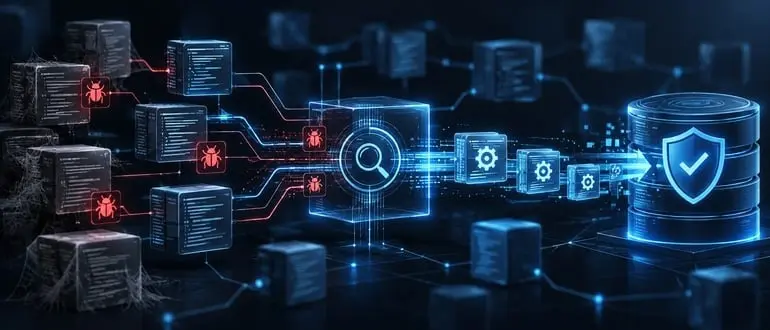
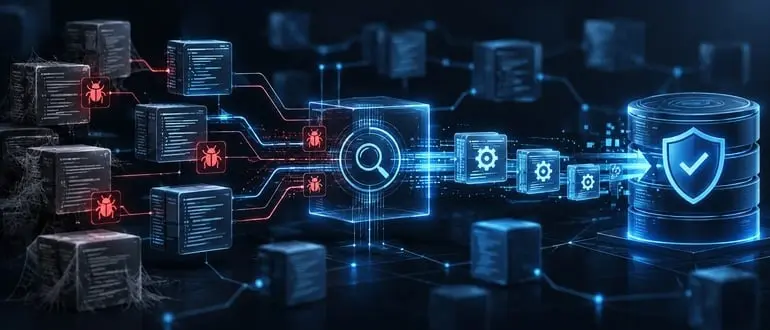
As the software industry looks toward the horizon, the path forward is clear. Prevention and remediation must no longer operate in silos; they must form an integrated, continuous loop where upstream intelligence drastically reduces downstream toil.
To successfully adapt to this new paradigm, organizations must implement four foundational pillars of change:
1. Bring Security Intelligence to the Point of Selection
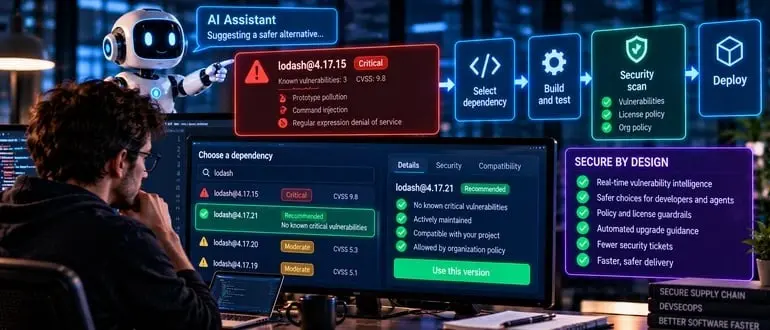
Security context must be injected directly into the integrated development environment (IDE) and AI prompt workflows. When a human developer or an AI agent searches for a package to fulfill a specific requirement, real-time telemetry regarding component health, known vulnerabilities, maintainer activity, and organizational policy compliance should be instantly surfaced. By providing this visibility upfront, teams can prevent vulnerable components from ever being written into the package.json or pom.xml file.
2. Embed Guardrails into AI Coding Agents
As organizations increasingly adopt AI-driven development workflows, governance policies must travel with the agents. Organizational rules regarding approved open-source licenses, banned components, and maximum acceptable risk thresholds must be baked into system prompts, custom instructions, and IDE extensions used by AI assistants. If an agent attempts to import a deprecated or high-risk library, it should be automatically nudged toward a secure, equivalent alternative before the code is even committed.
3. Automate the Path to a Safe Upgrade
Identifying an outdated dependency is only half the battle. Modern tooling must move beyond mere notification to active remediation pathways. When a vulnerability is discovered, automated systems should perform compatibility checks, run regression suites, and deliver a fully validated, ready-to-merge pull request directly to the developer. Shifting from "telling developers what is broken" to "giving developers a tested path forward" is essential for minimizing cognitive load.
4. Measure Upstream Risk Intake
Engineering leadership must expand their key performance indicators (KPIs) beyond traditional remediation metrics like MTTR (Mean Time to Remediation). While fixing bugs quickly remains important, organizations must begin tracking avoidable risk introduction rates. If an organization’s vulnerability backlog continues to grow despite shrinking patch times, it is a definitive sign that upstream architectural and dependency decisions require immediate intervention.
Conclusion
The software industry stands at a definitive crossroads. For over a decade, we have optimized the mechanics of how quickly vulnerabilities can be fixed, building an impressive machinery of automated remediation. Yet, the sheer acceleration of software production—supercharged by the explosion of generative AI—makes it mathematically impossible to patch our way out of the current risk crisis.
By shifting our focus upstream, empowering both human developers and AI agents with real-time risk context, and making secure dependency selection frictionless, organizations can fundamentally alter the economics of application security. Reducing downstream rework does not mean slowing down innovation; rather, it unlocks precious engineering hours, allowing builders to focus on crafting exceptional software while giving security teams the capacity to manage the risks that truly cannot be avoided.
The future of secure software development will not be won by those who fix vulnerabilities the fastest, but by those who prevent them from ever being born.