For years, the software industry has treated generative artificial intelligence as a turbocharged code generator—a remarkably fast digital typist designed to shave hours off routine development tasks. Analysts have dissected the metrics, consulting firms have built lucrative practices around implementation strategies, and tech vendors have appended "AI-powered" to virtually every product description in their marketing catalogs.
Yet, a profound shift occurs when the message originates not from a third-party observer, but from one of the foundational creators of the disruptive technology itself.
Anthropic recently published The AI-Native SDLC Playbook, a meticulously detailed proposal authored by Louis Claxton that draws heavily on practices from the company’s Applied AI team and its enterprise customers. The playbook introduces a deceptively simple, industry-rattling assertion: Code is no longer necessarily the bottleneck.
While Claude is not literally reviewing the industry that spawned it, this release is as close to hearing the truth directly from the source as the software world is likely to get. The very company whose artificial intelligence models accelerated software development is now sounding the alarm: the surrounding human and technical processes cannot keep pace.
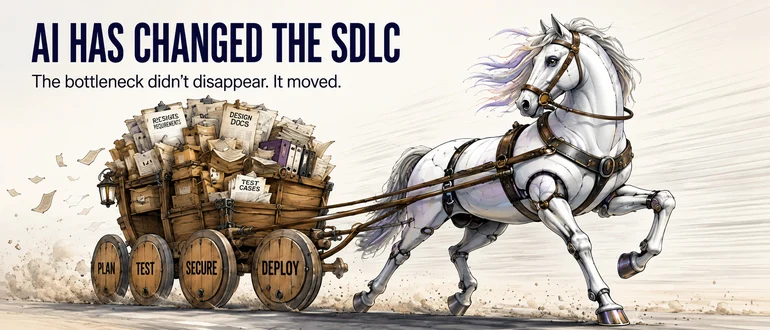
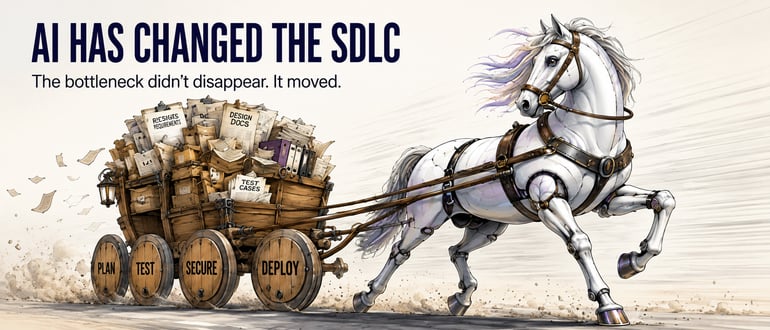
Metaphorically speaking, the horse has looked back at the carriage and announced that it is moving far too slowly.
Executive Overview: The Shifting Bottleneck of Software Engineering
For decades, the standard Software Development Lifecycle (SDLC) was forged around a core economic constraint: writing and implementing code consumed the vast majority of time, effort, and financial capital. Organizations built elaborate requirements-gathering phases, lengthy architecture reviews, complex estimation rituals, rigid QA gates, and heavy change-approval boards to manage projects that routinely spanned weeks, months, or quarters.
Agentic coding has completely shattered that production rate. Modern AI agents can independently explore a complex repository, draft a comprehensive implementation plan, modify multiple files simultaneously, generate thorough unit tests, and prepare a polished pull request in a fraction of the time previously required.
However, acceleration in one isolated corner of the factory does not mean the entire organization moves in sync.
Product requirements still demand human clarification. Complex architectural trade-offs require strategic decisions. AI-generated code must still undergo rigorous review, integration testing, and security auditing. Production changes must clear compliance hurdles, and deployed applications must be continually observed, maintained, and repaired.
If code generation speed increases exponentially while surrounding governance, testing, and deployment processes remain stagnant, the bottleneck simply relocates. Review queues swell into unmanageable backlogs. Security teams are inundated with more code than they can reasonably evaluate. Testing infrastructure groans under the volume, and traditional change-approval boards throttle the delivery of completed work. Ultimately, the organization risks producing an overwhelming volume of code without delivering a single ounce of additional software stability or business value.
This friction aligns directly with recent empirical findings from DORA (DevOps Research and Assessment). DORA’s research into AI-assisted software development reveals a nuanced truth: while AI adoption reliably improves developer productivity and delivery throughput, it can exhibit a negative correlation with overall software-delivery stability. AI functions as a powerful digital amplifier. Organizations equipped with strong internal platforms, automated testing frameworks, and rapid feedback loops effortlessly translate raw coding speed into superior delivery performance. Conversely, organizations hampered by weak foundations merely scale and amplify their existing organizational dysfunctions.
Code has not magically stopped being difficult, and Anthropic’s visionary assertions will not apply uniformly across every legacy enterprise or greenfield application. Yet, for elite engineering teams aggressively deploying advanced coding agents, code is no longer the sole limiting factor—and increasingly, it may no longer be the most important one.
Detailed Chronology: Reimagining the Six Stages of the SDLC
Anthropic’s playbook proposes something far more radical than simply slotting an AI chatbot into a developer’s existing toolchain.
Traditional software development is historically understood as a linear, sequential pipeline of six distinct phases: Plan, Design, Build, Test, Deploy, and Maintain. In legacy environments, work passes clumsily between these stages via disconnected tickets, static documentation, endless alignment meetings, manual reviews, and bureaucratic sign-offs.
Anthropic reimagines this linear sequence as a continuous, closed-loop ecosystem. Every single stage generates a structured, machine-readable artifact that subsequent humans or autonomous agents can immediately parse and act upon:
$$textIntent longrightarrow textSpecification longrightarrow textPlan longrightarrow textCode & Tests longrightarrow textReview & Evidence longrightarrow textIncident Record longrightarrow textNew Intent$$
These living artifacts establish an unbroken chain of digital provenance across the entire lifecycle, creating an ironclad audit trail of what was requested, what the agent proposed, which compliance policies were applied, what empirical evidence was generated, and who authorized the final deployment. While humans remain firmly accountable for core business outcomes, their daily responsibilities shift dramatically. They spend less time manually ferry-boeing data across organizational silos and far more time evaluating intent, assessing risk, managing policy exceptions, and driving consequential strategic decisions.
1. Plan: Capturing Intent at the Source
The modern lifecycle begins with a simple artifact: an intent.md file. Instead of burying requirements in disconnected Jira tickets or sprawling Confluence wikis, a business user, product owner, or engineer describes a desired business problem to Claude in conversational, natural language. Through an interactive dialogue, Claude helps crystallize the core objectives, identify affected users and downstream systems, outline explicit technical constraints, and surface unresolved edge cases.
A human stakeholder reviews, refines, and approves the resulting file before it ever touches the development pipeline. This methodology targets a chronic enterprise disease: the severe distortion and information loss that occurs when an original business idea travels through multi-tier workshops, product backlogs, user story refinement sessions, and endless handoffs before finally reaching the engineers tasked with implementation.
2. Design: Enforcing Policy Before Building
Once the intent is validated, it morphs into a rigorous requirements and architectural design specification. Crucially, enterprise knowledge concerning corporate security, regulatory compliance, system architecture, brand guidelines, and UX standards is formally encoded as reusable instructions or modular "skills" that the agent automatically applies during specification drafting.
This completely shifts the timeline of enterprise governance. Instead of discovering a fatal security flaw or architectural violation during a cumbersome manual review weeks down the line, the AI agent proactively enforces relevant governance policies while the system is being architected, flagging any irreconcilable conflicts instantly. A human product owner retains ultimate authority over whether the specification solves the intended problem, but the AI shoulders the cognitive load of cross-referencing organizational rules.
3. Build: Approving the Plan Before Writing Code
Equipped with an approved intent and specification, the coding agent analyzes the target repository and formulates a granular implementation plan. This blueprint explicitly identifies which files will be altered, the precise sequence of implementation, anticipated technical risks, and the specific test suites required to validate the work.
An engineer reviews and signs off on this execution plan before the agent is permitted to touch a single line of code. This procedural safeguard is vital. AI does not render planning obsolete; it elevates planning to a paramount priority, because the marginal cost of generating thousands of lines of code has dropped to near zero. Catching a flawed architectural approach in a text-based plan is exponentially cheaper than extracting it from an expansive, completed codebase.
4. Test: Demanding Empirical Evidence Over Blind Confidence
Anthropic’s testing framework rejects vague developer optimism in favor of continuous, verifiable evidence.
For bug fixes, the agent is mandated to first construct an automated test that explicitly replicates the failure. This test must fail for the expected reason prior to code modification, and agents are strictly forbidden from weakening or deleting tests merely to manufacture a superficial "green" build. For UI and interface work, visual agents compare dynamic screenshots against approved design files, iterating autonomously until pixel-perfect compliance is achieved.
The underlying philosophy is absolute: never trust code simply because a sophisticated large language model generated it. Demand rigorous, verifiable proof through comprehensive unit tests, benchmark execution results, visual regression tests, and automated security scans.
5. Deploy: Making Governance Executable
In an AI-native SDLC, governance is embedded directly into the deployment pipeline. Autonomous agents review incoming pull requests, cross-reference completed implementations against approved architectural blueprints, scan code modifications for zero-day vulnerabilities, and verify strict adherence to internal compliance mandates.
Anthropic advocates for intelligent deployment hooks that can autonomously approve, block, or pause workflows until a designated human grants explicit authorization. Routine, low-risk changes flow through the pipeline rapidly, while major production releases, foundational infrastructure modifications, and regulated workloads retain strict human-in-the-loop oversight. Governance ceases to be a static PDF document that developers skim once a year, evolving instead into an active, programmable component of the execution environment.
6. Maintain: Closing the Production Feedback Loop
When an application reaches production, autonomous agents monitor system health, triage noisy alerts, and assist engineers with rapid incident response. When a production anomaly breaches established operational thresholds, the diagnostic data and root-cause analysis automatically formulate a new intent.md file, seamlessly looping back into the planning phase.
Maintenance is no longer treated as a lonely, neglected terminal box at the end of a linear flowchart. Production environments continuously generate real-world evidence, operational learnings, and fresh business intent that dynamically informs the entire software factory.
Supporting Context & Metrics: The Gap Between Vision and Reality
While Anthropic’s playbook outlines an inspiring architectural horizon, empirical data reveals just how far the broader software industry remains from achieving a genuinely AI-native lifecycle.
Recent research into Software Lifecycle Engineering decision-makers highlights a stark, bifurcated adoption curve. Enterprise use of AI is currently heavily front-loaded into the early phases of software creation:
- Code Generation: 40.17% of surveyed organizations utilize AI.
- Code Review: 37.66% leverage AI assistance.
- Testing & QA: 28.01% apply AI tooling.
- Architecture & Design: 26.58% integrate AI into system planning.
However, adoption rates plummet precipitously as workloads approach production environments:
- CI/CD Pipelines: Only 13.23% utilize AI integration.
- Security Scanning: A meager 12.40% employ AI-driven security analysis.
- Deployment Decisions: Just 6.20% trust AI with release automation.
- Autonomous End-to-End Development: A scarce 5.84% report fully autonomous lifecycles.
Concurrently, 42.43% of organizations identify inadequate governance frameworks as a primary blocker to broader AI adoption, while a staggering 75.2% report experiencing at least one major software delivery incident over the preceding 12 months.
The underlying pattern is glaringly obvious. Most enterprises are aggressively injecting AI into the exact point where code is initially manufactured, but they are failing to extend those same capabilities into the complex operational systems required to safely deliver, secure, and operate that code. They are furiously accelerating one single station of the industrial factory while leaving the surrounding assembly line structurally untouched.
Official Industry Perspectives & The DevOps Imperative
Much of Anthropic’s prescriptive vision will feel intimately familiar to anyone who has spent the last decade championing DevOps culture. The core tenets remain identical: relentlessly eliminate handoffs, automate repeatable tasks, shift testing and security leftward, preserve complete traceability, establish rapid feedback loops, treat infrastructure and policy as code, and foster continuous learning from operational failures.
Crucially, artificial intelligence does not invalidate DevOps principles; rather, it makes the long-unfinished work of digital transformation an urgent, existential necessity.
Organizations that continue to rely on manual change advisory boards, brittle test suites, hidden tribal knowledge, and siloed operational teams will fail to extract meaningful value from faster code generation. Instead, they will simply manufacture massive review queues, poorly vetted codebases, and catastrophic production instability.
Furthermore, this paradigm shift dramatically elevates the strategic importance of platform engineering. Individual developers cannot realistically be expected to independently author, configure, and maintain the complex guardrails, organizational context, and security evidence required for safe agentic development. Platform teams must step up to provide curated model access, standardized execution environments, robust identity controls, dynamic repository instructions, automated testing frameworks, and clear escalation paths.
The internal developer platform becomes the undisputed control plane for both human and autonomous engineering. It dictates what permissions agents possess, what files they are permitted to mutate, what empirical evidence they must submit, and precisely when a human engineer must intervene.
Future Outlook: Navigating the Road Ahead
Anthropic’s playbook marks a monumental milestone in maturing the discourse around artificial intelligence in software engineering. By shifting the conversation away from narrow benchmarks, syntax completion, and localized developer productivity gains toward holistic lifecycle orchestration, the company has provided a pragmatic foundation for enterprise transformation.
Yet, significant strategic and technical questions remain unresolved:
- Who will ultimately capture and control the AI-native SDLC? Will dominance rest with foundational model providers, established enterprise DevOps platforms, or internal platform engineering organizations?
- Can an autonomous agent reliably review and validate code generated by the exact same underlying model family?
- How will enterprises manage institutional knowledge decay as repository instructions and agent skills scale in complexity?
- Where is the tipping point where human review bottlenecks re-emerge in a hyper-accelerated pipeline?
These unresolved hurdles do not diminish the value of Anthropic’s proposal; they simply define the roadmap for the next generation of software engineering innovation.
The overarching message is clear and undeniable. The next major hurdle for enterprise technology is not teaching large language models to write yet more lines of code. It is radically rebuilding the entire software delivery carriage so that planning, security, governance, deployment, and operations can finally keep pace with the hyper-accelerated horse pulling them forward.