Executive Overview
In an era where modern enterprises generate vast amounts of structured and unstructured data across disparate systems, cloud architecture decisions have shifted from simple infrastructure procurement to long-term strategic investments. Enterprise leadership teams face a dual imperative: accelerating artificial intelligence (AI) adoption and analytics innovation while simultaneously controlling operational complexity, regulatory risk, and cloud costs.
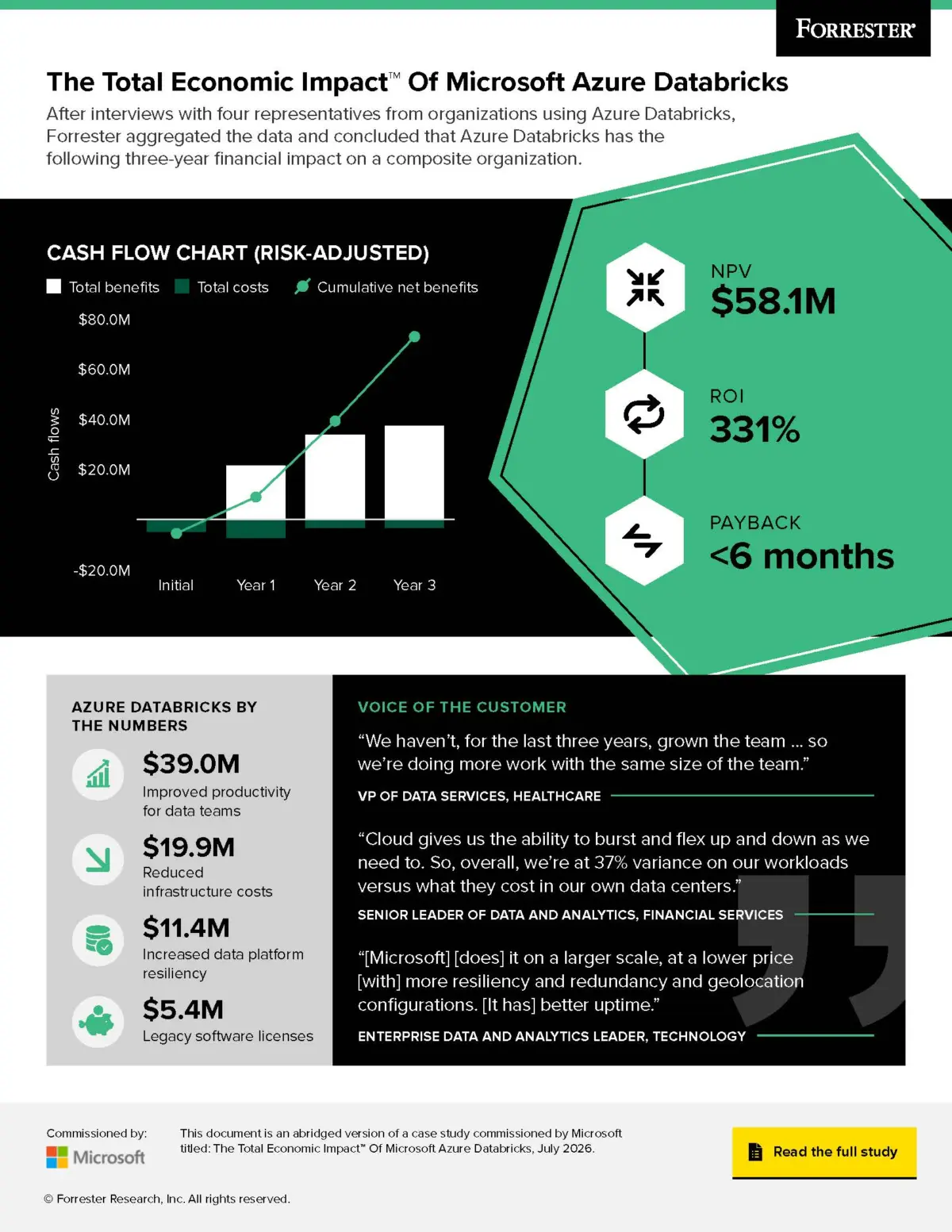
To quantify the financial and operational impact of unifying enterprise data estates, Microsoft commissioned an independent Total Economic Impact™ (TEI) study conducted by Forrester Consulting. The research evaluated the tangible financial outcomes achieved by organizations deploying Microsoft Azure Databricks—a platform uniquely co-engineered by Microsoft and Databricks as a native, first-party Azure service.
The findings demonstrate significant business performance improvements. According to the study, a representative composite enterprise utilizing Azure Databricks achieved a 331% Return on Investment (ROI) over a three-year period, generating $58.1 million in Net Present Value (NPV) and achieving full payback on its initial investment in less than six months.
+-----------------------------------------------------------------------+
|                 AZURE DATABRICKS FINANCIAL SUMMARY                   |
+------------------------------+----------------------------------------+
| Return on Investment (ROI)   | 331% over three years                  |
| Net Present Value (NPV)      | $58.1 Million                          |
| Total quantified Benefits    | $75.6 Million                          |
| Total Implementation Cost    | $17.5 Million                          |
| Payback Period               | Less than 6 months                     |
| Enterprise Baseline Profile  | $6B revenue, 10 Petabytes under mgmt  |
+------------------------------+----------------------------------------+
The underlying driver of these economic metrics is what engineering leaders describe as the first-party advantage. Rather than acting as a third-party application layered on top of cloud infrastructure, Azure Databricks is deeply integrated into the Azure platform. This native alignment provides unified billing, consolidated support, shared security constructs, and a single product roadmap across the Microsoft data and AI ecosystem.
Detailed Chronology: The Evolution of a Native Cloud Service
Understanding the financial and performance metrics of Azure Databricks requires examining the joint architectural journey of Microsoft and Databricks.
                  CHRONOLOGY OF CO-ENGINEERING & INNOVATION

  2017–2018                  2021–2023                  2024–2026+
+------------+             +------------+             +------------+
| Strategic  |  ========>  | Lakehouse  |  ========>  | GenAI &    |
| First-Party|             | Architecture|            | Copilot    |
| Launch     |             | & Unity    |             | Ecosystem  |
+------------+             +------------+             +------------+
  • Deep kernel              • Delta Lake               • Genie &
    optimizations              standardization            Copilot Cowork
  • Native IAM/RBAC          • Unified Unity            • Deep grounding
  • Single Azure               Catalog security           via Unity
    billing motion             governance                 Catalog
Phase 1: Strategic First-Party Foundation (2017–2018)
Microsoft and Databricks entered into a strategic partnership to co-engineer an analytics platform optimized specifically for Microsoft Azure. Unlike standard marketplace offerings, Azure Databricks was built directly into the Azure control plane. This allowed enterprise teams to deploy Spark-based compute clusters with native Azure Active Directory (now Microsoft Entra ID) authentication, direct Azure Storage driver optimizations, and consolidated resource management.
Phase 2: Lakehouse Architecture & Unified Governance (2021–2023)
As data architectures evolved from traditional data warehouses to unified Lakehouse models, the strategic partnership expanded. Databricks introduced Delta Lake and Unity Catalog—a centralized governance model for data and AI assets. Microsoft integrated these capabilities deeply into the broader Azure ecosystem, ensuring that policy enforcement, data lineage, and access controls worked seamlessly alongside Azure Purview, Azure Data Factory, and Power BI.
Phase 3: Generative AI and Copilot Ecosystem Integration (2024–2026)
The rise of Generative AI created a demand for natural-language interface capabilities grounded in enterprise data. Microsoft and Databricks introduced direct integration between Azure Databricks Genie—a natural language data query engine—and Microsoft Copilot Cowork, Microsoft 365 Copilot, and Microsoft Teams. By enforcing security boundaries through Unity Catalog, enterprise users gained the ability to query multi-petabyte data lakes in natural language directly within daily collaboration software without exposing restricted data.
Supporting Context & Metrics: Analyzing the Financial & Operational Findings
1. The Forrester Total Economic Impact (TEI) Breakdown
To construct the economic model, Forrester interviewed enterprise customers with real-world operational experience using Azure Databricks. These insights were aggregated into a composite enterprise model characterized as follows:
- Global Revenue: $6 Billion annually.
- Industry Sector: Regulated enterprise (Financial Services, Healthcare, Manufacturing).
- Data Scale: Approximately 10 Petabytes managed across analytical and operational workloads.
Baseline Challenges (Pre-Deployment)
Prior to standardizing on Azure Databricks, the composite organization operated a fragmented data architecture. Data was siloed across legacy warehouses, disparate cloud storage buckets, and isolated compute engines. This architecture suffered from:
- High pipeline maintenance overhead and excessive data duplication costs.
- Governance friction caused by mismatched access control policies across platforms.
- Slow operational execution, delaying time-to-market for predictive models and business reports.
Financial Outcomes (Post-Deployment)
Over a three-year evaluation window, the composite organization spent $17.5 million in total implementation, licensing, operational, and training costs. In return, the platform generated $75.6 million in total quantified benefits, yielding a net financial gain of $58.1 million (NPV) and an ROI of 331%.
                     THREE-YEAR VALUE REALIZATION ($M)

  $80M +---------------------------------------------------------+ $75.6M
       |                                                         |
  $60M |-----------------------------------------+ $58.1M -------|
       |                                         |               |
  $40M |                                         |               |
       |                                         |               |
  $20M |-----------------------+ $17.5M ---------|               |
       |                       |                 |               |
   $0M +---------------------------------------------------------+
                          Total Costs        Net Value        Gross Benefits
Primary Drivers of Value
Forrester categorized the $75.6 million in quantified value across four operational pillars:
- Infrastructure Acceleration and Consolidation: Eliminating duplicate storage paths, legacy ETL tooling, and redundant analytical software lowered cloud infrastructure spend.
- Data Science and Engineering Productivity: Native platform integration, automated cluster provisioning, and unified development environments reduced pipeline build times, enabling data teams to ship models faster.
- Operational Business Efficiency: Business analysts and non-technical staff gained faster access to real-time analytics, driving measurable improvements in supply chain management, customer retention, and dynamic pricing strategies.
- Risk Reduction and Automated Governance: Unifying cataloging and RBAC policies via Unity Catalog significantly mitigated compliance risks and lowered the cost of regulatory reporting.
2. Independent Performance Benchmarks
Financial performance in modern cloud environments is inextricably linked to compute speed. Because cloud billing models operate on consumption runtime, faster query execution translates directly into lower operational expenditure.
To evaluate technical execution speed, independent testing firm Principled Technologies conducted a industry-standard, TPC-DS-like decision-support benchmark comparing Azure Databricks against alternative deployment models.
                TPC-DS-LIKE BENCHMARK PERFORMANCE COMPARISON

  Single Query Stream Execution Time
  [Azure Databricks]  =========================> 21.1% Faster
  [AWS Databricks]    ===============================> (Baseline)

  Concurrent Query Execution (4 Parallel Streams)
  [Azure Databricks]  =========================> Completed >9 Minutes Faster
  [AWS Databricks]    ===============================> (Baseline)
Key Benchmark Results (10-Terabyte Dataset):
- Single Query Execution: Azure Databricks completed a single query stream in up to 21.1% less time than Databricks deployed on Amazon Web Services (AWS) with autoscale disabled.
- Concurrent Multi-Stream Execution: When processing four concurrent query streams simultaneously, Azure Databricks completed the workload more than nine minutes faster than competing cloud setups.
These engineering efficiencies stem from platform optimizations between Azure compute infrastructure, NVMe-backed storage caching, and customized kernel tuning built into the native Azure Databricks runtime.
3. Technical Synergies: Copilot Cowork, Databricks Genie, and Unity Catalog
The operational return highlighted by Forrester relies on deep architectural integration across the broader Microsoft software stack.
                      ENTERPRISE GENAI INTEGRATION FLOW

 +-----------------------+        +-----------------------+
 | Microsoft 365 Copilot |  <---> | Microsoft Teams /     |
 |                       |        | Copilot Cowork        |
 +-----------------------+        +-----------------------+
             ^                                ^
             |                                |
             +----------------+---------------+
                              |
                              v
                  +-----------------------+
                  | Azure Databricks Genie|
                  | (Natural Language UI) |
                  +-----------------------+
                              |
                              v
                  +-----------------------+
                  |  Genie Ontology &     |
                  |  Unity Catalog        |
                  |  (Entra ID Security)  |
                  +-----------------------+
                              |
                              v
                  +-----------------------+
                  | Azure Lakehouse       |
                  | Compute & Storage     |
+-----------------------+- Natural Language Queries via Databricks Genie: Non-technical executives and operational staff can query complex data assets using standard English queries. Genie dynamically translates natural language requests into structured SQL routines.
- In-Context Collaboration inside Copilot Cowork: By embedding Genie directly within tools like Microsoft Teams and Microsoft 365 Copilot Cowork, queries are handled within the user’s active workspace, eliminating the need to context-switch between applications.
- Contextual Grounding via Genie Ontology: Answers provided by Generative AI systems are grounded in business context derived directly from company metadata, eliminating model hallucinations.
- Unified Security Enforcement with Unity Catalog: Every natural language interaction routed through Copilot Cowork respects data policies stored in Unity Catalog. If an employee lacks row-level or column-level permissions in Azure Databricks, those boundaries are enforced inside Microsoft Teams.
Official Perspectives on Strategic First-Party Engineering
Discussing the economic and operational findings of the report, executives from both Microsoft and Databricks emphasized that business agility is the central benefit of deep platform integration.
"The value realized by enterprise customers isn’t an accident—it is the direct product of deep architectural alignment," noted product leaders within the Microsoft Azure Data division. "When engineering teams don’t have to spend months building custom integration layers between disparate cloud tools, identity providers, and governance frameworks, their time to market accelerates dramatically. The Forrester TEI study demonstrates that native co-engineering translates directly into financial velocity."
Product leadership from Databricks echoed this sentiment, pointing to unified platform management as a critical cost control mechanism for large-scale enterprise deployments:
"Enterprise decision-makers consistently ask us how to simplify their architecture without sacrificing performance or governance. By delivering Databricks as a native Azure service, organizations gain a single procurement workflow, unified support paths, and deeply integrated security via Unity Catalog. The benchmark data and economic figures prove that combining best-in-class open data analytics with native cloud capabilities drives measurable performance gains."
Future Outlook & Enterprise Implications
As enterprises shift focus from initial AI experimentation to enterprise-wide deployment, unified data platforms will play a crucial role in operational strategy.
                      FUTURE ENTERPRISE DATA ECOSYSTEM

  +-------------------------------------------------------------------+
  |                       Unified User Layer                          |
  |      Power BI  |  Copilot Cowork  |  Custom AI Agents           |
  +-------------------------------------------------------------------+
                                    |
                                    v
  +-------------------------------------------------------------------+
  |                     Unified Governance Layer                      |
  |      Unity Catalog  <--->  Azure Purview  <--->  Entra ID         |
  +-------------------------------------------------------------------+
                                    |
                                    v
  +-------------------------------------------------------------------+
  |                      Unified Compute & Data                       |
  |         Azure Databricks Engine  |  Delta Lake / OneLake          |
  +-------------------------------------------------------------------+
Strategic Takeaways for CIOs and CDOs:
- Governance as an AI Enabler: The integration of Unity Catalog across Azure services ensures that as companies deploy agentic AI workflows and Copilot extensions, enterprise security remains robust.
- Realizing TCO Reductions via Compute Efficiency: As confirmed by the Principled Technologies benchmarks, hardware-level optimization and query acceleration directly reduce runtime costs, providing a hedge against rising cloud infrastructure spend.
- Democratization of Data Access: Combining natural-language query tools like Azure Databricks Genie with common productivity suites like Microsoft 365 allows non-technical employees to perform data analysis safely, reducing workload pressure on centralized data engineering teams.
Conclusion
The Forrester Total Economic Impact study offers clear empirical evidence: unifying data pipelines, governance models, and machine learning operations under a native cloud platform yields significant, measurable value. With a 331% ROI, a $58.1 million NPV, and a payback period under six months, Microsoft Azure Databricks demonstrates how deep technical integration translates directly into rapid business value.