







Executive Overview
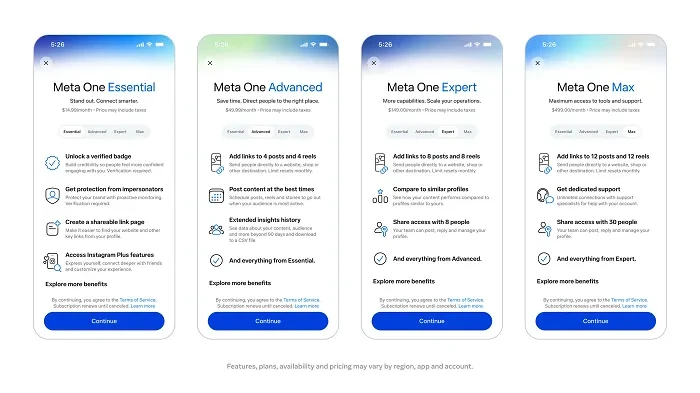
Meta has officially introduced Meta One for Business, a tiered subscription framework designed to reshape how brands, small-to-medium-sized businesses (SMBs), and creators establish and scale their digital presence across Facebook, Instagram, and WhatsApp. Ranging from an accessible entry-level price point of $14.99 per month to an enterprise-grade tier costing $499 monthly, these new packages consolidate a suite of advanced artificial intelligence capabilities, deep analytics, and long-awaited platform features into unified ecosystems.
For years, brands have relied on organic content strategies complemented by paid advertising spend to capture the attention of billions of daily active users on Meta’s platforms. However, Meta One bridges a critical operational gap. By integrating sophisticated AI-driven customer service bots, competitive intelligence feeds, custom audience segmentation, and unprecedented native linking features directly into the applications where consumers spend the bulk of their digital time, Meta is fundamentally changing the rules of social media engagement.
Most notably, the rollout finally answers a prayer long whispered by digital marketers: clickable links in standard Instagram feed posts and Reels. By gating these capabilities behind specific subscription thresholds, Meta is creating a dual incentive structure. It offers brands high-value commercial tools while generating a robust, recurring enterprise revenue stream to help fund the tech giant’s multi-billion-dollar investments in generative AI and foundational infrastructure.
Detailed Chronology: The Evolution of Meta’s Paid Ecosystem
To fully understand the strategic weight of the Meta One launch, it is essential to trace the deliberate, step-by-step evolution of Meta’s monetization strategy over recent years.
1. The Foundation: Meta Verified
Meta’s journey into subscription services began in earnest with the introduction of Meta Verified for creators and general users. Designed to establish identity authenticity, combat impersonation, and offer direct customer support access, Meta Verified set a crucial operational precedent: users and creators were willing to pay a monthly fee for enhanced platform utility, trust signals, and direct lines of support.
2. The AI Integration Push
As generative AI accelerated in capability and enterprise demand throughout 2023 and 2024, Meta began layering advanced intelligence tools into its advertising and business suites. Last month, the company rolled out preliminary AI-powered subscription add-ons for power users, testing the market’s appetite for automated content generation, predictive analytics, and enhanced audience targeting.
3. The Meta One Unification
Building directly upon these consumer packages and early AI experiments, Meta One arrives as a cohesive, multi-tiered commercial product. Rather than forcing brands to piece together disparate tools for ad targeting, messaging automation, and content scheduling, Meta One centralizes these functions.
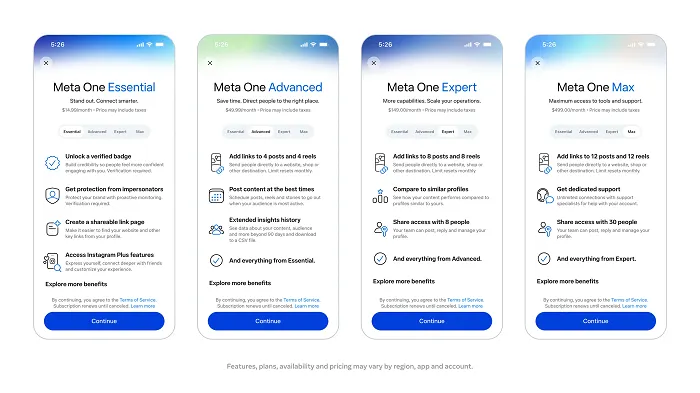
The packages scale across four distinct tiers, structured to accommodate everyone from solopreneurs to mid-sized e-commerce operations:
- Entry-Level Tier ($14.99/month): Provides foundational business tools and standard automation capabilities tailored for emerging brands.
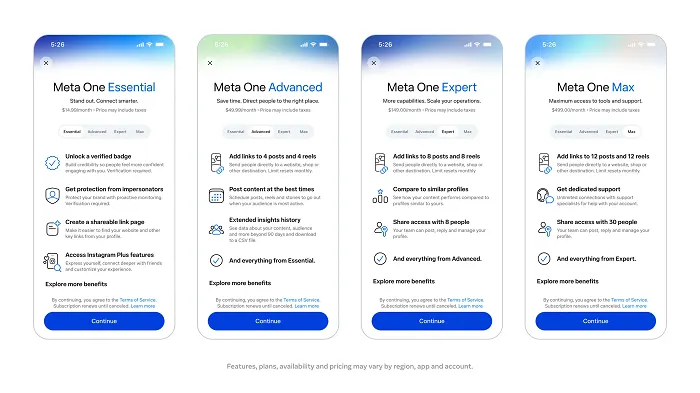
- Meta One Advanced ($49.99/month): Introduces critical mid-market features, including limited native linking capabilities on Instagram posts and Reels.
- Meta One Expert ($149.00/month): Scales up analytical depth, customer service automation limits, and monthly Instagram linking allowances.
- Meta One Max ($499.00/month): The premier, enterprise-level offering engineered for high-volume brands requiring maximum AI autonomy, comprehensive competitive data streams, and extensive native linking.
Core Features and Capabilities Breakdown
The value proposition of Meta One rests on a robust toolset designed to solve operational bottlenecks for modern digital marketers. The core features included across the various subscription iterations encompass several strategic pillars.
1. Advanced AI-Powered Business Agents
Customer service is often a primary operational drag for growing brands. To alleviate this, Meta One introduces a custom, AI-powered business agent built to operate around the clock.
Unlike generic chatbots, the Meta One business agent is deeply integrated with WhatsApp Business. It is engineered to field inbound customer inquiries, answer FAQs, and guide potential buyers through product catalogs natively.
- Continuous Responsiveness: Brands no longer need to staff 24/7 support teams to maintain rapid response times, a critical metric for conversion rates.
- Human-in-the-Loop Control: Meta has emphasized that business owners retain total control. Companies can train the AI on specific brand guidelines, product details, and frequently asked questions, while retaining the ability to seamlessly step in and take over live conversations whenever necessary.
- Strategic Guidance: Beyond customer service, the business agent is equipped to provide actionable insights regarding customer engagement strategies, optimal posting schedules, and lead-generation approaches tailored to the brand’s specific vertical.
2. The Holy Grail: Clickable Links on Instagram
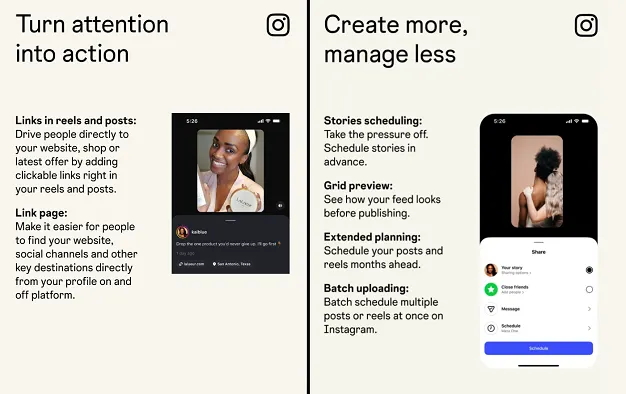
For over a decade, social media managers have lamented Instagram’s restrictive linking infrastructure, which historically forced brands to rely on a single "link in bio" or expensive paid advertising campaigns to drive traffic to external websites. Meta One fundamentally shifts this paradigm, albeit through a strictly metered, paid model:
- Meta One Advanced ($49.99/mo): Permits users to attach direct external links to 4 Instagram feed posts and 4 Reels per month.
- Meta One Expert ($149.00/mo): Expands the allowance to 8 posts and Reels per month.
- Meta One Max ($499.00/mo): Grants the ability to include direct links in 12 posts and Reels per month.
While limited by monthly caps, this feature represents a major shift in Meta’s product philosophy. Brands can now drive direct, frictionless traffic from organic or hybrid content straight to product pages, landing sites, and checkout flows without needing to run paid ad units for every promotional push.
3. Enhanced Visibility and Trust Signals
To help brands stand out amidst the endless flood of in-stream content, Meta One includes specialized visual indicators:
- The Bold Follow Button: Available on Facebook, this redesigned call-to-action button is engineered to draw the eye, capture in-stream attention, and drive organic follower conversion rates.
- Verified Channels on WhatsApp: Providing an exclusive communication channel, these verified spaces allow brands to nurture high-value customer relationships, broadcast updates securely, and build loyalty away from the noisy public feed.
4. Competitive Intelligence and Custom Audience Data
Data is the currency of modern digital marketing. Meta One packages bundle advanced competitive insight tools that allow brands to benchmark their performance against industry rivals. Combined with enhanced custom audience data models, these insights help marketing teams refine their targeting parameters, optimize ad spend, and identify emerging content trends before they saturate the market.
Supporting Context, Market Metrics, and Financial Strategy
Meta’s aggressive push into subscription models is not happening in a vacuum. As privacy regulations tighten—exemplified by Apple’s App Tracking Transparency (ATT) framework and the impending deprecation of third-party cookies across the wider web—traditional behavioral ad targeting has faced structural headwinds. Diversifying revenue streams through high-margin Software-as-a-Service (SaaS) and subscription tiers offers Meta a reliable financial cushion.
Analyzing the Numbers
While Meta has not broken down explicit, granular uptake figures for every individual subscription tier, financial analysts can piece together the scale of Meta’s subscription ecosystem using public quarterly disclosures and trend analysis.
- The Scale of Meta Verified: Market estimates suggest that approximately 35 million individual Facebook and Instagram users have signed up for consumer-facing subscription packages (such as Meta Verified) since their inception.
- Revenue Impact: At standard monthly price points, this consumer subscriber base generates an estimated $2 billion in annual recurring revenue (ARR) for the company.
- The Enterprise Upside: The introduction of Meta One for Business represents a significant monetization multiplier. Because business subscriptions command higher price points—ranging from roughly $180 annually for entry-level packages to nearly $6,000 annually for the Max tier—the average revenue per user (ARPU) within the subscription segment is poised to rise sharply.
Fueling the AI Arms Race
Developing, training, and running foundational artificial intelligence models requires staggering computational power, advanced data centers, and immense energy expenditures. By establishing predictable subscription revenues, Meta secures a steady financial stream to offset the capital expenditures required to maintain its leadership position in the global AI landscape.
Official Statements and Industry Reception
In introducing the product suite, Meta framed Meta One as a natural evolution of its platform utility, emphasizing convenience and consolidation:
“[Meta One is] a new subscription service that brings together more AI, advanced business tools, and content and audience insights designed to help grow your business,” Meta explained in its official product announcement. “Now you get these tools in one place, built directly into the platforms where your customers already spend their time.”
Regarding the automation capabilities of the new business agents, the company underscored the balance between technological efficiency and human oversight:
“It responds to customer messages on your behalf on WhatsApp Business, so you can stay responsive without being online 24/7,” Meta noted. “You always stay in control, taking over conversations when you want and training your agent on the details that matter most to your business.”
The Industry Response
Reaction from the digital marketing and creator economy has been mixed, characterized by a blend of tactical enthusiasm and fiscal pragmatism.
- The Optimistic View: Growth-focused e-commerce brands and agencies have largely praised the inclusion of native Instagram linking and 24/7 AI customer service agents. For smaller teams that lack the budget to hire round-the-clock support staff or launch complex multi-tool tech stacks, paying $49.99 or $149.00 a month for integrated tools is viewed as a high-ROI operational expense.
- The Skeptical View: Conversely, bootstrap startups and smaller creators have expressed frustration over the gating of features like Instagram links behind paid tiers. Critics argue that capabilities long standard on open web platforms—such as embedding a hyperlink—are being monetized simply because Meta holds a near-monopoly on attention within the photo- and video-sharing verticals.
Future Outlook: What Meta One Means for the Future of Social Commerce
The launch of Meta One for Business signals a profound structural shift in how social media platforms interact with commercial entities. We are moving rapidly past the era where a business page was simply a free digital storefront with basic posting capabilities.
1. The Professionalization of Social Feeds
As more brands adopt Meta One tiers to access advanced competitive data, bold follow buttons, and automated AI agents, the competitive baseline on Facebook and Instagram will rise. Organic reach will increasingly favor brands that utilize these integrated software tools, further widening the gap between casual operators and professionally managed corporate accounts.
2. The Normalization of Platform Paywalls
Meta is not alone in this strategy. Across the social media landscape—from X (formerly Twitter) to LinkedIn and TikTok—platforms are aggressively testing and deploying tiered monetization models. The normalization of paying a monthly platform fee to unlock organic distribution levers, verification badges, and advanced communication tools is now an established industry standard.
3. The Convergence of AI and Commerce
Ultimately, Meta One represents the convergence of social media, conversational commerce, and generative AI. By embedding 24/7 AI agents directly into WhatsApp Business and pairing them with real-time customer insights and frictionless in-stream linking, Meta is transforming its family of apps from engagement networks into comprehensive transactional ecosystems.
For brands willing to navigate the new pricing tiers, Meta One offers a powerful, consolidated toolkit designed to drive growth. For Meta, it represents a brilliant financial bridge, turning everyday platform utility into a resilient, high-margin subscription business that will help fund the next generation of digital innovation.