








Executive Overview
The intersection of artificial intelligence, massive datasets, and intellectual property law has birthed some of the most complex litigation in digital history. Among these, a high-stakes copyright infringement lawsuit filed by adult film producers Strike 3 Holdings and Counterlife Media against tech giant Meta Platforms stands out for its unique blend of corporate scrutiny, peer-to-peer networking mechanics, and astronomical financial stakes.
In its formal answer filed in a California federal court, Meta has aggressively pushed back against an amended complaint that accuses the company of pirating thousands of adult films via BitTorrent to train its advanced AI models. While categorically denying that it utilized adult content for machine learning, Meta has acknowledged a crucial piece of the plaintiffs’ investigative puzzle: an IP address central to the controversy traces directly back to the residential home of one of its former data engineers.
With Strike 3 expanding its claims to include 2,973 distinct films—potentially opening the door to a staggering $446 million in statutory damages—the legal battle has evolved past a routine copyright dispute. Meta’s defense strategy introduces several novel legal mechanics, including an untested "de minimis" BitTorrent defense and aggressive challenges to the validity of the plaintiffs’ underlying copyright registrations. As the case hurtles toward a jury trial slated for February 2028, both legal scholars and technology analysts are watching closely to see how courts will evaluate peer-to-peer data transfers in the era of generative AI.
Detailed Chronology: From Initial Filings to the Amended Complaint
The legal confrontation between Strike 3 Holdings and Meta began to take shape in the summer of last year. Renowned as one of the most litigious copyright enforcement entities in the United States, Strike 3, alongside Counterlife Media, initiated legal action against Meta under the premise that the social media conglomerate had systematically utilized BitTorrent protocols to download thousands of adult motion pictures. According to the plaintiffs, this material was harvested to build, refine, and train Meta’s artificial intelligence architectures, including its prominent LLaMA family of large language models.
The initial phase of the litigation saw Meta attempt to halt the proceedings early. The tech company filed a motion to dismiss the lawsuit, arguing that the allegations failed to sufficiently connect the peer-to-peer downloading activity to corporate AI development efforts, while downplaying the incidents as isolated or personal. However, these dismissal efforts suffered a decisive setback when U.S. District Judge Eumi K. Lee officially denied Meta’s motion to dismiss, ruling that the plaintiffs had presented enough plausible evidence to push the case forward into the discovery and fact-finding phases.
Emboldened by the court’s refusal to dismiss the case, Strike 3 filed an expanded amended complaint. The revised filing dramatically increased the scope of the litigation, scaling the number of allegedly infringed works from 2,396 up to 2,973 films. Because U.S. copyright law permits statutory damages of up to $150,000 per willfully infringed work, the expansion of the catalog placed Meta under the shadow of a theoretical maximum liability of $446 million.
Responding to this expanded pressure, Meta submitted its comprehensive answer to the amended complaint in a California federal court. The filing formally denies all substantive allegations of willful piracy for AI training, yet it offers granular clarifications regarding the specific residential IP addresses flagged by the plaintiffs, setting the stage for a prolonged and deeply contested legal battle.

Supporting Context & Metrics: Unpacking the Technical and Financial Stakes
To fully grasp the significance of Meta’s latest court filing, one must examine the specific mechanics of both BitTorrent networks and large-scale AI training data pipelines.
The BitTorrent Ecosystem and the "De Minimis" Defense
BitTorrent is a decentralized file-sharing protocol designed to distribute massive files efficiently across the internet by breaking them down into small, manageable cryptographic fragments ("pieces"). When a user downloads a file via BitTorrent, they simultaneously upload (or "seed") those received fragments to other participants in the swarm.
Strike 3’s entire litigation business model rests on tracking these swarms, logging participating IP addresses, and filing thousands of copyright infringement lawsuits against alleged downloaders. Traditionally, defendants in these routine suits argue that a dynamic residential IP address does not reliably identify an individual human wrongdoer.
Meta, however, has introduced a far more sophisticated and legally novel argument in its ninth affirmative defense. Rather than merely denying control over the IP address, Meta contends that any data uploaded from its corporate footprint or associated networks during the BitTorrent process was fundamentally "de minimis and did not result in the creation of an identifiable or usable copy of any copyrighted work."
Legal experts note that this "de minimis" defense represents a largely untested frontier in copyright jurisprudence. Meta is effectively arguing that the automated, microscopic exchange of file fragments inherent to torrent swarms does not cross the legal threshold required to constitute actionable reproduction or distribution of a protected work. If accepted by the court, this defense could fundamentally alter how peer-to-peer copyright liability is adjudicated in cases involving automated network protocols.
The Contrast with Kadrey v. Meta
Meta’s defense posture in this adult film lawsuit mirrors, yet distinctively diverges from, its legal strategy in other high-profile generative AI litigations. For instance, in the parallel Kadrey v. Meta lawsuit—where authors accuse Meta of ingesting pirated books for AI training—Meta has openly acknowledged utilizing torrented text repositories, relying primarily on a robust "fair use" defense to justify the ingestion of copyrighted literary works for machine learning.
In contrast, Meta’s answer in the Strike 3 litigation draws a hard line: the company flatly denies ever downloading or integrating adult films into its training pipelines. While Meta concedes that it has downloaded portions of publicly available text datasets via direct downloads and torrents for LLaMA development, it insists those datasets were strictly text-based and completely devoid of adult entertainment content. Nevertheless, Meta has carefully preserved fair use as a backup affirmative defense, ensuring it retains maximum tactical flexibility as the litigation unfolds.
Official Statements and the Data Engineer Revelation
One of the most compelling aspects of Meta’s answer involves its explanation of a specific residential IP address highlighted in the original and amended complaints.
Strike 3’s investigators initially mapped infringement activity to a residential Comcast IP address. Their investigation linked this network not only to external downloads but allegedly to internal corporate communications and what the plaintiffs characterized as hidden or "stealth" IP addresses associated with Meta. The amended complaint specifically tied this single residential address to the unauthorized distribution of 97 distinct Strike 3 works. Furthermore, the plaintiffs noted a suspicious chronological correlation: the torrenting activity originating from that account abruptly ceased the exact month the household resident’s contract with Meta ended.
Meta’s answer addresses this revelation directly, offering a benign family explanation while distancing the corporation from the activity:
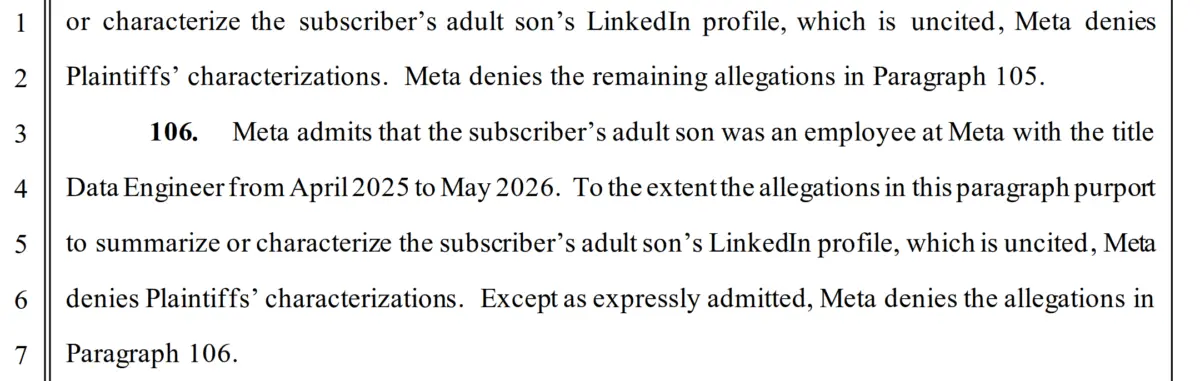
"The subscriber’s adult son was a Contingent Worker at Meta from October 2022 to October 2024."
Furthermore, Meta confirmed that the same individual subsequently became "an employee at Meta with the title Data Engineer from April 2025 to May 2026."
By carefully framing the activity as the independent, personal actions of an employee’s adult family member utilizing a private home internet connection, Meta seeks to sever any liability link between the individual’s off-hours BitTorrent usage and Meta’s official corporate operations. Meta’s legal team noted that Strike 3 apparently identified this individual via public professional networking profiles like LinkedIn, asserting that such profiles "speak for themselves" while maintaining that no employee engaged in peer-to-peer file sharing for the benefit of Meta’s AI research teams.
Challenging the Plaintiffs’ Copyrights
Beyond denying direct involvement and introducing the de minimis defense, Meta’s tenth affirmative defense takes direct aim at the validity and scope of Strike 3’s copyright portfolio. Meta alleges that the adult films in question may incorporate third-party creative works without authorization, rendering them unauthorized derivative works. Meta argues that these productions may copy preexisting elements that were never properly disclosed in Strike 3’s official copyright registrations filed with the U.S. Copyright Office, potentially invalidating or significantly weakening the plaintiffs’ enforcement claims.

Future Outlook: Timeline and Industry Implications
As the legal proceedings enter their next major phase, the stakes for both parties could hardly be higher. With nearly 3,000 works at issue and statutory damages potentially soaring toward $446 million, neither side is expected to back down easily.
The procedural roadmap ahead is already firmly established by the presiding federal court:
- Mediation: Both parties are mandated to participate in formal settlement mediation sessions scheduled to take place by early August. Given the astronomical financial exposure and the novelty of Meta’s defenses, mediation will serve as a critical pressure valve to test whether a mutually agreeable settlement can be reached before trial.
- Trial Date: Should settlement talks fail, the case is officially locked in for a high-stakes jury trial scheduled to commence in February 2028.
Broader Implications for the Tech Industry
The outcome of Strike 3 Holdings v. Meta Platforms will resonate far beyond the adult entertainment industry. As generative AI developers face an expanding wave of copyright lawsuits from book publishers, news organizations, record labels, and visual artists, courts are increasingly forced to grapple with the collision between massive data aggregation practices and traditional intellectual property doctrines.
If Meta’s "de minimis" BitTorrent defense gains traction, it could provide technology companies with a fresh shield against liability stemming from decentralized data-gathering mechanisms. Conversely, a victory for Strike 3 could expose tech giants to severe financial liabilities whenever corporate personnel interact with peer-to-peer networks on residential or corporate infrastructure. For now, legal observers will closely monitor the upcoming mediation sessions and preliminary motions as this multi-million-dollar copyright clash marches steadily toward its 2028 courtroom showdown.