Executive Overview
In a tentative ruling that could profoundly reshape how local municipalities across California process massive digital infrastructure developments, an Imperial County Superior Court judge has dealt a significant blow to a planned 330-megawatt (MW) hyperscale data center. Imperial County Superior Court Judge L. Brooks Anderholt determined that the County improperly categorized critical approvals for the multi-million-square-foot facility as "ministerial"—a classification that allowed officials to bypass rigorous environmental scrutiny.
Instead of evaluating the project as a cohesive, high-impact industrial ecosystem, the County had relied on an outdated 2017 environmental review originally drafted for generic zoning code amendments, ignoring the unique and intensive infrastructure demanded by modern artificial intelligence and cloud computing facilities.
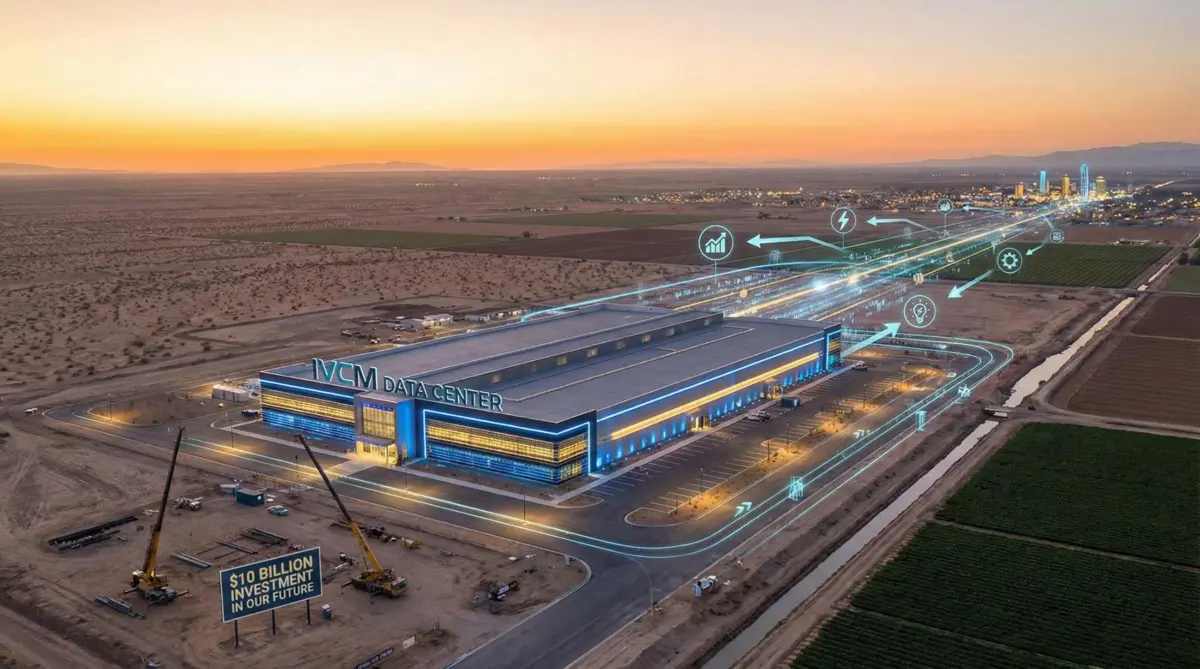
The dispute centers on a sprawling proposal by Imperial Valley Computer Manufacturing, LLC (IVCM) to construct an approximate 950,000-square-foot data center on roughly 75 acres of land located southeast of Aten Road and Clark Road. The scale of the proposed development is staggering, featuring an initial 330 MW load supported by an on-site 330 MW substation, an 862-megawatt-hour (MWh) battery energy storage system (BESS), extensive water treatment and cooling facilities, four 500,000-gallon water storage tanks, a six-acre retention basin, and a massive 330 MW emergency backup generation fleet comprising 132 natural gas generators.
If Judge Anderholt’s tentative decision is formally adopted as the court’s final ruling, Imperial County will be legally mandated to rescind its key project approvals. Furthermore, the County would be required to prepare a comprehensive Environmental Impact Report (EIR) under the California Environmental Quality Act (CEQA) before any grading, construction, or other physical development can commence.
Legal experts and municipal leaders note that the ruling underscores a mounting tension between local economic development ambitions—often fueled by promises of high-tech jobs and tax revenues—and the stark resource realities of municipal water supplies, constrained electrical grids, and community health protections. As data center operators increasingly race to secure powered land for compute-intensive AI applications, this case establishes a vital judicial precedent reinforcing that massive, integrated digital infrastructure projects cannot circumvent public review through piecemeal, expedited permitting strategies.
Detailed Chronology & Legal Proceedings
The legal confrontation between the City of Imperial and Imperial County traces its roots back to regulatory changes made nearly a decade ago, which ultimately collided with the modern boom in hyperscale data center construction.
The 2017 Zoning Amendments and the "Ministerial" Miscalculation
In 2017, Imperial County enacted amendments to its municipal zoning code explicitly establishing data centers as permitted uses within designated industrial zones. To facilitate these changes, the County adopted a negative declaration, a streamlined environmental determination concluding that the zoning modifications would not result in significant environmental impacts. At the time, the local footprint of the data center industry was a fraction of its current size, and the infrastructure demands of modern AI-driven hyperscale facilities were largely unforeseen.
When IVCM formally proposed its massive complex on Aten and Clark roads, County officials treated the subsequent regulatory steps—including grading permits, lot mergers, and road vacations—as "ministerial" actions. In administrative law, ministerial approvals are purely mechanical tasks where officials have no independent discretion to deny a permit if objective criteria are met, thereby exempting the action from comprehensive environmental review under CEQA.
The City of Imperial’s Legal Challenge
Alarmed by the sheer scale of the proposal and its close proximity to populated areas, the City of Imperial intervened, mounting a vigorous legal challenge represented by attorney Alene Taber. The City argued that the County’s fragmentation of the approval process effectively disguised the true, cumulative impacts of the development.
Judge Anderholt firmly rejected the County’s ministerial argument. In his tentative ruling, the judge emphasized that the array of regulatory clearances sought by the developer could not be artificially separated from the overarching operational purpose of the site.
“The grading, lot merger, road vacation, electrical facilities, water systems, and related infrastructure serve one cohesive construction and operation of the data center,” Judge Anderholt noted in the decision.
The court pointed out that the grading approval was inherently discretionary because County officials retained the authority to impose specific, subjective conditions concerning site drainage, roadway alignments, traffic flows, soil engineering, and safety requirements. Additional discretionary actions—such as merging parcels and vacating Leimgruber Road—further demonstrated that the County possessed, and should have exercised, broader administrative oversight.
Procedural Next Steps and the Remedy
The tentative ruling does not outright reject the data center project, nor does it dictate whether the County must ultimately approve or deny the development once environmental reviews are completed. Instead, the legal remedy provides a strict procedural reset: the County must set aside its prior approvals, identify the "whole of the action" as a single cohesive project, and complete a full EIR under CEQA prior to allowing any grading or construction.
If the tentative decision becomes final, legal counsel and municipal parties will face a 20-day window following the service of notice of entry to meet and confer. During this period, the parties will collaborate to draft a formal writ of mandate and judgment reflecting the court’s directives, guiding the County on how to proceed with the mandated environmental review.
Supporting Context & Infrastructure Metrics
To understand why the court ordered a comprehensive CEQA review, one must examine the staggering physical and operational metrics of the IVCM data center project. Industry analysts emphasize that modern data centers—particularly those tailored for high-performance computing (HPC) and artificial intelligence—are no longer passive real estate shells housing computer servers. Rather, they function as heavy industrial complexes requiring dedicated power plants, massive water reserves, and complex safety systems.
The Scale of the IVCM Development
Public records and court documents reveal an infrastructure footprint designed for extreme compute capacity:
- Building Footprint: Approximately 950,000 square feet of enclosed data center space situated on a 75-acre parcel.
- Electrical Load: A continuous power demand of 330 MW, roughly equivalent to the electricity consumption of hundreds of thousands of residential homes.
- Substation Infrastructure: An on-site 330 MW electrical substation requiring complex transmission interconnections with the Imperial Irrigation District (IID).
- Energy Storage: An 862 MWh Battery Energy Storage System (BESS) designed to manage peak loads, smooth out grid fluctuations, and provide backup resiliency.
- Emergency Generation Fleet: A 330 MW emergency generation facility powered by a staggering 132 individual natural gas generators.
- Water and Cooling Systems: Extensive cooling and water treatment infrastructure supported by four dedicated 500,000-gallon water storage tanks and a six-acre stormwater retention basin.
The "Whole Project" Doctrine
Neil Osnato, an infrastructure analyst and CEO of Persistence Analytics, highlighted the critical engineering reality that governs these facilities: technical interdependence. According to Osnato, treating a hyperscale data center as a collection of disconnected components—a power load here, a battery bank there, and backup generators elsewhere—fundamentally misrepresents how the physical asset functions.
"A data center is not a power load plus a battery plus a generator. It is one coupled infrastructure obligation," Osnato explained. He noted that environmental and infrastructure consequences arise directly from how these massive systems interact during normal operations, peak demand cycles, grid constraints, and emergency blackouts. Consequently, sound permitting strategies must mirror the physical realities of the system, evaluating cumulative dependencies ranging from upstream utility upgrades and fuel supply lines to water discharge rates and noise emissions.
Official Statements & Stakeholder Perspectives
The judicial decision has triggered widespread reactions across municipal governments, legal circles, and the data infrastructure sector, highlighting deep-seated debates over land use transparency and resource allocation in arid regions.
The City of Imperial’s Position
Municipal leaders in the City of Imperial expressed overwhelming relief at the court’s decision, framing the ruling as a crucial victory for community safety, environmental stewardship, and democratic transparency.
City Manager Dennis Morita articulated the City’s motivation in written statements, emphasizing that the intervention was driven by the project’s direct proximity to local residents.
"The City is elated with the court’s tentative decision," Morita said. "As a tentative decision, there is a process to navigate, but the City is hopeful the tentative decision will become final."
Morita pushed back against suggestions that the ruling established radical legal precedents, maintaining instead that the decision simply applies established California environmental law to the unprecedented scale of modern hyperscale infrastructure.
"A project of that sort comes with much in the way of potential benefits, but must be properly analyzed to determine and mitigated for environmental impacts," Morita noted.
Legal and Industry Interpretations
Alene Taber, legal counsel representing the City of Imperial, underscored the dangers of administrative shortcutting in municipal governance. She warned that allowing developers to utilize serial, piecemeal approvals effectively blinds the public to the true cumulative toll of large-scale industrial projects.
"Massive hyperscale data centers cannot bypass CEQA and public review by employing a fast-tracked piecemeal approval process," Taber stated. "They must undergo a comprehensive environmental review that considers alternative locations, buffer zones, and all potential impacts as part of a transparent decision-making process."
From an infrastructure perspective, industry observers like Osnato suggest that the ruling should serve as a wake-up call for developers nationwide. Rather than viewing comprehensive environmental reviews as mere bureaucratic hurdles, data center developers must integrate multi-system impact modeling into their earliest site-selection and engineering phases.
Future Outlook & Broader Implications
The Imperial County ruling arrives at a pivotal juncture for the data center industry. Across the United States—and particularly in energy-stressed regions of the American Southwest—local communities are grappling with an unprecedented wave of data center proposals driven by the explosive growth of generative artificial intelligence and cloud computing.
Key Environmental Areas for the Forthcoming EIR
Should Judge Anderholt’s tentative ruling become final, the Environmental Impact Report prepared by Imperial County will be forced to scrutinize several high-stakes environmental domains:
- Water Security and Wastewater Management: Given Imperial County’s arid climate and agricultural heritage, the project’s substantial water consumption—driven by evaporative cooling towers, water treatment systems, and massive storage tanks—will face intense public and legal scrutiny regarding long-term regional water availability and wastewater discharge effects.
- Grid Reliability and Fossil Fuel Reliance: The EIR will examine the strain placed on the local electrical grid managed by the Imperial Irrigation District, evaluating potential reliability risks, cost implications for local ratepayers, and the heavy reliance on on-site fossil-fuel generation.
- Battery Safety and Hazardous Materials: The deployment of an 862 MWh BESS introduces complex safety evaluations, specifically regarding thermal runaway risks, potential fire hazards, explosions, and the emission of toxic gases in densely populated or agricultural regions.
- Air Quality and Greenhouse Gas Emissions: Continuous electrical demands, construction-related particulate matter, and the operation of 132 natural gas emergency generators will require rigorous modeling for air pollution compliance and greenhouse gas mitigation.
- Acoustic Impacts and Urban Heat Islands: The cumulative noise generated by massive cooling fans, towers, HVAC systems, and technical equipment will be assessed, alongside the potential contribution of large-scale industrial heat dissipation to local urban heat island effects.
Precedent for California Municipalities
Legal experts agree that the ramifications of this case extend far beyond the borders of Imperial County. As local planning commissions across California face mounting pressure to approve high-revenue tech infrastructure, Judge Anderholt’s ruling reinforces the foundational tenets of CEQA.
By demanding that public agencies evaluate the "whole of the action" rather than isolating individual permits, the judiciary has signaled that the green energy and digital infrastructure transitions cannot bypass environmental accountability. For developers, communities, and municipal regulators alike, the message is clear: the era of piecemeal data center permitting in California is drawing to a close, replaced by an era of mandatory transparency, comprehensive system analysis, and rigorous public engagement.