









Executive Overview
Internet service provider (ISP) RCN has formally petitioned a New Jersey federal court to reconsider a pivotal six-year-old ruling and dismiss a high-stakes, multi-million-dollar copyright infringement lawsuit brought by the world’s major record labels. The motion, filed yesterday, asserts that the legal ground beneath the music industry’s allegations has completely eroded following the United States Supreme Court’s landmark decision in Cox v. Sony.
For nearly a decade, major record labels and Hollywood movie studios waged an aggressive nationwide litigation campaign against American internet providers. The core strategy of rightsholders was simple yet devastating: hold ISPs financially and legally responsible for the piracy of their subscribers if the providers failed to disconnect repeat copyright infringers.
That foundational liability theory collapsed in March when the Supreme Court dramatically reversed a staggering billion-dollar jury verdict against Cox Communications. The high court ruled that an internet service provider cannot be held liable for contributory copyright infringement merely because it continues to supply internet connectivity to users who have been repeatedly flagged for illegal downloading.
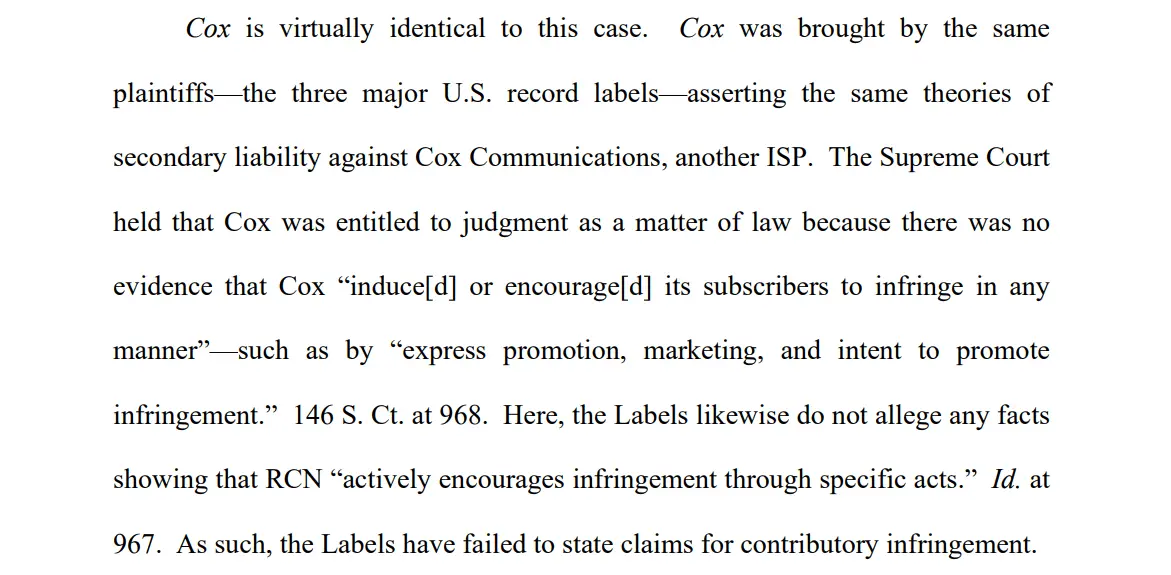
Armed with this fresh precedent, RCN is now urging the U.S. District Court for the District of New Jersey to apply the ruling and officially terminate a legal battle that has dragged on since 2019. According to RCN’s legal counsel, this case stands as the absolute last major-label secondary copyright infringement lawsuit still active against an American ISP, with all similar actions across the country having already been voluntarily dropped or settled in the wake of the Cox decision.
Detailed Chronology of a Seven-Year Legal Battle
To understand the gravity of RCN’s latest maneuver, one must trace the timeline of a prolonged, grueling conflict that has spanned nearly seven years of complex litigation, discovery disputes, and tectonic shifts in copyright jurisprudence.
2019: The Opening Salvo
The legal feud began in 2019 when major music publishers and record labels filed lawsuits targeting several prominent ISPs, including RCN, Grande Communications, Verizon, and Altice. The plaintiffs—representing corporate titans such as Sony Music, Warner Music Group, and Universal Music—argued that these broadband providers were turning a blind eye to widespread peer-to-peer (P2P) file sharing on their networks. By refusing to sever connections for flagged accounts, the labels contended, the ISPs were actively profiting from and contributing to rampant digital piracy.
2020–2022: The Standoff and Discovery Quagmire
As the case progressed through the New Jersey federal court, it quickly bogged down in administrative hurdles and aggressive procedural maneuvers. In May 2022, Magistrate Judge Tonianne J. Bongiovanni imposed a strict stay on all fact depositions until ongoing disputes regarding internal Digital Millennium Copyright Act (DMCA) records and privilege logs could be fully resolved.
Despite the submission of at least 20 separate discovery letter briefs, that stay remained frozen. RCN now contends that the prolonged standoff was never about reaching a trial. Instead, the ISP alleges that the labels utilized the ongoing privilege disputes as calculated leverage—keeping the lawsuit alive simply to extract nuisance settlements or pressure RCN and its sister companies into financial concessions.
March 2024: The Cox Earthquake
The legal landscape shifted dramatically when the U.S. Supreme Court issued its ruling in Cox v. Sony. The decision completely dismantled the rightsholders’ favorite litigation weapon: the theory that an ISP’s passive provision of broadband access, coupled with the refusal to disconnect repeat infringers, constitutes contributory infringement.
The Aftermath and Current Filing
Immediately following the Cox ruling, rightsholders hastily retreated across multiple fronts. The movie studios behind films like The Hitman’s Wife’s Bodyguard dismissed a virtually identical lawsuit against RCN with prejudice, while parallel actions against WideOpenWest (WOW), Verizon, and Altice were dropped within weeks. Grande Communications, RCN’s sister ISP operating under the Astound Broadband umbrella, also saw the pressure ease, though it continues to push for a formal, permanent win on the docket.

Only the major record labels’ case against RCN remained obstinately alive—prompting yesterday’s decisive motion for reconsideration.
Legal Analysis: No Inducement, No Claim
In its detailed motion for reconsideration and accompanying memorandum, RCN outlines a rigorous, multi-pronged legal defense predicated entirely on the dismantling of the labels’ original theories of liability: contributory infringement and vicarious infringement.
1. The Collapse of Contributory Infringement
Under the standard established and reinforced by Cox v. Sony, establishing contributory copyright infringement requires proving much more than generalized knowledge that a service is being used for unlawful purposes. An ISP cannot be held liable simply because it continues to collect subscription fees from users flagged for piracy.
RCN’s filing emphasizes that liability now demands concrete evidence that a service provider:
- Actively encouraged or induced infringement through explicit marketing, design choices, or affirmative instructions; or
- Operates a service that possesses no substantial non-infringing uses.
Because broadband internet access has virtually infinite legitimate, non-infringing uses—ranging from remote work and education to healthcare and global communications—and because RCN did nothing to actively induce copyright theft, this claim is legally dead in the water. RCN explicitly states that its case is "virtually identical" to the defeated Cox matter.
2. The Failure of Vicarious Infringement
To sustain a claim of vicarious infringement, plaintiffs must demonstrate that the defendant possessed the right and ability to supervise the infringing conduct and derived a direct financial benefit from it.
RCN attacks the financial benefit prong head-on. Citing rulings from the Fourth Circuit in the Cox litigation—which the Supreme Court ultimately left undisturbed when it declined to hear the labels’ appeal—RCN notes that standard monthly subscription fees do not constitute a direct financial benefit from piracy.
Subscribers pay RCN the exact same flat-rate monthly fee regardless of whether they spend their time streaming educational videos, browsing social media, or illegally downloading copyrighted discographies. Because the revenue generated is flat and decoupled from the volume of infringing activity, no direct financial benefit exists.
Supporting Context, Metrics, and Industry Implications
The ripple effects of the Cox v. Sony decision extend far beyond a single courtroom in New Jersey. For years, copyright litigation against network intermediaries was one of the most lucrative and fiercely contested arenas in intellectual property law.
The Economics of ISP Piracy Litigation
- Billion-Dollar Stakes: The initial verdict against Cox Communications reached an astronomical $1 billion, setting a terrifying precedent for ISPs nationwide and forcing many to implement aggressive, automated termination policies to mitigate legal risk.
- The "Notice and Takedown" Paradigm: Rightsholders routinely flooded ISPs with millions of automated infringement notices, demanding that broadband providers act as private-sector copyright police by terminating household internet access upon reaching arbitrary strike thresholds.
- Massive Discontinuations: Following the Supreme Court’s intervention, the sudden voluntary dismissal of cases against Verizon, Altice, WOW, and RCN’s film-industry counterparts signals an abrupt end to the era of "repeat infringer" shakedowns against infrastructure providers.
By insulating ISPs from the policing obligations that record labels sought to impose, the Cox precedent fundamentally redefines the boundaries of intermediary liability. It clarifies that internet service providers are conduits of digital traffic, not guarantors of third-party compliance.
Official Statements and Procedural Posture
As of press time, the major record labels and their legal representatives have not yet filed a formal response to RCN’s motion for reconsideration. However, the posture of both parties reveals a starkly divergent view of the litigation’s final chapter.
RCN’s legal team has pulled no punches in describing the labels’ stubborn persistence. In their memorandum, counsel writes:
"Instead, it seems that the Labels view the ongoing privilege dispute as a form of leverage. In other words, the Labels seem to believe that RCN might be willing to pay money to avoid a resolution of that issue."
By forcing the hand of the New Jersey federal court, RCN is demanding an end to what it characterizes as bad-faith litigation designed purely to extract settlements in a case that has lost all legal viability.
RCN has formally requested that the district court:
- Vacate its previous 2020 scheduling and discovery orders;
- Dismiss the labels’ amended complaint with prejudice; and
- Grant oral arguments to allow both sides to debate the direct application of the Cox precedent.
Future Outlook: The End of an Era
The resolution of RCN’s motion marks what is almost certainly the final curtain call for the systematic campaign to hold American ISPs secondarily liable for mass peer-to-peer copyright infringement.
With the film industry having already conceded defeat across its parallel dockets and major telecommunications giants securing clean slates, the record labels’ persistence against RCN stands as an isolated outlier. If the New Jersey federal court follows the clear mandate of the Supreme Court’s Cox v. Sony ruling—as legal experts widely anticipate it must—this seven-year standoff will finally conclude with a decisive victory for RCN and a definitive closure to one of the most contentious chapters in modern digital copyright history.
The legal battleground between rightsholders and internet intermediaries has definitively shifted. Moving forward, copyright enforcement efforts are expected to focus far more narrowly on direct infringers, offshore piracy operations, and unregulated hosting providers, leaving ISPs secure in their role as neutral conduits of the modern internet.