Executive Overview
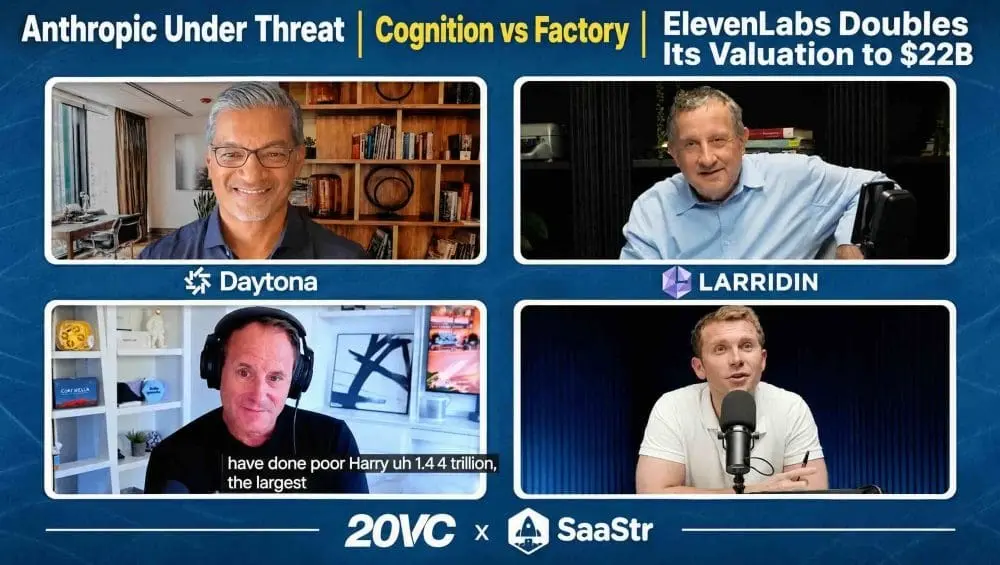
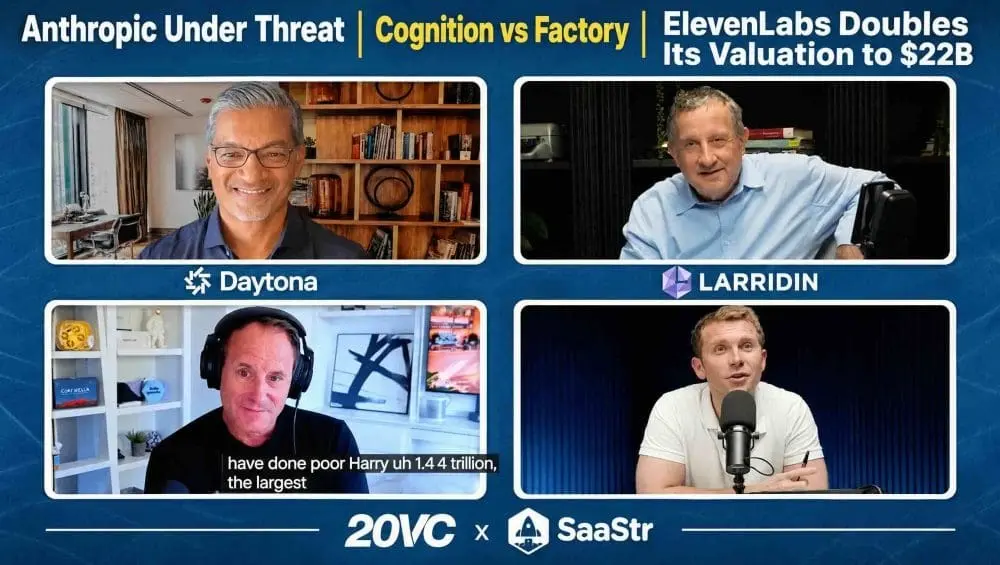
The artificial intelligence landscape is undergoing a structural realignment characterized by massive capital expenditures, shifting market moats, and severe economic friction. In a recent high-level analytical discussion, venture capitalists Harry Stebbings, Rory O’Driscoll, and Jason Lemkin dissected the realities of the modern AI economy.
At the center of this storm is Nvidia’s aggressive ecosystem spending spree—highlighted by its $6 billion arrangement with Poolside and its backing of high-growth platforms like Mercor—which signals that even the world’s most dominant hardware giant is heavily engineering its downstream demand. Meanwhile, frontier labs face an escalating capital wall where only a handful of hyperscalers can finance state-of-the-art training runs.
Simultaneously, enterprise software and consumer-facing applications are grappling with the realities of "token addiction." As corporations transition from experimental deployments to mandatory budgeting regimes, the financial mechanics of software are being entirely rewritten. This report breaks down the critical shifts in venture math, the collapse of neo-labs, the hyper-competitive race for the number-two spot in foundational models, and the looming crisis corporate CFOs will face by 2027.
Detailed Chronology & Market Shifts
1. Nvidia’s $6 Billion Poolside Deal and the Limits of "Infinite Capitalism"
In one of the most revealing moves of the market cycle, Nvidia committed $6 billion for a non-exclusive license to Poolside’s Model Factory—the internal system used to construct its models—alongside a separate $1 billion investment at a $12 billion pre-money valuation. As part of the transaction, 109 engineers received offers to join Nvidia’s open-weight Nemotron initiative, while Poolside’s three founders remained onboard.
Crucially, internal investor letters emphasized that the transaction was neither an acquisition nor an acquihire. The catalyst behind the deal was simple and stark: Poolside had a six-week window to raise $2 billion to fund a massive 40,000 GB300 cluster slated to come online in January. When that funding round failed to close in time, the company lost the cluster.
- The Takeaway: The episode underscores a humbling reality for the tech sector—infinite capitalism is not as boundless as public perception suggests. Even amidst a historic AI boom, the venture capital gravy train has limits, proving that the sheer capital intensity required to build frontier models has outpaced traditional venture financing capabilities.
- The Neo-Lab Backlash: Across the venture ecosystem, investor sentiment toward neo-labs has soured. The consensus among top-tier investors is that stand-alone, next-generation model providers are increasingly falling out of favor due to insurmountable infrastructure costs.
2. The Math of a $9 Billion Outcome in the 2026 Seed Landscape
For a seed-stage fund, a $9 billion outcome—yielding roughly a 15x return for early backers like Harry Stebbings—might historically have been celebrated as a massive win. However, in the modern AI venture paradigm, a 15x return often fails to clear the hurdle rate required to return an entire fund.
Accounting for successive rounds of heavy dilution in capital-intensive sectors, an effective entry price is often pushed much higher than the nominal seed price. To achieve a true fund-returning 50x multiple in today’s hyper-inflated environment, early investors require exits well north of $60 billion. While a 15x failure is exceptional by historical standards, the underlying math highlights the unforgiving parameters of modern venture capital.
3. The Hyperscaler Monopoly on Frontier Model Financing
The structural reality of the artificial intelligence sector is that venture capital cannot—and does not—fund state-of-the-art frontier models. Early VC firms long ago diluted out of major positions in entities like OpenAI and Anthropic. Today, only the tech hyperscalers (Microsoft, Google, Amazon) possess balance sheets robust enough to underwrite the multi-billion-dollar compute clusters required for frontier development.
With Nvidia stepping in as the fifth member of this elite club to bankroll the open-weight ecosystem, a formidable barrier has been erected. Any aspiring startup attempting to challenge the frontier tier now hits an immovable capital wall.
4. Nvidia’s Free Cash Flow Strategy
Nvidia’s capital allocation strategy involves deploying massive chunks of its historic free cash flow—projected near $70 billion annually—directly into its ecosystem. Alongside its Poolside involvement, Nvidia has engaged in talks to back Mercor at a staggering $20 billion valuation, doubling its valuation from October as run-rate revenue crosses $2.5 billion.
While investments in neoclouds and open-weight inference providers clearly expand Nvidia’s Total Addressable Market (TAM) by driving chip sales, backing data-labeling and training-data platforms like Mercor represents a broader ecosystem play. With Wall Street encouraging aggressive capital deployment rather than passive balance sheet accumulation, Nvidia is effectively buying ecosystem insurance.
5. OpenAI’s Reacceleration and the Battle for Number Two
OpenAI’s announcement that CFO Sarah Friar is targeting a public debut by 2027 comes at a critical juncture. Financial disclosures revealing a Q1-to-Q2 revenue growth rate of roughly 18% quarter-over-quarter—annualizing to just under 100% and yielding under $30 billion in GAAP revenue—sparked intense debate. While impressive by traditional standards, this growth rate lagged behind aggressive market expectations and hyper-growth competitors.
This deceleration narrative forced a rapid strategic pivot to prove that Q2 was an anomaly and that Q3 momentum is accelerating. Simultaneously, the market dynamics for the "number two" spot have deteriorated. Rather than a clean oligopoly between two dominant players, the market is now crowded with over a dozen competitors running performant open-weight models. Being a premium product in a hyper-commodity market leaves companies competing heavily on brand and security rather than raw capability.
6. The Dominance of Coding as the Ultimate AI Use Case
When evaluating the strategic direction of frontier labs, market observers point to a singular, defining thesis: "It’s all about code."
While consumer applications like chat interfaces command massive public brand awareness, the monetization economics present stark contrasts:
- The Consumer Dilemma: Selling thousands of dollars worth of high-intensity tokens to consumers for a flat $200 subscription creates an unsustainable business model if viewed in isolation. Consumer propensity to pay remains low, making chat apps primarily proof-of-concept vehicles.
- The Enterprise Coding Advantage: Software engineering represents the fastest-adopting, highest-ROI market in the AI economy. Both OpenAI and Anthropic have leaned heavily into coding capabilities because enterprises possess both the high propensity to pay and the immediate productivity gains to justify the token spend.
7. The Public Software Reordering and Stripe’s Acceleration
Stripe’s recent financial disclosures revealed revenue growth accelerating to 41%, billings surging by 71%, and a contracting share count driven by aggressive stock buybacks. Operating at massive scale, Stripe has effectively become a structural derivative of the broader AI boom—embedded so deeply into modern digital infrastructure that avoiding it is nearly impossible.
When paired with companies like OpenAI and Databricks scaling at high velocities, these private giants are reshaping the software leaderboard. Their performance highlights a stark valuation divide between elite compounders and legacy SaaS providers, driving institutional investors increasingly toward crossover rounds.
Supporting Context & Metrics
- Poolside Deal Structure: $6 billion non-exclusive license to the Model Factory; $1 billion equity investment at a $12 billion pre-money valuation; 109 engineers recruited for Nvidia’s Nemotron initiative.
- Mercor Growth: Surpassing $2.5 billion in run-rate revenue, with valuation talks reaching $20 billion.
- OpenAI Financial Trajectory: Q1-to-Q2 GAAP revenue growth of approximately 18% quarter-over-quarter, tracking toward sub-$30 billion annual figures.
- Token Utilization: OpenRouter data indicates roughly 68% of total inference tokens are routing through open-weight models, a figure continuing to climb steadily.
- Stripe Metrics: 41% revenue growth acceleration; 71% year-over-year billings growth.
Future Outlook: The 2027 CFO Crisis and Agentic Realities
The Token Addiction Backlash
As corporations move past the phase of performative AI experimentation, the financial reckoning is arriving. Companies that initially embraced uncapped token usage for employees are now facing massive monthly software bills, forcing strict budgetary caps—ranging from $200 to $500 for general staff to $10,000 for engineering teams.
By 2027, the central crisis for corporate Chief Financial Officers will be managing token addiction. Because corporate intelligence is fungible and vital to modern operations, CFOs cannot simply eliminate token budgets without tanking productivity. However, they are caught between two existential pressures:
- The Profitability Mandate: Public markets will not accept lower earnings per share (EPS) driven by unchecked AI spending disguised as productivity gains. Automation must ultimately translate to structural headcount optimization.
- The Talent Retention Threat: Empowered engineering and knowledge talent are increasingly dependent on advanced AI tools. Failing to provide adequate compute and agentic access risks alienating top-tier staff, driving them toward AI-native competitors.
The Security Dilemma of Autonomous Agents
Next-generation personal agents and autonomous frameworks (such as Instinct, Grokbot, and OpenClaw) continue to struggle with fundamental data security and execution reliability. Because these probabilistic systems operate autonomously, unmitigated access to corporate infrastructure creates severe vulnerability vectors. Despite these challenges, industry leaders argue that consumer and enterprise trust in autonomous systems is an inevitability, echoing the early days of online credit card adoption.
Categories Facing Over-Venture
As venture capital searches for the next generational outcome, several sectors are showing signs of exhaustion and over-allocation:
- Customer Support: Software margins are compressing as support features become commoditized features rather than standalone products.
- Humanoid Robotics: While specialized automation (like warehouse robotics) thrives, general-purpose humanoids face severe unit-economic hurdles compared to purpose-built machinery.
- Legal and Accounting Services AI: The premise of converting traditional professional services firms into high-margin AI platforms via convoluted corporate structures has yet to produce the promised multi-billion-dollar scale.
Notable Quotable Moments
Jason Lemkin:
"Hardware and capital constraints mean $9 billion doesn’t clear the bar for seed investing in 2026. Moreover, I need my ten sub-agents running 24 hours a day to do my job, or I quit. Take away my agents, I quit. I won’t do the job."Rory O’Driscoll:
"If you get 15x on your failures in venture, you’ll die a rich man… Sometimes when you look back at outcomes, you realize only one sentence matters. Today, what Anthropic is, is: it’s all about code. That’s the only sentence that matters."Harry Stebbings:
"Neo labs are just going out of favor, and next-generation model providers too. That’s universal from everyone I speak to… To most of the general population in large majorities of the world, AI is ChatGPT. I am in awe that Sam is not going: we are the next Google."