Executive Overview
In a dramatic and alarming escalation of the conflict in Eastern Europe, a coordinated series of sea and aerial drone attacks has struck commercial shipping within the exclusive economic zones (EEZs) of NATO member states in the Black Sea. The weekend assaults mark a historic and deeply concerning threshold: for the first time since the onset of the Russian invasion of Ukraine, drone warfare has directly breached the maritime sovereign economic spaces of the Alliance, resulting in the sinking of two cargo ships, the severe damage of a third, and the tragic loss of civilian lives.
The incidents, unfolding across October 5 and 6, targeted international merchant vessels thousands of miles from traditional high-seas combat zones, thrusting maritime safety, international law, and collective security into uncharted waters. Two cargo ships—the Togo-flagged Alfa Watan and the Palau-flagged Able—were targeted roughly 80 miles off the coast of Bulgaria, while a Turkish-owned vessel, the Royad Mammadov, was struck and ultimately sunk within Romania’s exclusive economic zone.
The attacks have triggered urgent security consultations across European capitals and NATO headquarters. While Western leaders have exercised measured caution as international maritime investigators work to reconstruct the exact telemetry and launch vectors of the strikes, Ukrainian officials have pointed an immediate finger at Moscow, citing joint naval intelligence gathered with Bulgarian authorities. The strikes have intensified long-standing concerns regarding what security experts term "hybrid warfare"—a gray-zone strategy allegedly employed by Russia to disrupt global supply chains, intimidate NATO’s eastern flank, and exert economic strangulation over Black Sea trade corridors. As diplomatic fallout builds, the incident forces a profound reassessment of commercial shipping vulnerabilities and challenges NATO’s deterrence posture in a critical maritime theatre.
Detailed Chronology of the Black Sea Assaults
The sequence of events unfolded rapidly over a catastrophic 48-hour window in early October, transforming the western Black Sea from a tense commercial corridor into an active combat-adjacent zone.
October 5: The Strike in Romanian Waters
The campaign of disruption began on Sunday, October 5, when maritime radar and coastal monitoring stations picked up unidentified aerial and surface signatures in the western sector of the Black Sea. The target was the Royad Mammadov, a Turkish-owned cargo ship transiting peacefully through Romania’s exclusive economic zone.
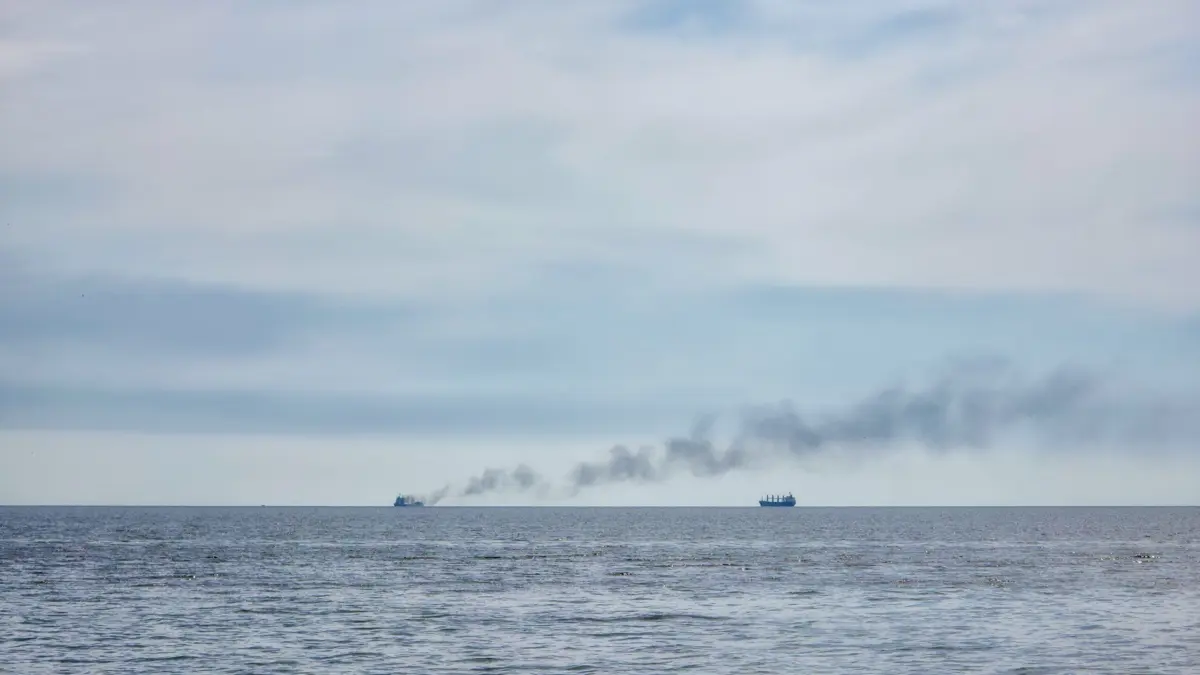
According to reports from Euronews and regional maritime authorities, multiple explosive-laden drones converged on the vessel without prior warning. The impact triggered massive secondary explosions among the ship’s cargo holds and fuel reserves, engulfing the Royad Mammadov in a ferocious blaze. The structural integrity of the ship was fatally compromised, and it slipped beneath the waves shortly after the attack.
A multinational rescue operation, spearheaded by Romanian naval vessels and search-and-rescue helicopters, rushed to the coordinates. Out of its crew, 11 mariners were pulled from the frigid waters alive, though many suffered severe burns and shrapnel injuries. Tragically, two crew members were confirmed dead at the scene, while another mariner remained unaccounted for as search efforts stretched into the night. The strike within Romanian EEZ boundaries sent immediate shockwaves through the international shipping community, serving as the opening salvo of a weekend that would shatter regional stability.
October 6: The Double Strike off Bulgaria
Before maritime agencies and intelligence analysts could fully process the tactical implications of the Romanian-zone attack, a second, larger assault materialized on Monday, October 6. This time, the violence struck approximately 80 miles (128 kilometers) off the coast of Bulgaria—well within the nation’s exclusive economic zone.
The assault was sophisticated and dual-pronged, utilizing a mixed swarm of high-speed unmanned surface vessels (USVs) and unmanned aerial vehicles (UAVs). Two distinct merchant vessels became the focus of the coordinated strike:
- The Alfa Watan: Operating under the flag of Togo, this cargo vessel took the brunt of the kinetic impact. Overwhelmed by successive direct hits from sea-borne and airborne drones, the Alfa Watan suffered catastrophic hull breaches. The ship rapidly took on water and sank. At the time of publication, the immediate fate and whereabouts of its entire crew remain shrouded in uncertainty, with rescue teams battling adverse sea conditions to scour the debris field.
- The Able: Flying the flag of Palau, this cargo ship was targeted simultaneously by the drone swarm. While it managed to avoid sinking, it was set ablaze, turning into a floating inferno in the middle of the Black Sea.
A rapid response by a Bulgarian civilian ferry in the vicinity averted an even greater humanitarian disaster. The ferry successfully evacuated all 18 crew members aboard the burning Able. Emergency medical transport planes were scrambled to airlift two severely injured mariners directly to specialized trauma units in the coastal Bulgarian city of Varna, where they remain in critical condition.
Supporting Context, Metrics, and Maritime Vulnerabilities
To understand the gravity of the October 6 attacks, one must examine the geopolitical geography and economic stakes of the Black Sea. As a critical maritime artery connecting Eastern Europe, the Caucasus, and Central Asia to global markets, the Black Sea handles millions of tons of grain, steel, oil, and manufactured goods annually. Since Russia’s full-scale invasion of Ukraine in February 2022, this body of water has transformed into a high-stakes chessboard.
Key Metrics of the Escalation:
- Geographic Boundary Crossed: First time commercial shipping has been kinetic-targeted deep inside NATO member-state EEZs (Bulgaria and Romania).
- Casualties: At least 2 confirmed dead from the Royad Mammadov strike, multiple severe injuries requiring emergency airlifts (Varna), and an unverified number of missing crew from the sunken Alfa Watan.
- Vessels Impacted: 3 total commercial ships destroyed or heavily disabled within a 48-hour operational window (Royad Mammadov, Alfa Watan, and Able).
- Response Assets: Coordinated deployments involving Romanian naval assets, search-and-rescue helicopters, Bulgarian ferries, and specialized naval intelligence task forces.
For months, commercial shipping companies operating outside the humanitarian grain corridors have navigated a perilous landscape of floating mines, GPS-spoofing, and intermittent naval blockages. However, the unprovoked targeting of ships flagged by neutral or third-party nations (Togo, Palau) within undisputed NATO economic zones represents a dramatic tactical pivot.
Naval analysts point out that executing precision drone strikes 80 miles off the Bulgarian coast requires sophisticated long-range reconnaissance, satellite or local relay guidance, and a disregard for international maritime law. These capabilities far exceed the operational scope of localized asymmetric actors, pointing directly toward state-level military architecture.
Furthermore, the choice of targets highlights the vulnerability of the "shadow fleet" and standard commercial freighters alike. Unlike heavily armored warships, merchant vessels lack active point-defense systems, electronic jamming arrays, or kinetic interception capabilities, making them sitting ducks for modern asymmetric drone swarms.
Official Statements and Diplomatic Fallout
The breach of NATO maritime space has ignited a firestorm of diplomatic condemnation and urgent security assessments across European capitals. Governments are caught between the imperative to project strength and the tactical need to verify the precise mechanics of the attacks before triggering collective defense protocols.
European Union and NATO Reactions
European Commission President Ursula von der Leyen took to social media platform X (formerly Twitter) to voice the bloc’s alarm. Describing the drone strikes on the three vessels as "increasingly concerning," von der Leyen emphasized the sanctity of civilian shipping lanes.
"Attacks on civilian shipping are unacceptable," von der Leyen wrote. "We stand in full solidarity with our Member States on the Eastern flank."
However, maintaining diplomatic prudence, von der Leyen cautioned that the technical circumstances and attribution of the attacks are "still being established," pointedly refraining from officially naming the perpetrator in her initial remarks. This measured stance reflects the delicate balance NATO capitals must maintain: acknowledging an unprecedented security crisis without prematurely escalating a regional conflict into a direct military confrontation between the Alliance and a nuclear-armed power.
National leaders on the front line were far more explicit regarding the violation of their sovereign domains. Bulgarian Prime Minister Rumen Radev did not mince words during a press briefing following the incident. Radev categorically described the strikes as "an unacceptable attack in Bulgaria’s exclusive economic zone" and condemned the action as "a blatant violation of international law and maritime law."
Ukrainian Intelligence and Attribution
While Brussels and individual NATO capitals called for thorough forensic investigations, Kyiv offered an immediate and definitive attribution based on joint intelligence operations.
According to reports by Reuters, Ukrainian President Volodymyr Zelenskyy revealed that a joint investigation conducted by Ukrainian intelligence and the Bulgarian navy concluded that the strikes were executed as a "Russian combined attack using both sea and aerial drones." Zelenskyy firmly rejected any notion of Ukrainian involvement or operational overlap, stating explicitly that Ukraine’s military forces were not conducting operations, exercises, or kinetic engagements in that specific sector of the western Black Sea.
The Ukrainian assessment aligns with broader Western suspicions that Moscow is systematically expanding its gray-zone harassment campaign. By utilizing expendable, attribution-plausible drone swarms, the aggressor aims to disrupt regional commerce, drive up maritime insurance premiums for grain and oil transit, and test the red lines of NATO’s collective resolve.
Future Outlook: Implications for Regional Security and Global Trade
The sinking of the Alfa Watan and Royad Mammadov, alongside the crippling of the Able, marks a watershed moment that will permanently alter the security architecture of the Black Sea basin. As investigators piece together telemetry data, drone fragments, and electronic signatures, the fallout from these attacks will reverberate across multiple domains.
1. Hardening NATO’s Eastern Flank
The incidents exposed a critical vulnerability in NATO’s maritime perimeter. While the Alliance maintains robust air-policing and naval patrolling operations (such as Activity Neptune Shield and enhanced Black Sea naval watch groups), protecting every commercial vessel across thousands of square miles of open ocean is an immense logistical challenge.
In the wake of these strikes, defense ministers from Bulgaria, Romania, and Turkey—the three NATO littoral states bordering the Black Sea—are expected to convene emergency consultations. Pressures will mount to expand airborne early warning (AWACS) flights, deploy dedicated anti-drone naval picket ships, and establish comprehensive electronic warfare and counter-UAS (Unmanned Aerial Systems) umbrellas covering civilian maritime traffic lanes.
2. Economic Shockwaves and Maritime Insurance
Global commodity markets and maritime insurance providers are already reacting to the heightened risk profile. The Black Sea remains a vital conduit for global food security, particularly for shipments to the Global South. Incidents of this magnitude threaten to cause a spike in freight rates, war-risk insurance premiums, and potential shipping boycotts. If mariners and shipowners conclude that navigating the western Black Sea carries an unacceptable risk of unprovoked drone attacks, trade volumes could plummet, reigniting global inflationary pressures on agricultural and energy commodities.
3. The Evolution of Hybrid Warfare
Ultimately, the October drone attacks serve as a grim reminder of the changing character of modern warfare. The line separating sovereign land territory, exclusive economic zones, and open international waters is increasingly blurred by long-range asymmetric weapons. As state actors experiment with hybrid tactics—combining deniable drone swarms, cyber attacks on port infrastructure, and electronic interference—international law and maritime governance structures face an existential test.
For NATO and the international community, the challenge ahead is clear: establish credible deterrence against gray-zone maritime aggression, or risk watching the world’s vital shipping lanes become a lawless hunting ground for asymmetric warfare.