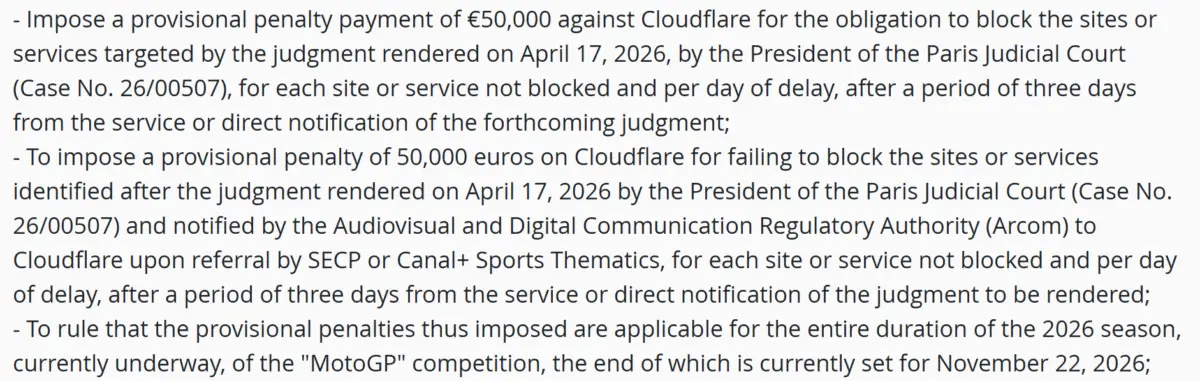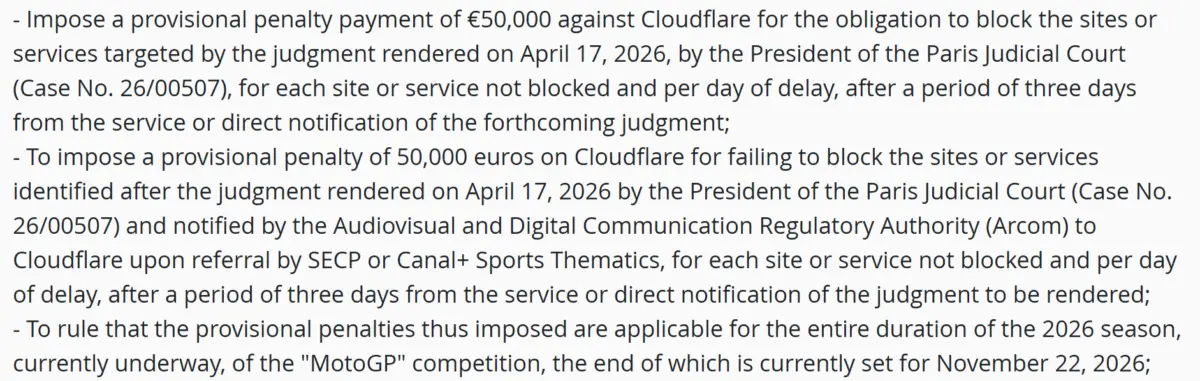
Executive Overview
In the ongoing digital battleground between major entertainment conglomerates and modern piracy rings, rightsholders are increasingly utilizing aggressive legal shortcuts to unmask anonymous operators. Under United States copyright law, rightsholders can leverage a potent procedural mechanism—the Digital Millennium Copyright Act (DMCA) subpoena—to compel third-party service providers to surrender identifying information about alleged infringers without ever needing to initiate a formal, full-scale civil lawsuit.
In the latest escalation of this enforcement strategy, the Motion Picture Association (MPA), acting on behalf of the global anti-piracy coalition known as the Alliance for Creativity and Entertainment (ACE), has filed two sweeping new subpoena requests in federal courts across California. These legal filings represent a two-pronged offensive: the first targets internet infrastructure giant Cloudflare in an effort to unmask the operators behind 49 high-traffic pirate domains, while the second focuses directly on the popular chat platform Discord to expose individuals running illicit streaming communities.
The targeted domains include massive global streaming hubs such as the anime titan Miruro and the prominent German-language television portal Aniworld.to, alongside well-known copycat brands trading on the legacy of defunct sites like 123movies, Fmovies, and SolarMovie. Meanwhile, the Discord-focused filing zeros in on specific server administrators and account holders accused of distributing unauthorized copies of blockbuster films and hit television series, including Wreck-It Ralph, Shutter Island, Invincible, and The Pitt.
As these legal requests await formal sign-off from federal court clerks, the action underscores how major entertainment studios—representing giants like Disney, Netflix, Warner Bros., Universal, Paramount, and sports body UEFA—are systematically dismantling the infrastructure that supports global digital piracy.
Detailed Chronology & Legal Mechanisms
To fully grasp the significance of the MPA’s latest maneuvers, it is essential to examine the mechanics of the DMCA subpoena process and the timeline of events leading up to the recent California court filings.

Unlike traditional civil litigation, which requires the filing of a summons and complaint followed by a lengthy discovery phase governed by judicial oversight, a DMCA subpoena operates as an administrative shortcut. Authorized under Section 512(h) of the DMCA, a copyright holder can submit a formal request to a federal court clerk. Upon verifying that the statutory requirements have been met—such as providing a copy of the copyright infringement notification and a sworn declaration—the clerk signs the subpoena. No judge needs to review or debate the merits of the case before the subpoena is issued to the third-party service provider.
In recent years, ACE and the MPA have turned this legal instrument into a cornerstone of their Open Source Intelligence (OSINT) gathering operations. By serving these subpoenas on companies that provide reverse-proxy, content delivery, or hosting services—most notably Cloudflare—rightsholders can demand comprehensive dossiers on anonymous account holders.
The Cloudflare Subpoena: A Web of 49 Domains
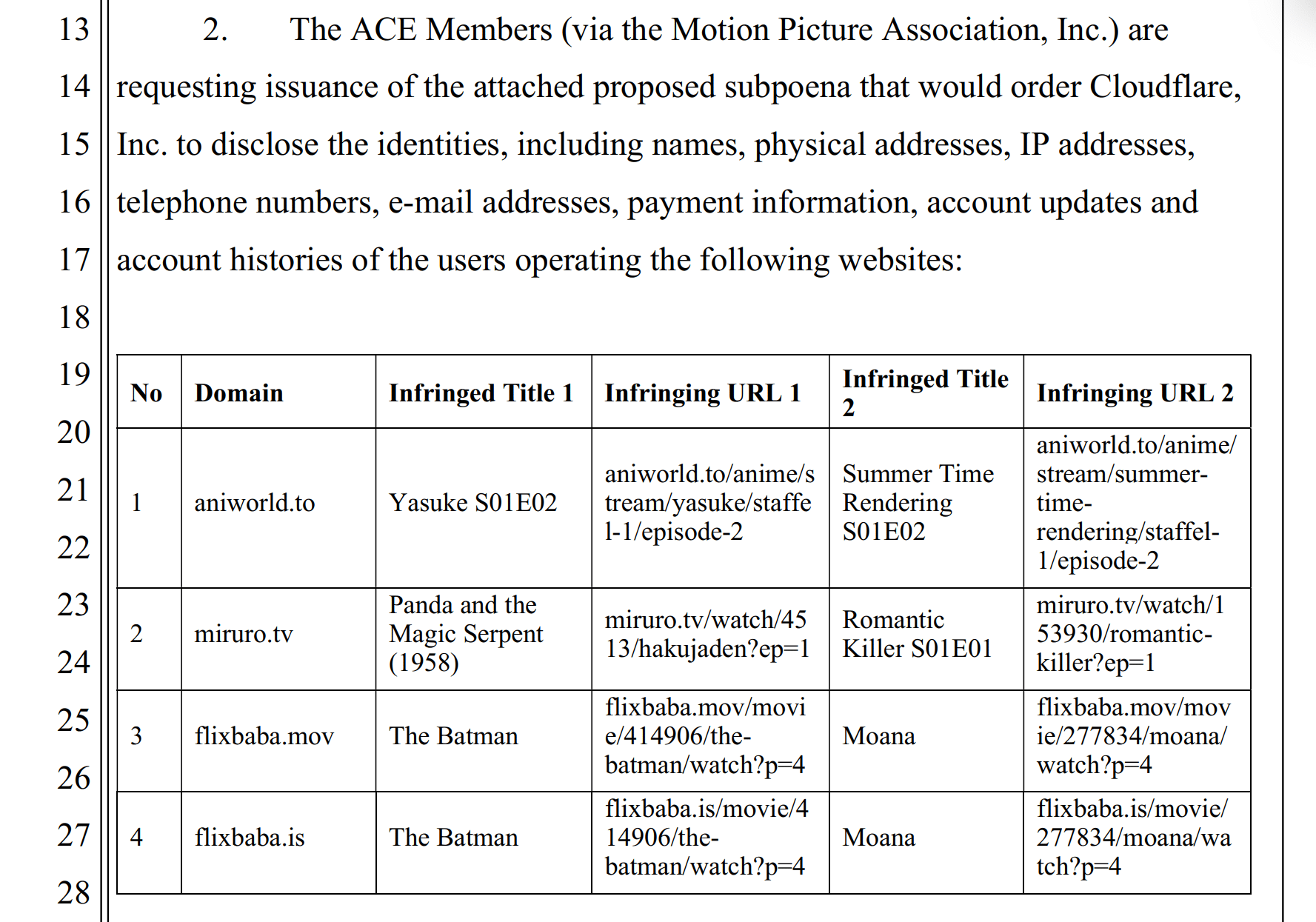
Filed at the U.S. District Court for the Central District of California, the first of the MPA’s recent actions targets Cloudflare. The petition encompasses 49 distinct domain names that collectively draw tens of millions of monthly visits from global audiences.
The scope of the request is exhaustive. For every targeted domain, ACE is demanding that Cloudflare turn over:
- Full names and physical addresses
- IP addresses associated with account creation and management
- Telephone numbers and email addresses
- Detailed payment histories and billing details
- Complete account opening logs and historical usage data
While experienced pirate operators frequently employ false names, masked credit cards, and virtual private networks (VPNs) to obscure their identities, copyright enforcers rely on these data points to cross-reference payment trails, recovery emails, and legacy login logs. Even a single slip-up by an administrator can expose an entire network of mirror sites.
The Discord Subpoena: Targeting Chat Communities
Simultaneously, a second subpoena request was filed at the U.S. District Court for the Northern District of California, focusing on Discord. Rather than casting a wide net across thousands of users—a tactic occasionally used in extreme data leaks, such as Take-Two Interactive’s pursuit of Grand Theft Auto VI leakers—the MPA’s Discord subpoena is remarkably narrow and precise.
The legal paperwork targets specific numeric server IDs, account IDs, and channel IDs. According to the metadata embedded within these Discord identifiers, the digital footprints reveal distinct operational timelines:
- Server One: Created in September 2025, this server, along with its associated channels and user accounts, was spun up within a compressed 30-minute window. It remained active as a distribution hub until earlier this month.
- Server Two: A much older infrastructure component created in September 2020. Interestingly, the specific user account flagged alongside this server was only created last November, indicating that the original creator of the community and the recent distributor of pirated media are distinct entities.
By the time the legal documents were unsealed, both Discord servers had already vanished. Whether Discord’s trust and safety teams terminated the communities following MPA takedown notices or the administrators wiped their servers in anticipation of legal action remains unconfirmed. However, the MPA’s separate administrative notices made it explicitly clear that the primary, if not sole, purpose of these servers was to funnel Discord users toward external online services providing unauthorized access to copyrighted films and television series.
Supporting Context & Metrics
The sheer scale of the web traffic directed toward the domains named in the Cloudflare subpoena illustrates the monumental challenge rightsholders face in suppressing online piracy. Far from being fly-by-night operations, many of these illicit streaming portals rival legitimate subscription-based video-on-demand (SVOD) platforms in terms of monthly user engagement.
Traffic Analysis of the Top Infringement Hubs
According to data analytics from Similarweb cited in the court filings, a handful of domains dominate the landscape of the targeted 49 URLs:

- Miruro (.to and .tv variants): Standing out as the absolute heavyweight in the current crackdown, the anime-focused streaming network Miruro commands staggering viewership. Its primary
.todomain pulls in an estimated 45 million visits every month, while its.tvvariant adds another 37 million monthly visits, totaling over 80 million visits a month. - Aniworld.to: Catering primarily to German-speaking audiences looking for anime and television series, Aniworld.to draws an estimated 23 million visits monthly, making it a primary target for European and international rights enforcement.
- The Global Copycat Network: The remaining 47 domains read like a comprehensive directory of international piracy brands. The list features numerous clones trading on the high-equity brand recognition of defunct pioneers like 123movies, Fmovies, and SolarMovie. It also includes Spanish-language Pelisflix mirrors, Chinese-language Gimy networks, Hindi-language download portals, and various StreamEast-branded sports streaming platforms broadcasting live matches from UEFA competitions—a core member of the MPA/ACE coalition.
Below is the complete official inventory of the 49 domain names cited in the Cloudflare DMCA subpoena request:
- Aniworld.to
- Miruro.tv
- Flixbaba.mov
- Flixbaba.is
- Flixmomo.tv
- Encontrei.info
- Fastflix.top
- Seeflix.to
- Empire-streaming.us
- Fmoviess.org
- Yesmovies.ag
- Tinyzone.org
- Solarmovie2.com
- Streamzy.org
- Watchnest.to
- Watchnest.org
- Indexflix.to
- Indexflix.org
- Imdb.su
- Streamimdb.ru
- Miruro.ru
- Pelisflix200.work
- Pelisflix200.club
- Pelisflix200.best
- Pelisflix1.cc
- Pelisflix1.bio
- Pelisflix1.de
- Coflix.esq
- Gimy.tv
- Gimy.now
- Gimyv.com
- 94580.net
- Movieffm.net
- Gimytv.biz
- Gimytube.com
- Miruro.to
- Miruro.bz
- Repelisplus.my
- 94itv.app
- 99itv.net
- Solarmovies.co
- 123moviesfun.is
- Moviesmod.at
- Moviesmod.zone
- Nupload.top
- Thestreameast.fun
- Direttecommunity.online
- Livetv903.me
- Streameasti.is
Official Statements and Industry Perspective
While neither Cloudflare nor Discord has issued expansive public statements regarding these specific federal filings—standard practice for tech platforms responding to routine legal subpoenas—representatives for the Alliance for Creativity and Entertainment and the Motion Picture Association have consistently championed these measures as essential components of global content protection.
Industry stakeholders emphasize that modern piracy is no longer a decentralized hobbyist movement driven by peer-to-peer file sharing; instead, it has evolved into a highly sophisticated, commercialized enterprise. Illicit streaming networks generate substantial revenue through aggressive advertising, premium subscriptions, and cryptocurrency donations, all while operating behind corporate shields like Cloudflare’s reverse-proxy services.
"The misuse of digital infrastructure to facilitate mass commercial copyright infringement undermines the creative economy, threatens legal jobs, and harms consumers who rely on legitimate platforms," noted a representative tracking international media piracy trends. By leveraging DMCA subpoenas, rightsholders aim to pierce the veil of digital anonymity, transforming faceless domain administrators and chat room moderators into identifiable defendants who can be held legally and financially accountable for their actions.
Future Outlook
The convergence of these legal actions against both core internet infrastructure providers (Cloudflare) and community-driven chat platforms (Discord) signals a clear trajectory for future anti-piracy enforcement.
As automated scraping tools, artificial intelligence, and sophisticated OSINT methodologies continue to improve, rightsholders are shortening the timeline between the detection of a pirate portal and the deployment of legal countermeasures. Even if individual site operators utilize false registration data or flee across international jurisdictions, the pressure applied to intermediaries—such as content delivery networks, domain registrars, and messaging platforms—creates severe operational friction for illicit networks.
Looking ahead, legal experts anticipate that DMCA subpoenas will remain the weapon of choice for coalitions like ACE. While pirate operators will undoubtedly adapt by shifting to decentralized hosting, utilizing encrypted messaging alternatives, and further obfuscating their payment rails, the legal risks of running high-profile streaming empires have never been higher. For platforms like Cloudflare and Discord, balancing user privacy against legal compliance mandates will remain an ongoing challenge as Hollywood and international sports federations continue their relentless pursuit of digital copyright violators.