Executive Overview
For years, the paradigm of software development operations maintained a strict boundary between human accountability and machine assistance. AI tools could flag bugs, suggest syntax optimizations, and even draft entire pull requests, but when it came to the final gateway—the formal sign-off required to merge code into production—the pen remained firmly in human hands.
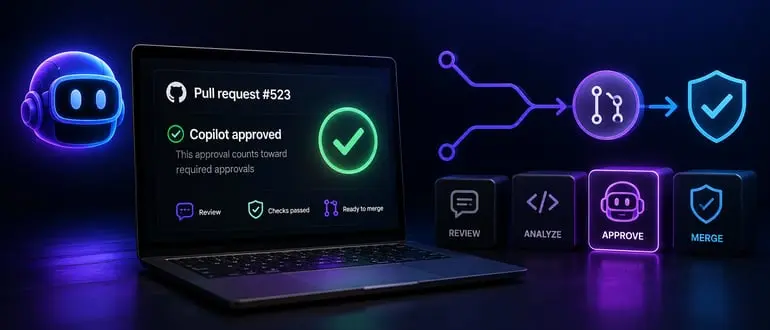
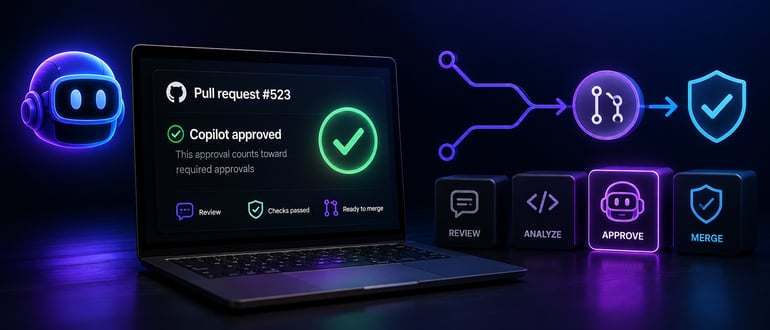
That fundamental division has officially ended. GitHub has announced a paradigm-shifting capability for GitHub Copilot: the ability to submit formal, binding approvals on pull requests (PRs). When enabled by administrative oversight, Copilot’s sign-off now counts directly toward a repository’s required-approvals rule, carrying the identical regulatory and structural weight as an approval from a human senior engineer.
This transition transforms Copilot from an advisory sidekick into an authoritative stakeholder within the software development lifecycle (SDLC). While the feature introduces unprecedented efficiencies for engineering teams choked by code review bottlenecks, it also forces a radical re-evaluation of developer governance, accountability, and trust. As artificial intelligence steps across the threshold from advice to authority, enterprise leaders must grapple with a profound question: How much operational power are they willing to delegate to a system that cannot be fired, cannot sit in a post-mortem retro, and bears no direct liability when a critical system fails in production?
Detailed Chronology of the Update
To understand the magnitude of this release, one must trace its recent evolutionary path. The introduction of automated approvals did not happen in a vacuum; it is the culmination of a deliberate, multi-stage expansion of Copilot’s operational footprint within the GitHub ecosystem.
Late August: Removing the Barriers
Just weeks prior to the approval announcement, GitHub quietly removed one of the most significant operational constraints on its AI tooling: the long-standing 300-file and 20,000-line size cap on automated code reviews. By lifting these restrictions, GitHub enabled Copilot to analyze massive, enterprise-scale pull requests in their entirety rather than forcing piecemeal reviews.
Simultaneously, coverage was extended to pull requests initiated not just by human developers, but also by third-party bots and Copilot’s own autonomous cloud agents. This laid the necessary groundwork for an automated ecosystem capable of reviewing and validating work generated by other automated systems—a closed-loop development cycle that made eventual approval authority the logical next step.
The Mechanism of Action
Under the current public rollout—which spans Copilot Pro, Pro+, Business, and Enterprise plans—every Copilot code review continues to conclude with its traditional overview comment. However, this comment now houses a critical new component: an explicit approval assessment.
By default, this assessment acts as a recommendation rather than a mandate. It simply communicates the AI’s reading on whether a pull request is mathematically and structurally sound enough to merge. However, once administrators alter the platform’s settings, that assessment transforms into a formal, binding approval that satisfies strict branch protection rules and clears the path for deployment.
Granular Guardrails and Controls
Recognizing the anxiety an autonomous sign-off mechanism might provoke among enterprise security teams, GitHub engineered a multi-tiered safety architecture:
- Opt-In Architecture: Approvals are strictly disabled by default. No organization will wake up to find Copilot rubber-stamping code across repositories without explicit, deliberate administrative intervention.
- Hierarchical Control: Administrative enforcement operates across three distinct tiers—enterprise, organization, and repository levels. Each layer possesses the authority to enable approvals outright, restrict them, or defer the decision downward to the next organizational level.
- File-Path Precision: Repository administrators gain granular control over where Copilot can exert its authority. Engineering teams can configure the system to restrict Copilot approvals strictly to low-risk areas—such as documentation files, test fixtures, and non-production configuration scripts—while ring-fencing critical components like authentication modules, cryptographic logic, and payment gateways exclusively for human eyes.
- The Reset Trigger: GitHub explicitly built in a behavioral safeguard mirroring human review standards: if a developer pushes a new commit after Copilot has issued an approval, that approval is instantly and automatically dismissed. Copilot cannot issue a blanket sign-off and ignore subsequent alterations; it must re-evaluate the modified codebase from scratch.
Supporting Context & Metrics: The Engineering Dilemma
The introduction of automated review authority arrives at a critical juncture for the software industry. Development teams are shipping code faster than ever before, largely propelled by generative AI coding assistants. Yet, this acceleration has created a massive bottleneck at the review stage. Human engineers are increasingly overwhelmed by the sheer volume of incoming pull requests, leading to rubber-stamped approvals driven by fatigue rather than rigorous inspection.
The Productivity-Governance Trade-Off
Engineering metrics consistently show that code review delays are among the primary sources of friction in modern CI/CD pipelines. When pull requests sit stagnant waiting for a senior developer’s bandwidth, velocity plummets. Copilot’s new approval capability promises to eliminate this bottleneck, particularly for routine updates, dependency bumps, and standard test coverage additions.
However, industry analysts warn of a dangerous trade-off: trading a review bottleneck for a governance gap.
"Teams that skip staged rollouts and flip approvals on everywhere at once are trading a review bottleneck for a governance gap, and they may not notice the trade until a catastrophic incident forces the conversation."
Without deliberate instrumentation, organizations risk blindly trusting AI-generated assessments. Unlike human reviewers, who build institutional knowledge through team retrospectives, code ownership, and shared scars from production outages, an AI model operates entirely on statistical probability and pattern matching. If an organization fails to monitor the accuracy of Copilot’s approvals against post-merge bug disclosures, the feature ceases to be a productivity enhancer and becomes a systemic vulnerability.
Official Industry Statements & Expert Perspectives
The gravity of GitHub’s announcement has sparked intense debate among industry analysts, chief information officers, and software lifecycle engineering experts.
Mitch Ashley, Vice President and Practice Lead for CIO & Technology Buyers and Software Lifecycle Engineering at The Futurum Group, offers a sharp analysis of what this transition means for the enterprise:
"Approval is where code review stops being advice and becomes authority, and GitHub just moved Copilot across that line," Ashley observes. "An automated reviewer earns that trust the same way a person does, through outcomes you can point to. Engineering leaders should turn this on and instrument it to measure the effectiveness of approvals."
Ashley’s emphasis on instrumentation highlights a critical blind spot in the current product rollout: GitHub provides the mechanism for automated approval, but it does not supply the dashboards required to audit its performance. If an engineering organization treats Copilot’s approval as legally and operationally equivalent to a human sign-off, leadership must independently construct telemetry systems to track:
- The false-positive and false-negative rates of Copilot-approved pull requests.
- The frequency with which human developers discover bugs after Copilot has signed off.
- Whether the pursuit of review velocity is systematically degrading the depth and quality of code inspections.
Furthermore, security architects emphasize that compliance frameworks—such as SOC 2, ISO 27001, and HIPAA—rely heavily on the concept of "segregation of duties" and human oversight. While automated linters and security scanners have long played a role in CI/CD pipelines, granting an AI model the formal authority to bypass branch protection rules forces compliance officers to rewrite their definitions of human-in-the-loop verification.
Future Outlook: The Autonomous CI/CD Pipeline
The rollout of Copilot code review approvals is not an isolated feature update; it is a foundational milestone pointing toward a radically automated future for software engineering. GitHub is clearly positioning Copilot not merely as a chatbot interface inside an IDE, but as an active, permissioned citizen of the development pipeline.
Strategic Roadmap for Engineering Leaders
To navigate this new era successfully, forward-thinking engineering organizations are adopting a phased, highly disciplined playbook:
- Phase 1: Zero-Risk Confinement. Enable Copilot approvals exclusively for non-production artifacts—internal documentation, README files, automated test suites, and mock data. Evaluate the system’s propensity for hallucinations or missed edge cases in a zero-consequence environment.
- Phase 2: Quantitative Telemetry. Build internal dashboards to measure review speed, accuracy, and downstream defect injection rates. Treat Copilot like a junior engineer on probation: grant trust incrementally based on verifiable metrics.
- Phase 3: Domain-Specific Expansion. Gradually extend approval authority to repetitive, low-risk production changes—such as minor dependency updates or localized styling tweaks—while maintaining an unbreakable human wall around core business logic, data models, and security infrastructure.
The Ultimate Destination
As artificial intelligence matures within the enterprise, the question facing software teams is no longer if AI will govern the codebase, but how humans will maintain oversight over an increasingly autonomous machine workforce.
By crossing the line from advisor to approver, GitHub has initiated a profound transformation in how software is validated and deployed. The organizations that thrive in this new landscape will not be those that blindly surrender control to machine intelligence, nor those that stubbornly cling to obsolete manual workflows. Rather, they will be the organizations that establish rigorous boundaries, demand verifiable telemetry, and treat AI governance with the same seriousness they afford human engineering management.
The era of automated authority has arrived. The safeguards, boundaries, and metrics must now catch up.