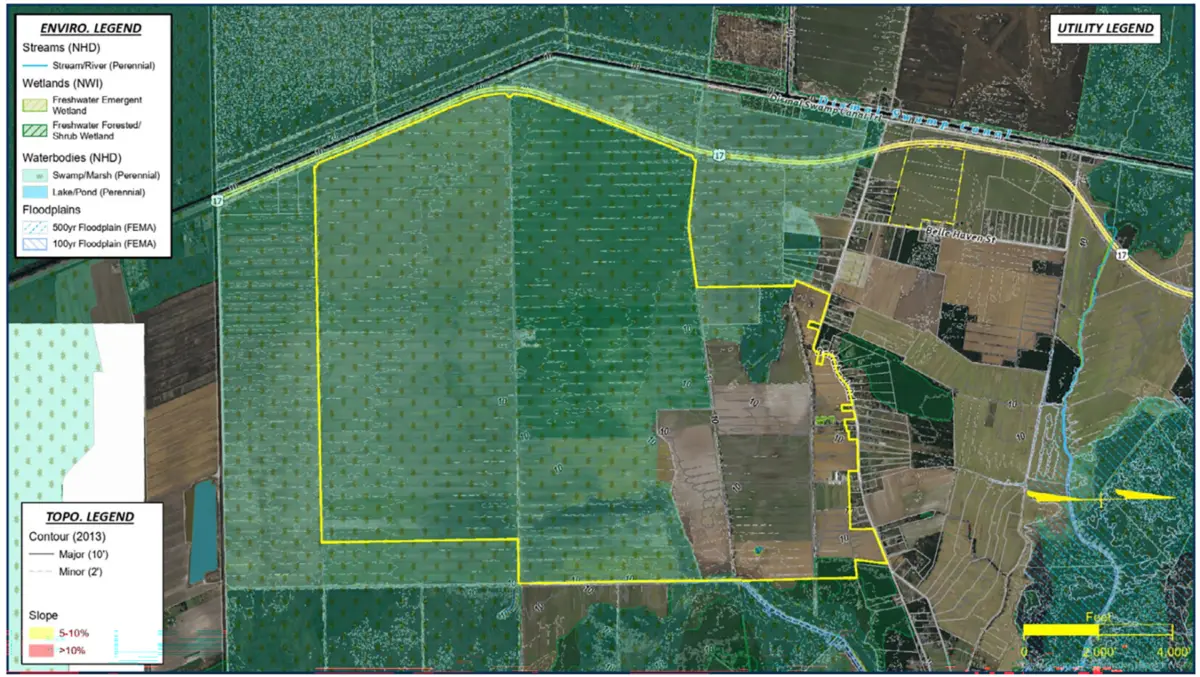
CHESAPEAKE, Va. — In the high-stakes arena of industrial site selection, few properties command the immediate intrigue—or the systemic complexity—of the Coastal Virginia Commerce Park. Spanning roughly 4,000 acres near the North Carolina border along US Route 17, this sprawling tract is poised to change hands following Praetorian Fund’s planned acquisition. Yet, despite widespread speculation linking the massive property to the booming data center sector, neither the developer nor municipal authorities have identified a specific project, tenant, or customer for the land.
The transaction highlights a critical tension in modern commercial real estate development: the chasm between a property’s broad regulatory permissions and the concrete commitments required to power and build modern digital infrastructure. While data centers are an explicitly permitted use under the site’s existing framework, the lack of a publicly declared customer leaves local officials, utility providers, and community advocates navigating a landscape defined as much by what is unknown as what has already been planned.
As Chesapeake works to tighten its citywide zoning rules regarding massive utility consumers, the Praetorian acquisition serves as a case study in the intersection of speculative land banking, municipal economic development strategy, and the skyrocketing power demands of the 21st-century economy.
Executive Overview
The planned acquisition by the Praetorian Fund brings renewed attention to a multi-decade effort by the City of Chesapeake to establish a premier regional megasite. Originally conceived to capture massive advanced manufacturing projects—ranging from automotive assembly lines to electric-vehicle battery plants—the Coastal Virginia Commerce Park offers a scale rarely found in the Mid-Atlantic region.
However, the shifting dynamics of industrial real estate have placed data centers squarely in the conversation. Under current Planned Unit Development (PUD) guidelines established in 2022, data centers are fully authorized uses within the park. This regulatory green light exists even as Chesapeake’s City Council moves forward with a sweeping package of zoning amendments and draft policies designed to exercise tighter municipal control over power-intensive computing facilities.
The core narrative of the Chesapeake megasite is built on three pillars:
- Existing Entitlements: The site’s PUD framework allows for data center construction without requiring an initial comprehensive rezoning.
- Pre-Existing Utility Planning: Years of preliminary discussions between the city, Dominion Energy, and local utilities have mapped out potential infrastructure pathways, though not specifically for a 100+ megawatt data center load.
- Corporate Confidentiality: Bound by non-disclosure agreements, Praetorian Fund has kept its long-term master plan under wraps, leaving municipal leaders unbriefed on specific electric loads, water demands, or prospective tenants.
This convergence of factors has created a regulatory vacuum where data centers are legally possible, infrastructure planning is theoretically underway, yet tangible commitments remain entirely absent.
Detailed Chronology: From Municipal Ambition to Private Acquisition
To understand the current state of the Coastal Virginia Commerce Park, one must trace the timeline of municipal efforts that predate Praetorian’s involvement by years. The property’s trajectory is a testament to the long-term, iterative nature of megasite development.
The Early Pursuit and Manufacturing Aspirations (2018–2021)
Long before Praetorian set its sights on the property, Chesapeake city officials recognized the strategic value of assembling a massive, contiguous industrial footprint near the North Carolina border. Around 2021, the city positioned the commerce park as a finalist for several high-profile economic development projects, including major automotive manufacturing plants and EV battery production facilities.
During this phase, the primary utility focus was on heavy manufacturing requirements: heavy rail accessibility, robust freight corridors, and substantial water and wastewater capacities. When those competitive bids ultimately went to other regions, Chesapeake did not abandon the site. Instead, municipal leaders continued to refine the property’s infrastructure blueprint, initiating speculative consultations with Dominion Energy, Columbia Gas, and the city’s internal utility departments to determine how to extend necessary services into the largely rural expanse.
The Municipal Purchase Attempt and Cost Realities
At one point, Chesapeake’s ambitions for the site went beyond facilitation; the city actively pursued direct acquisition of the property to bring it under municipal control. Vice Mayor S.Z. “Debbie” Ritter noted that the city once had the property under contract.
However, the prohibitive economics of the endeavor brought the deal to a halt. Stephen Wright, Chesapeake’s economic development director, confirmed that the contemplated purchase relied heavily on financial participation from the Commonwealth of Virginia—participation that ultimately failed to materialize.
Estimates suggested that acquiring the land and pushing the required heavy infrastructure to the remote site could easily exceed $150 million. Unwilling to obligate local taxpayers to such an immense fiscal burden without significant state backing, Chesapeake walked away from the contract. This history underscores a vital reality: the infrastructure and utility strategies associated with the commerce park are deeply institutional, having been shaped by years of municipal planning rather than originating solely with Praetorian’s impending purchase.
The Shift Toward Modern Digital Infrastructure
As traditional manufacturing bids slowed, the economic development landscape shifted dramatically. The explosion of generative AI, cloud computing, and hyperscale digital infrastructure created an unprecedented wave of demand for large-scale land parcels across Northern Virginia and its surrounding corridors.
While Chesapeake’s earlier site-development work focused on smokestack industries, the existing 2022 PUD guidelines quietly accommodated data centers as a permitted use. This foresight—or loophole, depending on one’s perspective—has positioned the 4,000-acre site as a prime target for digital real estate funds like Praetorian, even as the city attempts to recalibrate its broader regulatory framework for computing facilities.
Supporting Context & Metrics: Navigating Scale and Power
Evaluating a 4,000-acre industrial megasite requires a granular look at acreage, zoning breakdowns, and utility metrics. The scale of the Coastal Virginia Commerce Park offers unique opportunities, but it also presents severe infrastructure hurdles.
Acreage and Zoning Framework
- Total Land Area: Approximately 4,000 contiguous acres situated along US Route 17 near the border of North Carolina.
- Entitled Acreage: Roughly 1,420 acres have already been formally rezoned under the site’s established Planned Unit Development (PUD) framework.
- Flexibility of Scale: The sheer size of the footprint allows Praetorian to pursue a mixed-use industrial strategy, potentially dividing the park among multiple advanced manufacturing plants, logistics hubs, and potentially digital infrastructure projects, rather than confining the entire tract to a single user.
The Power Paradigm: Speculation vs. Commitment
A central debate surrounding the Praetorian acquisition involves the distinction between site readiness and customer commitment.
According to Stephen Wright, city discussions with Dominion Energy regarding the commerce park’s electrical capacity have been ongoing for years. Municipal officials have frequently taken the stated power requirements of prospective industrial inquiries to Dominion, asking a fundamental question: "If we put this user on the site, can you deliver the load?"
In many cases, the projected load requirements of these prospective inquiries conceptually exceed what is currently available at the perimeter of the property. Consequently, unlocking the site’s full potential will necessitate substantial capital investment in transmission lines and localized substations.
However, Wright clarified that the vast majority of inquiries fielded by the city have come from manufacturing companies, whose electrical load requirements are vastly different from those of modern hyperscale data centers. When asked if any prospective user had formally requested 100 megawatts (MW) or more—a standard threshold for large-scale data center campuses—Wright responded, "I don’t think so."
This distinction is reinforced by Neil Osnato, founder of Persistence Analytics Group, who emphasizes the gap between infrastructure planning and actual execution:
"The most important distinction is between designing a megasite capable of receiving extraordinary load and having an executable large-load customer already committed to it. The site’s infrastructure history is consistent with preparation for major industrial development, but customer-specific utility planning would provide stronger evidence of an actual project."
Official Statements and Regulatory Tightening
As Praetorian prepares to finalize its acquisition, Chesapeake’s municipal government is caught in a delicate balancing act. On one hand, the city has spent a decade marketing the site for massive industrial growth; on the other hand, elected officials are facing mounting pressure from residents to institute stricter oversight over data center expansion.
Local Leadership in the Dark
Despite the sweeping implications of a 4,000-acre transfer, local representatives maintain they have been kept at arm’s length regarding Praetorian’s specific intentions.
Vice Mayor S.Z. “Debbie” Ritter confirmed that she has not been briefed on an intended use for the property, nor has she been informed of any prospective user’s projected electric load. Crucially, Ritter noted that there have been zero substantive discussions with Dominion Energy regarding the construction of a new electrical substation or high-voltage transmission lines specifically dedicated to serving a Praetorian-backed project on the site.
Furthermore, while city officials were aware that Praetorian was in active negotiations with the property’s previous owners prior to the public announcement, municipal disclosures remain legally constrained. Wright noted that the city is bound by a non-disclosure agreement (NDA) with Praetorian, limiting the public release of proprietary development details.
The Citywide Regulatory Push
The timing of the acquisition coincides with a broader legislative effort by Chesapeake to overhaul its approach to data centers. In January, the City Council initiated a comprehensive zoning amendment designed to address the intensive utility needs and appropriate spatial siting of computing facilities.
Under the proposed zoning changes slated for City Council consideration on August 18, data centers would transition from broad allowances to conditional uses within specified industrial districts and the Fentress Airfield Overlay District.
Complementing these zoning adjustments is a draft data center policy released in June, which mandates rigorous, multi-faceted reviews of:
- Total electrical load and grid impact
- Water and wastewater consumption (particularly regarding cooling systems)
- Noise pollution and acoustic mitigation
- Proximity to transmission corridors (preferring sites within 0.5 miles of existing infrastructure to minimize the environmental footprint of new high-voltage lines)
However, a major legal and regulatory hurdle remains: the existing PUD guidelines at the Coastal Virginia Commerce Park predate these stricter municipal policies and explicitly permit data centers. This creates a complex legal precedent where citywide policy updates may clash with pre-approved PUD entitlements embedded within the commerce park’s master plan.
Community Opposition and Environmental Concerns
The prospect of heavy industrialization at the commerce park has not gone unchallenged. From the moment Chesapeake first targeted the area for megasite development, local environmental groups and community members have mounted organized resistance.
Jeff Staples, a leading voice with the local advocacy group Save the Dismal, has opposed development at the site since 2015. Speaking on behalf of the coalition, Staples expressed persistent skepticism regarding the new ownership structure.
"We still oppose the construction of a megasite or anything industrial there," Staples said, adding that the group was entirely caught off guard by Praetorian’s acquisition announcement and has not engaged in recent dialogues with the city, the developer, or Dominion Energy.
Staples pointed out a unique historical irony in the local debate: data centers were not a primary talking point when community opposition first mobilized against the megasite a decade ago.
"Data centers were never a concern until recently," he noted.
Beyond digital infrastructure concerns, community advocates continue to raise alarms regarding the astronomical fiscal costs of extending public municipal services—such as natural gas, heavy sewer lines, and advanced water treatment facilities—into a largely undeveloped ecological corridor near protected wetlands. Critics argue that the infrastructure investments required to service the site could place an unfair financial burden on local taxpayers, echoing the very concerns that caused Chesapeake to abandon its own municipal purchase attempt years prior.
Future Outlook: What Lies Ahead for the Chesapeake Megasite?
As the August 18 City Council meeting approaches, the future of the Coastal Virginia Commerce Park hangs in a delicate balance. The intersection of a major private equity acquisition, established PUD entitlements, and aggressive new municipal data center policies has set the stage for a contentious planning phase.
Key Questions for the Horizon:
- Will Praetorian Pursue Digital Infrastructure? While data centers remain an authorized use under current guidelines, Praetorian has yet to confirm whether its master plan includes hyperscale computing, advanced manufacturing, or a hybrid industrial model.
- How Will the PUD Interact with New Zoning Rules? Legal analysts will be watching closely to see whether Chesapeake’s newly proposed conditional use restrictions and draft data center policies can override or constrain the pre-existing entitlements held within the commerce park’s PUD framework.
- Can the Grid Keep Pace? Even if a major tenant steps forward, the fundamental bottleneck remains electrical capacity. Without formal commitments and multi-year infrastructure investments from Dominion Energy, transforming the rural acreage into an active digital or manufacturing powerhouse will remain a conceptual exercise rather than a reality.
For now, the public record offers three undeniable truths: the site possesses the regulatory pathway for data center development; Chesapeake has spent years evaluating utility frameworks for large-scale industrial users; and Praetorian Fund is keeping its cards close to its chest. Until the developer unveils its definitive blueprint, the Coastal Virginia Commerce Park remains one of the most intriguing, high-stakes question marks in American industrial real estate.