By Shane Snider | Senior News Writer, Data Center Knowledge
September 2, 2026 | 4 Min Read
Executive Overview
As artificial intelligence workloads sweep across the global economy, the bottleneck for hyperscale technology companies is expanding far beyond local power grids and regional data center campuses. The infrastructure race has officially moved to the oceans.
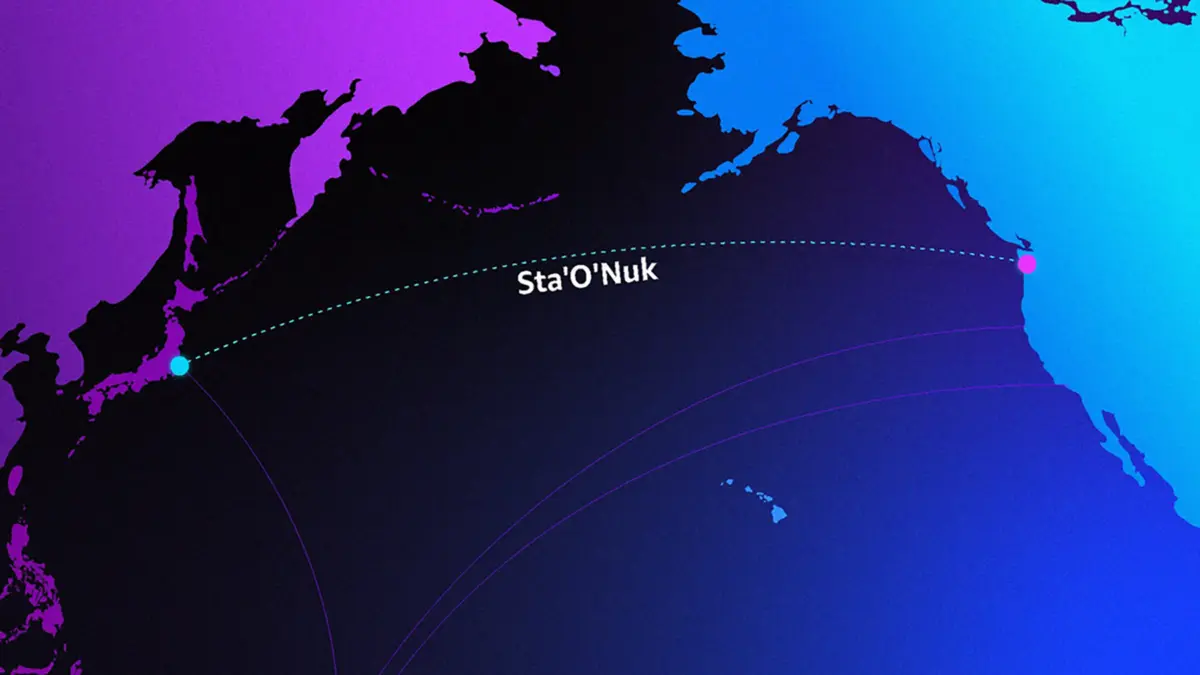
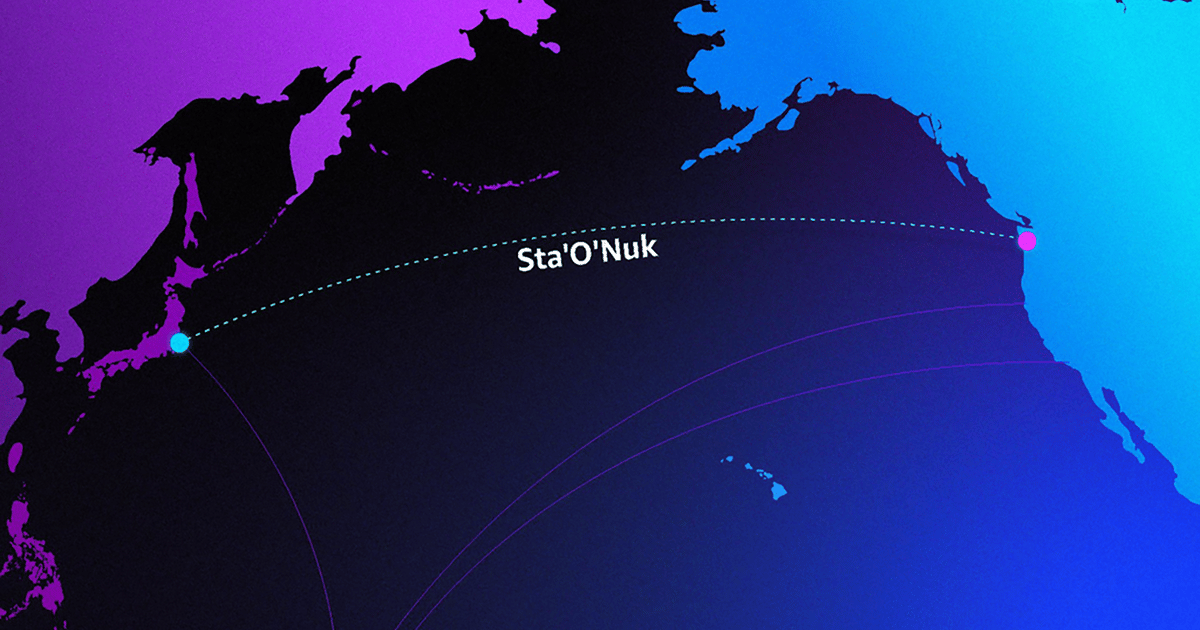
In a landmark move that highlights the rapidly escalating demands of next-generation computing, Amazon Web Services (AWS) has announced plans to construct the Sta’O’Nuk subsea cable—a high-capacity, 420 Terabits per second (Tbps) trans-Pacific fiber-optic link connecting Japan to the state of Washington.
Slated to enter commercial service in 2029, the Sta’O’Nuk system represents a critical milestone in global digital infrastructure. Engineered with 20 distinct fiber pairs, the cable is specifically designed to handle the heavy, low-latency data transport required by bandwidth-intensive, distributed artificial intelligence applications, including large language model (LLM) training, real-time financial trading, high-performance edge computing, and ultra-high-definition video streaming.
Crucially, the project introduces a brand-new United States landing corridor in Ocean Shores, Washington. Developed in partnership with Toptana Technologies—an Indigenous-owned telecommunications infrastructure company wholly owned by the Quinault Indian Nation—this landing station breaks a 25-year drought for trans-Pacific cable arrivals in Washington State. By diversifying U.S. landing points away from the congested California and Oregon coasts, AWS is establishing a resilient network backbone to support the massive influx of data center capacity taking shape across the Pacific Northwest.
Detailed Chronology and Project Evolution
The development of the Sta’O’Nuk cable and its associated terrestrial infrastructure is the culmination of years of strategic planning by AWS, Toptana Technologies, and their ecosystem of partners.
1999–2026: The Washington State Hiatus
For over a quarter of a century, Washington State sat largely dormant on the map of new trans-Pacific subsea cable developments. According to historical industry data from Data Center Dynamics, the last major subsea cables to make landfall in Washington were laid in 1999: the Pacific Crossing-1 (PC-1) system landing at Harbour Pointe, and the Alaska United East cable connecting the Pacific Northwest directly to Alaska. Since then, the overwhelming majority of trans-Pacific subsea cables have concentrated their U.S. landings along established corridors in Central and Southern California, as well as Oregon.
The Birth of Toptana Technologies
Recognizing an opportunity to revitalize the Pacific Northwest as a primary gateway for international data, the Quinault Indian Nation established Toptana Technologies. Partnering with strategic program manager and operations service provider Assured Communications, Toptana set out to build a world-class cable landing station in Ocean Shores, Washington. Designed from the ground up to accommodate up to four subsea cable systems initially—with structural provisions for future expansion up to 16 cable vaults—the facility bridges the physical gap between international marine fiber and high-speed terrestrial networks.
The 2026 Announcement and 2029 Target
Announced in September 2026, the AWS Sta’O’Nuk project solidifies the Ocean Shores station as a premier landing site. With construction planning underway, project teams are mapping out deep-water burial paths, engineering horizontal directional drilling (HDD) strategies for the shoreline, and coordinating terrestrial backhaul routes. The system is scheduled for completion and commercial readiness by 2029, aligning with projected multi-year expansions in global hyperscale AI architecture.
Supporting Context & Metrics: The Mechanics of Modern Subsea Networks
To understand the sheer magnitude of the Sta’O’Nuk project, one must examine the metrics governing modern subsea cable engineering and the macroeconomic forces driving hyperscale network investments.
Technical Specifications and Resilience
The Sta’O’Nuk cable is not merely a high-bandwidth pipe; it is a fortress of modern optical and physical engineering:
- Total Bandwidth Capacity: 420 Tbps, enabling seamless multi-terabit data flows across the Pacific basin.
- Fiber Architecture: Built utilizing 20 fiber pairs to maximize multiplexing capabilities and redundancy.
- Security Layers: AWS has integrated quantum-safe optical encryption at Layer 1, MACsec security at Layer 2, and standard transport protocols (TLS, SSL, and QUIC) at Layer 4.
- Physical Protection: Recognizing industry estimates that roughly 200 subsea cable cuts occur worldwide each year—predominantly driven by commercial fishing activities and dragging ship anchors—AWS has designed the cable to be heavily armored and buried at depths reaching up to 1,500 meters in vulnerable offshore areas. Horizontal directional drilling will be heavily utilized near the shoreline to protect the asset from surf and human activity.
The Shifting Economics of Hyperscale Networks
According to Jimmy Yu, vice president at Dell’Oro Group, hyperscalers were already the primary consumers of subsea capacity long before the current generative AI boom took hold. However, the explosive rise of AI has transformed network infrastructure from a background utility into a core strategic differentiator.
"Even before the rise of AI investments, hyperscalers were among the primary consumers of subsea cables and capacity," noted Yu. "The surge in AI demand should further drive demand for both terrestrial and submarine networks."
Yu emphasizes that AWS’s deliberate selection of Washington State underscores a broader industry trend: the necessity of connecting subsea infrastructure directly to major inland data center hubs. This strategy simultaneously improves end-to-end connectivity, introduces vital route diversity, and enhances overall network resilience against regional disruptions.
Official Statements and Industry Insights
Industry analysts agree that as AI compute models scale into the hundreds of billions of parameters, the constraints facing operators will extend past municipal power availability to include network backhaul and interconnect capacity.
The Interconnect Bottleneck
Ron Westfall, vice president and practice lead for networking and infrastructure at HyperFrame Research, points out that distributed training clusters and inference locations demand unprecedented terabit-scale data transport.
"Large AI models can require terabit-scale data transport between distributed training clusters and inference locations," Westfall explained. "As hyperscalers spread computing across regions, network backhaul and interconnect capacity could become a constraint alongside power availability."
While a data center’s geographic footprint is often dictated by where utility providers can supply multi-hundred-megawatt blocks of power, the network infrastructure dictates how effectively those power-dense facilities communicate with other global computing hubs, cloud regions, and enterprise customers.
Indigenous Leadership in Telecom Infrastructure
The collaboration between AWS and Toptana Technologies also marks a historic milestone in Indigenous enterprise ownership within the telecommunications sector. By developing the Ocean Shores landing station as an Indigenous-owned facility, the Quinault Indian Nation is positioning its sovereign lands at the epicenter of trans-Pacific digital trade.
Furthermore, Toptana’s terrestrial deployment strategy—routing high-capacity fiber along the Interstate 5 (I-5) corridor down to major data center markets in Seattle, Washington, and Hillsboro, Oregon—ensures that international traffic landing on the Washington coast can be rapidly and efficiently ingested into the Pacific Northwest’s robust peering ecosystems.
Future Outlook: The Total Infrastructure Stack for the AI Era
As the technology sector looks toward the close of the decade, projects like the Sta’O’Nuk subsea cable provide a clear window into how hyperscalers are redefining their capital expenditure strategies.
Building an AI-ready enterprise no longer stops at the walls of a data center shell. Today’s digital infrastructure stack requires a synchronized expansion across four distinct pillars:
- Power Generation and Transmission: Securing baseload and renewable energy supplies (including nuclear, geothermal, and advanced solar/storage) to feed massive campus loads.
- On-Campus Compute Capacity: Deploying liquid-cooled server racks packed with advanced accelerators and GPUs.
- Terrestrial Fiber Backhaul: Constructing high-density, low-latency terrestrial routes connecting remote or coastal facilities to metropolitan peering points.
- International and Trans-Oceanic Connectivity: Deploying ultra-high-capacity subsea cables—like AWS’s 20-pair, 420 Tbps system—to link global compute regions seamlessly.
AWS’s massive investment in the Pacific Northwest demonstrates that the network is no longer a secondary consideration; it is an active, vital component of the AI buildout. By combining a cutting-edge trans-Pacific cable, a newly established Washington landing station, and robust inland backhaul, AWS is laying the physical tracks for the next generation of global digital intelligence.