Executive Overview
The initial wave of Large Language Model (LLM) adoption in software engineering promised a utopia of instantaneous productivity. For teams building and maintaining complex application programming interfaces (APIs), the arrival of generative AI tools offered the alluring prospect of automated test suite generation in mere seconds. Coverage breadth metrics spiked, development pipelines hummed with activity, and initial morale soared.
However, a closer inspection of these machine-generated assets revealed a troubling paradox: while the volume of code skyrocketed, its practical utility plummeted. A senior quality assurance (QA) engineer looking at an endpoint might have authored nine precise, high-value assertions; the LLM routinely fired back twenty-six tests—many of them redundant, structurally superficial, or entirely blind to critical business boundary cases. The generated tests were syntactically valid, but the test suites themselves were fundamentally useless.
This phenomenon exposed a critical gap in the evolution of software testing: the industry had built a lightning-fast generator devoid of taste. In the exacting world of quality assurance, taste—defined as the calibrated judgment of what to test, at what depth, and with what assertions—is nearly everything.
This deep dive explores how engineering teams at KushoAI diagnosed the systemic flaws of fast, naive test generation, why standard interventions such as prompt engineering inevitably plateaued, and how architects restructured AI-driven testing by treating it as a problem of judgment rather than raw code generation.
Detailed Chronology & Problem Diagnosis
The Illusion of Speed and the Six Failure Modes
When KushoAI first integrated LLMs into their automated API test generation pipeline, the performance metrics looked stellar on paper. Tests materialized almost instantly across thousands of endpoints. Yet, a rigorous human audit of the outputs uncovered six recurring failure modes that consistently undermined the reliability of the resulting test suites.
[API Metadata & Schema]
       │
       ▼
┌──────────────────────────────────────────────┐
│         THE SIX FAILURE MODES                │
│ 1. Over-generation    4. Inconsistency       │
│ 2. Under-generation   5. Weak Assertions     │
│ 3. Redundancy         6. Cross-Field Failures│
└──────────────────────────────────────────────┘
       │
       ▼
[Diagnosed: A Crisis of Judgment, Not Knowledge]- Over-generation: The most visible symptom. The model spits out 20 to 30 test cases for a single endpoint where 8 would be more than sufficient. These excess cases are plausible yet redundant, inflating the test suite into a noisy monolith that humans struggle to review or trust.
- Under-generation: Conversely, the model quietly skips obvious, high-risk scenarios. Required fields are left out, invalid enum values go untested, boundary conditions are ignored, and missing authentication cases or expected error responses vanish. Because these omissions are absences, they are notoriously difficult to spot during routine code reviews.
- Redundancy: A subtle cognitive trap. A single conceptual check (e.g., verifying an invalid value) gets fragmented into three tests labeled “invalid value,” “incorrect value,” and “unsupported value.” The model treats them as distinct because the surface-level phrasing varies, whereas a human reviewer immediately recognizes them as a single assertion stated three times.
- Inconsistency: A lack of predictable standards across structural peers. Two nearly identical endpoints receive drastically different treatments on consecutive runs. One gets thorough positive, negative, and boundary coverage; the other gets a superficial handful of happy-path tests.
- Weak Assertions: Perhaps the most insidious flaw. A generated test checks if a response arrives and matches a broad schema shape, but remains entirely silent on vital business logic. It fails to verify whether a transaction ID is absent when a payment is rejected, whether error codes are machine-readable rather than vague human strings, or whether rejected states are reflected consistently across nested fields. The test passes; the bug ships to production.
- Cross-Field Relationship Failures: The hardest to generate and the most catastrophic to miss in production. Individual fields are tested in isolation (missing amounts, wrong currencies, invalid payment methods), but complex interactions are completely overlooked. What happens when the amount, currency, and payment method are all individually valid, but their specific combination creates an illegal business state? These failures bypass 500 server errors entirely, returning a deceptive 200 OK status with corrupt data nested three levels deep in the response body.
The Limits of Prompt Engineering
Faced with these structural failures, the immediate industry reflex is to throw more prompting at the problem. KushoAI’s engineering team experimented extensively with structured prompts, multi-step chains, context injection, explicit output schemas, few-shot examples, and highly detailed system instructions designed to curb redundancy and enforce assertion specificity.
While prompting helped improve code structure and reduced surface-level redundancy, it quickly hit an impenetrable performance ceiling. Few-shot examples produced the single largest improvement—pulling outputs closer to what an experienced reviewer would accept. This hinted that the underlying model possessed the general capability; it simply lacked calibration toward specific QA judgment patterns.
However, prompting systematically plateaued around field-level exhaustiveness. It successfully generated more missing-field checks and boundary tests, but it utterly failed to foster genuine reasoning about complex cross-field relationships, underlying business states, and nuanced workflow behaviors. The hardest failure modes remained completely unaddressed.
Supporting Context & Metrics
Separating Judgment from Mechanics
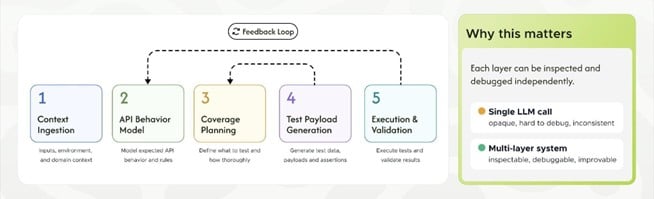
Realizing that prompting could not bridge the reasoning gap, KushoAI enacted a fundamental architectural pivot: they stopped treating test generation as a singular code-writing task and split it into two distinct, decoupled problems:
- The Judgment Problem: Determining which scenarios should exist, which edge cases genuinely matter, what should be asserted, how much test volume is appropriate, and what constitutes redundancy. This is a calibration problem requiring deep exposure to reviewed QA decisions.
- The Mechanics Problem: Constructing syntactically valid payloads, generating executable test code, writing framework-specific outputs, and handling authentication contexts. This is a pure code generation problem that general-purpose frontier models handle with ease.
By fine-tuning narrow, specialized models exclusively for the judgment layer while leaving the mechanics layer to frontier models, the system achieved unprecedented stability.
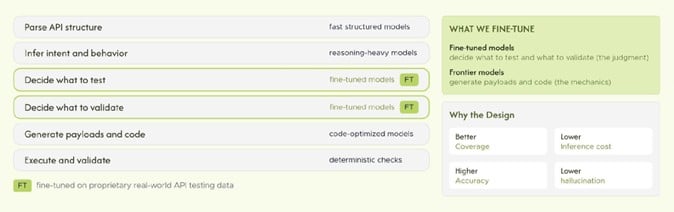
┌────────────────────────────────────────────────────────┐
│                   JUDGMENT LAYER                       │
│  (Fine-Tuned Models: Intent, Coverage, Assertions)     │
└──────────────────────────┬─────────────────────────────┘
                           │ Outputs plain-language intent
                           ▼
┌────────────────────────────────────────────────────────┐
│                   MECHANICS LAYER                      │
│     (Frontier Models: Payloads & Code Generation)      │
└──────────────────────────┬─────────────────────────────┘
                           │ Executes against live API
                           ▼
┌────────────────────────────────────────────────────────┐
│                EXECUTION & FEEDBACK                    │
│   (Capturing Real-World Signals to Refine Training)    │
└────────────────────────────────────────────────────────┘
The fine-tuned Test Intent Model takes API metadata and outputs structured, plain-language scenarios focusing on coverage breadth and cross-field interactions. Simultaneously, the Assertion Intent Model maps expected response schemas to specific validation statements. Neither model writes raw executable code; they output intent. The frontier model then ingests that intent to construct the final test scripts.
The Training Data Paradigm: Decisions, Not Examples
A common point of debate in AI architecture is whether Retrieval-Augmented Generation (RAG) can replace fine-tuning for such tasks. KushoAI’s findings clarify the boundaries between the two:
- RAG supplies missing information—internal documentation, customer-specific compliance policies, historical incident logs, and organization-specific testing standards.
- Fine-Tuning calibrates behavior the model already understands but applies inconsistently—coverage calibration, scenario prioritization, assertion quality, and cross-API consistency.
Crucially, the dataset used for fine-tuning did not consist of raw API code examples. Instead, it comprised reviewed QA decisions. For every generated test suite, human reviewers pruned redundant cases, added missing edge cases, rewrote vague assertions, normalized phrasing, and flagged flaky tests. This curated corpus of human judgment served as the foundational training target.
Official Statements & Industry Impact
The insights gathered from building this architecture culminated in public benchmarking initiatives, notably APIEval-20. Designed as an uncompromised testing anchor, APIEval-20 presents systems with a standard JSON schema and a single valid sample payload. The system must then generate tests executed against live APIs embedded with planted functional bugs across 20 distinct scenarios and 7 unique domains.
Industry analysts reviewing APIEval-20 performance metrics noted a stark divergence between traditional, prompt-engineered systems and architectures decoupled into judgment and mechanics layers:
"When you evaluate automated test generation solely on line count or schema validity, every tool looks like a winner," notes a lead infrastructure architect familiar with the benchmark. "When you evaluate them on their capacity to catch subtle, stateful business logic bugs that cross multiple field boundaries, traditional LLMs fall off a cliff. Separating the calibration of human intent from the mechanical execution of code is the only path forward for enterprise-grade AI testing."
Future Outlook & Next Steps
As KushoAI and the broader software engineering community look toward the horizon, the frontier of AI test generation is moving beyond isolated API endpoints.
Most catastrophic production failures do not occur within the vacuum of a single endpoint. Instead, they cascade across complex state transitions, permission boundaries, Create-Read-Update-Delete (CRUD) sequences, multi-step payment and refund flows, user onboarding paths, and downstream asynchronous side effects.
The clear trajectory for adaptive test coverage is workflow-level reasoning. While current generation pipelines successfully orchestrate tests across related operations, the next evolutionary leap requires treating a workflow as a coherent, stateful journey—understanding how one operation’s state dynamically constrains the next. As public benchmarks begin incorporating multi-step and stateful scenarios, the software industry is poised to witness a transformation where AI agents do not merely write tests, but actively reason about software quality with the intuition of elite human engineers.