Executive Overview
In the modern software development lifecycle, integration testing is often treated as a solved problem. For internal microservices and first-party APIs, traditional sandbox testing functions precisely as designed. Engineering teams define the service architecture, construct the requisite mocks, dictate exact return payloads, and establish a closed-loop system where outcomes are predictable and reproducible.
However, this foundational testing paradigm catastrophically breaks down the moment a system relies on external, third-party dependencies. Whether integrating payment processors, identity providers, SMS gateways, financial banking APIs, or complex shipping logistics, development teams routinely plug into external services they do not own, cannot fully inspect, and are powerless to replicate.
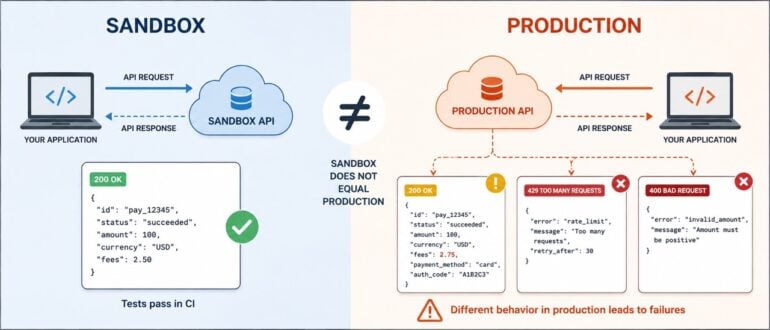
While third-party providers invariably furnish developer sandbox environments for pre-production validation, these environments are rarely true structural mirrors of production. Instead, they are independent simulations—often maintained on a deprioritized lifecycle track by providers whose primary engineering incentives lie elsewhere. The resulting delta between the simulated sandbox and the live production environment creates a silent technical debt. This gap is the birthplace of modern production incidents: tests pass with flying colors in Continuous Integration (CI) pipelines, only for real-world transactions to fracture upon deployment.
This investigative report examines the structural failures of third-party sandbox testing, deconstructs the hidden mechanics of "sandbox drift," and outlines the architectural shifts—from traffic capture-and-replay tools like Keploy to rigorous fixture version-control—that forward-thinking engineering organizations are adopting to insulate their production systems from external volatility.
Detailed Chronology: The Anatomy of a Sandbox Failure
To understand why traditional integration testing fails in API-heavy ecosystems, it is necessary to trace the lifecycle of a modern integration vulnerability—a phenomenon that typically unfolds over weeks or months of undetected divergence.
Phase 1: The Honeymoon Period (Day 1)
An engineering team sets out to integrate a critical third-party capability, such as a global payment gateway or an identity verification provider. They ingest the provider’s API documentation, configure their SDKs, write comprehensive integration tests against the provided sandbox environment, and verify that every test passes. At this stage, confidence is high. The sandbox returns expected response codes, authenticates tokens seamlessly, and mimics happy-path workflows cleanly.
Phase 2: The Silent Divergence (Weeks 1 to 12)
As months pass, the third-party provider continuously updates its production environment to patch vulnerabilities, optimize backend routing, roll out new commercial features, and comply with evolving regulatory frameworks. However, updating the isolated developer sandbox is invariably deprioritized.
- A payment provider updates its webhook payload structure in production to include granular fraud-scoring metrics, but neglects to update the sandbox documentation or schema for two months.
- Rate-limiting algorithms are tuned aggressively on live traffic nodes to defend against DDoS attacks, while the sandbox runs on a legacy, unthrottled cluster.
- Subtle shifts occur in authorization token expiration handling and cryptographic signature validation algorithms.
Throughout this period, the development team’s CI/CD pipeline continues to execute integration tests against the stagnant sandbox. Every test passes. The team remains blissfully unaware that their test suite is validating behavior against an alternate reality.
Phase 3: The Production Collision (Day N)
The team pushes a routine update to production. The code relies on an assumption validated by the sandbox—for instance, expecting a specific error code format when a credit card is declined, or anticipating a synchronous webhook response.
In production, the external API behaves according to its current, undocumented reality. The system fails to parse the new payload fields, mishandles an unannounced error code, or stalls indefinitely awaiting a webhook that is now dispatched asynchronously. An incident is declared, emergency hotfixes are deployed, and engineering hours are consumed diagnosing a discrepancy that had been quietly maturing in the shadows for weeks.
Supporting Context & Metrics: The Anatomy of Integration Complexity
Modern software architectures are increasingly compositional. Enterprises rarely build core infrastructure primitives from scratch; instead, they compose applications out of dozens of specialized SaaS APIs. This hyper-connected reality exposes engineering organizations to systemic risks that legacy testing methodologies were never designed to handle.
The Four Pillars of API Integration Vulnerability
An analysis of complex system failures reveals that integration breakdowns generally cluster around four distinct layers of friction:
+-------------------------------------------------------+
|             Behavioral Consistency Over Time          |  <-- No sandbox tracks historical regression
+-------------------------------------------------------+
|               Error Path & Failure Coverage           |  <-- Sandboxes focus on happy paths
+-------------------------------------------------------+
|                State & Side-Effect Management         |  <-- Shared test state causes intermittent flakiness
+-------------------------------------------------------+
|         Request & Response Shape Validation           |  <-- The baseline layer of schema matching
+-------------------------------------------------------+- Request and Response Shape Validation: At the most fundamental level, systems must correctly serialize outgoing requests and deserialize incoming responses. While sandboxes assist when current, they exacerbate failure modes when outdated schemas mask breaking changes.
- Error Path Coverage: Real-world systems must gracefully handle systemic degradation: HTTP 402 payment requirements, identity provider timeouts, malformed payloads, and out-of-order webhooks. Many third-party sandboxes treat the happy path as the absolute boundary of their simulation surface, making it nearly impossible to test disaster recovery mechanics deterministically.
- State Management and Side Effects: External integrations frequently leave stateful footprints within the provider’s ecosystem—audit logs, user records, webhook subscriptions, and ledger entries. When multiple test runs mutate shared sandbox state without clean isolation mechanisms, test suites suffer from intermittent, non-deterministic failures that defy easy diagnosis.
- Behavioral Consistency Over Time: Even if an API schema remains static, the underlying semantics can shift. A financial API might retain the exact same response schema while silently altering the underlying calculation logic for transaction fees or currency conversions. No static sandbox configuration accounts for these semantic drifts.
Official Statements and Industry Insights
Industry veterans and architectural researchers have increasingly spoken out against the over-reliance on provider-managed sandboxes, advocating for a shift toward locally governed verification strategies.
"Sandbox testing creates a dangerous illusion of safety," notes Dr. Aris Thorne, Principal Distributed Systems Architect at Enterprise Cloud Solutions. "When you test against a provider’s sandbox, you aren’t testing your integration against reality; you are testing your code against a ghost of what that API used to be, or what the provider hopes it might become. The moment you push to production, you are breaking containment."
Engineering leadership across major financial technology and SaaS platforms echo these sentiments. Internal post-mortem analyses consistently highlight third-party environment drift as a primary contributor to prolonged Mean Time to Resolution (MTTR) metrics during critical incidents.
Furthermore, tool-agnostic engineering circles are challenging the dogma surrounding contract testing. While frameworks like Pact provide robust schema validation across microservice boundaries, industry experts emphasize their fundamental limitations when applied to external vendors:
"Contract testing assumes both parties are willing and able to negotiate and maintain the contract," explains Elena Rostova, Director of Quality Engineering at FinTech Global. "When you are integrating with a Tier-1 identity provider or global payment rail, there is no negotiation. They change their API when they need to change it. Contract tests will tell you if the schema matches, but they are blind to the fact that the provider just altered the semantic meaning behind a boolean flag or modified their webhook delivery semantics."
Future Outlook: Approaches That Hold Up Under Real Conditions
As the software engineering community reckons with the limitations of traditional sandboxes, a new playbook for API-heavy system testing is emerging. Forward-thinking organizations are abandoning the pursuit of the "perfect sandbox" in favor of architectures that prioritize control, determinism, and recorded historical fidelity.
1. Shift from Simulation to Observation (Capture and Replay)
Rather than trusting a simulated provider sandbox, resilient engineering teams are anchoring their regression suites in observed reality. By capturing authentic API traffic—actual requests and responses generated during exploratory testing or controlled staging interactions—teams build a localized, immutable library of test fixtures.
Tools that specialize in HTTP traffic capture and replay (such as Keploy, Hoverfly, and WireMock in recording mode) allow developers to embed real-world behavior directly into their CI pipelines.
- Deterministic Execution: Tests run against recorded interactions rather than live or simulated endpoints, eliminating network flakiness and external downtime dependencies.
- Deliberate Evolution: When a provider updates its API, updating the test suite becomes an explicit, transparent code change. Fixtures are version-controlled alongside application logic, providing a crystal-clear audit trail for when and why an integration contract evolved.
2. Explicit Error Path Simulation
Reliable systems do not hope for failure conditions; they engineer for them. Instead of relying on provider sandboxes to spontaneously generate HTTP 500 errors, rate limits, or dropped connections, mature teams write explicit fixtures and mock behaviors for edge cases. By explicitly asserting how application code handles timeouts, malformed JSON, and truncated payloads, teams ensure robust error boundary behavior before code ever touches production.
3. Treating Fixtures as Code
The dirty secret of local mocking and recorded fixtures is maintenance debt. If fixtures are left unowned, they drift from production just as provider sandboxes do.
Industry leaders solve this by establishing strict ownership models. Fixture maintenance is tied directly to API client library version updates and product release cycles. When a third-party vendor publishes an API deprecation notice, updating the corresponding recorded fixtures is treated as a mandatory engineering task—placed on the backlog with the same urgency as security patches.
Conclusion
The era of trusting third-party sandboxes as the ultimate arbiter of integration quality is coming to a close. As software systems grow more interconnected and dependencies multiply, the hidden cost of sandbox drift—measured in production outages, emergency rollbacks, and eroded customer trust—has become unsustainable.
By recognizing that external sandboxes are inherently ephemeral simulations, engineering organizations can reclaim control over their integration testing strategies. Through the adoption of capture-and-replay tooling, version-controlled behavioral fixtures, and explicit failure-path testing, development teams can decouple their release cycles from the administrative whims of third-party providers, ensuring robust, predictable, and resilient software delivery in an increasingly complex API economy.