Executive Overview
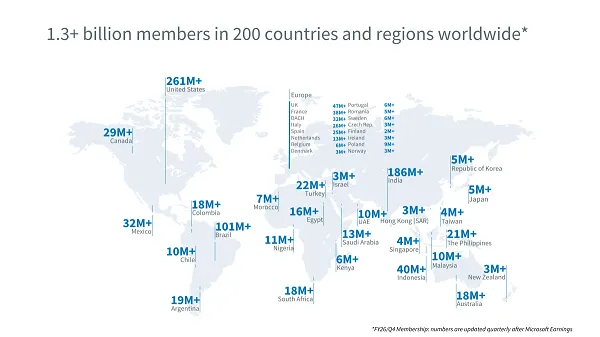
In the modern digital economy, the metrics platforms choose to highlight often reveal as much as the data they attempt to conceal. For years, professional networking behemoth LinkedIn—now deeply integrated into the Microsoft corporate ecosystem—has dazzled marketers, investors, and enterprise leaders with colossal topline figures. The platform routinely commands headlines by announcing milestones of 1.3 billion registered global members, painting a picture of an ever-expanding, unstoppable digital town square for the global workforce.
However, a closer examination of regulatory filings paints a markedly more nuanced—and perhaps more realistic—portrait of the platform’s health. According to LinkedIn’s latest compliance report under the European Union’s Digital Services Act (DSA) covering the first half of 2026, the platform added 1.4 million active users in the EU compared to the final six months of 2025, bringing its regional active user count to 56.5 million. While this represents steady, incremental growth, the real story lies in the vast chasm between LinkedIn’s total registered "members" and its genuinely "active users."
When juxtaposed with EU data, global membership metrics suggest that only about 30% of LinkedIn accounts are actively engaging with the platform. This metric has remained remarkably static over several reporting periods, challenging the narrative of explosive, compounding daily engagement. At the same time, LinkedIn is waging an aggressive internal war against synthetic interference. The platform reported a staggering 46% surge in the detection and enforcement of inauthentic activity during the first half of 2026 alone, as it fights to purge automated bots, engagement pods, and low-quality "AI slop" from professional feeds.
This deep-dive investigation analyzes LinkedIn’s trajectory through the lens of recent DSA data, exploring the structural realities of platform engagement, the widening gap between registered accounts and active participants, and the escalating battle to preserve authenticity in an era of generative artificial intelligence.
Detailed Chronology: Unpacking the EU DSA Data and Platform Evolution
To understand how LinkedIn navigates the delicate balance between reporting impressive growth and maintaining platform integrity, it is vital to trace the historical timeline of its regulatory disclosures and executive disclosures.
The Regulatory Catalyst: The Digital Services Act (DSA)
When the European Union implemented the Digital Services Act, it imposed unprecedented transparency requirements on Very Large Online Platforms (VLOPs). For LinkedIn, this meant periodic mandatory disclosures regarding monthly active recipients of the service within the EU. Unlike the global metrics crafted for press releases and investor earnings calls, DSA disclosures do not allow platforms to hide behind lifetime sign-ups or dormant accounts; they require a strict accounting of who is actually logging in and using the platform within a given timeframe.
- October 2024: LinkedIn’s early DSA disclosures revealed an active user base in the EU where roughly 28% of total registered regional members were actively using the application. Industry analysts noted this baseline as a crucial reality check against global membership totals.
- March 2025: Subsequent reporting periods reinforced this trend. Despite CEO-level pronouncements of record-breaking content consumption and rising enterprise interest, the active-to-registered ratio in the EU remained stubbornly locked at 28%.
- H2 2025 to H1 2026: In its latest DSA disclosure report covering the first half of 2026, LinkedIn reported the addition of 1.4 million active EU users, pushing its regional active footprint to 56.5 million. Concurrently, the ratio ticked upward only marginally, stabilizing at approximately 30%.
The Executive Narrative vs. Regulatory Reality
The contrast between executive reporting and regulatory transparency became particularly pronounced during parent company Microsoft’s Q2 2026 earnings cycle. LinkedIn CEO Daniel Shapero took to public updates to trumpet double-digit member growth, alongside a reported 10% year-over-year increase in content consumption.
To the casual observer, these metrics signal a runaway network effect. Yet, when evaluated alongside the EU active user disclosures, a different narrative emerges. If the 30% active-to-registered ratio observed in the European Union holds true globally—a statistically sound assumption given LinkedIn’s uniform feature rollout and global user behavior—it implies a worldwide monthly active user (MAU) base of roughly 433 million.
While 433 million monthly active users is an elite digital achievement, it represents a fraction of the 1.3 billion headline figure. More importantly, the temporal data demonstrates that while LinkedIn is undeniably effective at capturing sign-ups, it is experiencing a plateau in converting those signups into long-term, habitual, active participants. The platform, it appears, is largely sustained by a committed core cohort of professionals repeatedly interacting with one another, rather than a continuously widening sea of fresh daily participants.
Supporting Context & Metrics: The Active User Paradox
The divergence between total members and active users introduces what digital media analysts call "The Active User Paradox." For enterprise brands, B2B marketers, and executive thought leaders, understanding this paradox is essential for optimizing digital strategies.
Registered Members vs. Monthly Active Users (MAUs)
Why does LinkedIn cling so fiercely to its 1.3 billion member metric if active usage is considerably lower? The answer lies in the mechanics of professional identity. Unlike consumer social networks like TikTok or Instagram, where users log in multiple times a day for entertainment, LinkedIn functions primarily as a digital resume, a networking repository, and a passive career insurance policy.
[ Global Registered Members: ~1.3 Billion ]
       |
       |  (Dormant accounts, single-use job seekers, alumni networks)
       v
[ Estimated Global Active Users (MAU): ~433 Million (~30%) ]
       |
       |  (Core networking, content creators, recruiters, daily posters)
       v
[ Highly Active Contributors: A Fraction of the Core ]
Millions of professionals create a LinkedIn profile upon graduating university or transitioning between jobs, update it infrequently, and leave it dormant for years. They remain "members" in perpetuity, contributing to LinkedIn’s formidable valuation and marketing clout, but they add zero value to the active content ecosystem.
What This Means for B2B Marketers
For B2B marketers, the revelation that LinkedIn’s active user growth is modest and stabilized carries practical implications:
- Saturation Within the Core: The people seeing, sharing, and commenting on organic content are largely the same professionals they were interacting with a year ago. The audience is loyal and professionally focused, but it is not expanding exponentially on a day-to-day basis.
- Quality Over Reach: Because active growth is steady rather than explosive, organic visibility relies less on riding a wave of massive new user acquisition and more on precision targeting, authority building, and algorithmic resonance within established professional niches.
- The Ad-Load Dynamics: As active user growth plateaus while revenue and consumption targets rise, LinkedIn has leaned heavily into monetization strategies—increasing ad density in feeds and pushing sponsored content to extract higher yield from the existing active user base.
Official Statements and the Crackdown on Inauthentic Activity
While managing the realities of user growth metrics, LinkedIn faces an equally daunting operational challenge: the pollution of its professional ecosystem by automated systems, engagement rings, and generative AI noise.
The platform’s H1 2026 DSA report revealed a dramatic 46% increase in detected instances of inauthentic activity compared to the preceding six-month period. This staggering spike is not necessarily indicative of a sudden, unprecedented wave of attacks; rather, it highlights LinkedIn’s aggressive deployment of advanced detection algorithms designed to hunt down systemic abuse.
Dismantling Engagement Pods and Automation Bots
For years, LinkedIn has battled "engagement pods"—private networks of users who artificially boost each other’s posts through coordinated likes and comments to game the platform’s distribution algorithm. Concurrently, third-party browser extensions and unauthorized automation tools have proliferated, promising job seekers and influencers automated networking and mass-messaging capabilities.
In response, LinkedIn has systematically tightened its terms of service and automated countermeasures. The platform’s trust and safety teams have rolled out behavioral analysis models that identify unnatural posting velocities, coordinated engagement patterns, and synthetic profile networks. The 46% jump in enforcement actions proves that these detection nets are catching bad actors at a scale never seen before.
The War on "AI Slop"
Beyond coordinated human manipulation, LinkedIn is fighting a modern technological menace: the proliferation of "AI slop."
With the explosive democratization of generative artificial intelligence, millions of users have turned to large language models to draft thought-leadership posts, auto-comment on articles, and generate synthetic profiles. The result has been an environmental degradation of the feed—flooded with generic, overly optimistic, emoji-laden text that adds little to no professional value.
In recent statements, LinkedIn executives highlighted that over one million users have actively reported low-quality, AI-generated content or "slop." In response, the platform has integrated algorithmic filters designed to downgrade synthetic, low-effort posts that mimic human discourse without offering substantive insight. The spike in enforcement metrics reflects this dual-front war: eradicating malicious bot networks while simultaneously filtering out lazy, AI-driven noise that threatens to turn professional discourse into an echo chamber of automated platitudes.
Future Outlook: Navigating Maturity in the AI Era
As LinkedIn looks toward the latter half of the decade, its strategic trajectory will be defined by how it navigates maturity. The era of unchecked hyper-growth for web platforms is giving way to an era of operational efficiency, regulatory scrutiny, and content quality control.
1. Shift from Growth to Quality Enforcement
LinkedIn is transitioning from a growth-at-all-costs acquisition model to a defensive posture focused on ecosystem hygiene. As artificial intelligence makes it frictionless to generate infinite volumes of text and fake profiles, the competitive advantage for LinkedIn will not be its raw member count, but the verified trust of its network. Platforms that fail to purge AI slop risk descending into digital wasteland status, where human professionals abandon automated feeds in favor of closed messaging groups or private networks. LinkedIn’s aggressive 46% increase in enforcement actions suggests management recognizes this existential risk.
2. Redefining Success Metrics for Enterprise
For enterprise leaders and advertisers, the realization that LinkedIn’s active user base hovers around 433 million globally—rather than the mythical 1.3 billion—should prompt a strategic recalibration. Success on the platform will increasingly depend on cultivating deep, high-intent relationships within specialized vertical communities rather than banking on broad-brush impression metrics.
3. Regulatory Pressure as a Catalyst for Transparency
The European Union’s Digital Services Act has proven to be an invaluable diagnostic tool for industry analysts. By piercing the veil of marketing-friendly registration numbers, regulatory disclosures force platforms like LinkedIn to confront—and reveal—their true operational scale. As global regulators eye similar transparency frameworks, LinkedIn will likely face continued pressure to align its public communications with the sober realities of its active user data.
Ultimately, LinkedIn remains the undisputed heavyweight of professional networking. Its ability to command the attention of the world’s workforce is unmatched. Yet, as it charts its path forward in 2026 and beyond, its long-term viability will not be measured by how many millions of dormant accounts it can add to its historical ledger, but by its success in cultivating a clean, authentic, and genuinely active community of working professionals.