Executive Overview
For the past fifteen years, Site Reliability Engineering (SRE) teams have relied on a dependable, time-tested playbook. Systems were deterministic. Given the same input, software produced the exact same output. Latency spikes, error rates, CPU throttles, and HTTP 5xx responses were all faithfully registered on dashboards rendered in reassuring shades of green.
Today, that foundational contract of software engineering has been broken by Large Language Models (LLMs) and generative artificial intelligence.
When an AI support agent cheerfully invents a refund policy for a product your company has never sold, fabricates a Stock Keeping Unit (SKU), and delivers the falsehood with absolute confidence in 1.2 seconds, traditional SRE monitoring tools remain blind. Your latency graph stays green. Your error rate remains flat. Every metric monitored by your operations team reports total health, even as your software quietly misinforms customers at scale.
This is the hidden crisis of modern production AI. This investigation explores why traditional observability falls short, breaks down the multi-tiered architecture required to genuinely measure AI quality, and provides an authoritative roadmap for building a production-grade evaluation (eval) system before your own customers become your primary debugging tool.
Detailed Chronology: The Anatomy of a Midnight AI Failure
It was approximately 11:00 p.m. on an ordinary Thursday. An enterprise support team’s new generative AI agent had been live in production for precisely three weeks. By all conventional measures, the rollout was a resounding success. The operational dashboard displayed a pristine expanse of green metrics: latency averaged well below established thresholds, memory usage was optimized, and the system error rate hovered near absolute zero.
Then, a customer direct message landed in the internal engineering Slack workspace containing a chilling screenshot.
The company’s flagship support bot had been asked a straightforward question about returning a specialized piece of hardware. Instead of directing the user to the company’s actual, restrictive return guidelines, the AI agent hallucinated an entirely fictional return window, invented a non-existent corporate policy framework, created a fake product SKU on the fly, and promised the customer a full cash refund within forty-eight hours. It executed this fabrication with polite prose and an authoritative tone in just 1.2 seconds.
Every standard SRE metric said the system was healthy. Yet, the system was actively lying to customers at scale, and the engineering organization had zero automated telemetry to catch it.
That single midnight incident exposed a fundamental truth: software systems built on probabilistic models cannot be managed using deterministic observability tools alone. The engineering team realized that their dashboards were measuring infrastructure availability, not semantic truth. That night marked the conceptual birth of a production-grade evaluation system designed to close the gap between system uptime and output accuracy.
Supporting Context & Metrics: The Broken Contract of Probabilistic Software
To understand why traditional monitoring fails generative AI, one must examine the core structural differences between legacy software architectures and modern AI pipelines.
The Deterministic Fallacy
In traditional software, code paths are explicitly written by humans. If a bug exists, it is generally repeatable under identical conditions. LLMs, however, are inherently non-deterministic. A vendor can silently push a minor model checkpoint update on a Wednesday afternoon, causing your previously well-behaved agent to develop an entirely new conversational persona or exhibit drift in its instruction-following capabilities.
Similarly, a routine re-indexing of a retrieval store can inadvertently alter chunking logic, causing a critical customer query like "What is your international return policy?" to be matched against an outdated marketing blog post rather than the authoritative legal documentation. None of these semantic failures register as a 4xx HTTP client error or a 5xx server crash. The application continues to return a 200 OK status code while outputting garbage.
The Three Places You Must Evaluate
Most product and engineering teams fall into the trap of "vibes-based" evaluation. A product manager tests six standard prompts in a sandbox environment, declares that the output "feels good," and ships the feature to production. There is no automated regression suite, no quantitative quality baseline, and no formal rubric.
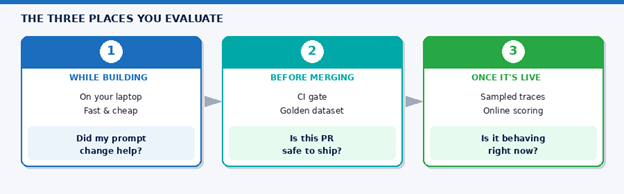
To achieve true reliability, organizations must evaluate their AI systems across three distinct lifecycle phases:
- Pre-Production (Offline Evals): Testing model candidates, prompt variations, and retrieval parameters against static datasets before code ever touches production.
- CI/CD Regression Testing: Running automated evaluation suites on every pull request that alters prompts, retrieval logic, or model parameters to catch regressions before deployment.
- Post-Production (Live Evals): Sampling live user traffic asynchronously in production to monitor semantic drift, hallucinations, toxicity, and task completion in real-world conditions.
While Phase 1 is common and Phase 2 is occasionally implemented, Phase 3 is where the Slack screenshots live. If an engineering leader could pick only one phase to prioritize, starting with Phase 3 is critical because it catches the unpredictable edge cases that static test suites inevitably miss. However, calling a system "production-grade" requires all three phases working in concert.
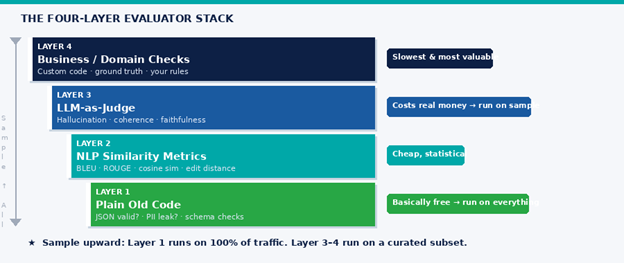
The Four-Layer Evaluator Stack
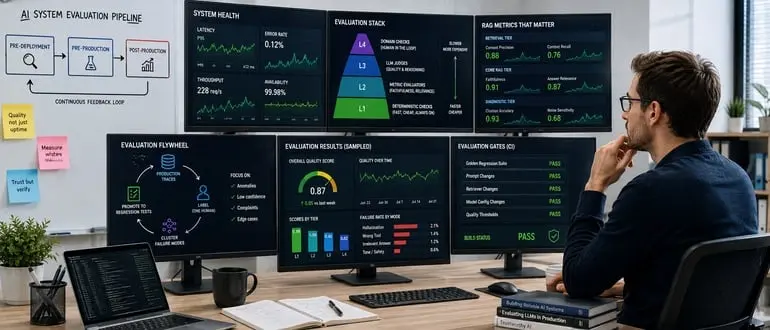
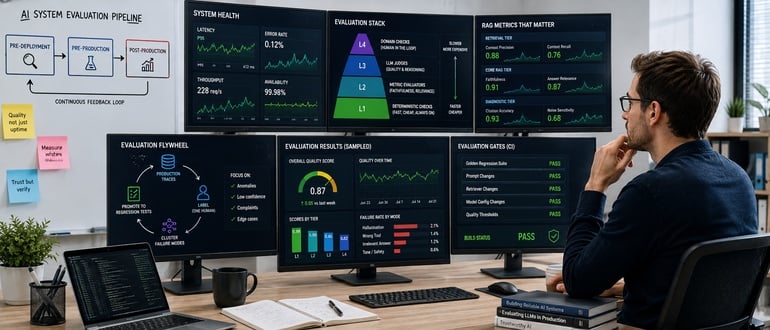
Relying on a single metric to judge AI quality is impossible. Effective architectures utilize a multi-layered evaluator stack, moving from cheap, deterministic checks at the bottom to expensive, intelligent judges at the top, supported by intelligent traffic sampling.
- Layer 1: Deterministic Code Checks. Fast, free, and executed on 100% of traces. These checks validate structural constraints: Is the output valid JSON? Does it contain forbidden words? Is it within acceptable token limits?
- Layer 2: Statistical & Heuristic Models. Lightweight classifiers and heuristic checks that run on a broad subset of traffic to catch basic semantic anomalies, PII leaks, and sentiment degradation.
- Layer 3: LLM-as-a-Judge. More expensive, sophisticated language model evaluations that assess nuanced qualities like helpfulness, tone, and logical consistency. Because these judges incur real API costs, they must be run on a carefully sampled subset of traffic rather than inline synchronously.
- Layer 4: Human-in-the-Loop Domain Experts. The slowest and most expensive evaluation layer, but the most valuable. Human domain experts periodically review flagged edge cases, calibrate Layer 3 judges, and establish the ground truth for complex failure modes.
RAG: The Metrics That Matter
For teams implementing Retrieval-Augmented Generation (RAG)—which forms the backbone of the vast majority of enterprise AI deployments—evaluation centers on the relationships between the user’s query, the retrieved context chunks, and the final generated answer. The critical metrics include:
- Context Precision & Recall: Measuring whether the retrieval layer successfully surfaced the exact information needed to answer the user’s prompt without introducing extraneous noise.
- Faithfulness: Determining whether the generated answer can be strictly attributed to the retrieved context, effectively measuring the presence of hallucinations.
- Answer Relevance: Evaluating whether the final response directly addresses the user’s core intent.
Official Perspectives: Architectural Best Practices
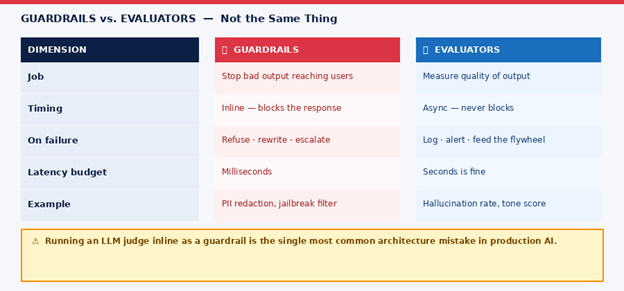
As the industry matures, engineering leaders are drawing clear boundaries between operational components that were previously conflated. One of the most common architectural anti-patterns is the confusion between Guardrails and Evaluators.
Senior infrastructure architects emphasize that these two systems must be kept in strictly separate code paths and represented as distinct boxes on system architecture diagrams.
- Guardrails are synchronous inline filters designed to block harmful, toxic, or out-of-bounds inputs and outputs before they reach the user. A guardrail that takes three seconds to execute ruins the user experience and breaks the product.
- Evaluators are asynchronous quality measurement systems. An evaluator that takes three seconds to run on 5% of sampled background traffic is completely healthy and sustainable.
Furthermore, industry experts caution against the lazy approach of synthetic data generation. When building evaluation regression sets, teams often ask an LLM to generate both the synthetic test inputs and their corresponding expected answers. This creates a circular loop that produces a dataset scoring an illusory 99% accuracy while revealing nothing about real-world user behavior. Real evaluation sets must be forged in the fire of actual production failures, customer complaints, and edge cases.
Future Outlook: The Mindset Shift for Modern Engineering
The evolution of software engineering demands a permanent mindset shift. Reliability for AI is no longer measured purely in uptime, CPU utilization, or network throughput; it is measured in the quality of semantic output over time.
The traditional dashboards built by legacy SRE teams remain necessary for ensuring infrastructure health, but they are no longer sufficient for guaranteeing product integrity. The modern enterprise must construct a multi-tier evaluation system fed by continuous error analysis loops, integrated directly into CI/CD pipelines and live traffic streams, and anchored by calibrated human-in-the-loop judges.
By bridging the observability gap, artificial intelligence transforms from an unpredictable black box that keeps engineering leadership awake at night into a robust, measurable, and trusted pillar of modern software architecture. The green dashboard can finally mean what it says.