Executive Overview
For the past two years, the customer experience (CX) industry has chased a singular, alluring metric: deflection rate. Across boardrooms and software demonstrations, tech leaders have praised automated chatbots and fully autonomous resolution agents for their ability to intercept inbound customer tickets before they ever reach a human representative.
Yet, beneath the glossy dashboards and self-reported percentages, a persistent operational reality has remained largely unaddressed: headcount hasn’t budged, support budgets are still ballooning, and customer frustration with complex B2B issues persists.
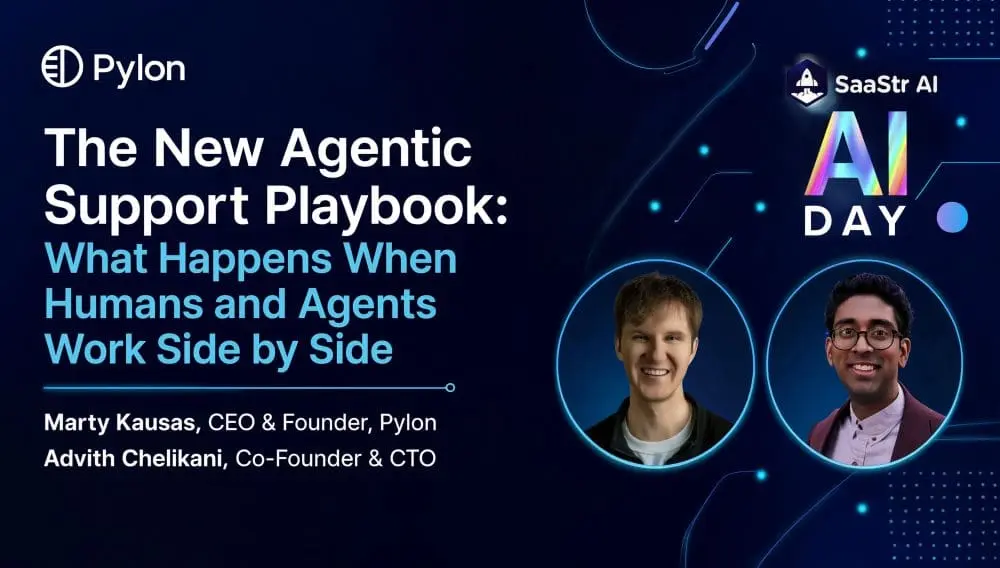
At the recent SaaStr AI Day, Marty Kausas and Advith Chelikani—the co-founders of B2B customer operations platform Pylon—delivered a stark critique of the current CX software landscape. Kausas, the company’s CEO, and Chelikani, its CTO, argued that customer support organizations have spent the last 24 months buying the wrong category of AI products. By fixating on deflection, businesses have merely automated the easiest, least time-consuming inquiries while leaving the hard, context-heavy engineering and logistical investigations squarely on the shoulders of human agents.
In a wide-ranging presentation, the Pylon co-founders unveiled their newly shipped "agentic customer support" model—a paradigm shift that moves away from full human replacement and toward deep human-AI augmentation. Rather than trying to keep customers away from human staff, Pylon’s system automatically pre-investigates tickets in the background, pulling together code bases, historical logs, sentiment analysis, and past interactions before a support engineer even opens the queue.
This deep-dive report explores the mechanics of Pylon’s new playbook, dissects why traditional deflection metrics are deeply flawed, and examines how the role of the modern support professional is undergoing a radical, irreversible transformation.
Detailed Chronology: The Evolution of Pylon’s Agentic Support Playbook
1. The Bar for Success: When the Job Becomes Unrecognizable
Kausas opened his presentation by drawing a parallel to the software engineering world. He highlighted a developer who joined Pylon earlier this year after a two-year sabbatical. Having left the industry right before the generative AI boom, the engineer returned to a role that he described as completely unrecognizable. Previously, software creation involved writing, testing, and reviewing code manually line by line. Today, that same engineer spends their time orchestrating networks of AI agents that perform the heavy lifting.
Kausas established this as the benchmark for customer support. If a new support representative joins your company and finds that their day-to-day routine mirrors the job they left five years ago, your organization has not truly adopted AI.
Furthermore, Kausas presented internal data mapping AI spending across various corporate departments. Software engineering is the sole function where efficiency and tool adoption have scaled exponentially. In contrast, enterprise functions like customer support, legal, and HR remain stuck at the starting line, relying on superficial automation that fails to alter fundamental workflows.
2. The Deflection Illusion and the Math That Doesn’t Add Up
Why hasn’t deflection translated to reduced headcount? According to Pylon, the fastest-growing AI-native companies—ranging from foundational model laboratories to specialized legal tech tools like Harvey and coding assistants like Cursor—do not rely on full replacement. Instead, they embrace a human-plus-AI augmentation model.
Support leadership, however, took the opposite route. Many rushed to deploy fully automated resolution agents capable of deflecting up to 50% of incoming tickets. Yet, in practice, a major enterprise customer with 5,000 employees and a 1,000-person support team deploying a 50% deflection tool often found their headcount entirely unchanged.
The reason lies in the mismatch between ticket volume and actual workload. Automated resolution agents typically handle a narrow slice of queries: low-complexity, repetitive questions that took minimal time to resolve manually. Deflecting 50% of these superficial tickets removes only a fraction of the actual working hours. Everything complex, nuanced, or technical still cascades straight to human agents.
3. Overcoming the DIY Wall with Precomputed Context
Many engineering-forward support teams attempt to bypass commercial solutions by connecting standalone large language models—such as Anthropic’s Claude—directly to help centers, Jira logs, and internal code bases. While this approach offers initial utility, Kausas explained that it inevitably hits a brick wall.
For example, when a new, complex B2B ticket arrives, one of the most effective troubleshooting steps is finding analogous historical tickets. Forcing an unassisted model to parse through thousands of raw, past customer tickets in real-time for every single query is computationally impractical, expensive, and slow.
Pylon’s architectural answer is the precomputed context layer. Instead of making the AI search from scratch on demand, Pylon continuously computes account setups, strategic goals, primary use cases, interaction history, and customer sentiment ahead of time. When a ticket drops into the queue, the system already links related past issues, relevant knowledge base articles, and stakeholder profiles. This architecture drastically reduces inference costs while delivering exponentially faster, more accurate responses.
Supporting Context & Metrics: Inside the Technical Demo
During the SaaStr presentation, CTO Advith Chelikani stepped through live demonstrations of Pylon’s platform in action, showcasing what a pre-investigated ticket actually looks like in a real-world enterprise environment.
Case Study 1: Resolving a UI Regression in Minutes
- The Inbound Request: A customer named Ryan submitted a ticket requesting a fix for a malfunctioning filter within the analytics module of the product.
- The Background Investigation: Before a human representative ever touched the ticket, Pylon’s background agent executed a multi-step investigation:
- It interpreted uploaded screenshots and correctly identified the analytics module, even though the customer never explicitly named it.
- It scanned historical records and located two similar past issues filed by other customers.
- It surfaced a recorded customer success call from the previous week where Ryan had expressed frustration over the exact same bug.
- It queried the backend code base and confirmed that the feature was fully implemented on the server side, but failing to render on the frontend.
- It diagnosed the issue as a UI regression rather than a missing feature request and drafted recommended next steps.
- The Human Touch: Karen, the human support engineer, took over an interactively enriched queue. She asked the agent if an open feature request existed in Linear (it did not), directed the agent deeper into the code repository to confirm her technical suspicions, packaged the entire investigation into a linked Linear issue, and requested a drafted response matching her professional tone. After a quick review, she sent the reply. The division of labor was clear: the agent shouldered the exhaustive data gathering, while the human maintained judgment and responsibility.
Case Study 2: AWS Log Queries Without the Manual Overhead
In a second demonstration, a customer inquired about the precise timestamp when a specific team within their enterprise instance had been deleted.
- The Manual Bottleneck: Traditionally, a support engineer would have to log into AWS, open CloudWatch, look up the customer’s organization ID, write custom SQL queries against massive log files, parse the raw results, and synthesize a coherent explanation—a process easily taking 20 minutes of tedious engineering work.
- The Agentic Workflow: Pylon’s background agent already held the customer’s organizational metadata. Recognizing the query type from historical precedent, it instantly knew where to look and what queries to run. It retrieved the exact audit timestamps and drafted a comprehensive, fact-based response. Support team member Owen reviewed the results and sent them immediately, transforming a multi-hour delay into a two-minute resolution.
Official Statements & Industry Shifts
The introduction of agentic support is reshaping organizational dynamics across three key pillars: team composition, financial modeling, and skills distribution.
Shifting Team Composition and Hiring Profiles
As Kausas and Chelikani noted from customer interviews, support hiring is undergoing a structural evolution. First, raw infrastructure costs are becoming a visible line item. Companies that attempted to build custom internal LLM wrappers are discovering that unoptimized model call costs scale rapidly, making specialized platforms economically attractive.
Second, company team structures are pivoting. Organizations are increasingly hiring two distinct profiles:
- Technical, Junior-to-Mid Support Personnel: Individuals who possess foundational engineering or analytical literacy, empowered by AI tools to handle issues previously reserved for senior engineers.
- Dedicated Support Builders: A specialized persona responsible for configuring workflows, training background agents, and feeding institutional knowledge back into the system so that the broader team operates at a higher baseline.
The Democratization of Institutional Knowledge
One of the most durable benefits observed in beta testing is the flattening of expertise across support teams. In traditional organizations, a single veteran support engineer often holds the institutional keys to unlocking complex technical problems.
Under Pylon’s agentic framework, whenever that veteran goes back and forth with the system to solve an issue, they are effectively codifying their troubleshooting methodology into a reusable skill. The next time a similar ticket arrives, the agent executes those exact steps autonomously, instantly raising the baseline capability of the entire support organization and drastically shortening onboarding times for new hires.
Future Outlook: Evaluating Support AI in the New Era
For technology leaders and CX executives evaluating their software stacks, the Pylon playbook offers a clear diagnostic framework. If your AI strategy is built solely around keeping customers away from your team via deflection, you may be solving the wrong problem.
To future-proof your customer operations, industry experts recommend auditing your metrics using a more rigorous lens:
- Measure Handle Times Alongside Deflection: Track whether your deflection rate is actually compressing median handle times and reducing escalations for complex issues, or simply eliminating trivial work while leaving heavy workloads untouched.
- Evaluate Context Layering: Assess whether your AI tools merely search raw text on demand or proactively precompute institutional context, user sentiment, and codebase linkages before a human agent opens a ticket.
- Redefine Agent Productivity: Move away from measuring success purely by ticket volume closed, and instead measure how effectively your tooling transforms junior staff into technical problem-solvers.
As the boundary between software engineering and customer support continues to blur, the organizations that win will not be those that hide behind automated deflection walls, but those that empower their human teams with intelligent, context-aware digital agents.